

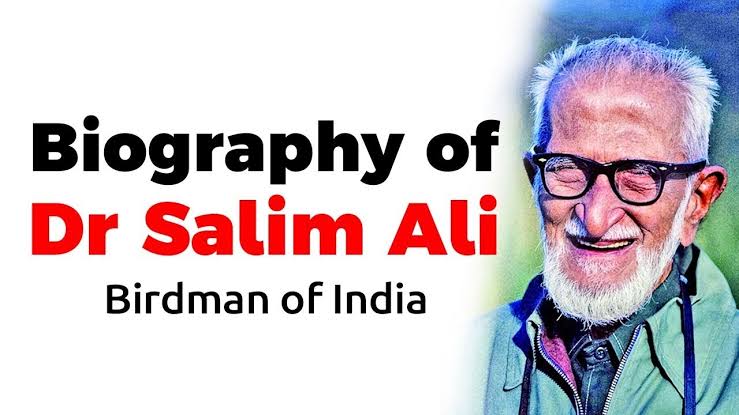
Dr.Salim Ali (1896-1987)🦜🕊:

Salim Moizuddin Abdul Ali (November 12, 1896- July 27,1987) was an Indian ornithology and naturalist. Known as the “🇮🇳birdman of India🇮🇳”, Salim Ali was among the first Indias to contact systematic bird survey across India and his bird books helped develop ornithology. He became the key figure behind the Bombay Natural History society after 1947 and used his personal influence to garner government support for the organization,create the Bharatpur bird sanctuary ( Keoladeo National Park) and prevent the destruction of what is now the silent valley National Park. He was awarded Indian’s second highest Civilian honour ,the padam vibhushan in 1976.
Early life❕❣❕:


Salim Ali was born into a sulaimani Bohra Muslim family of bommey, the ninth and youngest child. His father Moizuddin died when he was an one year old and his mother Zeenat-un-nissa died when he was three. The children were brought up by his maternal uncle Amiruddin Tyabji,and childness aunt, Hamida Begum ,in a middle-class household in Khetwadi, Mumbai. Another uncle was abbas Tybji,well known Indian freedom fighter. Salim was introduced to the series study of birds by W.S. Millard, secretary of the Bombay Natural History Society (,BNHS), who identified unusually coloured Sparrow that young Salim had shot for sport with is tough airgum. Millard identified it as a yellow-throated Sparrow,and showed Salim around the society’s collection of stuffed birds . Millard lent Salim a few books including Eha’s common birds of Bombay, encourage d Salim to make a collection of birds and co-operation offered to train him in skinning and preservation. Millard also introduced young Salim to (later sir) Norman Boyd Kinnear,the first paid curator at all BNHs, who later provide help from the British Museum. In his autobiography, The Fall of Sparrow Ali notes the yellow -throated Sparrow event as the Turning point of his life that let him into ornithology,an unusual career choice, especially for an Indian in those days. His early interest was in books on hunting in India and he became interested in sport -shooting , encourage d by the hunting interests of his foster-father Amiruddin. Shooting contests we’re often held in the neighbourhood in which he grew and among his playmates was Iskandar Mirza, a distant cousin who was a particularly good marksman and who went on in later life to become the first president of Pakistan.
Burma and Germany🦜🕊 :

Salim Ali's early education was at St. Xavier's college, Mumbai. Following a difficult first year in college,he dropped out and went to Tavoy,Burma(Tenasserim) to took after the family's wolfram (Tungstem) mining (tungsten was used in armour plating and valuable during the war) and timber interests there. The forest surrounding this area provided an opportunity for Ali to hone his naturalist (and hunting) skills. He also made acquaintance with J C Hopwood and Berthold Ribbentrop who were with Forest Service in Burma.
Other contribution🐦🦅:


⭐Dr. Ali had considerable influence in conservation related issues in post- Independence India especially through Prime Ministers Jawaharlal Nehru and Indira Gandhi was herself a keen birdwatcher, influence by Ali's bird book (a copy of the book of Indian Birds was gifted to her in 1942 by her father Nehru who was in Dehra Dun jail while she herself was imprisoned in Naini Jain and by the Gandhian birdwatcher Horace Alexander. Ali influenced the designation of the Bharatpur Bird Sanctuary and in decision in decisions that save the Silent Valley National Park. One of Ali's later interventions at Bharatpur involved the exclusion of cattle and graziers from the sanctuary and this was to prove costly and resulted in ecological changes that led to a deciline in the numbers of many species of waterbirds.


⭐Dr. Ali was a frequent visitor to the Doon school where he was an engaging and perusuasive advocate of ornithology to successive generation of pupils. As a consequence,he was considered to be part of the Dosco fraternity and became one of the very few people to be made an honorary member of The Doon School Old Boys Society.
Personal views🐦🦅:


⭐Salim Ali held may views that were contrary to the mainstream ideas of his time. A question that he asked frequently was about the collection of bird specimens particularly in later life when he became known for his conversation related activism. Although once a fan of shikar(hunting) literature,Ali held strong views on hunting but upheld the collection of bird specimens for scientific study. He held the view that the practice of wildlife conservation needed to the practical and not grounded in philosophies like ahimsa. He suggested that his fundamental religious sentiment had hindered the growth of bird study in India.


⭐In the early 1960s the national bird of India was under consideration and Salim Ali was intent that it should be the endangered Great Indian Bustard , however this proposal was over-ruled in favour of the Indian peafowl.


 Eduindex
You must be logged in to post a comment.