

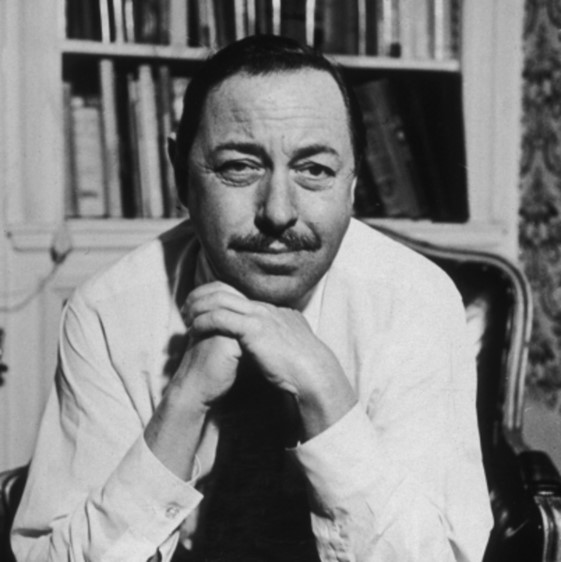
Tennessee Williams is an American playwright hailing from the southern state of Mississippi. For him, writing was an outlet through which he explored the mores of Southern life and the eccentricities and complexities of his own family. His most notable works include The Glass Menagerie (1944) which was considered to be a turning point in his career, A Streetcar Named Desire (1947) and Cat on a Hot Tin Roof (1955) both of which received Pulitzers, Summer and Smoke (1948), Orpheus Descending (1957) etc. Although he wrote throughout his life, his subsequent works never achieved the high acclaim of his earlier works.
Williams as a Southern writer shared a love-hate relationship with the south which provided for dramatic conflicts and excitements. Most of his work reflected traditional topics like agrarianism vs urbanism, New South vs antebellum South, chevalier vs the upstart and so on. For example, his play The Streetcar Named Desire represents the fallen aristocracy with the ethnic denizens a new industrial order, and his play Cat on a Hot Tin Roof represents the different family dynamics of the neo-rich. He drew upon the full resources of language to convey their pictures of culture based on moral absolutes. His characters are portrayed in a way in which they are unable to escape the burdens of their regional histories. Most often, the weight of the southern history the power of racial and social divisions, his rituals and taboos often make self-determination and moral choice unachievable for the characters. In his world, any defiance of this code results in personal destruction.
One of Williams’ most prominent southern trait is the very theatrical display of emotions, dysfunctional characters and unalterable sociological circumstances. He deconstructs the magical appeal of the southern culture and portrays the tension between their dream of an idyllic life and the reality of living it. He also provides constant allusions to plantations like Belle Reve in The Streetcar Named Desire. He also adheres to certain stereotypes of small-town life like gossipy neighbours, fear of scandal, aristocratic families who are deferentially treated by the rest of the community etc.
The usual southern hero is usually almost like an epic figure who embodies the ideals of the society and performs chivalric behaviour which is distinctly different from northern protagonists. A typical southern hero is the leader of men, honest, compassionate, a defender of the faith. They are usually heterosexual, while being protective of the women. But no such southern character exists in Williams’ work. But instead of abandoning the concept of a hero, he has adapted it to the world which has been hopelessly corrupted. He questions the paternalistic order of old South, the enslavement of the black men, the subjugation of the female, the corrupting power of wealth, and the obsession with keeping up appearances. He instead shows guilt caused by the acknowledgement of one sexuality, and the guilt of black subjugation in an antebellum society. Williams attributes perversion and distortions of human behavior to the rigid gender stereotypes that he uncovers in the southern landscape. Certain characters like Brick, who is Blanche’s husband, are unable to cope with the extreme need for masculinity in men. He also questions hypocrisy of a society that denies a woman’s sexuality. Although he does cling to prevailing and romantic point of view past offered luxury and that the present forces the individual to accept barest realities.
“Williams understands human needs and aspirations and is supremely aware of the artist’s role in illuminating urgent personal and social issues; yet his consistent exposure of hypocrisy and his off-beat is reverent sense of humor never hides his deep compassion for those who fear the truth.”
-Kimball King
On one hand, he appreciates the elegance of the past, while on the other, he considers its denial of plurality sufficient cause for its demise. This reflects the love-hate relation that he shares with the South. He does not set out to explain the South and its effects on his characters, but he understands the South and presents characters as real people. He’s a regional writer who does not exploit the peculiarities of his region, and his exploration of the southern value system and conflicts has influenced several later dramatists. To quote Kimball King, “Williams understands human needs and aspirations and is supremely aware of the artist’s role in illuminating urgent personal and social issues; yet his consistent exposure of hypocrisy and his off-beat is reverent sense of humor never hides his deep compassion for those who fear the truth.”
Reference Links:

 Eduindex
You must be logged in to post a comment.