

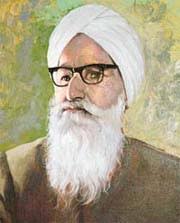

Looking Back to inmost salient lion from North-west corner of India:
The milieu where we are going through, reminds us of such a beacon whose life was out of the world of ceramic painting. In the prevailing situation in where myriad of youths are gloomy and distracted, all the deluge of depression and ‘break-up’ with our soul & courage, that poet-cum-author pillages our interest towards his escapade in the worrit situation he passed through, not lying on fortune’s lap.
“It seems to imply that in the lifeblood of our society, red corpuscles have disappeared.”
From Novel Chitta Lahu (White Blood), by Nanak Singh
Yes, we are talking about that very Panjabi author — Nanak Singh. This Indian poet, songwriter & novelist of Panjabi language made a royal entry to this world on the 4th July, 1897 through a poor Punjabi Hindu family. His literature produced crackles in the period of India’s Independence movement. If we take a magnificent lens on the pages of Modern Indian History, Nanak Singh was more prominent of them who wanted to eliminate the dual mentality of that ‘babu’ who went soft on the fierce deeds of the British.
The revolutionary identity got influenced and involved in the Jallianwala Bagh Massacre. On that auspicious day (April 13, 1919), of Punjabi New Year, Singh saw a lot of kin shot to death by the British troops, even two of his friends drooped on his lap for their last time. Then the author entity of Singh’s inner mind erupted in anger — invented an epic poem, mocking colonial rule — “Khomeini Visayans” (Bloody Baisakhi) from native heart. While conducting ‘Akali Movement’, in charge of the editor of ‘Akali’ papers, he became the subject of crimson eyes of the British — that resulted in the imprisonment of that new leader. In the meanwhile, he converted himself into Sikh. Hence, he portrayed the savagery and ‘legal violence’ of the British on peaceful Sikhs — and published his second anthology called “Zakhmi Dil ” (1923), which got banned within a fortnight of its publication, as expected.
Implementation of Singh’s Views in Present time:
This legend’s natural inclination towards protest against coercion, unjust & inequitable feud, as well as bluffing at every step, pulled him to pick-up ink as well as the flag of Mother India. Under Singh’s tenure, both the fallacy of British & dogmatism of Literature (specially in regional languages) got curtained. Yes, we agree delightfully that the British are no longer in power in India. But the orthodoxy, bigotry & undesired fanaticism has prepared a lot of arrest warrants for Indians. This situation reminds us of that nonesuch person:
Who escaped the boundary of patriarchy — implemented the quote of Lalan Fakir in reality —
“Everyone Sees Male & Female/ But, I see Only Humans”
“সবাই দেখে নারী পুরুষ, আমি দেখি শুধুই মানুষ”
Lalan Fakir
We get a lot of views in his novels.
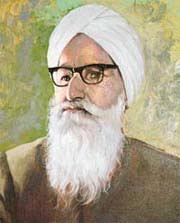
He’s Nanak Singh, whose voice was full of courage & pluck that successfully punctured British’s confidence, gives a message to us to belabor the deception of socio-political hand-cuffs. In his writing, always one thing got itself highlighted — the search for celestial happiness through fraternity, integrity & Liberty.
However, all Indians, not only Panjabis draw inspiration from this icon who gives birth to every Indian from the previous fluffy life of usual inertia — that erects pillars to build a Happier nation for Future.
So, don’t delay to come forward to blow the conch of Humanity with the previously chanted hymns of Nanak Singh.

 Eduindex
You must be logged in to post a comment.