

Before starting with building, it’s important to have the base strong. Similarly, before diving into the sea of ministers, let us look into our parliamentary system.
Indian system of Parliament is based on British constitution. It is a bicarmel legilature composed of the President of India and the two houses: the Rajya Sabha (Council of States/ Upper House) and the Lok Sabha (House of the People/ Lower House.). The Lok Sabha members are chosen by the people as Member of Parliament. There are 543 members in the Lok Sabha currently. Out of these members, the party in majority choses the Prime Minister. Prime Minister holds the power to chose his ministers who help to run the country. This group of ministers is called Council of Ministers. Articles 74 and 75 deal with the council of ministers. Article 352 defines the cabinet as “The council consisting of Prime Minister and other ministers of cabinet rank appointed under Article 75. The council helps and advises president for any decision to be taken.
The part of council of ministers who holds important portfolios is called cabinet. The Ministers in this position are called Cabinet ministers. Some cabinet ministries are Minister of Defence, Finance, Home Affairs, External Affairs, Education, etc. The decisions of the cabinet are important for PM to take into consideration. Unlike the council, cabinet ministers have frequent meetings to formulate policies. Council is a wider body consisting up to 60-70 ministers and Cabinet is a smaller body with 15-20 ministers. However, the word cabinet was never mentioned in the constitution. It came into use in the 44th Constitutional Amendment Act, 1978.
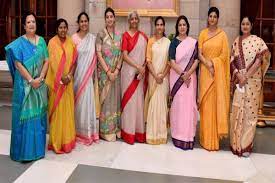
Prime Minister Narendra Modi’s Council of Ministers has been realigned recently. Many new faces have been appointed with an eye on next year’s assembly polls. A total of 43 political leaders have been sworn-in as union ministers, and some have been promoted. Council of Ministers now includes a wide range of youth and experienced leaders from across the board. Interestingly, the Union Cabinet has taken the number of women a notch up, inducting seven fresh faces to add to the existing scanty list. A diversity in terms of representation of caste, religion and gender was kept in mind. The Union Cabinet now consists a total of 11 women ministers.
Cabinet Ministers
Union ministers Harsh Vardhan (Health), Ravi Shankar Prasad (Law/IT), Prakash Javadekar (Environment/I&B), Ramesh Pokhriyal (Education), Santosh Gangwar (Labour) and Sadananda Gowda (Chemicals & Fertilizers) etc. resingned from their posts. BJP leaders who were sworn in as Union ministers include Jyotiraditya Scindia (Aviation), Narayan Rane, Sarbananda Sonowal and Ashwini Vaishnaw(Railay) among the 43. The oath-taking ceremony was held at the Rashtrapati Bhavan in New Delhi.
7 new women MPs of PM Modi’s Council of Ministers:
Anupriya Singh Patel, Sushri Shobha Karandlaje, Darshana Vikram Jardosh, Meenakshi Lekhi, Annpurna Devi, Sushri Pratima Bhoumik, Bharati Pravin Pawar
Criticism
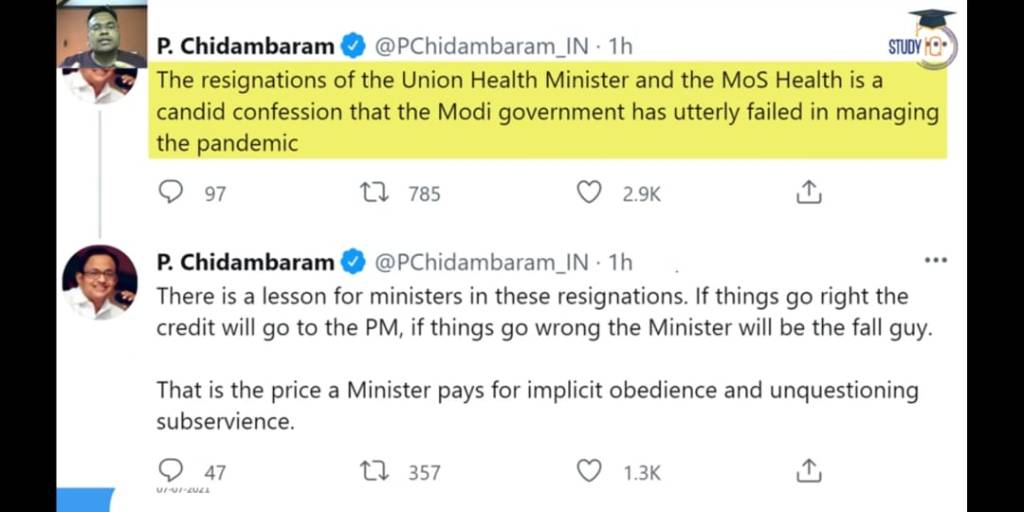
Opposition party has clearly stated the step as Modi government’s failure in managing the situation. Also that the ministers are blamed solely whenever there is a collective error. Many also consider the political agenda as the reason- to attract people support in upcoming elections by selecting ministers from that particular state

 Eduindex
You must be logged in to post a comment.