


Dilip Kumar (born Mohammed Yusuf Khan; 11 December 1922 – 7 July 2021) was an Indian actor and film producer who worked in Hindi films. Referred to as the “Tragedy King” for his portrayal of serious roles and contemporarily as “The First Khan” of Bollywood, he has been described as one of the most successful film stars in the industry and is credited with bringing a distinct form of method acting to cinema. Kumar holds the record for most wins for the Filmfare Award for Best Actor (which was later equalled by Shah Rukh Khan), and was also the inaugural recipient of the award.
In a career spanning over five decades, Kumar worked in over 65 films. He debuted as an actor in the film Jwar Bhata (1944), produced by Bombay Talkies. Following a series of unsuccessful ventures, he had his first box office hit in Jugnu (1947). Kumar found further success with the romantic Andaz (1949), the swashbuckling Aan (1952), the social drama Daag (1952), the dramatic Devdas (1955), the comical Azaad (1955), the epic historical Mughal-e-Azam (1960), the social dacoit crime drama Gunga Jamuna (1961), and the comedy Ram Aur Shyam (1967). Both Andaz and Aan briefly became the highest-grossing Indian film upto that point, a feat later achieved by Mughal-e-Azam, which sustained the record for 11 years. As of 2021, the latter remains the highest-grossing film in India when adjusted for inflation.
In 1976, Kumar took a five-year break from film performances and returned with a character role in the film Kranti (1981) and continued his career playing leading roles in films such as Shakti (1982), Mashaal (1984), Karma (1986) and Saudagar (1991). His last on-screen appearance was in Qila (1998), which saw him in a dual role.
Kumar’s personal life was the subject of much media attention. He was in a long-term relationship with actress and frequent co-star Madhubala that ended after the Naya Daur court case in 1957. He married actress Saira Banu in 1966 and resided in Bandra, a suburb of Mumbai, until his death in 2021. For his contributions to film, the Government of India awarded him with the Padma Bhushan in 1991 and the Padma Vibhushan in 2015, the country’s third and second-highest civilian awards respectively. He was also awarded India’s highest accolade in the field of cinema, the Dadasaheb Phalke Award in 1994. In 1998, the Government of Pakistan conferred Kumar with Nishan-e-Imtiaz, the highest civilian decoration, making him the only Indian to receive the honor.

AWARDS WON BY DILIP KUMAR
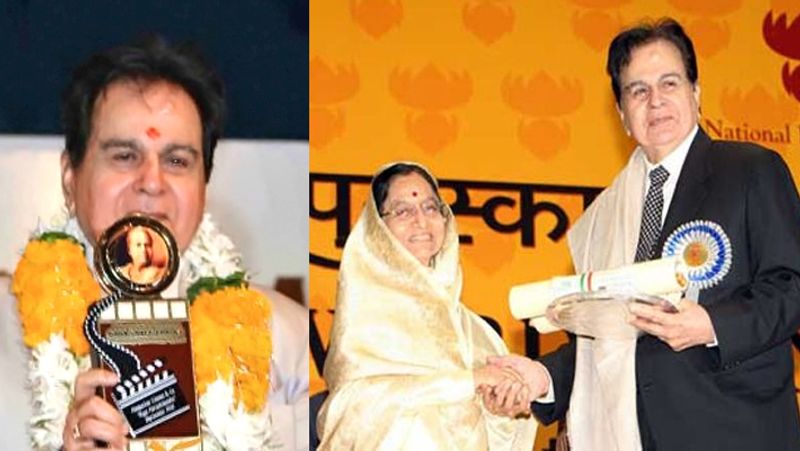
Over his career, Kumar received eight Filmfare Awards for Best Actor (with 19 total nominations), the most of any actor (and was also it’s inaugural recipent), and a Filmfare Lifetime Achievement Award (1993). He also received a Special Recognition Filmfare Award at the 50th Filmfare Awards for being one of the first recipients of Filmfare Awards along with Lata Mangeshkar and Naushad Ali.
Kumar was appointed Sheriff of Mumbai (an honorary position) for 1980. The Government of India honoured Kumar with the Padma Bhushan in 1991, the Dadasaheb Phalke Award in 1994 and the Padma Vibhushan in 2015. The Government of Andhra Pradesh honoured Kumar with NTR National Award in 1997. The Government of Pakistan conferred Kumar with the Nishan-e-Imtiaz, the highest civilian award in Pakistan, in 1998. The ruling political party of Shiv Sena in Maharashtra had objected to this award and questioned Kumar’s patriotism. However, in 1999, in consultation with the then-Prime Minister of India Atal Bihari Vajpayee, Kumar retained the award. He was honoured with CNN-IBN’s Lifetime Achievement Award in 2009.
From the independence of India in 1947 to the late 2010s, Kumar held the record of performing in the highest number of highest-grossing box office grossing films (9 films) until his record was broken by Salman Khan by performing in 10 films. However, when adjusted for inflation, the record remains with Kumar, with his historical movie Mughal-E-Azam remaining the highest-grossing film in India.
Kumar died at Hinduja Hospital, Mumbai, on 7 July 2021 at 7:30 am, aged 98. He had been suffering from prostate cancer. The Government of Maharashtra approved his burial with state honours at Juhu Cemetery on 7 July 2021. The Prime Minister of Pakistan Imran Khan condoled his death and remembered his efforts in raising funds for the Shaukat Khanum Memorial Cancer Hospital in a tweet.
If you allow fame to get the better of you, you become nuisance, a public nuisance, a nuisance as a friend, as a member of the family, a nuisance to yourself.
Dilip Kumar
I think personality correction is necessary for successful men, like prime ministers, businessmen, politicians… it’s essential that one should keep an eye on one’s own personality. You must have seen people in politics who become chief ministers and then pass into oblivion – how egotistical they became and how pathetic they look.
Dilip Kumar

 Eduindex