

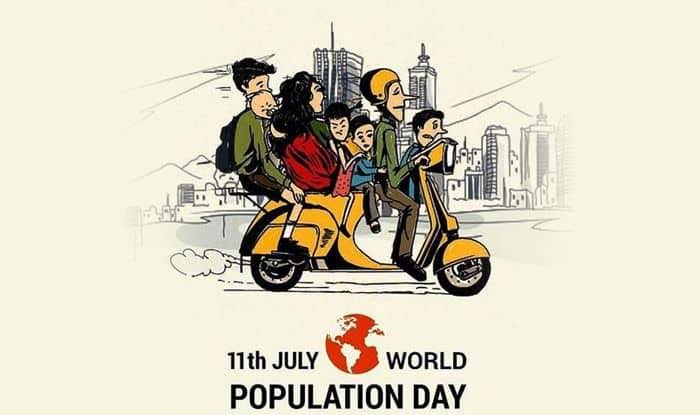
Uttar Pradesh Chief Minister Yogi Adityanath unveiled the new population policy today, saying increasing population is the root of major problems, including inequality prevailing in the society.
“Population control is the primary condition for the establishment of an advanced society. Let us, on this ‘World Population Day’, take a pledge to make ourselves and the society aware of the problems arising from the increasing population”
Yogi Adityanath tweeted
Population Explosion in India
Baby boom or population explosion is one of the major problems being faced by India. India is an overpopulated country, the second largest in the world after China. Thanks to the progress of medical science, the mortality rate has appreciably declined and the life expectancy increased. These have resulted in rapid growth in the population of children, youngsters and those above sixty years of age. These population trends have further complicated the matters and there is heavy pressure on the country’s economic and natural resources. The baby boom has very adversely affected our economy, planning and development.
According to 2010 census, India’s population stood at 12.5 billion. It means India is the land of 20% of the world’s population with just 2.42 percent of the earth area. The average density in terms of population is 350 persons per sq. km. Which varies from place to place and state to state. At the present rate of growth in our population it is feared that in the coming years India would beat China behind . The increasing number of babies has set alarm bells ringing. The problem has created many other serious difficulties like unemployment, food scarcity, poverty, illiteracy, starvation, shelterlessness, insanitation, pollution and so on.
More than 5,500 new mouths are there every day to be fed. Over 1.3 million people are added to our population every year. It means India’s population would double within the next few years. The number of people is multiplying very fast and there seems no effective check on it. This explosion in population has nullified all our economic and developmental achievements. The planners, policy makers, economists and leaders feel on the horns of the dilemma. In these circumstances, it has become almost impossible to improve the quality of life and living standard to an appreciable level. It has neutralized all efforts of poverty alleviation and obtaining of sustainable food security. The enormity of the problem has been realised but matching and commensurate measures to check the baby boom and control the rise in the population have not been taken.
The fertility in Indian women is very high. Here a girl of 15-16 years of age is mature enough to conceive and deliver a baby, if married. The tropical climate has further aggravated the situation. Most of the people in village, towns and slums are totally unaware of the family planning methods and measures. They still believe children to be the gift of gods and regard them as divine ornaments of a woman. Small and marginal farmers, daily labourers, mill workers etc. have large families and refuse to plan their families. The backward and most populated States like Uttar Pradesh, Bihar, Madhya Pradesh etc. have abnormally high rate of population growth. In these States the use of contraceptives like condoms, copper Ts etc. has declined in recent years. We are still groping in the dark as far as population stabilisation is concerned. We have to stabilise the population in relation to our resources.
In spite of 60 years of independence there has been no national policy on population. Experts believe that we are decades behind in population stabilisation in comparison to China. They opine that as long as elementary education and primary health care are neglected nothing concrete and palpable can be achieved in this matter. What is needed is emulation of Kerala’s demographic transformation but is seems rather impossible unless the same literacy rate prevails in other States as it does in Kerala. Economic and literary backwardness are major factors of baby boom in India as is evident from the demographic figures in such backward States as Bihar, Uttar Pradesh, Rajasthan etc. Lack of common civil code is another stumbling block in strictly adhering to the 2 children family norm. Our leaders should rise to the occasion and realise the urgency to check the baby boom. They should come forward with a firm, specific and result-oriented national policy on population and family planning.
UP’s Growth Rate 3.1 Against National Rate of 2.7, ‘Hum Do Hamare Do’ Must be Followed
– Yogi Adityanath on the occasion of World Population Day, 2021

 Eduindex
You must be logged in to post a comment.