

The periods from A.D..(CE) 700 to 1200 and from A.D.(CE) 1200 to 1700 are classified as Early Medieval and Later Medieval periods, respectively,in Indian history.Numerous and varied sources are fortunately available to the historians engaging in the study of Medieval India.Added to the information that can be gleaned from inscriptions, monuments and coins are the accounts left by Arab,Persian and Turkish chronicles.These accounts are rich in detail and have given first-hand information on the life of kings, though they provide very little information on the life of the common people.The opinions of the countries and chronicles are often one-sided, written in a hyperbolic language, exaggerating the king’s achievements.Let us now explore the various sources available for the study of the history of Medieval India.
Sources
Sources are the supporting materials, documents or records in the form of evidence that help to reconstruct the past.

We examine the details of political, economic and social-cultural developments with the aid of sources.
Primary sources:
Inscriptions, monuments and coins, and the information available in them.Secondary sources:
Literary works, Chronicles, travelogues, biographies and autobiographies.Inscriptions
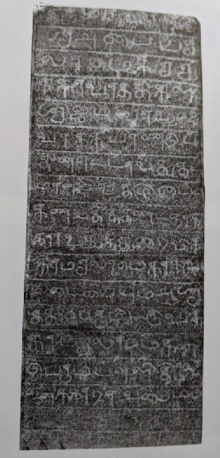
Several copper-plate grants issued during the later Chola period (10th 13th century)record gifts to individual priests or teachers who were Hindu, Buddhist,or Jaina,or to persons of eminence.Both the giver and the receiver are very elaborately described.By Contract, most stone inscriptions differ in their content.In stone inscriptions,the beneficence of a donor is recorded.The major focus is upon the giver.Tiruvalangadu plates of Rajendra Chola are notable examples.Uttiramerur inscriptions in Kanchipuram district provide details of the way in which the village administration was conducted.various types of lands gifted by the Chola kings are known from the inscriptions and copper plates.They are:
Monuments
Temples, palaces,mosques,tombs,forts,minars and mirnarates are called by the collective name monuments.

The Sultans if Dekhi introduced a new type of architecture.The monuments they built had arches,domes and mirnarates as the main features.The inscriptions in these monuments contain rich information, which can be used to construct history.The Medieval Khajuraho monuments (Madhya Pradesh)and temples in Konark (Odisha)and Dilwara(Mt.Adu, Rajasthan)constitute valuable sources to understand the religion-centered cultural evolution in northern India.Temples in Thanjavur (Brihadeshwara),Gangaikonda Cholapuram and Darasuram symbolise the magnificent structure the Later Cholas built in Tamil Nadu.Vitala and Virupaksha temples at Hampi similarly speak of the contribution of Vijayanagara rulers(15th century)

Quwwat-ul Islam Masjid ,Moth-ki-Masjid,Jama Masjid,Fatehpur Sikri Dargah(all in and around Delhi)and Charminar (Hyderabad)are the important mosques belonging to the Medieval times.

The forts of historical importance are Agra Fort,Chittar Fort, Gwalior Fort and Delhi Red fort as well as the forts of Daulatabad (Aurangabad)and Firoz Shah Kolta(Delhi).Palaces in Jaipur, Jaisalmer and Jodhpur signify the greatness of the Rajput dynasty that wielded enormous power from these places.Qutb Minar and Alai-Darwaza,the tombs of Iltutmish,Balban and all the Mughal rulers are the other prominent of information.Cities in ruin such as Firozabad and South India remain rich repositories of the history of Medieval India.
Coins
The portrait and legend on the coins convey the names of kings with thier titles, events,places,dates, dynasties and Royal emblems.The composition of metals in the coins gives us information on the economic condition of the empire.Mention of king’s achievements like military conquests,territotmrial expansion,trade link and religious faith can also be found in the coins.Muhammad Ghori had stamped the figure of Goddess Lakshmi on his gold coins and had his name inscribed on it.This coin tells us that this early Turkish invader was in all likelihood liberal in religious outlook.Copper jitals are available for the study of the period of the Delhi Sultans,


Silver Tanka introduced by Iltutmish,Ala-ud-din Khalji’s gold coins, Muhammad-bin-Tughluq’s token currency are indicative of coinage as well as the economic prosperity or otherwise of the country of the time.
Religious Literature
Devotional movement in South India and later in North resulted in the development of bhakti or devotional literature.The Chola period was known as the period of devotional literature and works such as Kamna Ramayanam,Sekkizhar’s Periyapuranam,Nalayira Divyaprabhandham,composed by 12 Azhwars and complied by Nathamuni,Devaram composed by Appear,sambandar and Sundarar and complied by Nambiyandar Nambi,Manikkavasakar’s Thiruvasagam,all were scripted during the Chola times.Jayadeva’s Gita Govindam(12th century)was a follow-up of the Bhakti Movement in South India.Kabir Das, a 15th century mystic poet,also had an influence on the Bhakti Movement in India.
Secular Literature
Madura viniyam and Amuktamalyatha were poems composed by Gangadevi and Krishnadevaraya respectively that help us gain insight into the events and individuals associated with the Vijanagara Empire.Chand Bardai’s Prithiviraj Raso portays the Rajput king’s valour.For pre-Islamic periods the only exception was Kalhana’s Rajtarangini (11th century).
Travellers and Travelogues
Marco Polo,a ventain traveller , visited when the Pandya kingdom was becoming the leading Tamil power in the 13th century.Marco Polo was twice in Kayal,which was a port city (presently in Thoothukudi district of Tamilnadu).It was full of ships from Arabia and China.Marco Polo tells us that he himself came by a ship from China.According to Marco Polo, thousands of horeses were imported into southern India by Sea from Arabia and Persia.Al-Beruni (11th century) accompanied Mahmud of Ghazni in one of his campaigns,and stayed in India for 10years.The most accurate account of Mahmud’s Somnath expedition is that of Alberuni.As learned man and a scholar,he travelled all over India trying to understand India and her people.He learnt sanskrit and studied the lhilo of India.In his book Tahquiq-i-Hind,Alberuni discussed the Indian conditions, systems of. knowledge ,social norms and religion.
Ibn Battuta(14th century),an Arab-born Morocco scholar, travelled from Morocco right across North Africa to Egypt and then to central Asia and India.His travelogue (Rihla [The Travels]) contains rich details about the people and the countries he visited.According to him,Egypt was rich then, because of the whole of the Indian trade with the west passed through it.Ibn Battuta tells us of caste in India and the practice of sati.we learn from him that Indian merchants were carrying on a brisk tamrade in foreign ports and Indian ships in the seas.He diescribes the city of Delhi a vast and magnificent city.Those were the days when Sultan Muhmmad bin Tughluq transferred his capital from Delhi to Devagiri in South,converting this city into a desert.
In the south,Vijanagar had many foreign visitors who left behind their detailed accounts of the state.An Italian named from Heart(the court of Great Khan in Central Asia) in 1443.Domingo Paes,a Portuguese traveller, visited the city in 1522.All of them recorded their observations, which are very useful for us today to know the glory of the Vijanagar Empire


 Eduindex
You must be logged in to post a comment.