


Kerala is a state in Southern India is known as a tropical paradise of waving palms and wide sandy beaches. Parasurama, an avatar of Vishnu threw his battle axe into the sea after he reached Gokuram from Kanyakumari. as a result, the land of Kerala arose, reclaimed from the waters. He was the sixth of the ten avatar (incarnation) of Vishnu. It is a narrow strip of coastal territory that slopes down the western ghats in a cascade of lush green vegetation, and reaches to the Arabian seas. The culture of Kerala evolved through the Sanskritization of Dravidian ethos, revivalism of religious movements and reform movements against caste discrimination. Kerala showcases a culture unique to itself developed through accommodation, accumulation of various faculties of civilized lifestyle. Hinduism an Islam are the two major religions of Kerala. More than 50 percent of people in Kerala follow Hinduism, and more than 25 percent follow Islam. Around 20 percent are Christians, and others follow Buddhism, Jainism, and other religions. The cultural diversity of Kerala is well known. Kerala is also well-known for its mesmerizing backwaters, ecotourism initiatives, scenic beauty, beaches and mouth watering cuisine.
Old name of Kerala
A treaty brought it under British protection in 1795. Travancore was known for its relatively high literacy rate and its progressive government. After Indian Independence, Travancore and Cochin merged to form the state of Travancore-Cochin, boundaries were redrawn, and it was renamed Kerala in 1956.
Kerala famous spices
Kerala is famous for its spices and hence is popularly known as the Spice Coast of India. It flavor an assortment of species originating from the cultures of Jews, Christians, Muslims and merchants who settled down in this state. Kerala is one of the prominent tourist destinations of India, with coconut-lined, sandy beaches, backwaters, hill stations, ayurvedic tourism and tropical greenery as its major attractions. Kerala is a home to a variety of spices pepper, vanila, cardamom, clove, cinnamon, nutmeg, ginger and turmeric. The flavor of species lingers long in one’s tongue and even longer in one’s memory. Spices shaped Kerala’s tryst with destiny.
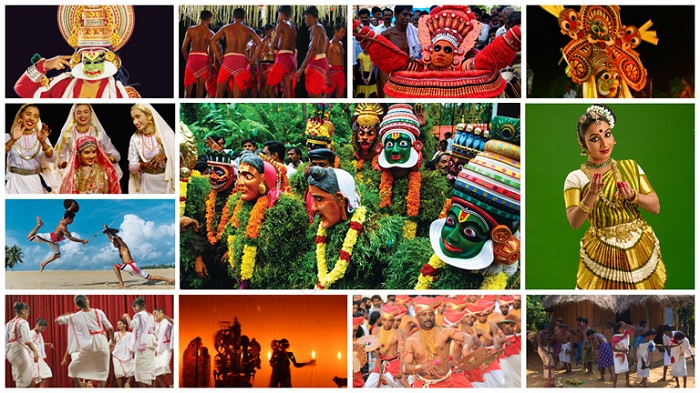
Major Festival
- ONAM – Onam is a harvest festival celebrated extravagantly by the people of Kerala, India. It is also the state festival of Kerala with State holidays on 4 days starting from Onam Eve (Uthrdom) to the 4th Onam day. Onam Festival falls during the Malayalam month of Chingam (August-September) and marks the commemoration of Vamana avatara of vishnu and the subsequent homecoming of King Mahabali, who Malayalees consider to be just and fair King who was exiled to the underworld. It is one of the festivals celebrated with the most number of cultural elements. Some of them are Vellam Kali, Pulikali, Pookalam, Onatthappan, Thumbi Thullal, Onavillu etc. Another distinct feature of the festival is Ona Sandhya (Onam Feast) and consists of numerous dishes served on a banana leaf and Ona Kodi (Onam Dress).
- VISHU – Among the various Hindu festivals in Kerala. Vishu occupies a unique position in more than one respect. As a symbol of the Keralite, Vishu, is free from the usual pomp and show and merry-making associated with other festivities. The frist day of the Malayalam month of medam is the unchangeable day of Vishu. The day on which Vishu falls is the astronomical New Year day. The Malayalees believe that the subject one sees first in the morning of Vishu day. In order to fulfill the desire to look at the auspicious articles, they prepare a “Kani” on the previous day for seening in the next morning. The eldest member of the family takes some silver coins and gives them to a junior member with some raw rice and konna poovu.

 Eduindex
You must be logged in to post a comment.