

OVERVIEW :-
COVID-19 has emerged out as the greatest challenge to the world community in the past 100 years. Due to it, millions of people are affected and lakhs of people have to lost their life. It also has broken the backbone of all the countries. The economy of every country around the world suffered massively. Whether it is manufacturing sector or any kind of service providing sector, it has dismantled everything. The Civil Aviation Sector of India is no other exception to it . It has also suffered huge losses due to COVID-19. People working in this sector washed hands from their jobs. All the airlines saw a historic decline in their revenues and many went into losses.
WHAT COVID-19 HAS DONE…????
The major reason for these losses is due to COVID-19 related restrictions on travel. All the countries banned people from other countries to enter in their country.
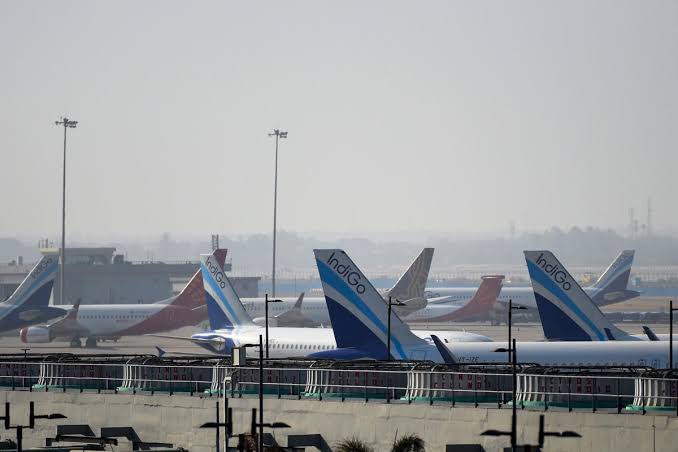
Due to this, passengers footfall on the airports have declined. International and domestic flights were cancelled. People working in this industry had no work. Many airlines including Government of India owned AIR India took steps like lay off employees.
EFFECTS OF COVID-19 :-
- IndiGo incurred net losses of ₹ 2,884 crore and rupees 1,194 crore in Q1 and Q2 of this fiscal respectively. SpiceJet posted net losses of ₹ 600 crore and ₹ 112 crore in Q1 and Q2, respectively.
- “The revival of overseas travel is expected to be slower and more challenging than domestic. This will hurt Air India in particular as around 60 per cent of its revenue was earlier generated from international operations,” said aviation consultancy firm CAPA in October. In the financial year more than 200 million passengers travelled in India. But this number has declined to about only one-forth in the next year.
- CAPA India estimated a loss of more than USD 6.5 Billion in the financial year 2021.
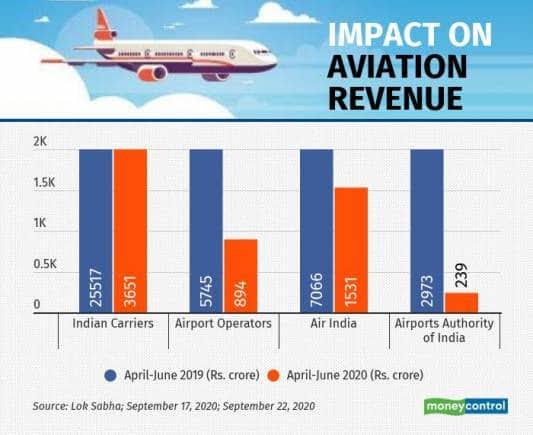
- The Airports Authority of India (AAI) — responsible for managing and maintaining civil aviation infrastructure across the country — reported a 92 percent fall in its revenue from Rs 2,973 crore during April-June 2019 to Rs 239 crore during the corresponding period in 2020, a government reply to the Lok Sabha on September 22, 2020, said.
- “Civil aviation has been severely hit with the tourism sector being down, and the former has a huge debt on them,” Sanat Kaul, Chairman (India Chapter) International Foundation for Aviation, Aerospace & Drones (IFFAAD), said.
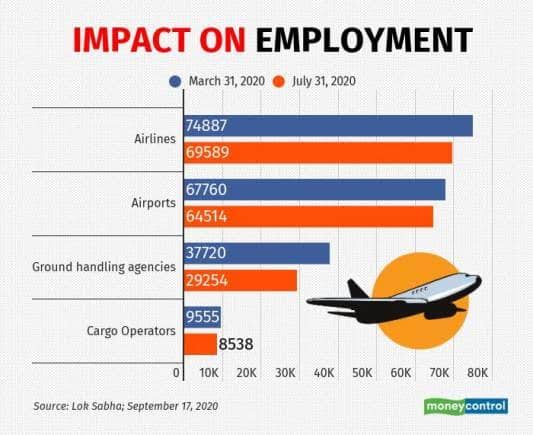
- “The revenue impact on the Indian aviation industry for FY21 is likely to be over 50 percent, and job losses, including compulsory leave without pay, are likely to be around 30 percent-plus,” Manvi Hooda, Practice Lead Consulting & Research, CAPA South Asia, said.
- The passenger footfall across AAI airports saw a significant drop from 14.5 million in January 2020 to 27,687 in April 2020.
POST-COVID TIME FOR CIVIL AVIATION SECTOR :-
“Post-COVID, we need an aviation reform agenda, which must be well-directed and result in a sustainably profitable aviation industry,” said Hooda of CAPA India.
“This must include reducing negative fiscal regime, including aviation turbine fuel in the GST and ensuring that the Directorate General of Civil Aviation and Bureau of Civil Aviation Security turn into independent institutions. Privatisation of Air India and more AAI airports, and dismantling of government ownership of aviation assets, except for ATC, should also be expedited” she suggested. Further, strategic reforms like long-term airport master plan and remote airport infrastructure to deliver tangible results under the ‘flexible use of airspace’ should be envisaged, she advised.
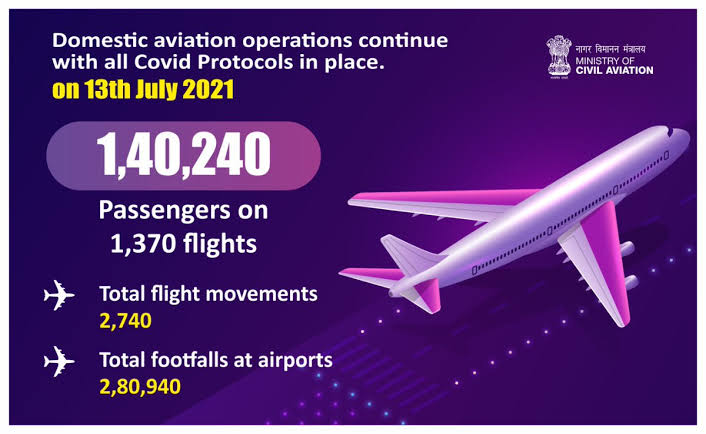
It will take time to completely free the world from the pandemic COVID-19. Till then, all the appropriate Covid protocols must be strictly followed by everyone during their journey so that civil aviation sector health can be improved.
Links :-
- https://twitter.com/MoCA_GoI/status/1415285881007579136?s=19
- https://www.google.com/amp/s/www.moneycontrol.com/news/business/economy/heres-how-covid-19-has-hurt-the-indian-aviation-industry-5965511.html/amp
- https://www.google.com/amp/s/www.deccanherald.com/amp/business/covid-19-had-massive-impact-on-indian-aviation-sector-in-2020-931796.html

 Eduindex
You must be logged in to post a comment.