

OVERVIEW :-
COVID-19 is one of the most disastrous epidemic in the last 100 years. It has killed millions of people and ruined the lives of many people. It has destroyed more or less many families around the globe. Millions of jobs lost and there is a sudden rise in unemployment throughout the world. Whether a developed country or not, all have suffered equally in this pandemic.
Besides all these, it is posting new threats every day. New variants of this pandemic are reported regularly. These variants affect people in different ways. Even the medical facilities get exhausted very quickly. This was the similar case of India. In the 2nd wave of COVID-19, India saw a sudden increase in the requirement of Liquid Medical Oxygen (LMO) for Covid positive patients. India never felt the requirement of that much amount of LMO previously. Due to this, India was left with the shortage of transport facilities to transport LMO from oxygen-generating plants to hospitals as these plants were far away from hospitals. Even the time required to transport LMO by road was quite high.
In this situation, Indian Railways stood up and decided to run “Oxygen Express” to the states were there was acute shortage of LMO.
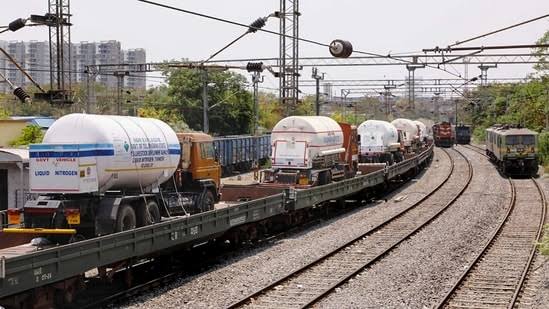
The first “Oxygen Express” ran by Indian Railways was on 20th April 2021 loaded with LMO carrying tankers from Vizag. But the process of running “Oxygen Express” was not so easy for railways as this idea was first of its kind and was not tried before.
DIFFICULTIES FACED DURING THE PROCESS OF RUNNING “OXYGEN EXPRESS” :-
- Indian Railways had no prior experience of running this kind of “Oxygen Express” anytime before.
- The height of the tankers loaded on oxygen express was more as compared to rail coaches. This also created a major problem.
- “Due to restrictions of height of Road Over Bridges (ROBs) and Over Head Equipment (OHE) at certain locations, out of the various specifications of road tankers, the model of road tanker T 1618 with height of 3320 mm was found feasible to be placed on flat wagons (DBKM) with height of 1290 mm,” the release by Indian Railways added.
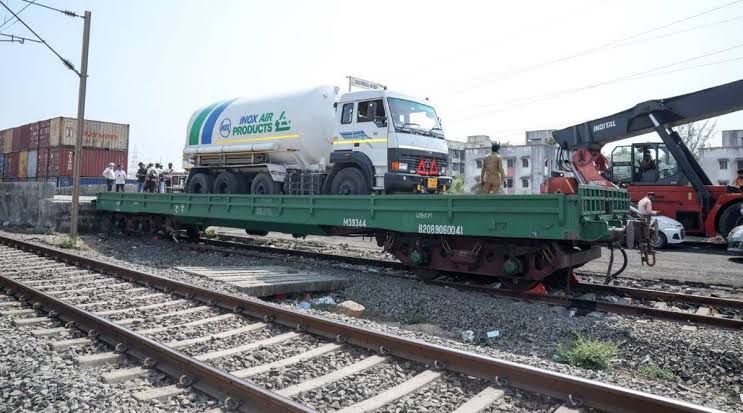
- “It was decided that the tankers would be organized by Transport Commissioner, Maharashtra. These empty tankers would be moved from Kalamboli/Boisar, Railway stations in and near Mumbai, and sent to Vizag and Jamshedpur/Rourkela/Bokaro, for loading of liquid medical oxygen tankers from there ,”said a railway official after a meeting held on 17th April, 2021.
- Before running of the first official “Oxygen Express” on 20th April, trial runs were conducted on railway tracks to check whether it is possible to run “Oxygen Express” on track or not. After the railway officials were satisfied and the trials were successful only then the permission to run “Oxygen Express” was given.
CONCLUSION :-
“Oxygen Express” ran as per the priority basis that means where LMO requirement was more and availability was quite less then “Oxygen Express” was allotted to that state. A total of 313 Oxygen Express trains run by Indian Railways have delivered 21,392 metric tonnes (MT) of liquid medical oxygen across the country. In this way, Indian Railways came out as the saviour of millions of lives in India by its great initiative to run “Oxygen Express”.
Links :-
- https://www.google.com/amp/s/indianexpress.com/article/india/railways-to-run-oxygen-express-trains-to-meet-high-demand-amid-surge-in-covid-19-cases-7279231/lite/
- https://www.google.com/amp/s/www.hindustantimes.com/cities/gurugram-news/oxygen-express-train-with-85mt-of-medical-oxygen-to-arrive-in-gurugram-on-may-4-101620063920318-amp.html
- https://www.google.com/amp/s/www.livemint.com/news/india/indian-railways-gears-up-to-run-oxygen-express-across-country-amid-covid-surge/amp-11618747433500.html

 Eduindex
You must be logged in to post a comment.