

The major indicators to measure the level of economic development are
✓Net National Product (NNP)
✓Per Capita Income (PCI)
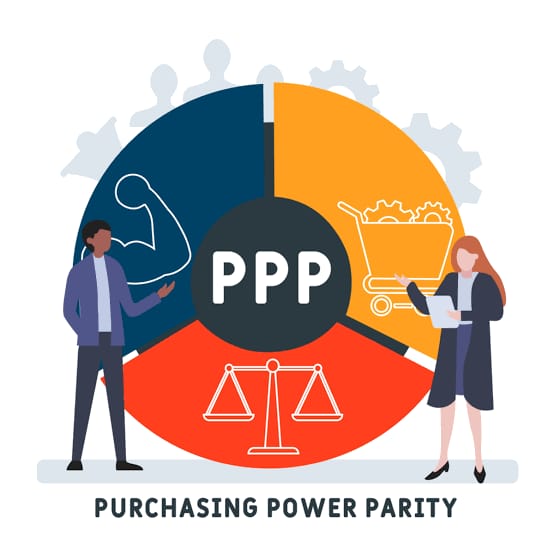
✓Purchasing Power Parity (PPP)
✓Human Development Index (HDI)

Net National Product
The Net National Product (NNP) is considered as a true measure of national output. It is also known as national income. A rise in per capita income means an increase in aggregate real output. Hence, this is a better indicator than national income for measuring development.
For measuring a country’s development, its income is considered to be one of the most important factors. Countries with higher income are considered to be more developed than those with lesser income. So, income itself is considered to be one of the indicators of economic development.

Per Capita Income
However, for comparing the development of various countries, total income is not satisfactory measure. Since countries have different populations, comparing total income will not be suggestive of what an average person is likely to earn, as people in one country are better off than others in a different country? The average income is calculated by dividing the country’s total income by its total population. The average income is also called per capita income. Calculations on the per capita income of all countries are calculated only in the US dollar in order to compare International level.

Purchasing Power Parity
Purchasing power parity is defined as the number of units of a country’s currency required to buy the same amount of goods and services in the domestic market as one dollar would buy in the US
The technique of purchasing power parity allows us to estimate what exchange between two currencies is needed to express the accurate purchasing power of the two currencies in the respective countries. Recently, India became the third largest economy in terms of PPP. China became the largest defeating the US to the second position.
Human Development
Human resource is necessary for the progress of any country. The term ‘human resources’ refers to the collective abilities of people, which can be utilised in the production sector.
Human resource development means the development of a person’s physical and mental abilities through education, health care and training. Therefore, investment in education and health of people can result in a high rate of returns in the future for a country. For example, if a child is invested with good education and health, he or she may turn to be very productive in future in the form of higher earnings and greater contribution to the society. Human Development Index (HDI) which indicates all round development of the people in the society.
In the past, economists believed that the rate of economic growth of nations could be increased only by increasing investment in physical capital. But they have realised over time that investment in human capital is as important as investment in physical capital.


 Eduindex News
You must be logged in to post a comment.