

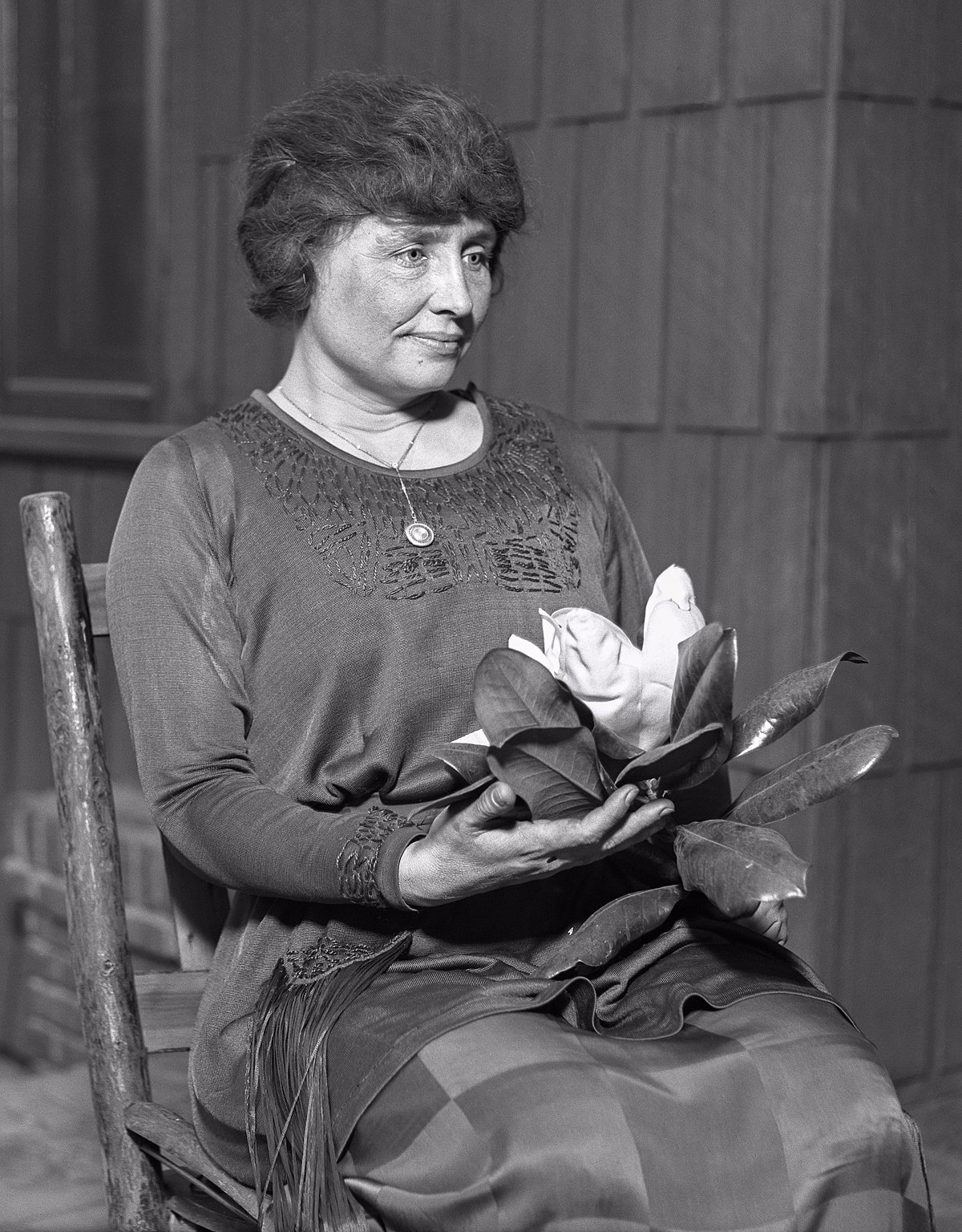
Helen Adams Keller (June 27, 1880 – June 1, 1968) was an American author, disability rights advocate, political activist and lecturer. Born in West Tuscumbia, Alabama, she lost her sight and hearing after a bout of illness at the age of nineteen months. She then communicated primarily using home signs until the age of seven when she met her first teacher and life-long companion Anne Sullivan, who taught her language, including reading and writing; Sullivan’s first lessons involved spelling words on Keller’s hand to show her the names of objects around her. She also learned how to speak and to understand other people’s speech using the Tadoma method. After an education at both specialist and mainstream schools, she attended Radcliffe College of Harvard University and became the first deafblind person to earn a Bachelor of Arts degree. She worked for the American Foundation for the Blind (AFB) from 1924 until 1968, during which time she toured the United States and traveled to 35 countries around the globe advocating for those with vision loss.
Keller was a prolific author, writing 14 books and hundreds of speeches and essays on topics ranging from animals to Mahatma Gandhi. Keller campaigned for those with disabilities, for women’s suffrage, labor rights, and world peace. She joined the Socialist Party of America in 1909. She was a supporter of the NAACP and an original member of the American Civil Liberties Union. In 1933, when her book How I Became a Socialist was burned by Nazi youth, she wrote an open letter to the Student Body of Germany condemning censorship and prejudice.
The story of Keller and Sullivan was made famous by Keller’s 1903 autobiography, The Story of My Life, and its adaptations for film and stage, The Miracle Worker. Her birthplace is now a museum and sponsors an annual “Helen Keller Day”. Her June 27 birthday is commemorated as Helen Keller Day in Pennsylvania and, in the centenary year of her birth, was recognized by a presidential proclamation from U.S. President Jimmy Carter.
She was inducted into the Alabama Women’s Hall of Fame in 1971 and was one of twelve inaugural inductees to the Alabama Writers Hall of Fame on June 8, 2015.
KELLER’S ILLNESS
At 19 months old, Keller contracted an unknown illness described by doctors as “an acute congestion of the stomach and the brain”, which might have been meningitis caused by the bacterium Neisseria meningitidis (meningococcus), or possibly Haemophilus influenzae (which could cause the same symptoms, but which is a less likely cause due to its 97% juvenile mortality rate at that time). Other possible infections were rubella (which generally only causes blindness or deafness in prenatal infections) or scarlet fever (which did not commonly cause blindness or deafness). The illness left her both deaf and blind. She lived, as she recalled in her autobiography, “at sea in a dense fog”. Helen Keller developed a febrile illness that left her both deaf and blind. Historical biographies attribute the illness to rubella, scarlet fever, encephalitis, or meningitis. This analysis of her illness suggests she likely had bacterial meningitis, caused by Neisseria meningitidis or possibly Haemophilus influenzae.
At that time, Keller was able to communicate somewhat with Martha Washington, the two-years-older daughter of the family cook, who understood her signs; by the age of seven, Keller had more than 60 home signs to communicate with her family, and could distinguish people by the vibration of their footsteps.
In 1886, Keller’s mother, inspired by an account in Charles Dickens’ American Notes of the successful education of another deaf and blind woman, Laura Bridgman, dispatched the young Keller, accompanied by her father, to seek out physician J. Julian Chisolm, an eye, ear, nose, and throat specialist in Baltimore, for advice.


 Eduindex