

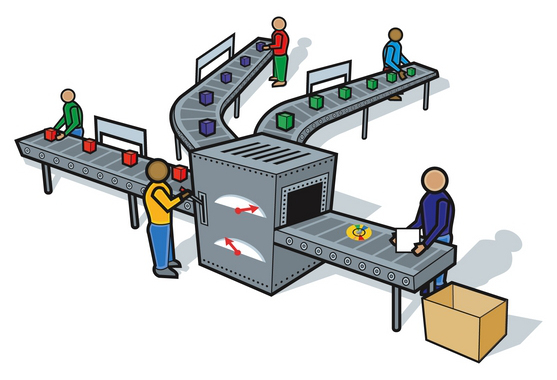
What are Manufacturing Systems?
A collection of integrated equipment and human resources whose function is to perform one or more processing or assembly operations. Manufacturing systems essentially integrates and transform inputs (raw material, labour and machines) into output (final goods and services).
Components of Manufacturing Systems
- Production machines: Most of the actual assembly work is accomplished by machines or with aid of tools. These machines are classified into- Manual, Semi-automated and Automated machines.
- Material Handling Systems: Material handling systems include machines that help in loading, unloading of units, positioning of units, transporting and storage of work units.
- Computer Control Systems: Computer control systems help in controlling the machines by communicating instructions, scheduling production, failure diagnosis, quality control, safety monitoring etc.
- Human Resources: Human resources are essential to ensure smooth functioning of all systems. They operate and manage systems, monitor the process, ensure all machines are in optimum condition and working properly. In some cases, they even help in loading, unloading and positioning of units.
Types of Production Systems
- Intermittent: The flow of production is not continuous i.e., units are produced according to its demand or on order on a small scale in large varieties.
- Continuous: Flow of production is continuous and not affected by its demand. Units are produced on a large-scale for stocking and selling.
Intermittent Production System
It can be classified into 3 categories-
- Project Production
- Jobbing Production
- Batch Production
In Project production, company accepts a single, complex order or contract. The order is to be completed within a specified amount of time at estimated cost. Requirement of resources varies with phases of production. In project production, many agencies are involved and interrelated. It is highly flexible but produced in low volume. An excellent example of Project Production is Construction.
In Jobbing Production, company accepts order to produce one or few units of a product strictly as per specifications given by the customer. It is also produced within a specified time at a specified cost. Units are produced in small lots and highly skilled labour is needed. An example of Jobbing Production is Repair and Tailoring services.
Batch Production: ‘Batch’ refers to a single production run according to demand. Batch size is the number of units produced in one batch size. It ranges from 100-1000 units. Every batch requires changes in Machine set-up. For example, daily production of numerous freshly baked goods in a bakery.
Continuous Production System
It can be classified into 2 categories-
- Mass Production System
- Process Production System
Mass Production System is also known as Repetitive Manufacturing System. Mainly one or two types of products are produced. Demand of such products is always high. Produced in large quantities and hence, mostly automated and handled by machines. This makes supervision easy. It involves limited work in progress. It also reduces per unit cost of production.
In Process Production System, a single product is produced and stocked. The product is standardised hence, there is hardly any scope for variety or customisation. It involves lower Work-in-Progress. It requires low skilled labour and skilled technicians. Automated/Mechanised systems are used for Material Handling.

 Eduindex