


🔸️The network topology is the structure or layout of the communication channels that connects the various computers on the network. Each computer in the network is called a node.
🔸️There are a number of factors that determine the topology suitable for a given situation. Some of the important consideration is the type of nodes, the expected performance, type of Wiring (physical link) used and the cost.
🔸️Network can be laid out in different ways. The five common topologies are
🔹️Star
🔹️Ring
🔹️Bus
🔹️Hybrid
🔹️FDDI
🌟Star Network:
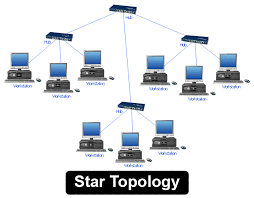
🔸️In a star network all computers and other communication devices are connected to a central hub.
🔸️Such as a file server or host computer usually by a Unishielded Twisted Pair (UTP) cables.
💍Ring Network:

🔸️In a ring network computers and other communication devices are connected in a continuous loop.
🔸️Electronic data are passed around the ring in one direction, with each node serving as a repeater until it reaches the right destination.
🔸️There is no central host computer or server.
🚌Bus Network:

🔸️In a bus network all communication devices are connected to a common cable called bus.
🔸️There is no central computer or server.
The data transmission is bidirectional.
Hybrid Network:
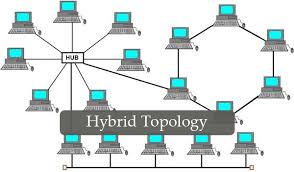

A hybrid network is a combination of the above three networks suited to the need.
FDDI Network:
🔸️A FDDI network (pronounced as giddy short for Fiber Distributed Data interface) is a high-speed network using fiber optic cable.
🔸️It is used for high tech purposes such as electronic images, high – resolution graphics and digital video.
🔸️The main disadvantage is its high cost.


 Eduindex
You must be logged in to post a comment.