


Yoga is a group of physical, mental, and spiritual practices or disciplines that originated in ancient India. Yoga is one of the six orthodox philosophical schools of Hinduism. There are a broad variety of yoga schools, practices, and goals in Hinduism, Buddhism, and Jainism and there are four paths or types of yoga: Karma yoga, Kriya yoga, Bhakti yoga, and Jnana yoga. Research studies have shown that traditional yoga systems that include breathing exercises and asanas or postures, chants, and meditation can reduce stress and improve immunity and lung functions. Traditional forms and modern methods of yoga are practiced worldwide.
The practice of yoga has been thought to date back to pre-vedic Indian traditions, possibly in the Indus valley civilization around 3000 BCE. Yoga is mentioned in the Rigveda, and also referenced in the Upanishads, though it most likely developed as a systematic study around the 5th and 6th centuries BCE, in ancient India’s ascetic and Śramaṇa movements. The chronology of earliest texts describing yoga practices is unclear, varyingly credited to the Upanishads. The Yoga Sutras of Patanjali date from the 2nd century BCE, and gained prominence in the West in the 20th century after being first introduced by Swami Vivekananda. Hatha yoga texts began to emerge sometime between the 9th and 11th century with origins in tantra.
Yoga gurus from India introduced yoga to the West following the success of Vivekananda’s adaptation of yoga without asanas in the late 19th and early 20th centuries. The term “yoga” in the Western world often denotes a modern form of hatha yoga and yoga as exercise, consisting largely of the asanas. Outside India, it has developed into a posture-based physical fitness, stress-relief and relaxation technique. Traditional yoga, however, includes physical exercise, meditation, and spirituality. Yoga has its own epistemological method, which assumes the ontology and metaphysics of the closely correlated Samkhya darsana.

The ultimate goal of Yoga is Moksha (liberation), although the exact form this takes depends on the philosophical or theological system with which it is conjugated.
In the classical Astanga yoga system, the ultimate goal of yoga practice is to achieve the state of Samadhi and abide in that state as pure awareness.
According to Jacobsen, Yoga has five principal traditional meanings:
- A disciplined method for attaining a goal.
- Techniques of controlling the body and the mind.
- A name of a school or system of philosophy (darśana).
- With prefixes such as “hatha-, mantra-, and laya-, traditions specialising in particular techniques of yoga.
- The goal of Yoga practice.
According to David Gordon White, from the 5th century CE onward, the core principles of “yoga” were more or less in place, and variations of these principles developed in various forms over time:
- A meditative means of discovering dysfunctional perception and cognition, as well as overcoming it to release any suffering, find inner peace and salvation. Illustration of this principle is found in Hindu texts such as the Bhagavad Gita and Yogasutras, in a number of Buddhist Mahāyāna works, as well as Jain texts.
- The raising and expansion of consciousness from oneself to being coextensive with everyone and everything. These are discussed in sources such as in Hinduism Vedic literature and its Epic Mahābhārata, Jainism Praśamaratiprakarana, and Buddhist Nikaya texts.
- A path to omniscience and enlightened consciousness enabling one to comprehend the impermanent (illusive, delusive) and permanent (true, transcendent) reality. Examples of this are found in Hinduism Nyaya and Vaisesika school texts as well as Buddhism Mādhyamaka texts, but in different ways.
- A technique for entering into other bodies, generating multiple bodies, and the attainment of other supernatural accomplishments. These are, states White, described in Tantric literature of Hinduism and Buddhism, as well as the Buddhist Sāmaññaphalasutta. James Mallinson, however, disagrees and suggests that such fringe practices are far removed from the mainstream Yoga’s goal as meditation-driven means to liberation in Indian religions.
White clarifies that the last principle relates to legendary goals of “yogi practice”, different from practical goals of “yoga practice,” as they are viewed in South Asian thought and practice since the beginning of the Common Era, in the various Hindu, Buddhist, and Jain philosophical schools.

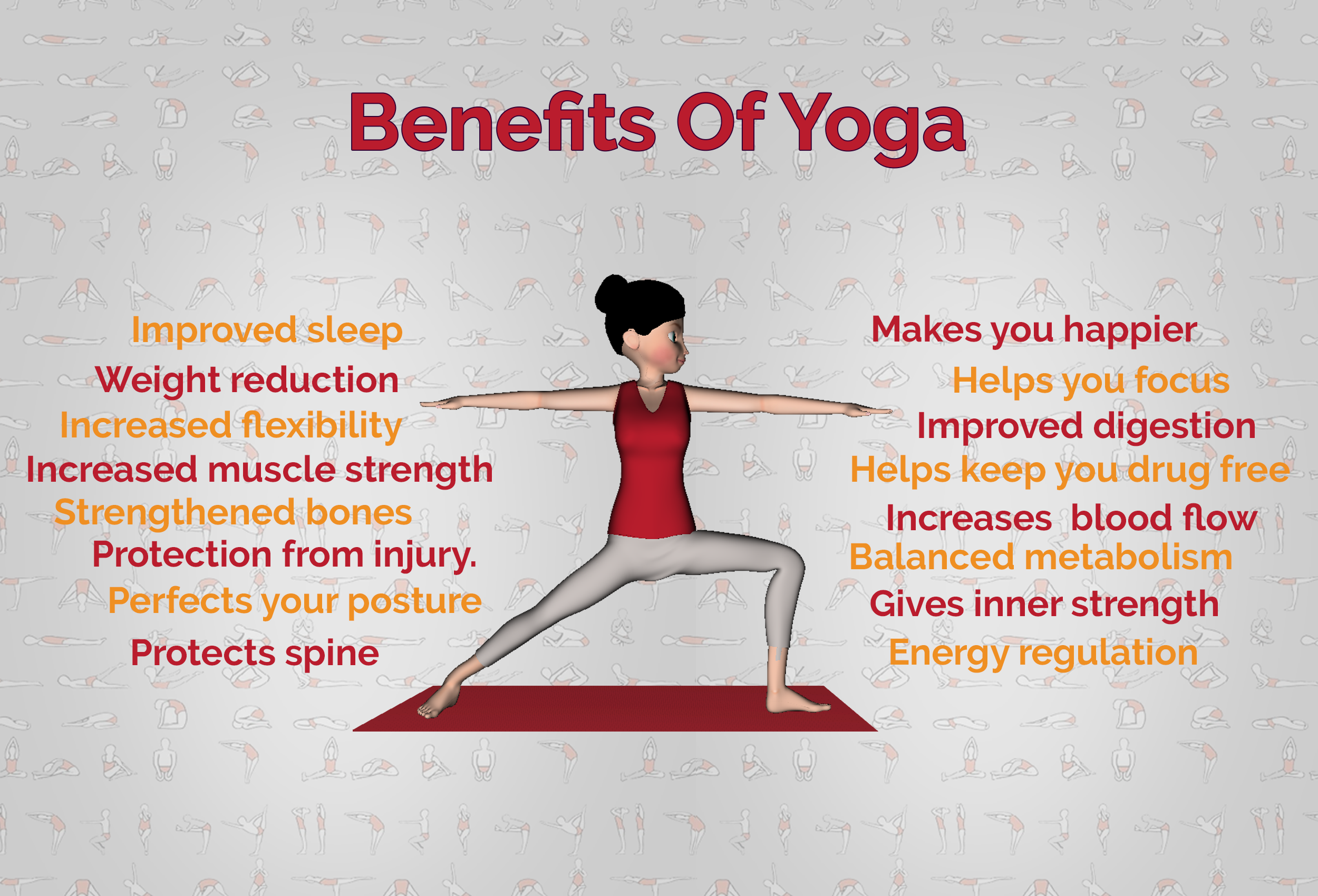
BENEFITS OF YOGA
1. Yoga improves strength, balance and flexibility.
Slow movements and deep breathing increase blood flow and warm up muscles, while holding a pose can build strength.
2. Yoga helps with back pain relief.
Yoga is as good as basic stretching for easing pain and improving mobility in people with lower back pain. The American College of Physicians recommends yoga as a first-line treatment for chronic low back pain.
3. Yoga can ease arthritis symptoms.
Gentle yoga has been shown to ease some of the discomfort of tender, swollen joints for people with arthritis, according to a Johns Hopkins review of 11 recent studies.
4. Yoga benefits heart health.
Regular yoga practice may reduce levels of stress and body-wide inflammation, contributing to healthier hearts. Several of the factors contributing to heart disease, including high blood pressure and excess weight, can also be addressed through yoga.
5. Yoga relaxes you, to help you sleep better.
Research shows that a consistent bedtime yoga routine can help you get in the right mindset and prepare your body to fall asleep and stay asleep.
6. Yoga can mean more energy and brighter moods.
You may feel increased mental and physical energy, a boost in alertness and enthusiasm, and fewer negative feelings after getting into a routine of practicing yoga.
7. Yoga helps you manage stress.
According to the National Institutes of Health, scientific evidence shows that yoga supports stress management, mental health, mindfulness, healthy eating, weight loss and quality sleep.
8. Yoga connects you with a supportive community.
Participating in yoga classes can ease loneliness and provide an environment for group healing and support. Even during one-on-one sessions loneliness is reduced as one is acknowledged as a unique individual, being listened to and participating in the creation of a personalized yoga plan.
9. Yoga promotes better self-care.

 Eduindex