

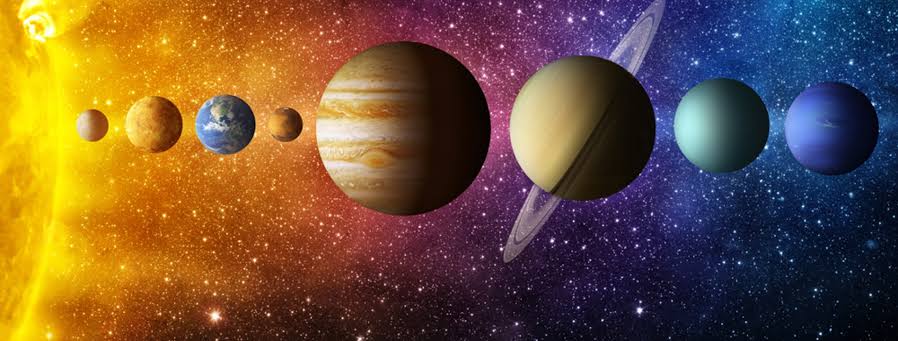
Sun and the celestial bodies which revolve around it form the solar system. It consists of large number of bodies such as planets, comets, asteroids and meteors. The gravitational force of attraction between the Sun and these objects keep them revolving around it.
The Sun
The Sun is a star which is located at the center of our solar system. It is a yellow dwarf star that gives off different types of energy such as infra-red energy (heat), ultraviolet light, radio waves and light.It gives off energy as electromagnetic radiation. It also gives off a stream of particles, which reaches Earth as “solar wind”.

Formation of the Sun
The Sun and the rest of the solar system formed from a giant, rotating cloud of gas and dust called a solar nebula about 4.5 billion years ago. As the nebula collapsed because of its overwhelming gravity, it spun faster and flattened into a disk.

Planets
A planet revolves around the Sun along a definite curved path which is called an orbit. It is elliptical. The time taken by a planet to complete one revolution is called its period of revolution.
The four planets grouped together in the inner solar system are Mercury, Venus, Earth and Mars. They are called inner planets.
The four large planets Jupiter, Saturn, Uranus and Neptune spread out in the outer solar system and slowly orbit the Sun are called outer planets.

Mercury
Mercury is a rocky planet nearest to the Sun. It is very hot during day but very cold at night. Mercury can be easily observed thorough telescope than naked eye since it is very faint and small. It always appears in the eastern horizon or western horizon of the sky.

Venus
Venus is a special planet from the sun, almost the same size as the Earth. It is the hottest planet in solar system. After our moon, it is the brightest heavenly body in our night sky. This planet spins in the opposite direction to all other planets. So, unlike Earth, the Sun rises in the west and sets in the east here. Venus can be seen clearly through naked eye. It always appears in the horizon of eastern or western sky.

The Earth
The Earth where we live is the only planet in the solar system which supports life. Due to its right distance from the sun it has the right temperature, the presence of water and suitable atmosphere and a blanket of ozone. All these have made continuation of life possible on the Earth. From space, the Earth appears bluish green due to the reflection of light from water and land mass on its surface.

Mars
The first planet outside the orbit of the Earth is Mars. It appears slightly reddish and therefore it is also called the red planet. It has two small natural satellites (Deimos and Phobos).

Jupiter
Jupiter is called as Giant planet. It is the largest of all planets (about 11 times larger and 318 times heavier than Earth). It has 3 rings and 65 moons. Its moon Ganymede is the largest moon of our solar system.

Saturn
Known for its bright shiny rings, Saturn appears yellowish in colour. It is the second biggest and a giant gas planet in the outer solar system. At least 60 moons are present – the largest being Titan. Titan is the only moon in the solar system with clouds. Having least density of all ( 30 times less than Earth), this planet is so light.

Uranus
Uranus is a cold gas giant and it can be seen only with the help of large telescope. It has a greatly tilted axis of rotation. As a result, in its orbital motion it appears to roll on its side. Due to its peculiar tilt, it has the longest summers and winters each lasting 42 years.

Neptune
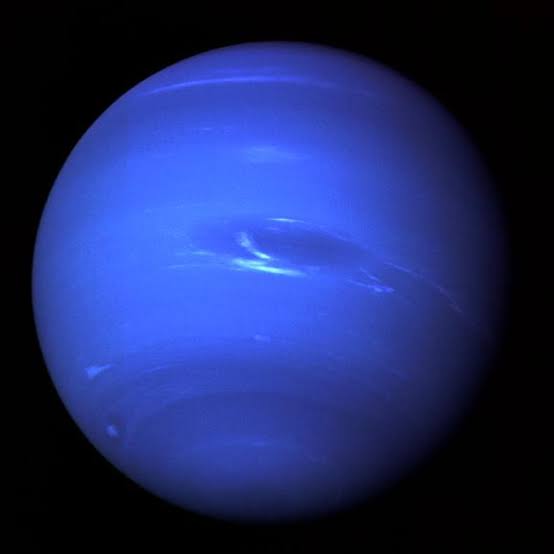
It appears as Greenish star. It is the eighth planet from the Sun and is the windiest planet. Every 248 years, Pluto crosses its orbit. This situation continues for 20 years. It has 13 moons – Triton being the largest. Triton is the only moon in the solar system that moves in the opposite direction to the direction in which its planet spins.

 Eduindex
You must be logged in to post a comment.