LGBT COMMUNITY

BY: VAIBHAVI MENON

LGBT or GLBT is an initialism that stands for lesbian, gay, bisexual, and transgender. In use since the 1990s, the term is an adaptation of the initialism LGB, which began to replace the term gay in reference to the broader LGBT community beginning in the mid-to-late 1980s. The first widely used term, homosexual, now carries negative connotations in the United States. It was replaced by homophile in the 1950s and 1960s, and subsequently gay in the 1970s; the latter term was adopted first by the homosexual community. As lesbians forged more public identities, the phrase “gay and lesbian” became more common. A dispute as to whether the primary focus of their political aims should be feminism or gay rights led to the dissolution of some lesbian organizations, including the Daughters of Bilitis, which disbanded in 1970 following disputes over which goal should take precedence.

As equality was a priority for lesbian feminists, disparity of roles between men and women or butch and femme were viewed as patriarchal. Lesbian feminists eschewed gender role play that had been pervasive in bars as well as the perceived chauvinism of gay men; many lesbian feminists refused to work with gay men, or take up their causes. Lesbians who held the essentialist view, that they had been born homosexual and used the descriptor “lesbian” to define sexual attraction, often considered the separatist opinions of lesbian-feminists to be detrimental to the cause of gay rights. Bisexual and transgender people also sought recognition as legitimate categories within the larger minority community. After the elation of change following group action in the 1969 Stonewall riots in New York City, in the late 1970s and the early 1980s, some gays and lesbians became less accepting of bisexual or transgender people. Critics said that transgender people were acting out stereotypes and bisexuals were simply gay men or lesbian women who were afraid to come out and be honest about their identity. Each community has struggled to develop its own identity including whether, and how, to align with other gender and sexuality-based communities, at times excluding other subgroups; these conflicts continue to this day. LGBTQ activists and artists have created posters to raise consciousness about the issue since the movement began.

From about 1988, activists began to use the initialism LGBT in the United States. Not until the 1990s within the movement did gay, lesbian, bisexual, and transgender people gain equal respect. This spurred some organizations to adopt new names, as the GLBT Historical Society did in 1999. Although the LGBT community has seen much controversy regarding universal acceptance of different member groups (bisexual and transgender individuals, in particular, have sometimes been marginalized by the larger LGBT community), the term LGBT has been a positive symbol of inclusion. Despite the fact that LGBT does not nominally encompass all individuals in smaller communities (see Variants below), the term is generally accepted to include those not specifically identified in the four-letter initialism. Overall, the use of the term LGBT has, over time, largely aided in bringing otherwise marginalized individuals into the general community. Transgender actress Candis Cayne in 2009 described the LGBT community as “the last great minority”, noting that “We can still be harassed openly” and be “called out on television”.

WHAT REALLY ARE VACCINES?

BY: VAIBHAVI MENON

A vaccine is a biological preparation that provides active acquired immunity to a particular infectious disease. A vaccine typically contains an agent that resembles a disease-causing microorganism and is often made from weakened or killed forms of the microbe, its toxins, or one of its surface proteins. The agent stimulates the body’s immune system to recognize the agent as a threat, destroy it, and to further recognize and destroy any of the microorganisms associated with that agent that it may encounter in the future. Vaccines can be prophylactic (to prevent or ameliorate the effects of a future infection by a natural or “wild” pathogen), or therapeutic (to fight a disease that has already occurred, such as cancer).

The administration of vaccines is called vaccination. Vaccination is the most effective method of preventing infectious diseases; widespread immunity due to vaccination is largely responsible for the worldwide eradication of smallpox and the restriction of diseases such as polio, measles, and tetanus from much of the world. The effectiveness of vaccination has been widely studied and verified; for example, vaccines that have proven effective include the influenza vaccine, the HPV vaccine, and the chicken pox vaccine. The World Health Organization (WHO) reports that licensed vaccines are currently available for twenty-five different preventable infections. The terms vaccine and vaccination are derived from Variolae vaccinae (smallpox of the cow), the term devised by Edward Jenner (who both developed the concept of vaccines and created the first vaccine) to denote cowpox. He used the phrase in 1798 for the long title of his Inquiry into the Variolae vaccinae Known as the Cow Pox, in which he described the protective effect of cowpox against smallpox. In 1881, to honor Jenner, Louis Pasteur proposed that the terms should be extended to cover the new protective inoculations then being developed. The science of vaccine development and production is termed vaccinology. There is overwhelming scientific consensus that vaccines are a very safe and effective way to fight and eradicate infectious diseases. The immune system recognizes vaccine agents as foreign, destroys them, and “remembers” them. When the virulent version of an agent is encountered, the body recognizes the protein coat on the virus, and thus is prepared to respond, by first neutralizing the target agent before it can enter cells, and secondly by recognizing and destroying infected cells before that agent can multiply to vast numbers. Limitations to their effectiveness, nevertheless, exist. Sometimes, protection fails because of vaccine-related failure such as failures in vaccine attenuation, vaccination regimes or administration or host-related failure due to host’s immune system simply does not respond adequately or at all. Lack of response commonly results from genetics, immune status, age, health or nutritional status. It also might fail for genetic reasons if the host’s immune system includes no strains of B cells that can generate antibodies suited to reacting effectively and binding to the antigens associated with the pathogen.

Even if the host does develop antibodies, protection might not be adequate; immunity might develop too slowly to be effective in time, the antibodies might not disable the pathogen completely, or there might be multiple strains of the pathogen, not all of which are equally susceptible to the immune reaction. However, even a partial, late, or weak immunity, such as a one resulting from cross-immunity to a strain other than the target strain, may mitigate an infection, resulting in a lower mortality rate, lower morbidity, and faster recovery. Adjuvants commonly are used to boost immune response, particularly for older people whose immune response to a simple vaccine may have weakened.

Management of hazardous and non-hazardous wastes

Management of hazardous wastes

Hazardous wastes may remain dangerous for thousands of years.Tye hazardous waste include radioactive refuse, metallic compounds, organic solvents, acid asbestos, organic cyanide’s, hospital wastes, disposable medical equipments and tools.

The hazardous methods are adopted for the disposal of hazardous wastes.

⭐Landfills:There are permanent storage facilities for military related liquid and radioactive waste materials in secured lands.High level radio active wastes are stored in deep underground storage.

⭐Deep well injection:It involves drilling a well into dry,porous material below ground water.Hazardous waste liquids are pumped into the well.They are soaked into the porous material and made to remain isolated indefinitely.However fractures in the impermeable layer may permit the injected wastes to escape and contaminate ground water.

⭐ Surface impoundments:This method is used to dispose large amounts of water carrying relatively small amounts of chemical wastes.Surface impoundments are simple excavated depressions(ponds)into which liquid wastes are drained.Solid wastes settle and accumulate which water evaporates.If the pond bottom is well sealed and if evaporation equals input,wastes may be stored in the impoundment indefinitely.

⭐Incineration:The hazardous biomedical wastes are usually disposed off by means of Incineration.Human anatomical wastes,discarded medicines,toxic drugs,blood,pus, animal wastes,microbiological and biotechnological wastes etc are called Bio medical wastes.

⭐ Bioremediation:This is another rapidly developing clean up technology.Cleaning environment with biological options such as microbes and plants is called Bioremediation.Some naturally occurring bacteria and other microorganisms have the capability to degrade or absorb or detoxify the wastes such as heavy metals.

Management of non hazardous wastes

⭐ Sanitary land fills:The refuse is spread in a hollow land or in a trench and compacted with a layer of clear sand fill.The sanitary land fills are far more desirable than open dumps but the ground water contaminated is always a potential problem.Once a land fill operation has been completed the site must be inspected periodically.This land fill is suitable for recreational activities such as parks and play ground.

⭐Incineration:Municipal incinerators burn combustible solid waste and melt certain non combustible materials.Since the high temperature destroys pathogens and their vectors,it is a good method of disposal from health point of view.

⭐Reuse and recycling techniques: Resource recovery is a broad term that is used for the retrieval of valuable materials or energy from a waste.The separating out of materials such as rubber,glass,paper and scrap metal from refuse and reprocessing them for reuse is named as reclamation of waste or recycling.

Paper(54% recovery) can be repulped and reprocessed into recycled paper, cardboard,and other paper products.

Glass(20% recovery)can be crushed, remelted and made into new containers or crushes used as a substitute for gravel or sand in construction materials such as concrete and asphalt.

Some forms of plastics(2.2% recovery) can be remelted and fabricated into carpet fibre,fill for insulated apparel, irrigation drainage,tiles and sheet plastics.

Metals can be melted and fabricated (39% recovery).

Food wastes and yard wastes(leaves,grass etc.) can be composted to produce humus soil conditioner.

Textiles can be shredded and used to strengthen recycled paper products.

Management of hazardous and non-hazardous wastes

Management of hazardous wastes

Hazardous wastes may remain dangerous for thousands of years.Tye hazardous waste include radioactive refuse, metallic compounds, organic solvents, acid asbestos, organic cyanide’s, hospital wastes, disposable medical equipments and tools.

The hazardous methods are adopted for the disposal of hazardous wastes.

⭐Landfills:There are permanent storage facilities for military related liquid and radioactive waste materials in secured lands.High level radio active wastes are stored in deep underground storage.

⭐Deep well injection:It involves drilling a well into dry,porous material below ground water.Hazardous waste liquids are pumped into the well.They are soaked into the porous material and made to remain isolated indefinitely.However fractures in the impermeable layer may permit the injected wastes to escape and contaminate ground water.

⭐ Surface impoundments:This method is used to dispose large amounts of water carrying relatively small amounts of chemical wastes.Surface impoundments are simple excavated depressions(ponds)into which liquid wastes are drained.Solid wastes settle and accumulate which water evaporates.If the pond bottom is well sealed and if evaporation equals input,wastes may be stored in the impoundment indefinitely.

⭐Incineration:The hazardous biomedical wastes are usually disposed off by means of Incineration.Human anatomical wastes,discarded medicines,toxic drugs,blood,pus, animal wastes,microbiological and biotechnological wastes etc are called Bio medical wastes.

⭐ Bioremediation:This is another rapidly developing clean up technology.Cleaning environment with biological options such as microbes and plants is called Bioremediation.Some naturally occurring bacteria and other microorganisms have the capability to degrade or absorb or detoxify the wastes such as heavy metals.

Management of non hazardous wastes

⭐ Sanitary land fills:The refuse is spread in a hollow land or in a trench and compacted with a layer of clear sand fill.The sanitary land fills are far more desirable than open dumps but the ground water contaminated is always a potential problem.Once a land fill operation has been completed the site must be inspected periodically.This land fill is suitable for recreational activities such as parks and play ground.

⭐Incineration:Municipal incinerators burn combustible solid waste and melt certain non combustible materials.Since the high temperature destroys pathogens and their vectors,it is a good method of disposal from health point of view.

⭐Reuse and recycling techniques: Resource recovery is a broad term that is used for the retrieval of valuable materials or energy from a waste.The separating out of materials such as rubber,glass,paper and scrap metal from refuse and reprocessing them for reuse is named as reclamation of waste or recycling.

Paper(54% recovery) can be repulped and reprocessed into recycled paper, cardboard,and other paper products.

Glass(20% recovery)can be crushed, remelted and made into new containers or crushes used as a substitute for gravel or sand in construction materials such as concrete and asphalt.

Some forms of plastics(2.2% recovery) can be remelted and fabricated into carpet fibre,fill for insulated apparel, irrigation drainage,tiles and sheet plastics.

Metals can be melted and fabricated (39% recovery).

Food wastes and yard wastes(leaves,grass etc.) can be composted to produce humus soil conditioner.

Textiles can be shredded and used to strengthen recycled paper products.

ARRANGED MARRIAGES

BY: VAIBHAVI MENON

Arranged marriage is a type of marital union where the bride and groom are primarily selected by individuals other than the couple themselves, particularly by family members such as the parents. In some cultures a professional matchmaker may be used to find a spouse for a young person. Arranged marriages have historically been prominent in many cultures. The practice remains common in many regions, notably South Asia, though in many other parts of the world, the practice has declined substantially during the 19th and 20th centuries. Forced marriages, practiced in some families, are condemned by the United Nations, and is not an arranged marriage. The specific sub-category of forced child marriage is especially condemned. In other cultures people mostly choose their own partner.

Arranged marriages were very common throughout the world until the 18th century. Typically, marriages were arranged by parents, grandparents or other relatives. Some historical exceptions are known, such as courtship and betrothal rituals during the Renaissance period of Italy and Gandharva Vivah in the Vedic period of India. In China, arranged marriages sometimes called blind marriages were the norm before the mid-20th century. A marriage was a negotiation and decision between parents and other older members of two families. The boy and girl were typically told to get married, without a right to demur, even if they had never met each other until the wedding day. Arranged marriages were the norm in Russia before the early 20th century, most of which were endogamous. Until the first half of the 20th century, arranged marriages were common in migrant families in the United States. They were sometimes called “picture-bride marriages” among Japanese-American immigrants because the bride and groom knew each other only through the exchange of photographs before the day of their marriage. These marriages among immigrants were typically arranged by parents, or relatives from the country of their origin. As immigrants settled in and melded into a new culture, arranged marriages shifted first to quasi-arranged marriages where parents or friends made introductions and the couple met before the marriage; over time, the marriages among the descendants of these immigrants shifted to autonomous marriages driven by individual’s choice, dating and courtship preferences, along with an increase in interracial marriages. Similar historical dynamics are claimed in other parts of the world. Arranged marriages have declined in prosperous countries with social mobility and increasing individualism; nevertheless, arranged marriages are still seen in countries of Europe and North America, among royal families, aristocrats and minority religious groups such as in placement marriage among Fundamentalist Mormon groups of the United States. In most other parts of the world, arranged marriages continue to varying degrees and increasingly in quasi-arranged form, along with autonomous marriages.

A woman who refuses to go through with an arranged marriage, tries to leave an arranged marriage via divorce or is suspected of any kind of immoral behaviour, may be considered to have dishonored her entire family. This being the case, her male relatives may be ridiculed or harassed and any of her siblings may find it impossible to enter into a marriage. In these cases, killing the woman is a way for the family to enforce the institution of arranged marriages. Unlike cases of domestic violence, honor killings are often done publicly for all to see and there are frequently family members involved in the act.

BIG ENDIAN AND LITTLE ENDIAN

– There are two ways that byte addresses can be assigned across words.

→ computer store data in Memory 

→Formating at the byte level of the data which is called endianness which refer to ordering of bytes.

→The name big-endian is used when lower byte addresses are used for the more Significant bytes (Left most)

→The little-endian is used for the opposite ordering where lower byte address are used for the less significant bytes (Right most)

Endianness refers to the way bytes are ordered when a data item with a site bigger than 1 Byte is placed in memory / transferred over a communication interface.

Two type of endianness:-

  1. Little endian- The bytes are ordered with the LSB placed at the low and address. 
  2. Big endian- The bytes are ordered with the MSB placed at the lowest address.

BIG ENDIAN AND LITTLE ENDIAN

– There are two ways that byte addresses can be assigned across words.

→ computer store data in Memory 

→Formating at the byte level of the data which is called endianness which refer to ordering of bytes.

→The name big-endian is used when lower byte addresses are used for the more Significant bytes (Left most)

→The little-endian is used for the opposite ordering where lower byte address are used for the less significant bytes (Right most)

Endianness refers to the way bytes are ordered when a data item with a site bigger than 1 Byte is placed in memory / transferred over a communication interface.

Two type of endianness:-

  1. Little endian- The bytes are ordered with the LSB placed at the low and address. 
  2. Big endian- The bytes are ordered with the MSB placed at the lowest address.

EFFECT OF MASS MEDIA ON MILLENIALS

BY: VAIBHAVI MENON

Individuals that fall into this generation known as “millennials” are particularly interesting to look into the effects of increased media presence, because they are the generation that is constantly surrounded with updated technology. These individuals are the group of people that are regularly online, taking full advantage of these resources; it has become not just a part of their life but their life in its entirety. Everything this generation does is centered on the Internet, whereas someone from an older generation grew up in a different kind of life, so the effects aren’t nearly as drastic or as meaningful. Millenials are the ones that have grown up with the presence of mass digital media in their lives and were the ones constantly subjected to the consequences of this presence while also adapting to new and improved technologies every day.

The existence of the smartphone has completely altered how this group of individuals interacts and participates in society, because they are the ones who stay constant with the progressions in technology and getting the new “iPhone” every time it is released. “The arrival of the smartphone has radically changed every aspect of teenagers’ lives, from the nature of their social interactions to their mental health. These changes have affected young people in every corner of the nation and in every type of household. The trends appear among teens poor and rich; of every ethnic background; in cities, suburbs, and small towns. Where there are cell towers, there are teens living their lives on their smartphone.” (Twenge). This age group is subjected to a life filled with mass media and technology every day, which results in different circumstances and different lives in comparison to older generations. There is a fundamental difference in how this generation and older generations process, analyze and understand information while they function in society. Comparing those who weren’t raised on the power of a smartphone and in the age of media constantly in your face to those who were, the contrast becomes quite clear.

Media messages can have a negative or unhealthy influence on teenage behavior and attitudes in certain areas, including body image, health and citizenship. Body image :- Your child’s body image is influenced by social media, other media and advertising. If teenagers see unrealistic ‘thin’ or ‘muscly’ body types often enough in the media they follow, it can have an impact on their body image and dieting behavior. This is especially true when there’s no-one to disagree with messages like ‘thin is beautiful’. Health and lifestyle :- Social media and other media can influence the decisions that teenagers make about their health and lifestyle. For example, media messages and content can make it look ‘normal’, cool or grown-up to eat junk food, smoke, drink alcohol and take other drugs. Citizenship:-To be responsible citizens, teenagers need reliable and good-quality information. But social media and other media are sometimes used in negative ways during elections and at other times. For example, ‘fake news’ might influence teenagers to believe false information about a politician, public figure or celebrity. Or sometimes online forums promote biased or hateful attitudes towards groups of people.

CHINTPURNI :- INCREDIBLE INDIA

One of the shaktipeethas (places of worship where the body parts of the goddess Sati fell), is the Chintpurni Temple located about 50 miles [80 km] from Dharamsala. The supreme deity is Goddess Chintpurni, who is said to remove troubles, and is represented by the pindi (circular goddess). Legend has it that when Lord Vishnu cut the body of Maa Sati in 51 parts to end King Shiva’s dance of the destruction of the earth, the pieces were scattered in different parts of India. Considered one of the most important of the 51 shaktipeethas, it is believed that the head of the goddess Shakti fell to Chintpurni.

The Chintpurni Devi Temple is visited by devotees from all over India, who come to pray at the Lotus feet of Mata Chhinnamastika Devi. Puranic traditions say that Chinnamnamastika Devi is protected by Rudra Mahadev or Lord Shiva on all four sides. At the same distance from Chintpurni stands four Shiva temples, Muchkund Mahadev in the north, Shiva Bari in the south, Kaleshwar Mahadev in the east and Narayna Mahadev in the west. The temple remains open between 4 a.m. and 11 p.m.

CHINTPURNI :- INCREDIBLE INDIA

One of the shaktipeethas (places of worship where the body parts of the goddess Sati fell), is the Chintpurni Temple located about 50 miles [80 km] from Dharamsala. The supreme deity is Goddess Chintpurni, who is said to remove troubles, and is represented by the pindi (circular goddess). Legend has it that when Lord Vishnu cut the body of Maa Sati in 51 parts to end King Shiva’s dance of the destruction of the earth, the pieces were scattered in different parts of India. Considered one of the most important of the 51 shaktipeethas, it is believed that the head of the goddess Shakti fell to Chintpurni.

The Chintpurni Devi Temple is visited by devotees from all over India, who come to pray at the Lotus feet of Mata Chhinnamastika Devi. Puranic traditions say that Chinnamnamastika Devi is protected by Rudra Mahadev or Lord Shiva on all four sides. At the same distance from Chintpurni stands four Shiva temples, Muchkund Mahadev in the north, Shiva Bari in the south, Kaleshwar Mahadev in the east and Narayna Mahadev in the west. The temple remains open between 4 a.m. and 11 p.m.

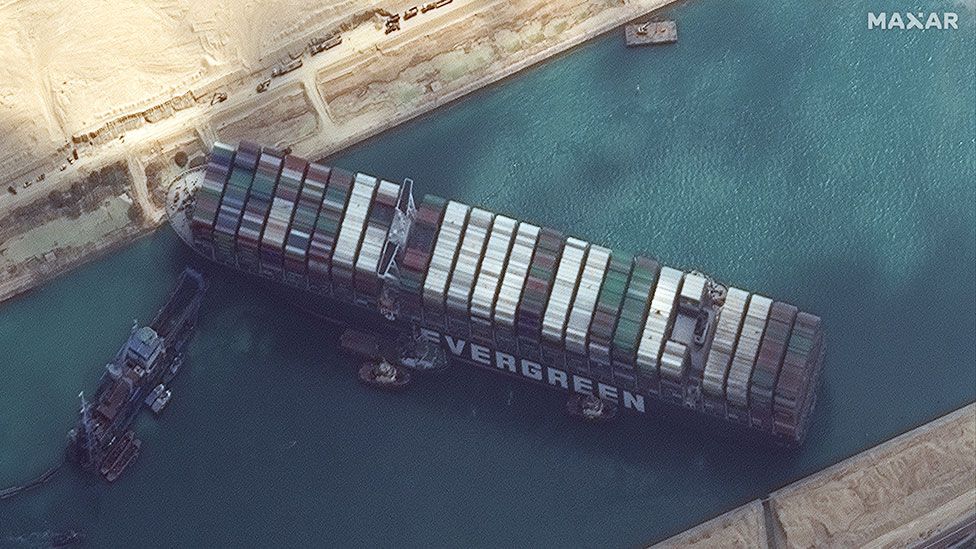
Ever Given : Ship that blocked Suez Canal

The 193km (120 mile) Suez Canal connects the Mediterranean Sea at the canal’s northern end to the Red Sea in the south and provides the shortest sea link between Asia and Europe.

On 28 March, at least 369 ships were queuing to pass through the canal. This prevented an estimated US$9.6 billion worth of trade. On 29 March, Ever Given was partially re-floated and moved by about 80 percent in the correct direction, although the bow remained stuck until the ship was finally freed by Egyptian, Dutch, and Italian tugs at and started moving, under tow, towards the Great Bitter Lake, for technical inspection. The canal was checked for damage, and after being found to be sound, the SCA allowed shipping to resume from 29 March. The vessel was subsequently impounded by the Egyptian government on 13 April 2021 for refusing to pay compensations demanded by the government, a claim deemed to be unjustified by the ship’s insurers. After the incident, the Egyptian government announced that they will be widening the narrower parts of the canal.

Suez Canal: How did they move the Ever Given? - BBC News

The ship has been impounded for three months near the canal city of Ismailia

The container ship was refloated following a six-day salvage operation that involved a flotilla of tug boats and dredging vessels. One person was killed during the operation. Since then, the Suez Canal Authority (SCA) has been seeking compensation from the Ever Given’s Japanese owner Shoei Kisen for the cost of the salvage operation, damage to the canal’s banks and other losses.

The SCA initially asked for $916 million compensation, including $300 million for a salvage bonus and $300 million for loss of reputation. But UK Club – which insured Shoei Kiswn for third-party liabilities – rejected the claim, describing it as “extraordinarily large” and “largely unsupported”.

The SCA later lowered its demand to $550 million. The final settlement, which has not been revealed, was agreed and signed and the ship was released on 7 July, 2021.

Ever Given : Ship that blocked Suez Canal

The 193km (120 mile) Suez Canal connects the Mediterranean Sea at the canal’s northern end to the Red Sea in the south and provides the shortest sea link between Asia and Europe.

On 28 March, at least 369 ships were queuing to pass through the canal. This prevented an estimated US$9.6 billion worth of trade. On 29 March, Ever Given was partially re-floated and moved by about 80 percent in the correct direction, although the bow remained stuck until the ship was finally freed by Egyptian, Dutch, and Italian tugs at and started moving, under tow, towards the Great Bitter Lake, for technical inspection. The canal was checked for damage, and after being found to be sound, the SCA allowed shipping to resume from 29 March. The vessel was subsequently impounded by the Egyptian government on 13 April 2021 for refusing to pay compensations demanded by the government, a claim deemed to be unjustified by the ship’s insurers. After the incident, the Egyptian government announced that they will be widening the narrower parts of the canal.

Suez Canal: How did they move the Ever Given? - BBC News

The ship has been impounded for three months near the canal city of Ismailia

The container ship was refloated following a six-day salvage operation that involved a flotilla of tug boats and dredging vessels. One person was killed during the operation. Since then, the Suez Canal Authority (SCA) has been seeking compensation from the Ever Given’s Japanese owner Shoei Kisen for the cost of the salvage operation, damage to the canal’s banks and other losses.

The SCA initially asked for $916 million compensation, including $300 million for a salvage bonus and $300 million for loss of reputation. But UK Club – which insured Shoei Kiswn for third-party liabilities – rejected the claim, describing it as “extraordinarily large” and “largely unsupported”.

The SCA later lowered its demand to $550 million. The final settlement, which has not been revealed, was agreed and signed and the ship was released on 7 July, 2021.

PHOBIA

BY: VAIBHAVI MENON

A phobia is a type of anxiety disorder defined by a persistent and excessive fear of an object or situation. Phobias typically, result in a rapid onset of fear and are present for more than six months. Those affected will go to great lengths to avoid the situation or object, to a degree greater than the actual danger posed. If the object or situation cannot be avoided, they experience significant distress. Other symptoms can include fainting, which may occur in blood or injury phobia, and panic attacks, which are often found in agoraphobia. Around 75% of those with phobias have multiple phobias.

Phobias can be divided into specific phobias, social phobia, and agoraphobia. Specific phobias include those to certain animals, natural environment situations, blood or injury, and specific situations. The most common are fear of spiders, fear of snakes, and fear of heights. Specific phobias may be caused by a negative experience with the object or situation in early childhood. Social phobia is when a person fears a situation due to worries about others judging them. Agoraphobia is a fear of a situation due to a difficulty or inability to escape. It is recommended that specific phobias be treated with exposure therapy, in which the person is introduced to the situation or object in question until the fear resolves. Medications are not useful for specific phobias. Social phobia and agoraphobia are often treated with some combination of counselling and medication. Medications used include antidepressants, benzodiazepines, or beta-blockers. Specific phobias affect about 6–8% of people in the Western world and 2–4% of people in Asia, Africa, and Latin America in a given year. Social phobia affects about 7% of people in the United States and 0.5–2.5% of people in the rest of the world. Agoraphobia affects about 1.7% of people. Women are affected by phobias about twice as often as men. Typically, the onset of a phobia is around the ages of 10–17, and rates are lower with increasing age. Those with phobias are at a higher risk of suicide. There are various methods used to treat phobias. These methods include systematic desensitization, progressive relaxation, virtual reality, modeling, medication and hypnotherapy. The good news is that over the past several decades, psychologists and other researchers have developed some effective behavioral and pharmacological treatments for phobia, as well as technological interventions.

Cognitive behavioral therapy (CBT) can be beneficial by allowing the person to challenge dysfunctional thoughts or beliefs by being mindful of their own feelings, with the aim that the person will realize that his or her fear is irrational. CBT may be conducted in a group setting. Gradual desensitization treatment and CBT are often successful, provided the person is willing to endure some discomfort. In one clinical trial, 90% of people were observed to no longer have a phobic reaction after successful CBT treatment. There is evidence that supports that eye movement desensitization and reprocessing (EMDR) is effective in treating some phobias. Its effectiveness in treating complex or trauma-related phobias has not been empirically established yet. Mainly used to treat post-traumatic stress disorder, EMDR has been demonstrated as effective in easing phobia symptoms following a specific trauma, such as a fear of dogs following a dog bite

Elysium(2013): Explained

A future where the earth is overpopulated is a definite possibility. Elysium is set in 2154 where due t overpopulation most of the citizens live in poverty, The rich however live on a man made space station known as Elysium. The space station has technology that can heal any disease and even reverse ageing, none of these facilities are given to the citizens on the planet. The residents of earth understandably want to use the Elysium’s technology to cure themselves, the residents of the Elysium however object.

The movie revolves around Max Da Costa an assembly line worker who lives in LA, he works for Armadyne which produces Elysium’s weaponry and police robots. He’s an ex convict that is usually bullied by the robotic police. During a shift Max is accidentally trapped in a kiln and exposed to a lethal dose of radiation, he is rescued but told that he has only five more days to live. Max tries to request John Carlyle the CEO of Armadyne to help, Max is instead given medication to cull the symptoms until his death.

Max unwilling to die tries to enlist the help of human smuggler Spider to get him onto Elysium. Meanwhile 2 out of 3 ships carrying immigrants are shot down by agent Kruger, he’s a government operative acting on the direct orders of Défense Secretary Delacourt. The president Patel reprimands Delacourt and threatens to fire her, Delacourt makes a deal with Carlyle to make her the president. Carlyle developed Elysium and can program it to think that Delacourt is the president, he agrees and stores the program in his brain.

Spider agrees to smuggle max to Elysium if he can steal the information from Carlyle, Max agrees to the deal and an exoskeleton is surgically attached to him. Max and spider’s men shoot Carlyle’s pod down and engage in a fight with the ships robotic guards, in the firefight max is injured and he downloads Carlyle’s program to his suits neural link. Agent Kruger is deployed to kill Max and recover the program. An injured max contacts his childhood friend Frey a nurse, after nursing Max back to health Frey begs him to take her daughter Matilda who suffers from terminal leukaemia to Elysium. Agent Kruger arrives and interogates Frey for Max’s location, realising Matilda to be ill he takes her and Frey onto his ship.

Max delivers the program to spider who reveals that the program can be modified to make everyone residents of Elysium. Max bargains with Kruger to be taken to Elysium, Spider uses this opportunity to board a ship to Elysium. Kruger is injured in a fight on his ship which disables the ships engines. After crashing on Elysium Max is knocked out and Frey tries to use Med bay to cure Matilda but discovers that the Med bays work only for the Elysium’s citizens. Max, Frey and Matilda are taken to Delacourt by Kruger, she orders Frey and Matilde to be taken away and also orders the decryption of Carlyle’s program knowing it will kill Max.

Kruger kills Delacourt and his henchman start killing the other political officers to seize control of Elysium. Max uses this chaos to escape his confinement and vows to use the program to help everyone, he frees Matilda and Frey and kills one of Kruger’s henchmen. Spider has Matilda and Frey escorted to a Med bay while he accompanies Max to the Elysium’s core. After a brief fight with Kruger the duo reaches the core, Spider realises that the codes activation will kill Max. Max makes the sacrifice by activating the program, the program registers every earth resident as an Elysian citizen. Matilda is cured by a med bay and a fleet of ships leave for earth to treat all the residents.

The movie is an amazing play on one of our possible futures. Our world might be heading in the same direction, the technological aspect would be welcomed by all but the financial and social aspect is something we must lookout for. The current pandemic gave us a pretty good look at what happens to the general public, the rich on the other hand keep getting richer. Something has to be done to bridge the gap and make amends while possible or stay ready for an Elysium like world.

Elysium(2013): Explained

A future where the earth is overpopulated is a definite possibility. Elysium is set in 2154 where due t overpopulation most of the citizens live in poverty, The rich however live on a man made space station known as Elysium. The space station has technology that can heal any disease and even reverse ageing, none of these facilities are given to the citizens on the planet. The residents of earth understandably want to use the Elysium’s technology to cure themselves, the residents of the Elysium however object.

The movie revolves around Max Da Costa an assembly line worker who lives in LA, he works for Armadyne which produces Elysium’s weaponry and police robots. He’s an ex convict that is usually bullied by the robotic police. During a shift Max is accidentally trapped in a kiln and exposed to a lethal dose of radiation, he is rescued but told that he has only five more days to live. Max tries to request John Carlyle the CEO of Armadyne to help, Max is instead given medication to cull the symptoms until his death.

Max unwilling to die tries to enlist the help of human smuggler Spider to get him onto Elysium. Meanwhile 2 out of 3 ships carrying immigrants are shot down by agent Kruger, he’s a government operative acting on the direct orders of Défense Secretary Delacourt. The president Patel reprimands Delacourt and threatens to fire her, Delacourt makes a deal with Carlyle to make her the president. Carlyle developed Elysium and can program it to think that Delacourt is the president, he agrees and stores the program in his brain.

Spider agrees to smuggle max to Elysium if he can steal the information from Carlyle, Max agrees to the deal and an exoskeleton is surgically attached to him. Max and spider’s men shoot Carlyle’s pod down and engage in a fight with the ships robotic guards, in the firefight max is injured and he downloads Carlyle’s program to his suits neural link. Agent Kruger is deployed to kill Max and recover the program. An injured max contacts his childhood friend Frey a nurse, after nursing Max back to health Frey begs him to take her daughter Matilda who suffers from terminal leukaemia to Elysium. Agent Kruger arrives and interogates Frey for Max’s location, realising Matilda to be ill he takes her and Frey onto his ship.

Max delivers the program to spider who reveals that the program can be modified to make everyone residents of Elysium. Max bargains with Kruger to be taken to Elysium, Spider uses this opportunity to board a ship to Elysium. Kruger is injured in a fight on his ship which disables the ships engines. After crashing on Elysium Max is knocked out and Frey tries to use Med bay to cure Matilda but discovers that the Med bays work only for the Elysium’s citizens. Max, Frey and Matilda are taken to Delacourt by Kruger, she orders Frey and Matilde to be taken away and also orders the decryption of Carlyle’s program knowing it will kill Max.

Kruger kills Delacourt and his henchman start killing the other political officers to seize control of Elysium. Max uses this chaos to escape his confinement and vows to use the program to help everyone, he frees Matilda and Frey and kills one of Kruger’s henchmen. Spider has Matilda and Frey escorted to a Med bay while he accompanies Max to the Elysium’s core. After a brief fight with Kruger the duo reaches the core, Spider realises that the codes activation will kill Max. Max makes the sacrifice by activating the program, the program registers every earth resident as an Elysian citizen. Matilda is cured by a med bay and a fleet of ships leave for earth to treat all the residents.

The movie is an amazing play on one of our possible futures. Our world might be heading in the same direction, the technological aspect would be welcomed by all but the financial and social aspect is something we must lookout for. The current pandemic gave us a pretty good look at what happens to the general public, the rich on the other hand keep getting richer. Something has to be done to bridge the gap and make amends while possible or stay ready for an Elysium like world.