


Dr. APJ Abdul Kalam is a motivation for the individuals of India. Individuals regarded him with great respect and used to call him Sir APJ Abdul Kalam. Indeed, even a child younger than ten knows who APJ Abdul Kalam is. He was an Indian aerospace researcher who filled in as the eleventh president of India.People consider him the ‘Rocket Man of India’. Dr APJ Abdul Kalam was a significant believer of ‘Simple Living High Thinking’.Sir Abdul Kalam has faced numerous problems throughout his life. His youth was full of struggles, and he wanted to become a fighter pilot. He was firm on his hard work and commitment and he, at last, turned into a famous scientist of India. His life is a motivation for us.

ACHIEVEMENTS
1.HE HELPED TO BUILD A FIRST INDIGENOUS HOVERCRAFT
Abdul Kalam joined the Aeronautical Development Establishment of the Defense Research and Development Organization (DRDO), right after graduating from the Madras Institute of Technology in 1960. As a young scientist, he was assigned his first project to design and develop a hovercraft for the country’s defence applications. A hovercraft is an amphibious craft capable of travelling over land, water, mud, ice and other surfaces. After days of hard-work, Kalam and his team were successful in developing India’s first indigenous hovercraft which was named Nandi, the impressive white bull who acts as the vehicle of the Hindu deity Lord Shiva. Project Nandi received massive applause from the then Defense Minister, V.K Krishna Menon, and encouraged Kalam for his future endeavours. However, Project Nandi was shelved as the new government in power didn’t show any interest in the invention.
2.HE WAS A PART OF TEAM WHICH SET UP TERLS
Though Project Nandi was put in cold storage, due to it Kalam got a call from the Indian Committee for Space Research (INCOSPAR) to attend an interview at the Tata Institute of Fundamental Research (TIFR). At the time, INCOSPAR was formed out of the TIFR talent pool. Among the members of the selection panel who interviewed Kalam was Dr. Vikram Sarabhai, the father of the Indian Space Programme and the founder of Indian Space Research Organisation (ISRO). Dr. Sarabhai took a deep interest in Kalam and selected him as a rocket engineer in INCOSPAR. The team of rocket engineers of which Kalam was a part, set up the Thumba Equatorial Rocket Launching Station (TERLS) in 1963. TERLS is used by ISRO to launch sounding rockets even today.
3.HE WAS PROJECT DIRECTOR FOR INDIA’S FIRST SLV
In 1969, when INCOSPAR led to the birth of the ISRO, Kalam was transferred there and was initially involved in research about building rockets. In the early 1970s, ISRO introduced its own Satellite Launch Vehicle program owing to geopolitical and economic considerations. It was a program to develop the technology needed to launch satellites. Dr. A. P. J. Abdul Kalam was made the project director of the program. Beginning with mechanical designing to electrical integration, Kalam single-handedly supervised every aspect of the project, which was a massive success. On July 18, 1980, Satellite Launch Vehicle-3 (SLV-3) was successfully launched from Sriharikota range in the Nellore district of Andhra Pradesh. It deployed the Rohini satellite in near-earth orbit. It was the first successful satellite launch that took place on Indian soil and thereby made India the seventh member of an exclusive club of space-faring nations in international society.
4.HE WAS RESPONSIBLE FOR THE SUCCESSFUL LAUNCH AGNI AND PRITHIV MISSILES
After the huge triumph of SLV-III and dedicating the paramount years of his life to ISRO, Dr. Kalam was issued transfer orders to DRDO, where he was given the responsibility to lead the Integrated Guided Missile Development Program (IGMDP). According to the instructions of then Defence Minister R. Venkataraman, four missiles were to be developed simultaneously as part of the program. After years of consistent hard work and immense dedication, India got her first range of ballistic missiles, the Prithvi, the Agni, the Aakash, and the Nag. Out of the four, two missiles, namely, Prithvi, the tactical surface-to-surface missile; and Agni, an intermediate-range ballistic missile; were launched successfully. Due to this mammoth achievement under his leadership, India became a major military power and Dr Kalam became popularly known as the “Missile Man of India” .
5.HE SERVED AS A FIRST PRINCIPAL SCIENTIFIC ADVISOR TO THE GOVERNMENT OF INDIA
After his retirement from DRDO, Kalam was appointed as the first-ever Principal Scientific Advisor (PSA) to the Government Of India from November 1999 to November 2001. Principal Scientific Advisor was a Cabinet rank position at the time and was largely created to assist scientific cross-sectoral synergy across ministries, institutions and the industry. During his service period, Dr. Kalam supervised committees making master plans regarding defence, agriculture, healthcare and information technology. Under this esteemed post, he was also responsible for evolving policies, strategies and missions for many developmental applications.
6.DR. A. P. J. ABDUL KALAM SERVED AS THE 11th PRESIDENT OF INDIA
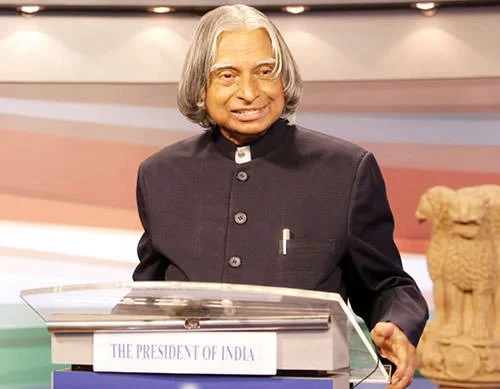
On June 10, 2002, the National Democratic Alliance (NDA), the then ruling party expressed their will to nominate Dr. Kalam for the post of President. On June 18, Kalam filed his nomination papers in the Indian Parliament. He went on to win the 2002 Indian presidential election with an electoral vote of 922,884 as compared to 107,366 votes won by Lakshmi Sahgal. Kalam was the first scientist to become the president of India. During his term as president, he was fondly called the People’s President because of his humility, integrity, vision; and his immense contribution to inspire and nurture the young minds of the nation. Dr. Kalam’s guidelines under the scheme of “Vision of 2020” to make India a developed country has been incorporated under plans of the Indian Government. After the expiry of his term and his unwillingness to contest the election for the second term, Pratibha Patil became his successor as the 12th president of India. Dr. A. P. J. Abdul Kalam served as the 11th President of India from July 25, 2002 to July 25, 2007.

AWARDS
Dr Kalam was awarded the Padma Bhushan in 1981 and the Padma Vibhushan in 1990 by the Government of India. These are the third highest and the second highest civilian awards in India respectively. He received the Padma Bhushan after the successful launch of SLV-III; while he received the Padma Vibhushan after the successful completion of the Integrated Guided Missile Development Programme. In 1997, Dr. A. P. J. Abdul Kalam received India’s highest civilian honour, the Bharat Ratna, for his contribution to the scientific research and modernization of defence technology in India. Kalam has received numerous other honours including Veer Savarkar Award (1998); Ramanujan Award (2000); King Charles II Medal (2007); International von Kármán Wings Award (2009); Hoover Medal (2009); and Von Braun Award (2013). Moreover, he has received 7 honorary doctorates from 40 universities. Apart from these prestigious accolades, in 2010, the United Nations declared October 15 as World Students’ Day to commemorate the birthday Dr. Kalam.

 Eduindex