Russia and Ukraine have failed to find a breakthrough on a ceasefire and other humanitarian issues at the first high-level talks in Turkey since Moscow’s military operation . Russia’s Foreign Minister Sergei Lavrov and Ukrainian counterpart Dmytro Kuleba met on the sidelines of a diplomatic forum in the Turkish resort city of Antalya .Mr Kuleba has accused his Russian counterpart of bringing “traditional narratives” about Ukraine to the table. However Kuleba said that he would be ready to meet with Lavrov again in this format if there are prospects of a substantial discussion for seeking solutions.Lavrov said Russia also wants to continue negotiations with Ukraine and President Vladimir Putin would not refuse a meeting with his Ukrainian counterpart Volodymyr Zelenskyy to discuss “specific” issues.
The first thought that comes to our mind when thinking about time is it can’t be changed. But we are not trying to understand the wastage of time in our day-to-day life. We know the benefits of it, but we don’t realize its importance in our life. The reasons we gave to waste time are infinity.
There are many reasons for wasting time we would have come across in our daily routine. Some of them are :
Addiction over small tasks : This type of time wastage occurs when we get addicted to small tasks that surrounding us neglecting the big tasks that are important and urgent. It is caused due to the need of perfection in our simple task, but the cost of this addiction is realised later.
Procrastination : It happens every time when we lost our focus on the current work and started thinking about something else without knowing. It is the most common and dangerous reason that finally leads to jeopardise our job.
Wrong priorities : We must prioritise our works correctly before involving in it. The more time we give to priorities our works, the more jobs we can finish. Wrong prioritising of jobs leads to losing of important and urgent work.
Multitasking : The tendency to do everything at once is the way to finishing none at last. Initially it may look like doing all at once and saving time. But eventually it makes our easy jobs more complex and atlast completing no tasks. The amount of time we take to do all simultaneously is more than the cumulation of time taken to do all jobs each at a time.
Disorganised : The surrounding of our work bench also influence our time. If it were too clumsy, the time to find something important is also comes under time wastage. The place we work must be clean and organised to make our jobs easier.
METHODS TO SAVE TIME
Eliminate Distractions : There must be no distractions during our work time. It must be eliminated as far as possible to finish the task quickly. Distractions took large amount of time and it results in postponing of jobs.
Creating a To-Do List : A To-Do list can help us prioritise our jobs and it is a easy way to work on our tasks in an proper order. To-Do List must be created either during day before night or early morning. The important point in creating a To-Do list is it must be minimum and must be possible schedule.
Take a Break : A small break between task keeps us productive during the task and motivate us to do other jobs as well. The best way to schedule breaks is pomodoro technique. Pomodoro is a technique which involves 25 minute work – 5 minute break. This break time must be used for our hobbies and favourite tasks instead of using smart phones and televisions.
Reduce social media Time : The time spend in social media must also be scheduled otherwise it will consume large amount of time. It can be used for some time and must be thrown away. Sometimes logging out of social media might help, since the next time we go to social media the lazyness of logging in again may tempt us to see it afterwards.
The more productive we are, the more achievements we can we do in our life. Stay productive!!
It is a well-established fact among the human race that “Some things can only be emotionally and mentally felt, rather than being expressed” Catering to the above thought, I would like to open my side of the debate by arguing, that we as humans express our feelings or rather what we believe in, for the benefit of our companions and relatives. Our beliefs are rather stored in our minds and are sometimes difficult to be given a ” DEFINITION”. But, in no way does that signify how strong our emotions are, or the stability of our mindset. Let’s take the most famous example here, Science vs Religion( GOD), or rather how we know it – ILLUMINATI. Some argue, that God does not exist, it is just a notion of our minds that has or can never be clinically proven. I would reply to that with a “Science” fact- If the earth’s gravity were less than 0.000000000001% of what it is right now, our planet would collapse. And if it was increased by the same value, the Earth would explode. There was obviously something that made our planet so perfect that we can survive on it. I am not arguing that there is any specific God, rather, I say that there is some unnatural power that drives our lives every day. And this power is what most people call ” God”. But can we define it? No, we cannot. But do we believe in it? Of course, we do. And there are some cases, where people know that “GOD” does not exist, but still pray to him in the form of meditation, to achieve mental stability of the mind.
Distinguishing science from non-science or religion is generally an easy matter, as the two rarely seem to make claims to be scientific. When they do make claims of being scientific, this becomes known as pseudoscience. Even so, it is useful to recognize the distinctions, as science doesn’t always clearly do so. For the boundary between science and religion, a majority of the cases can be separated well through the verificationistic view. While empirical matters are primarily dealt with science, spiritual matters are primarily dealt with religion because they cannot be objectively and empirically observed.
When distinguishing science from non-science, it’s easiest to start by defining the fundamentals that make up what science is, and then define all of the fields that fall outside this definition as non-science. At it core, science is a system of acquiring knowledge about the physical world through objective experimentation and observation. Therefore, fields that do not involve the acquisition of knowledge, such as art and business, can be classified as being non-science. Moreover, mathematics is a field considered to be non-science because doesn’t acquire knowledge about the physical world. The field of engineering proves to be an interesting case. While engineers practically apply scientific knowledge, the field as a whole is non-scientific.
The vineeta Singh is a successful entrepreneur. She is the founder and CEO of the Sugar Cosmetics. Sugar cosmetics is the India’s most popular cosmetic company. The revenue of company is around 3000cr.
Vineeta Singh done her schooling in Delhi. She completed her graduation in Electrical engineering from IIT, Madras. She done her master in MBA from IIM, Ahmedabad. During college days she won various badminton compitition. At age 23 she refuse to 1cr placement and started her own company. She is among top 100 mindful women in the world. Now she is one of most powerful shark in shark tank India.
Vineeta Singh got Start up of the year2019 by entrepreneur award. She is also most powerful women in business- Forbes December 2021.
In Josh talks she said,” I don’t want to try new things. I fear to try new because I always avoid failure. From childhood I do only thing which are easy and give success to me. My dreams are always according to my success. But at 23 I throw away my safe zone and tried new.”
she also advise young entrepreneurs,” To make a successful business or brand 3 thing are important that are patience, consistency in work and many more hardwork. When you are starting business start from your problem and your consumer/ costumer problem. As a entrepreneur think big and always have a big goal/ aim. And the last thing I want to tell you that don’t fear to failure. Learn from your failure and start again with new energy and confidence”.
Vineeta Singh with her husband kaushik Mukharjee (co-founder of sugar cosmetics)
It was in 1921 and 1922 that archaeologists discovered remains of an ancient civilization after distinct stone seals from around the Indus river valley perked their interest. This civilization which flourished around the Indus river was termed the Indus Valley civilization or the Harappan civilization and it was found to be one of the earliest civilizations along with the Mesopotamian and Egyptian civilizations. But what makes Indus valley civilization intriguing for many is that this civilization, unlike its counterparts in Egypt, China and Mesopotamia, had no evidence of war, conquests, or the existence of armies or slaves. It had some of the most impressive city planning and sewage systems. So, what is the story of this civilization and how did it come to an end?
source: wikipedia.org
Indus Valley Civilization existed from 3300 BC to 1300 BC. Archaeologists first identified the civilization at Harappa in the Punjab region of Pakistan in 1921 and then at Mohenjo-Daro in the Sindh region in 1922. These two sites were found to be the 2 major cities of the civilization. It is the most extensive of the world’s 3 earliest civilizations, covering an area of 1 million square kilometers. Like many other civilizations, this one also developed around river valleys. The people set up farming and grew crops along the banks of 2 rivers – the river Indus and the Ghaggar river. A larger number of settlements were found along the Ghaggar than the Indus and it appears to have been more productive too. The river Ghaggar has presently almost completely dried up, however, and flows only during the monsoon season. Many even believe that this is the lost river Saraswati which is mentioned in the Rig Veda as a big river located between the Indus and the Ganges.
Agriculture was the main source of livelihood while trade was also an important part of the economy. People grew wheat, barley, mustard field peas and spices like turmeric, ginger, cumin and cinnamon. Cattle, water buffalos, sheep, goats, chickens and even elephants were domesticated. Figurines of dogs with collars and paw prints suggest that dogs and cats were kept as pets too. . The Harappans also practiced extensive trade with the Mesopotamians, Central Asia and Iran, with Mesopotamian records calling the land of Harappans “Meluha”. Gold, silver, lapis lazuli, copper, timber etc. were exported to Mesopotamia probably in exchange for luxury or manufactured goods.
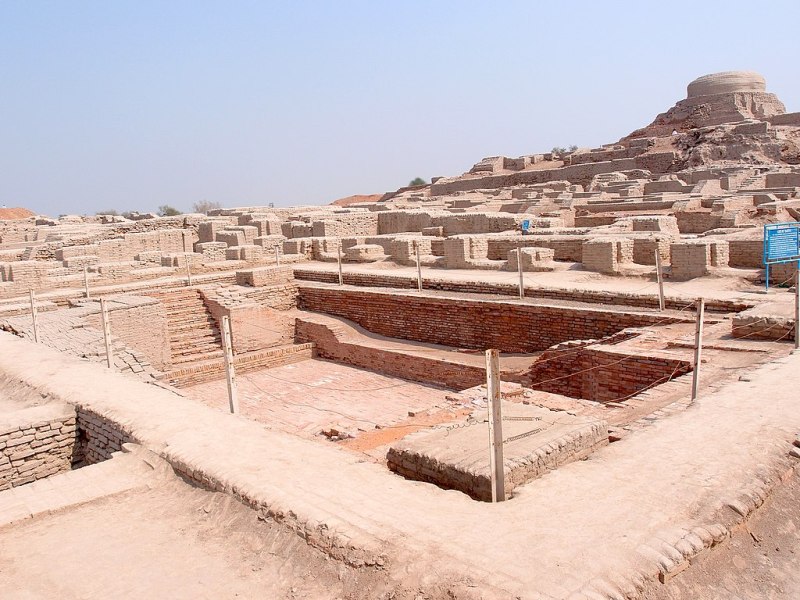
One of the most impressive discoveries about this civilization was how well planned their cities and sewage systems were. It seems water, drainage and bathing were held in high significance by the people. There was a brick-lined sewage system below the main streets that channeled water out of the city. Every house had a bathroom and toilet from where the used water flowed into a small drain cut into the house wall which brought it to the brick-lined sewage system. The public bath in Mohenjo-Daro called “The Great Bath” is one of the earliest instances of water-proofing in the world. This stately multistoried building had a 2.4m deep bathing pool in the center made of specifically-fitted burnt bricks coated with a layer of tar. Every brick found in these sites has the exact same ratio of 1:2:4. They also had a well-formed regular system of weights and measures. Harappan settlements were walled and important buildings like the granaries, warehouses and the Great Bath were separately walled and built on a mound to protect them at the time of floods.
source: wikipedia.orgsource: harappa.com
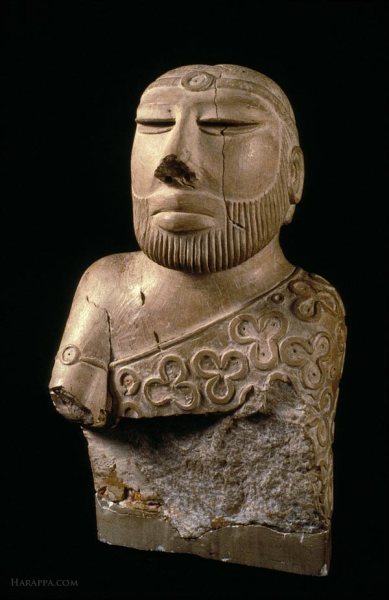
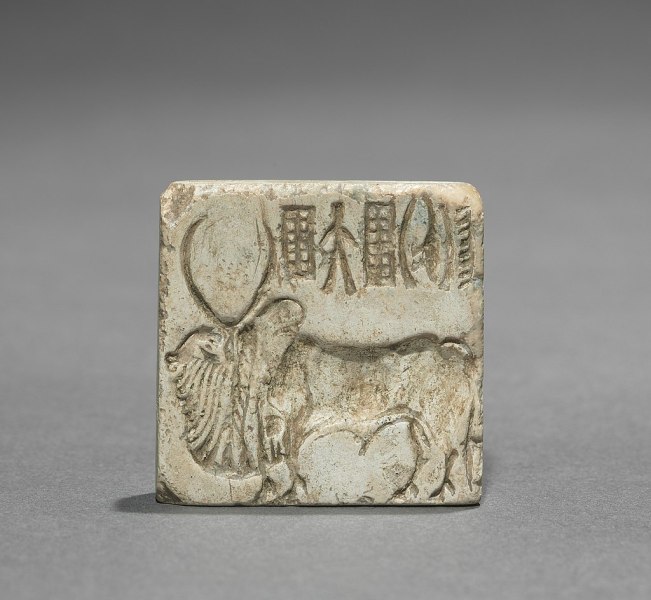
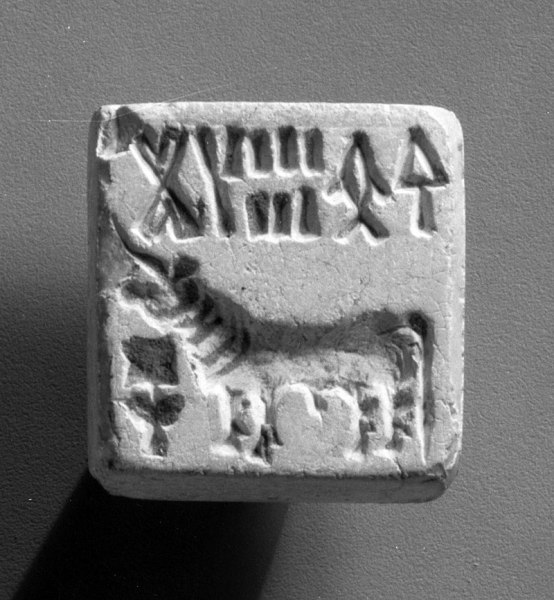
A number of statues and terracotta figurines have been excavated, most of which were probably intended as images for worship. There were figures of seated men, a standing nude male, a dancing girl, small chariots, and kids and animals which appear to be toys. All of them are of excellent quality, signifying that it was a highly developed art in the Harappan culture. Thousands of small Harappan seals are the best-known artifacts from these sites. These seals show an animal such as a “humpless unicorn”, buffalo, elephant, bison, rhinoceros or tiger, with some kind of inscription on top. Around 450 signs or symbols have been identified from these seals which are the only proof that the Harappans had a written language. These seals were could have been used as stamps, identity cards or passports.
source:wikipedia.org
This rich and prosperous civilization went into a sudden decline around 1900 BC. It is said that in over a century, the urban social and political system collapsed, and the use of seals and writing disappeared. The Ghaggar or the Saraswati river started to dry up, causing many of the Harappans living in its banks to move in search of greener pastures. Some of them moved to the Ganges which would become the center of North Indian civilization. By 1300 BC, this majestic civilization was completely gone, leaving no traces of its written language or beliefs.









 Eduindex
You must be logged in to post a comment.