

What everyone see is just a round, not round exactly but a GEOID shaped ball. Seeing the Earth as a ball and imagining it in the size of football which we all see in our science lab.
This is the 0% we know about our planet Earth. There is more to this than people just know. It’s like the rainbow flavored cake. when you see the outer part of the cake you tend to see the decoration and the whipping cream. but, when you cut it you the see the colorful layers of the cake. Earth is also the same. When you deep dig it you get to see different concentric layers which we call them as:
- Crust
- Mantle
- Core – inner core, outer core
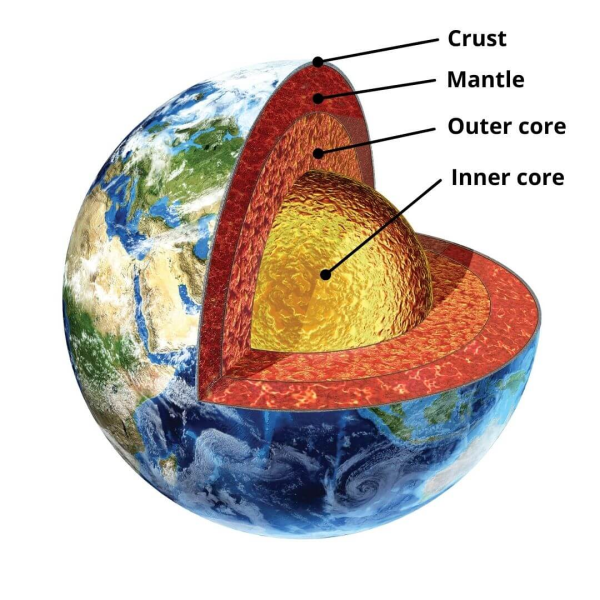
Like all terrestrial planets, the Earth’s interior is differentiated. This means that its internal structure consists of layers, arranged like the skin of an onion. Peel back one, and you find another, distinguished from the last by its chemical and geological properties, as well as vast differences in temperature and pressure.
Most of the ancient theories about Earth tended towards the “Flat-Earth” view of our planet’s physical form. This was the view in Mesopotamian culture, where the world was portrayed as a flat disk afloat in an ocean. To the Mayans, the world was flat, and at it corners, four jaguars held up the sky. The ancient Persians speculated that the Earth was a seven-layered ziggurat (or cosmic mountain), while the Chinese viewed it as a four-side cube.
By the 6th century BCE, Greek philosophers began to speculate that the Earth was in fact round, and by the 3rd century BCE, the idea of a spherical Earth began to become articulated as a scientific matter.
- CORE :
- The inner core:- radius of 1,220 kilometers (758 miles), or about three-quarters that of the moon.
- located some 6,400 to 5,180 kilometers (4,000 to 3,220 miles) beneath Earth’s surface
- Made of Iron and Nickel(solid form). Intensely hot and the Temperature sizzles at 5,400° Celsius (9,800° Fahrenheit).
- The outer core:- radius stands at about 5,180 to 2,880 kilometers (3,220 to 1,790 miles) below the surface.
- Heated largely by the radioactive decay of the elements like uranium and thorium.
- The outer core is not under enough pressure to be solid, so it is liquid even though it has a composition similar to the inner core.
2. MANTLE
- Upper mantle: It is the Earths thickest layer. Spreads across 84% of Earth’s volume
- The upper mantle, which starts at the “Mohorovicic Discontinuity”- the base of the crust extends from a depth of 7 to 35 km downwards to a depth of 410 km.
- lower Mantle: The lower mantle lies between 660-2,891 km
- Very little is known about the lower mantle apart from that it appears to be relatively seismically homogeneous.
3. CRUST
- The crust is made of relatively light elements, especially silica, aluminum and oxygen.
- Earth’s crust is like the shell of a hard-boiled egg. It is extremely thin, cold and brittle compared to what lies below it
- The thickness of the crust varies in the range of range of 5-30 km in case of the oceanic crust and as 50-70 km in case of the continental crust.
- Along with the upper zone of the mantle, the crust is broken into big pieces, like a gigantic jigsaw puzzle. These are known as tectonic plates. These move slowly — at just 3 to 5 centimeters (1.2 to 2 inches) per year.
- The continents are composed of lighter silicates — silica + aluminium (also called sial) while the oceans have the heavier silicates — silica + magnesium (also called sima)

 Eduindex
You must be logged in to post a comment.