WHAT IS FULGAR LIFESTYLE?

FRUGAL LIFESTYLE

Person who do not spend money on himself to save money, has a frugal lifestyle. If done properly, you’ll be able to prioritize the things that matter to you most. You’ll prioritize spending money on those things that matter and cut back on spending in other areas. Luckily, frugality can mean very different things to different people.

Frugal Living Tips To Save A Ton Of Money

  • Stretch your food budget:
  1. Plan your meals in advance. Grow your own herbs and vegetables.
  2. Opt for less-expensive cuts of meat.
  3. Buy store brands and generic labels.
  • Take low-cost experiences:
    You don’t have to spend a lot of money to create Instagramable moments that you’ll enjoy.
  • Frugal entertainment tips:
  1. Take advantage of free days at museums and national parks.
  2. Have a family game night.
  3. Check out books, movies, magazines and DVDs from your local library.
  4. Use credit card rewards to score free flights, car rentals and hotel stays.
  • Find savings on household expenses:
    Save on your cell phone bill with automatic payments. Get free TV with a digital antenna. Use YouTube tutorials to be your own handyman. Refresh your cabinets with new paint and hardware.
  • Consolidate Debt:
    Paying interest on debt makes it hard to buy the things you really want.
  • Use freebies and coupons to save when shopping:
    Stick to a list and take other steps to avoid impulse buying. Hit up thrift stores. Browse in-person and online garage sales. Download a free coupon app. Stock up on nonperishable items when they’re on sale.
  • Embrace DIY projects:
    Create your own beauty products, like deodorant, face masks and dry shampoo. Make household cleaning products, like stain remover, window cleaner and laundry detergent, at home. Pull out a needle and thread to repair and tailor your clothing.

BENEFITS OF FRUGALITY

  • More Freedom To Pursue Your Passions
  • Earlier Retirement
  • Financial Contentment
  • More Money For Saving And Investing
  • Less Financial Stress

Representation of Women in Armed Forces

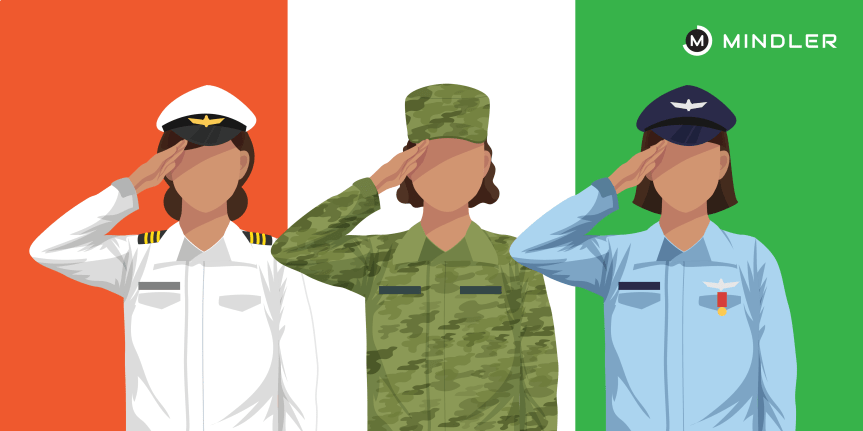
Recently, Captain Abhilasha Barak, created history by becoming the first woman officer to join the Army Aviation Corps as a Combat Aviator (pilot).

Captain Barak has been assigned to the second flight of the 2072 Army Aviation Squadron that operates the Dhruv Advanced Light Helicopter (ALH). While women officers in the Indian Air Force and the Indian Navy have been flying helicopters for long, the Indian Army paved the way for women pilots in 2021 by starting the ‘Army Aviation course’.

Army Aviation Corps is the component of the Indian Army which was established on 1st November, 1986, headed by a director-general at the Army headquarters in New Delhi.

It was inducted into ‘Operation Pawan’ which was a crucial test for the newly formed corps.

The Army Aviation Corps of the Indian Army primarily carries out the evacuation of the injured troops during operations or health emergencies in the high-altitude areas.

State of Women’s Representation in the Military

  • The Army, Air Force and Navy began inducting women as short-service commission (SSC) officers in 1992. This was the first time when women were allowed to join the military outside the medical stream.
  • One of the turning points for women in the military came in 2015 when Indian Air Force (IAF) decided to induct them into the fighter stream.
  • In 2020, the Supreme Court (SC) ordered the central government to grant permanent commission (PC) to women officers in the Army’s non-combat support units on par with their male counterparts.
  • In early 2021, the Indian Navy deployed four women officers on warships after a gap of almost 25 years.
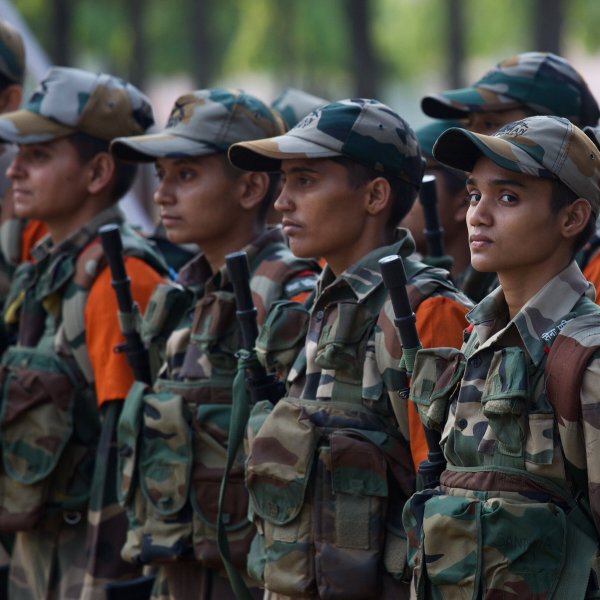
  • There are 9,118 women currently serving the army, navy and air force.
  • According to 2019 figures, women comprise only 3.8% of the world’s second-largest army – compared to 13% of the air force and 6% of the navy.

Significance

  • Gender is not a Hindrance: As long as an applicant is qualified for a position, one’s gender is arbitrary. In modern high technology battlefield technical expertise and decision-making skills are increasingly more valuable than simple brute strength.
  • Military Readiness: Allowing a mixed gender force keeps the military strong. The armed forces are severely troubled by falling retention and recruitment rates. This can be addressed by allowing women in the combat role.
  • Effectiveness: The blanket restriction for women limits the ability of commanders in theatre to pick the most capable person for the job.
  • Tradition: Training will be required to facilitate the integration of women into combat units. Cultures change over time and the masculine subculture can evolve too.
  • Global Scenario: When women officially became eligible for combat positions in the American military in 2013, it was widely hailed as another step towards the equality of sexes. In 2018, the UK military lifted a ban on women serving in close combat ground roles, clearing the way for them to serve in elite special forces.

The United States, Israel, North Korea, France, Germany, Netherlands, Australia and Canada are among the global militaries that employ women in front-line combat positions.

It is the right of every woman to pursue a career of her choice and reach the top since Equality is a constitutional guarantee.

Biodiversity – Types and causes of loss

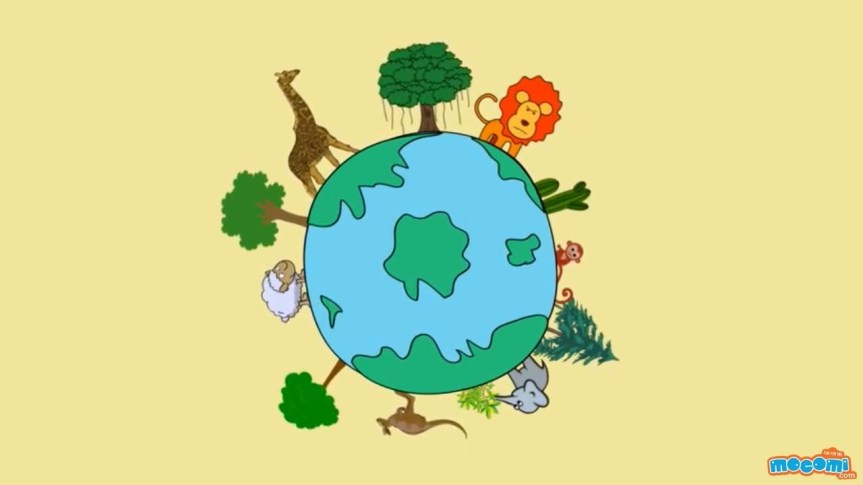
Diversity at all the levels of the biological organisation ca be classified into-

(i) Genetic diversity: A single species might show high diversity at the genetic level over its distributional range. India has more than 50,000 genetically different strains of rice and 1,000 varieties of mango. 

genetic diversity

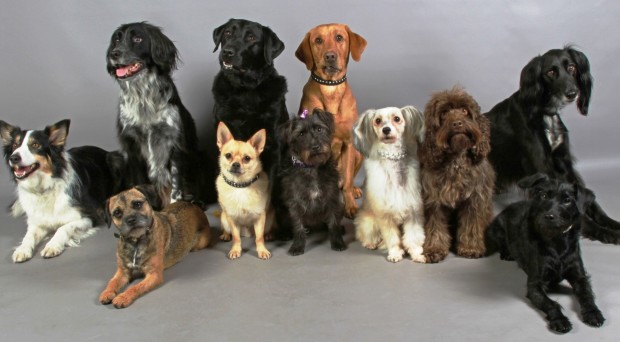
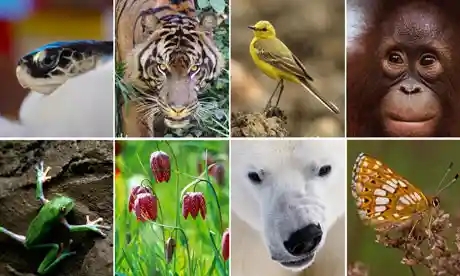
(ii) Species diversity: The diversity at the species level; for example, the Western Ghats have a greater amphibian species diversity than the Eastern Ghats. 

Species Diversity

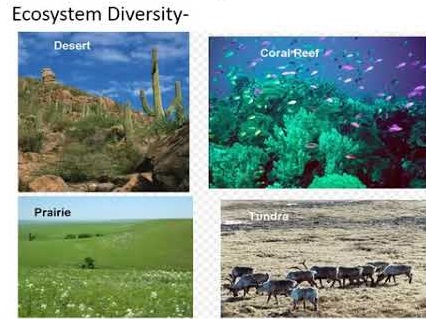
(iii) Ecological diversity: At the ecosystem level, India, for instance, with its deserts, rain forests, mangroves, coral reefs, wetlands, estuaries, and alpine meadows, has a greater ecosystem diversity than a Scandinavian country like Norway. 

Ecological diversity

Patterns of Biodiversity

  1. Latitudinal gradients: Species diversity decreases as we move away from the equator toward the poles. A forest in a tropical region like Equador has up to 10 times as many species of vascular plants as a forest of equal area in a temperate region like the Midwest of the USA.

What is so special about tropics that might account for their greater biological diversity?

(a) Speciation is generally a function of time, unlike temperate regions subjected to frequent glaciations in the past, tropical latitudes have remained relatively undisturbed for millions of years and thus, had a long evolutionary time for species diversification, 

(b) Tropical environments, unlike temperate ones, are less seasonal, relatively more constant and predictable. Such constant environments promote niche specialisation and lead to a greater species diversity

(c) There is more solar energy available in the tropics, which contributes to higher productivity; this in turn might contribute indirectly to greater diversity.

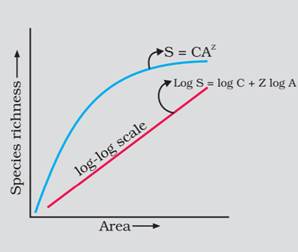
  1. Species-Area relationships: Within a region species richness increases with increasing explored area, but only up to a limit. The relation between species richness and area for a wide variety of taxa is a rectangular hyperbola.

log S = log C + Z log A,     where,

S= Species richness 

A= Area 

Z = slope of the line (regression coefficient) 

C = Y-intercept

Causes of biodiversity losses 

The accelerated rates of species extinctions that the world is facing now are largely due to human activities. There are four major causes ( ‘The Evil Quartet’ )

(i) Habitat loss and fragmentation

(ii) Over-exploitation

(iii) Alien species invasions: When alien species are introduced unintentionally or deliberately for whatever purpose, some of them turn invasive, and cause decline or extinction of indigenous species

(iv) Co-extinctions: When a species becomes extinct, the plant and animal species associated with it in an obligatory way also become extinct. 

Does the continents used to be together?

It started during the time of world war-II, some scientists identified that the ocean floor had unique features like ridges, trenches etc. This led to the discovery of the term Tectonics – is the scientific study of forces (convection currents in the mantle) and processes (collisions of the lithospheric plates, folding, faulting, volcanism) that control the structure of the Earth’s crust and its evolution through time.

Along with the concept of Tectonics came into the picture- THE CONTINENTAL DRIFT THEORY

Continental drift refers to the movement of the continents relative to each other.

To be a little specific, this continental drift theory was given by Alfred Wegener in 1920’s

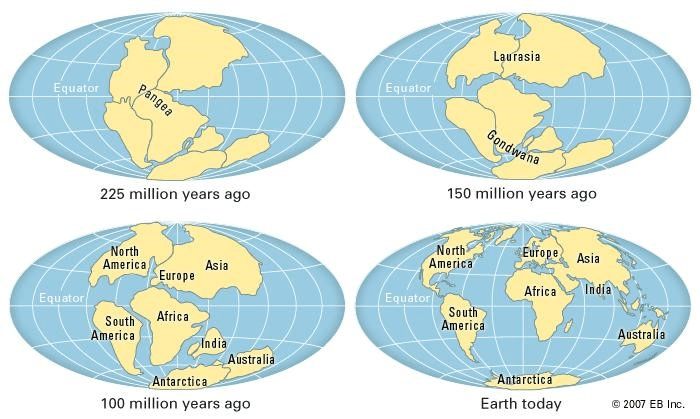
  • According to Continental Drift Theory there existed one big landmass which he called Pangaea which was covered by one big ocean called Panthalassa.
  • A sea called Tethys divided the Pangaea into two huge landmasses: Laurentia (Laurasia) to the north and Gondwanaland to the south of Tethys.
  • Drift started around 200 million years ago (Mesozoic Era, Triassic Period, Late Triassic Epoch), and the continents began to break up and drift away from one another.
drift of continents over time

EVIDENCES

Wegener, trained as an astronomer, used biology, botany, and geology, described Pangaea and continental drift. For example, fossils of the ancient reptile mosasaurs are only found in southern Africa and South America. Mosasaurs, a freshwater reptile only one meter (3.3 feet) long, could not have swum the Atlantic Ocean. The presence of mosasaurs suggests a single habitat with many lakes and rivers.

Wegener also studied plant fossils from the frigid Arctic archipelago of Svalbard, Norway. These plants were not the hardy specimens adapted to survive in the Arctic climate. These fossils were of tropical plants, which are adapted to a much warmer, more humid environment. The presence of these fossils suggests Svalbard once had a tropical climate.

Finally, Wegener studied the stratigraphy of different rocks and mountain ranges. The east coast of South America and the west coast of Africa seem to fit together like pieces of a jigsaw puzzle, and Wegener discovered their rock layers “fit” just as clearly. South America and Africa were not the only continents with similar geology. Wegener discovered that the Appalachian Mountains of the eastern United States, for instance, were geologically related to the Caledonian Mountains of Scotland.

Surrogacy

Recently, a petition was filed before Delhi High Court, challenging the exclusion of a single man and a woman having a child from surrogacy and demanding commercial surrogacy’s decriminalisation.

The Petitioner argued that the personal decision of a single person about the birth of a baby through surrogacy,a is a facet of the right to privacy guaranteed under Article 21 of the Constitution. Thus, the right of privacy of every citizen or person to be free from unwarranted governmental intrusion into matters fundamentally affecting a decision to bear or beget a child through surrogacy cannot be taken away.

What is Surrogacy?

About:

  • Surrogacy is an arrangement in which a woman (the surrogate) agrees to carry and give birth to a child on behalf of another person or couple (the intended parent/s).
  • A surrogate, sometimes also called a gestational carrier, is a woman who conceives, carries and gives birth to a child for another person or couple (intended parent/s).

Altruistic surrogacy:

  • It involves no monetary compensation to the surrogate mother other than the medical expenses and insurance coverage during the pregnancy.

Commercial surrogacy:

  • It includes surrogacy or related procedures undertaken for a monetary benefit or reward (in cash or kind) exceeding the basic medical expenses and insurance coverage.

Surrogacy (Regulation) Act, 2021

Provisions:

  • Under the Surrogacy (Regulation) Act, 2021, a woman who is a widow or a divorcee between the age of 35 to 45 years or a couple, defined as a legally married woman and man, can avail of surrogacy if they have a medical condition necessitating this option.
  • It also bans commercial surrogacy, which is punishable with a jail term of 10 years and a fine of up to Rs 10 lakhs.
  • The law allows only altruistic surrogacy where no money exchanges hands and where a surrogate mother is genetically related to those seeking a child.

Challenges:

The exploitation of the Surrogate and the Child:

  • One could argue that the state must stop the exploitation of poor women under surrogacy and protect the child’s right to be born. However, the current Act fails to balance these two interests.

Denies Legitimate income to Surrogates:

  • Banning commercial surrogacy also denies a legitimate source of income of the surrogates, further limiting the number of women willingly to surrogate.
  • Overall, this step indirectly denies children to the couples choosing to embrace parenthood.

Emotional Complications:

  • In altruistic surrogacy, a friend or relative as a surrogate mother may lead to emotional complications not only for the intending parents but also for the surrogate child as there is great deal of risking the relationship in the course of surrogacy period and post birth.
  • Altruistic surrogacy also limits the option of the intending couple in choosing a surrogate mother as very limited relatives will be ready to undergo the process.