

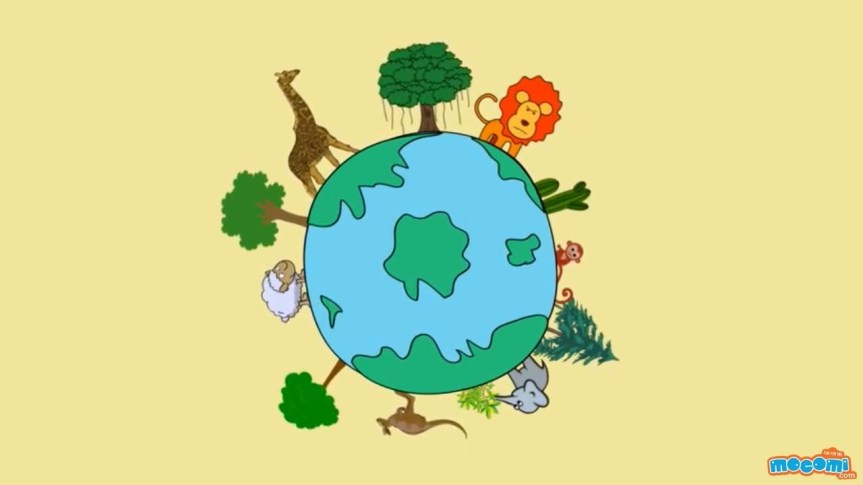
Diversity at all the levels of the biological organisation ca be classified into-
(i) Genetic diversity: A single species might show high diversity at the genetic level over its distributional range. India has more than 50,000 genetically different strains of rice and 1,000 varieties of mango.

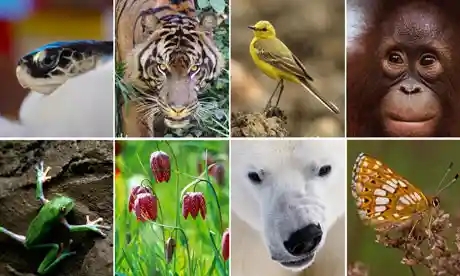
(ii) Species diversity: The diversity at the species level; for example, the Western Ghats have a greater amphibian species diversity than the Eastern Ghats.
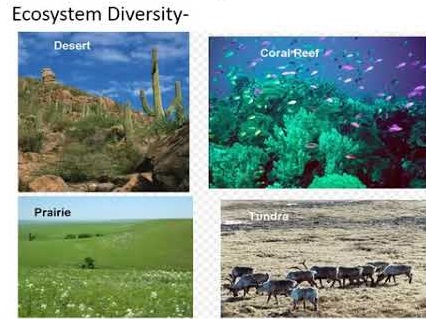
(iii) Ecological diversity: At the ecosystem level, India, for instance, with its deserts, rain forests, mangroves, coral reefs, wetlands, estuaries, and alpine meadows, has a greater ecosystem diversity than a Scandinavian country like Norway.
Patterns of Biodiversity
- Latitudinal gradients: Species diversity decreases as we move away from the equator toward the poles. A forest in a tropical region like Equador has up to 10 times as many species of vascular plants as a forest of equal area in a temperate region like the Midwest of the USA.
What is so special about tropics that might account for their greater biological diversity?
(a) Speciation is generally a function of time, unlike temperate regions subjected to frequent glaciations in the past, tropical latitudes have remained relatively undisturbed for millions of years and thus, had a long evolutionary time for species diversification,
(b) Tropical environments, unlike temperate ones, are less seasonal, relatively more constant and predictable. Such constant environments promote niche specialisation and lead to a greater species diversity
(c) There is more solar energy available in the tropics, which contributes to higher productivity; this in turn might contribute indirectly to greater diversity.
- Species-Area relationships: Within a region species richness increases with increasing explored area, but only up to a limit. The relation between species richness and area for a wide variety of taxa is a rectangular hyperbola.
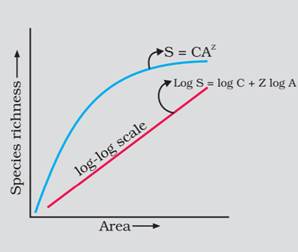
log S = log C + Z log A, where,
S= Species richness
A= Area
Z = slope of the line (regression coefficient)
C = Y-intercept
Causes of biodiversity losses
The accelerated rates of species extinctions that the world is facing now are largely due to human activities. There are four major causes ( ‘The Evil Quartet’ )
(i) Habitat loss and fragmentation
(ii) Over-exploitation
(iii) Alien species invasions: When alien species are introduced unintentionally or deliberately for whatever purpose, some of them turn invasive, and cause decline or extinction of indigenous species
(iv) Co-extinctions: When a species becomes extinct, the plant and animal species associated with it in an obligatory way also become extinct.

 Eduindex
You must be logged in to post a comment.