

It started during the time of world war-II, some scientists identified that the ocean floor had unique features like ridges, trenches etc. This led to the discovery of the term Tectonics – is the scientific study of forces (convection currents in the mantle) and processes (collisions of the lithospheric plates, folding, faulting, volcanism) that control the structure of the Earth’s crust and its evolution through time.
Along with the concept of Tectonics came into the picture- THE CONTINENTAL DRIFT THEORY
Continental drift refers to the movement of the continents relative to each other.
To be a little specific, this continental drift theory was given by Alfred Wegener in 1920’s
- According to Continental Drift Theory there existed one big landmass which he called Pangaea which was covered by one big ocean called Panthalassa.
- A sea called Tethys divided the Pangaea into two huge landmasses: Laurentia (Laurasia) to the north and Gondwanaland to the south of Tethys.
- Drift started around 200 million years ago (Mesozoic Era, Triassic Period, Late Triassic Epoch), and the continents began to break up and drift away from one another.
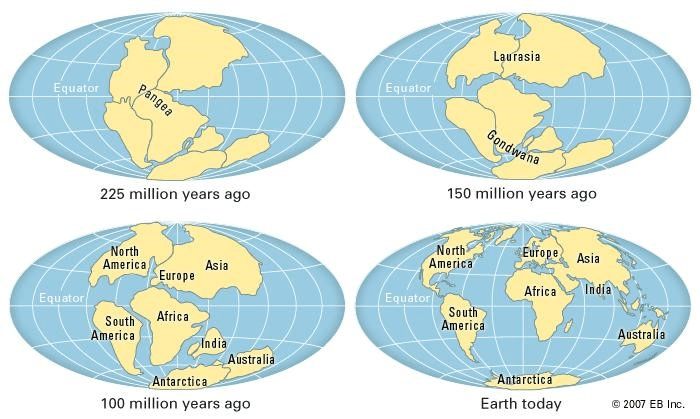
EVIDENCES
Wegener, trained as an astronomer, used biology, botany, and geology, described Pangaea and continental drift. For example, fossils of the ancient reptile mosasaurs are only found in southern Africa and South America. Mosasaurs, a freshwater reptile only one meter (3.3 feet) long, could not have swum the Atlantic Ocean. The presence of mosasaurs suggests a single habitat with many lakes and rivers.
Wegener also studied plant fossils from the frigid Arctic archipelago of Svalbard, Norway. These plants were not the hardy specimens adapted to survive in the Arctic climate. These fossils were of tropical plants, which are adapted to a much warmer, more humid environment. The presence of these fossils suggests Svalbard once had a tropical climate.
Finally, Wegener studied the stratigraphy of different rocks and mountain ranges. The east coast of South America and the west coast of Africa seem to fit together like pieces of a jigsaw puzzle, and Wegener discovered their rock layers “fit” just as clearly. South America and Africa were not the only continents with similar geology. Wegener discovered that the Appalachian Mountains of the eastern United States, for instance, were geologically related to the Caledonian Mountains of Scotland.

 Eduindex
You must be logged in to post a comment.