World NO TOBACCO DAY

World NO TOBACCO DAY is observed every year on 31st May.

Every year, the World Health Organization honors governments, organizations and individuals for their efforts and contributions to curbing tobacco use.

This day raises awareness about the damage caused by consuming tobacco. Consuming tobacco kills over 80 lakh people across the world every year. Besides the human cost, consuming tobacco also causes the environment to degrade. 

The WHO member countries agreed to observe World No-Tobacco Day on May 31 in 1987. Since then, this day is marked each year with a relevant theme.

 In 1987, the WHO’s World Health Assembly passed Resolution WHA40. 38, calling for 7 April 1988 to be “a world no-smoking day”. The objective of the day was to urge tobacco users worldwide to abstain from using tobacco products for 24 hours, an action they hoped would provide assistance for those trying to quit.

Theme for year 2022 is…………….“Protect The Environment”.

As per WHO, “The harmful impact of the tobacco industry on the environment is vast and growing adding unnecessary pressure to our planet’s already scarce resources and fragile ecosystems.”

Tobacco consumption is one of the factors that are believed to adversely impact the efforts to achieve the UN–adopted sustainable development agenda by 2030, which aims to reduce tobacco-related deaths by one-third by that time.

Tobacco consumption can lead to lung cancer, which mostly hits those with a substantial cigarette smoking history. Around 80-90% of people are diagnosed with lung cancer have a history of tobacco smoking. Tobacco is the leading cause of death for men and the second leading cause when both men and women are included.

World No Tobacco Day – Key messages

  • Tobacco harms the environment
  • Make the tobacco industry clean the mess.
  • Quit tobacco to save our planet.
  • Help tobacco farmers switch to sustainable farming.
The Mughal Empire

Back in 8th century, The Umayyad Caliphate had conquered Sindh, which we call the present day Pakistan. However, India was too distant to control and subsequent Caliphs were unable to exercise control over it and expand further.

Then in 11th century Mohammad of Ghazni invaded India and established a permenant Turkic regime there after taking Lahore in 1030. After the collapse of his empire, various dynasties ruled northern India and the dynasty is called Delhi Sultanate. although, no one was very successful for a very long time.

the last of this dynasty was the Lodhi dynasty. However in 1526, a Timurid prince named Zahir-ud-din-Muhammad Babur was left with nothing to loose and no options left in the central Asia, decided to invade India. Babur was the fifth generation descendant of Tamerlane and the 13th generation descendent of Genghis khan. Like many other Timurid princess, he claimed the entirety of Timur’s Empire. however he was barely able to control/ rule Fergana valley. he was pushed South from there by the rise of Uzbeks until he established his seat of power in Kabul. With the Safavids to the west and Uzbeks to the north he had nowhere to go but east. and that east is nothing but India.

In 1526, he faced the ruling Lodi Dynasty at Panipat. He defeated them over the 4years and he conquered almost all of Northern India after facing other local Hindu and Muslim rulers.

The dynasty he founded came to be known as the Mughals which is the Persian word for Mongol. Although, the dynasty itself held strong ties to timur and called themselves the Gurkani Dynasty. Babur died in 1530 at the age of 46years.

That’s when Humayun came into picture who is the son of Babur.

Humayun was not a very capable leader and on top of that he indulged a little too much in wine and opium. His incapableness led to invasion of many surrounding rulers. One Afghan noble named Sher Shah Suri- he over threw Humayun in 1539. Later Sher Shah Suri died in a battle in 1545 and his empire was divided up.

Humayun asked Safavids for help and started conquering the divided empire. By 1555, both Delhi and Lahore were under his control. But, unfortunately he died by falling from stairs in 1556.

Jalal-ud=din Muhammad Akbar a mere 12 year old was installed as the next ruler of Mughal Empire. Regents ruled and stabilized the empire on the young Shahan shah’s behalf for the very first five years of his reign. By 1551 he was ready to take charge.

He expanded the empire further by conquering Gujarat, Bihar and parts of Bengal. However at this point, the Mughals had a bit of legitimacy problem. They were a foreign Muslim Dynasty ruling over a realm where less than 5% of the population who followed the same faith as them.

Babur and Humayun were the followers of Sufi Islam and that was continued the same by Akbar. Although, over the years, he began a struggle to reconcile Islam and the various Indian religions, He invited scholars of various religions to have a open discussion in the Ibadat- khana. He also invited Jesuits from the portuguese enclave at Goa.

He was also the one who translated Mahabharata into persian, so his people could read it and understand Hinduism a bit better.

The Mughals designed a system of Bureaucracy called the Mansabdari system which was reformed by Akbar. Akbar was described as the Greatest Mughal ruler out of many. In fact Akbar means ” THEGREAT” and was a title given to him. He died in 1605

Jahangir-heir of Akbar took the throne. He tried to expand the empire but it had pretty much reached its limits.

The other rulers include Shah Jahan, Aurangazeb and this will be explained in another post.

UPSC ANNOUNCES 2021 FINAL RESULTS- Check the list of top 10 toppers this year

UPSC announces the final results of the exam on 30 May 2022 in its official website https://www.upsc.gov.in/ . 685 candidates have qualified in UPSC CSE 2021. Candidates who passed this year. Of these 244 candidates were from General Category, 73 were from Economic Backward Classes, 203 were from OBC [ Other Backward Classes ], 105 were from SC, and 60 were from ST.

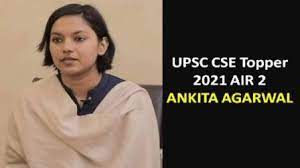
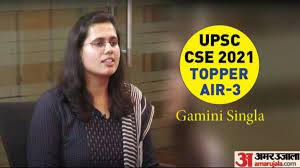
This time 3 All India Ranks were occupied by girls. Shruti Sharma secured AIR [ All India Rank ]1 this year. Along with her, Ankita Agrawal secured AIR 2 and Gamini Singla secured AIR 3. Shruti Sharma belongs to Bijnor city of UP, Ankita Agrawal belongs to Kolkata, West Bengal and Gamini Singla belongs to Anandpur Sahib city of Punjab. Candidates should note that the marks will be available on the website within 15 days from the date of declaration of result.

“I was hoping that i would clear the UPSC examination but I was not expecting to Top,” Shruti shared with reports.

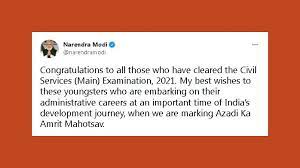
“Congratulations to all those who have cleared the Civil Services (Main) Examination, 2021. My best wishes to these youngsters who are embarking on their administrative careers at an important time of India’s development journey, when we are marking Azadi Ka Amrit Mahotsav.” wrote PM Modi on Twitter [https://twitter.com/narendramodi].

The examination is conducted annually in three stages – prelims, main and interview (personality test) – to select officers for Indian Administrative Service (IAS), Indian Foreign Service (IFS), Indian Police Service (IPS) and other posts.

Civil Services (Main) Examination, 2021 result was announced on March 17. Those who cleared the main examination were called for the interview round (personality test). The personality test was held from April 5 to May 26, 2022.

UPSC CSE final result is based on candidates’ performance in mains and interview rounds. Results of 80 candidates are provisional and that of one is kept withheld.

TOP 10 TOPPERS’S LIST 2021

  1. Shruti Sharma
  2. Ankita Agrawal
  3. Gamini Singha
  4. Aishwarya Verma
  5. Utkarsh Dwivedi
  6. Yaksh Chawdhary
  7. Samyak . S . Jain
  8. Ishita Rathi
  9. Pritam Kumar
  10. Harkirat Singh Randhawa

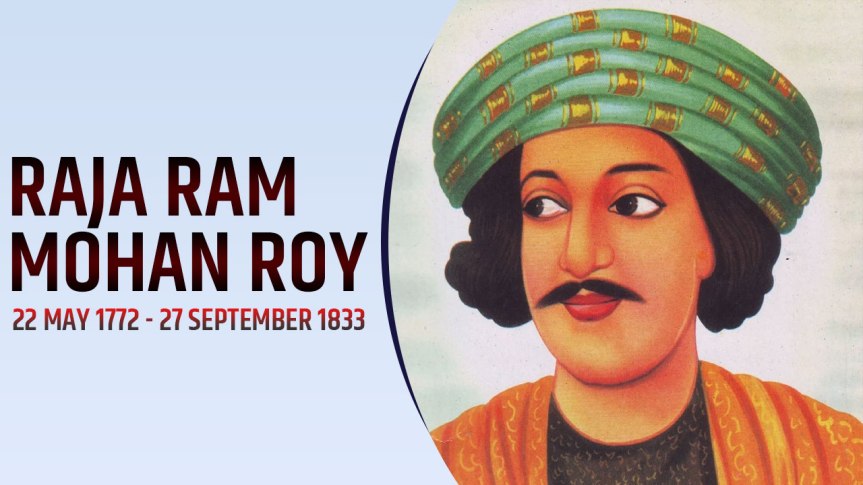
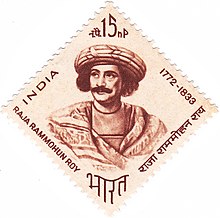
Raja Ram Mohan Roy

Raja Ram Mohan Roy was the father of Modern India’s Renaissance and a tireless social reformer who inaugurated the age of enlightenment and liberal reformist modernisation in India.

Life:

  • Raja Ram Mohan Roy was born on 22nd May 1772 in Bengal. His early education included the study of Persian and Arabic at Patna where he read the Quran, the works of Sufi mystic poets and the Arabic translation of the works of Plato and Aristotle.
  • From 1803 to 1814, he worked for East India Company as the personal diwan first of Woodforde and then of Digby.
  • In 1814, he resigned from his job and moved to Calcutta in order to devote his life to religious, social and political reforms.
  • In November 1830, he sailed for England to be present there to counteract the possible nullification of the Act banning Sati.
  • Ram Mohan Roy was given the title of ‘Raja’ by the titular Mughal Emperor of Delhi, Akbar II whose grievances the former was to present before the British king.
  • In his address, entitled ‘Inaugurator of the Modern Age in India,’ Tagore referred to Ram Mohan as ‘a luminous star in the firmament of Indian history’.

Ideology:

  • Ram Mohan Roy was greatly influenced by western modern thought and stressed on rationalism and modern scientific approach.
  • He believed that religious orthodoxies have become causes of injury and detrimental to social life and sources of trouble and bewilderment to the people, instead of tending to the amelioration of the condition of society.
  • He believed in social equality of all human beings and thus was a strong opposer of the caste system.
  • Ram Mohan was attracted to Islamic monotheism. He said that monotheism is also the fundamental message of Vedanta.
  • His idea of a single, unitarian god was a corrective to the polytheism of orthodox Hinduism and to Christian trinitarianism. He believed that monotheism supported one universal model for humanity.
  • Raja Ram Mohan Roy believed that unless women were freed from unhuman forms of oppression like illiteracy, child marriage, sati, purdah, Hindu society can not progress.
  • He characterised sati as the violation of every humane and social feeling and as symptomatic of the moral debasement of a race.

Contributions

Religious reforms:

  • Raja Ram Mohan Roy’s first published work Tuhfat-ul-Muwahhiddin (a gift to deists) published in 1803 exposed irrational religious beliefs and corrupt practices of the Hindus as the belief in revelations, prophets, miracles etc.
  • In 1814, he founded Atmiya Sabha in Calcutta to campaign against idolatry, caste rigidities, meaningless rituals and other social ills.
  • He criticized the ritualism of Christianity and rejected Christ as the incarnation of God. In Precepts of Jesus (1820), he tried to separate the moral and philosophical message of the New Testament, which he praised, from its miracle stories.

Social reforms:

  • Raja Ram Mohan Roy conceived reformist religious associations as instruments of social and political transformation.
    • He founded the Atmiya Sabha in 1815, the Calcutta Unitarian Association in 1821, and the Brahmo Sabha in 1828 which later became the Brahmo Samaj.
    • He campaigned against the caste system, untouchability, superstitions and use of intoxicants.
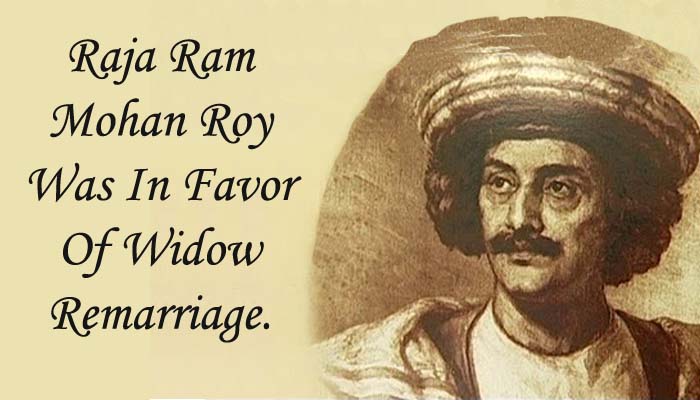
    • He was well known for his pioneering thought and action on the emancipation of women and especially on the abolition of sati and widow remarriage.
    • He attacked child marriage, illiteracy of women and the degraded state of widows and demanded the right of inheritance and property for women.

Educational reforms:

  • He supported David Hare’s efforts to the Hindu College in 1817, while Roy’s English school taught mechanics and Voltaire’s philosophy.
  • In 1825, he established Vedanta college where courses in both Indian learning and Western social and physical sciences were offered.

Economic and Political Reforms:

  • Civil liberties: Roy was impressed and admired the British system of constitutional government for the civil liberties it gave to the people. He wanted to extend the benefits of that system of government to Indian people.

Press freedom: 

Through his writings and activities, he supported the movement for free press in India. When press censorship was relaxed by Lord Hastings in 1819, Ram Mohan found three journals- The Brahmanical Magazine (1821); The Bengali weekly, Samvad Kaumudi (1821); and the Persian weekly, Mirat-ul-Akbar.

DIFFERENT KINDS OF BAIL

Bail, in law, means procurement of release from prison of a person awaiting trial or an appeal by the deposit of security to ensure his submission at the required time to legal authority. The monetary value of the security, known also as the bail, or, more accurately, the bail bond, is set by the court having jurisdiction over the prisoner. The security may be cash, the papers giving title to property, or the bond of private persons of means or of a professional bondsman or bonding company. Failure of the person released on bail to surrender himself/herself at the appointed time results in forfeiture of the security. Courts have greater discretion to grant or deny bail in the case of persons under criminal arrest. 

KINDS OF BAIL

1. Bail for Bailable Offence 

According to Criminal Procedure Code, if the offence alleged is bailable, then the accused is entitled for bail as a matter of rights either before the police or when presented before the Magistrate Court. In bailable offences bail is a right and not a favour. In such offences there is no question of any discretion in granting bail.

 2. Bail for Non-bailable Offence 

Criminal Procedure Code empowers two authorities to consider the question of bail, namely (1) a court and (2) an officer-in-charge of the police station who has arrested or detained without warrant a person accused or suspected of the commission of a non bailable offence.

Before exercising his power, a station officer should satisfy himself that release on bail of such accused would not prejudice the prosecution or affect investigation in any manner. In case of an offence punishable with death or imprisonment for life, station police officer cannot release a person on bail, if there appears reasonable grounds for believing that he has been guilty of such offence. If it appears to the Court that that there are not reasonable grounds for believing that the accused has committed a non-bailable offence, but that there are sufficient grounds for further inquiry into his guilt, then the accused (pending enquiry) can be released on bail. 

3. Anticipatory Bail 

Anticipatory Bail granted to a person in anticipation and apprehending arrest. It may be granted under a few circumstances: 

1. A special case is made out that would suggest that there are ample grounds to assume that the applicant may be detained for unreasonable grounds. 

2. The allegations were made with a false intent or to cause the claimant to be injured/humiliated and arrested. 

3. The arguments against the claimant are ambiguous or generic. 

4. The name of the accused is not mentioned in the FIR. 

5. The applicant satisfies the Court that he is from a respectable family, has deep roots in society, and is not likely to abscond from or avoid the Court’s proceedings or to hinder the investigation in any way.

4. Mandatory Bail or Statutory Bail 

Under Section 167, magistrate can either allow for police custody or judicial custody for a period of 15 days. However, the accused can also be sent to judicial custody for a period of 90 days or 60 days.

Section 167(2) further provides that if at the end of the period (60 or 90 days) of judicial custody, if the investigation is not completed by the police, the court shall release the person “if he fulfill bail conditions”.

Thus, a magistrate according to law or a statute (section 167 of CRPC) cannot authorise a person’s judicial remand beyond the 60-or 90-day limit. 

Education – passionate studies |5 simple ways

Education is an essential thing in our daily life. According to the growth of society, education must be provided to every citizen. The new world is mysterious, all things that exist had to be known to every people education ensures that. So whatever we want to be we should know about that.

Findings of great peoples, Technological know-how, awareness of the environment, History, etc are the main components of education. An educated person must show good character they were intelligent and efficient. They can build up our economy in a good manner

Nowadays students are struggling with exam results. They were worried about the marks they got. Parents also wanted marks from children. However, studying with understanding makes a perfect education. There are a few tips for good studies.

1. Awareness Of The Chapters

The student must have a correct idea of the chapters including the basic needs. It will increase our energy to study new things.

2. Making The Day For Studies

Mornings are a good time for making good decisions they may whisper through our ears for an entire day. Put a goal for the day in the mornings and we will begin to work toward that.

3. Visualization

When we were teaching or studying, try to imagine the concepts as well it will lead to an incredible memory of the topics.

4. Setting Our Mind

Setting our minds before studies is the best way to attain knowledge. When we think that we are free from anything, nothing can disturb us from our goals. Set our minds to study and make differences

5. Concluding Sentences

When we are willing to study a paragraph, make the important keywords from that. It will help you to study shortly and easily .