

The earth is a fascinating place with all kinds of variation and geographical interest. All over the world, wild and wondrous things have happened. These occurrences have created a series of landforms throughout Earth’s lifespan that make each many areas unique.
As defined by National Geographic, a landform is a “feature on the Earth’s surface that is part of the terrain.” The terrain of the land includes all of its topographic features. Whether a formation sticks out of the ground or sinks into it, it has topographic significance.
Endogenic forces and exogenic forces can create a lot of landforms. Mountains, hills, plateaus, and plains are the four major types of landforms. Minor landforms include buttes, canyons, valleys, and basins.
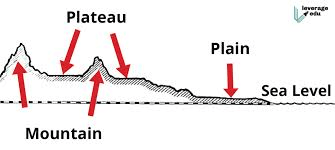
There are four major types of landforms. There are four that are accepted throughout the scientific community. These include mountains, plateaus, hills, and plains. Everything else can fall into these broad and general categories.
There are hundreds of minor landform typologies. Some of them are well known, like valleys. Others you have probably never heard of since they only belong to particular geographic regions.
Mountains
- A mountain is a large landform that rises above the surrounding land in a limited area, usually in the form of a peak. A mountain is generally steeper than a hill.
- Mountains are formed through tectonic forces or volcanism. These forces can locally raise the surface of the earth.
- Mountains erode slowly through the action of rivers, weather conditions, and glaciers. A few mountains are isolated summits, but most occur in huge mountain ranges.
- Nearly 27% of the world’s land surface is covered by mountains.
- It is from the mountains that up to 80% of the planet’s fresh surface water come from.
- According to the UN’s Food and Agriculture Organization (FAO), about 12% of the world’s population lives in the mountains, but over 50% are directly or indirectly dependent on mountain resources.
The mountains, on the basis of their mode of formation, can be classified as:
- Fold Mountains
- Block Mountains
- Volcanic Mountains/ Accumulated Mountains
- Residual Mountains/ Relict Mountains
Examples of mountains:- Himalayas, Andes, Rocky Mountains, Alps, Appalachian Mountains, Ural Mountains, Karakoram
Plateaus
- A plateau is a flat-topped table land.
- Plateaus occur in every continent and take up a third of the Earths land.
- They are one of the four major landforms, along with mountains, plains, and hills.
- Plateaus, like mountains may be young or old. The Deccan plateau in India is one of the oldest plateaus.
- Valleys form when river water cuts through the plateau. The Columbia Plateau, between the Cascade and Rocky mountains in the northwestern United States, is cut through by the Columbia River.
- Sometimes, a plateau is so eroded that it is broken up into smaller raised sections called Many outlier plateaus are composed of very old, dense rock formations. Iron ore and coal often are found in plateau outliers.
- Plateaus are very useful because they are rich in mineral deposits. As a result, many of the mining areas in the world are located in the plateau areas.
The plateaus can be classified as:
- Intermontane Plateaus
- Piedmont plateaus
- Continental plateaus
- Volcanic plateaus
- Dissected plateaus
Plains
- Plain, any relatively level area of the Earth’s surface exhibiting gentle slopes and small local relief. Plains vary widely in size.
- The smallest occupy only a few hectares, whereas the largest cover hundreds of thousands of square kilometers—as, for example, the Great Plains of North America and the expanse of gently undulating land that sweeps from the Pyrenees Range on the French–Spanish border across northern Europe and Asia almost halfway around the world nearly to the Bering Sea.
- Occupying slightly more than one-third of the terrestrial surface, plains are found on all continents except Antarctica.
- Most of the plain have been formed by deposition of sediments brought down by rivers. Besides rivers, some plains have also been formed by the action of the wind, moving ice and tectonic activities
- They occur north of the Arctic circle, in the tropics, and in the middle latitudes. Corresponding to their broad geographical distribution, the plains of the world show considerable variation in vegetation.
- Some are tree-covered and others are grassy. Still, others support scrub brush and bunch grass, while a few, which are nearly waterless deserts, have only the most sparse and scanty plant life.
More common examples of plains include:
- Great Plains (US) – 1,100,000 square miles
- Canterbury Plains (New Zealand) – 195 square miles
- Australian Plains – 2,966,200 square miles
- Serengeti Plains – 11,583 square miles
- European Plain – 2,000,000 square miles
- West Siberian Plain (Russia) – 1,200,000 square miles
- Indus Valley Plain (Pakistan) – 200,000 square miles
Hills
- Hills are like tiny mountains. They share many of their characteristics with mountains.
- For example, hills have to have a higher elevation than the land around them.
- Hills are smaller than mountains and are also not as steep. Although the heights of some hills might be close to some small mountains, their gently sloping nature prevents them from being a mountain.
Some of the more famous hills in the world include:
- Chocolate Hills (Philippines)
- Ananthagiri Hills (India)
- Tuscany Hills (Italy)
- Glastonbury Tor (England)

 Eduindex
You must be logged in to post a comment.