



Red Planet Day is an annual event celebrated on November 28 to honor the fascinating planet Mars, often referred to as the “Red Planet” due to its reddish appearance caused by iron oxide (rust) on its surface. The day is an opportunity to reflect on humanity’s interest in Mars, its exploration, and the ongoing research that helps us understand its potential to support life.
Why November 28?
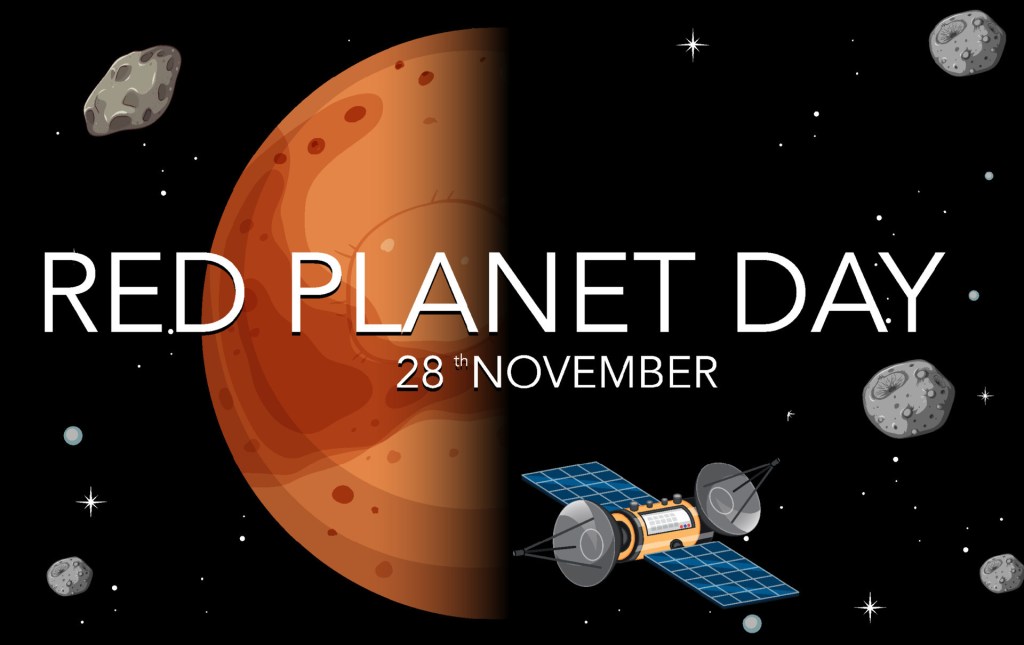
Red Planet Day marks the anniversary of the launch of Mariner 4, NASA’s first successful mission to Mars. On November 28, 1964, Mariner 4 was launched, and it became the first spacecraft to send back close-up images of the Martian surface, providing humanity with its first glimpse of the planet beyond telescopic observations. These images revealed a barren, cratered landscape, shattering some of the earlier misconceptions about Mars, such as the idea that it harbored canals built by intelligent life.
Mars: The Red Planet
Mars has been a subject of fascination for astronomers and science fiction writers for centuries. It is the fourth planet from the Sun and, like Earth, it has seasons, polar ice caps, and weather patterns. However, Mars differs significantly from Earth in its environment and atmospheric conditions.
Mars has:
- A thin atmosphere, mostly carbon dioxide, which offers little protection from the harsh solar radiation.
- The largest volcano in the solar system, Olympus Mons, which stands nearly three times the height of Mount Everest.
- The longest canyon, Valles Marineris, stretching over 4,000 km, which dwarfs the Grand Canyon.
- Evidence of past water flows, with dried riverbeds and ancient lake basins suggesting that liquid water may have once existed on its surface.
Despite its inhospitable surface, Mars remains one of the most studied planets in our solar system because of its potential for past life and its suitability for future human exploration.
The History of Mars Exploration
Over the decades, various space missions have explored Mars, and each has revealed new secrets about the planet. Here are a few key milestones:
- Mariner 4 (1964) – As mentioned, it was the first spacecraft to send back images of Mars, proving that the planet was not as Earth-like as once believed.
- Viking Program (1976) – NASA’s Viking 1 and Viking 2 orbiters and landers provided crucial data about the Martian atmosphere, surface, and geology, as well as the first in-depth studies of its potential for supporting life.
- Mars Rovers – In the 21st century, rovers such as Spirit, Opportunity, Curiosity, and Perseverance have landed on Mars to explore its surface, conduct experiments, and search for signs of past life. Perseverance, which landed in February 2021, is tasked with collecting rock samples that could one day be returned to Earth.
- Mars Helicopter Ingenuity – As part of the Perseverance mission, the small helicopter Ingenuity made history in 2021 by becoming the first powered flight on another planet. It successfully flew on Mars, providing aerial reconnaissance for scientific studies.
Why Celebrate Red Planet Day?
Red Planet Day serves multiple purposes:
- Education: It’s an opportunity to educate people of all ages about Mars, its exploration, and what we’ve learned from it. Schools, observatories, and museums often host special events or activities focused on Mars-related science and space exploration.
- Inspiration: Mars continues to inspire the imagination of people around the world. Celebrating the day can ignite curiosity about space and foster a sense of wonder about our universe.
- Scientific Advancement: As new missions to Mars are planned, including NASA’s Artemis Program aiming to return humans to the Moon and eventually send astronauts to Mars, Red Planet Day reminds us of the long-term goals of space exploration and the scientific advancements being made in the process.
- Future Exploration: Red Planet Day is also an opportunity to look forward to the future of Mars exploration, especially as private companies like SpaceX and governmental agencies like NASA are working towards the goal of human missions to Mars, potentially establishing the first human colony on another planet.
How Is Red Planet Day Celebrated?
While it is not a widely recognized holiday in the same way as some other observances, space enthusiasts, astronomers, and scientists mark Red Planet Day in various ways:
- Public Events: Some observatories and space museums host special exhibits, workshops, and presentations about Mars exploration.
- Social Media Campaigns: On Red Planet Day, many space organizations, including NASA and SpaceX, share information, updates, and fun facts about Mars on their social media platforms.
- Stargazing: Many amateur astronomers take the opportunity to observe Mars with telescopes, especially when the planet is in close proximity to Earth during opposition (when Earth is directly between Mars and the Sun).
- Educational Outreach: Schools and universities might engage in special lessons or activities centered on Mars, its exploration, and space science.
The Future of Mars Exploration
The future of Mars exploration is incredibly exciting. Several planned missions aim to further unravel the mysteries of Mars and explore its potential for human settlement:
- NASA’s Mars Sample Return Mission: In collaboration with the European Space Agency (ESA), NASA aims to bring Martian soil samples back to Earth by the late 2020s or early 2030s.
- SpaceX’s Starship Missions: SpaceX is developing the Starship vehicle with the goal of sending humans to Mars. Elon Musk’s vision is to eventually establish a sustainable human presence on Mars, potentially as soon as the 2020s or 2030s.
- Colonization: While still a long way off, there are ongoing discussions about establishing permanent human colonies on Mars. These would require advanced technologies for life support, food production, and protection from radiation.
Conclusion
Red Planet Day is not only a celebration of the Mariner 4 mission but also a reminder of our collective curiosity and ambition to explore Mars. As we continue to explore and learn about Mars, the planet holds promise as a stepping stone for humanity’s future in space. Whether through scientific discoveries, technological innovations, or inspiring the next generation of explorers, Red Planet Day is a chance to celebrate humanity’s ongoing journey to the stars.

 Eduindex
You must be logged in to post a comment.