



By Shashikant Nishant Sharma
REWARD (Rejuvenating Watersheds for Agricultural Resilience through Innovative Development Programme) is a collaborative effort between the Government of India, the State Governments of Karnataka and Odisha, and the World Bank. This program, funded with a $115 million (INR 869 crore) loan, aims to enhance farmers’ resilience to climate change and promote higher agricultural productivity and incomes. By adopting improved watershed management practices, the program seeks to support the restoration of degraded land, double farmers’ income, and build a more resilient food system. It will leverage science-based approaches, spatial data, technologies, and knowledge exchanges to achieve its objectives.
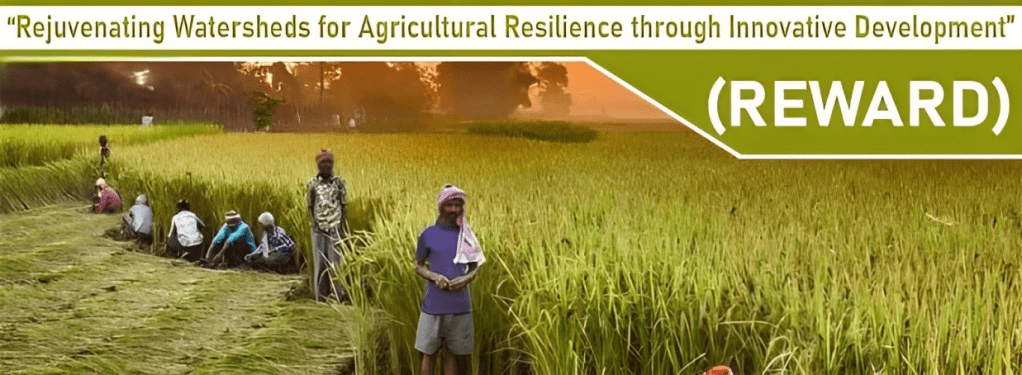
Through this short article I would like to introduce you to an exciting initiative called REWARD (Rejuvenating Watersheds for Agricultural Resilience through Innovative Development Programme). This scheme has been launched by the World Bank. The REWARD is a comprehensive program designed to address the challenges faced by agricultural communities in ensuring water availability and promoting sustainable farming practices. Water scarcity and its impact on agriculture have become increasingly significant concerns in recent years. The REWARD program aims to rejuvenate watersheds by implementing innovative solutions that enhance water conservation, management, and agricultural resilience. By adopting a holistic approach, the program seeks to create a positive and sustainable impact on local communities, agriculture, and the environment. Here are some key components of the REWARD program:
Watershed Restoration: REWARD focuses on restoring and rehabilitating degraded watersheds through various techniques such as reforestation, soil erosion control measures, and the construction of check dams and percolation tanks. These efforts aim to improve water retention capacity and recharge groundwater levels (Larson et al., 2001).
Water Conservation and Management: The program emphasizes the adoption of water conservation practices within agricultural systems. It promotes efficient irrigation methods like drip irrigation and micro-sprinklers, encourages rainwater harvesting, and implements water storage infrastructure. These measures help optimize water use and reduce wastage (Jha et al., 2019).
Capacity Building and Training: REWARD provides training and capacity-building programs to farmers, local communities, and other stakeholders. These initiatives enhance their knowledge and skills in water management, sustainable agricultural practices, and the implementation of innovative technologies. By empowering individuals and communities, the program seeks to create long-term resilience (Hanchinal et al., 2014).
Research and Innovation: REWARD encourages research and development activities to identify cutting-edge technologies and practices for water conservation and watershed management. This includes promoting the use of precision agriculture, remote sensing, and data analytics to optimize water usage, crop selection, and resource allocation (Fielke et al, 2022).
Collaboration and Partnerships: The success of REWARD relies on collaboration among various stakeholders, including government agencies, non-profit organizations, research institutions, and local communities. The program encourages partnerships to leverage expertise, resources, and knowledge-sharing, fostering a collective effort towards achieving sustainable water and agricultural practices (Daves et al., 2002).
In a collaborative effort, the Government of India, along with the State Governments of Karnataka and Odisha, and the World Bank, have entered into a significant agreement. This agreement involves a financial commitment of $115 million (INR 869 crore) for the implementation of a program called Rejuvenating Watersheds for Agricultural Resilience through Innovative Development Programme (Press Bureau of India, Feb 18, 2022). The primary objective of this program is to enable national and state institutions to adopt improved practices in managing watersheds. By doing so, the program aims to enhance the resilience of farmers to climate change, promote higher agricultural productivity, and ultimately improve their incomes. India’s government has set ambitious goals of restoring 26 million hectares of degraded land by 2030 and doubling farmers’ income by 2023. Effective watershed management plays a crucial role in achieving these targets, especially in rainfed areas, by fostering livelihood improvements and creating a more resilient food system (Mirzabaev & Wuepper, 2023). The new program will assist the participating state governments in their endeavors to revamp watershed planning and execution processes, emphasizing science-based approaches that can be replicated nationwide. It will also encourage other states to adopt innovative strategies for watershed development.
The COVID-19 pandemic has highlighted the urgent need for sustainable and risk-averse agricultural practices in India. Such practices can safeguard farmers from climate uncertainties and bolster their livelihoods (Sonkar et al., 2022). Although India already has a robust institutional framework for watershed development, this project places renewed emphasis on science-based and data-driven approaches, opening up new opportunities for farmers in the face of climate change (Lele et al., 2020).
India currently boasts one of the world’s largest watershed management programs. This new initiative will further advance the progress made by leveraging comprehensive spatial data and technologies, decision support tools, and knowledge sharing platforms. The International Bank for Reconstruction and Development (IBRD) will provide financial support through a loan. Out of the total loan amount, $60 million (INR 453.5 crore) will be allocated to Karnataka, $49 million (INR 370 crore) to Odisha, and the remaining $6 million (INR 45.5 crore) will be allocated to the central government’s Department of Land Resources. The loan has a maturity period of 15 years, which includes a grace period of 4.5 years (Press Bureau of India, Feb 18, 2022).
Through the REWARD program, the government aims to improve the overall water availability and quality, enhance agricultural productivity, and build resilient communities. By integrating innovative solutions with traditional knowledge, we envision a future where agriculture thrives while preserving our precious water resources.
References
Dawes, S. S., & Pardo, T. A. (2002). Building collaborative digital government systems: Systemic constraints and effective practices. Advances in digital government: Technology, human factors, and policy, 259-273.
Fielke, S., Taylor, B. M., Coggan, A., Jakku, E., Davis, A. M., Thorburn, P. J., … & Smart, J. C. (2022). Understanding power, social capital and trust alongside near real-time water quality monitoring and technological development collaboration. Journal of Rural Studies, 92, 120-131.
Hanchinal, R. R., Agrawal, R. C., Prakash, R., Stephen, T., & Jaiswal, J. (2014). Impact of awareness programmes and capacity building in Farmers’ Plant Variety Registration under the PPV&FR Act.
Jha, S., Kaechele, H., & Sieber, S. (2019). Factors influencing the adoption of water conservation technologies by smallholder farmer households in Tanzania. Water, 11(12), 2640.
Larson, M. G., Booth, D. B., & Morley, S. A. (2001). Effectiveness of large woody debris in stream rehabilitation projects in urban basins. Ecological Engineering, 18(2), 211-226.
Mirzabaev, A., & Wuepper, D. (2023). Economics of Ecosystem Restoration. Annual Review of Resource Economics, 15.
Press Bureau of India. (2022, February 18). Govt. of India, World Bank sign loan agreement of $115 million for implementation of “Rejuvenating Watersheds for Agricultural Resilience through Innovative Development” (REWARD) Project. Press Bureau of India. https://pib.gov.in/PressReleaseIframePage.aspx?PRID=1799348
Sonkar, V. K., Bathla, S., & Kumar, A. (2022). Impact of National Lockdown on Rural Household’s Income. Economic & Political Weekly, 57(1), 59.

 Eduindex
You must be logged in to post a comment.