
Ferruccio Lamborghini

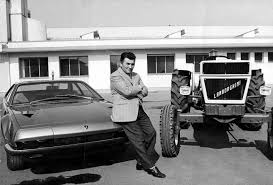
Ferruccio Lamborghini was an Italian industrialist who is best recognized as the founder of the high-end sports cars company Automobili Lamborghini in Sant’Agata Bolognese, northern Italy. The son of grape farmers, he tinkered with machinery in his youth and studied mechanics in college, following which he served as a vehicle maintenance supervisor during the Second World War. He subsequently established a garage which eventually turned into the tractor manufacturing business Lamborghini Trattori. Apart from these two vehicle businesses, he also founded Lamborghini Bruciatori, an oil heater factory which later became, Lamborghini Calor, which also produced air conditioners, and Lamborghini Oleodinamica, a hydraulic valves and equipment manufacturing company. While he is best known for the luxury car business, it is said that he was prompted to become a car manufacturer after he was insulted by racer and businessman Enzo Ferrari, founder of the Ferrari car brand, when he had approached the latter with his complaints about Ferrari’s after sales service.

Early life:

Ferruccio Lamborghini was born on April 28, 1916, in Renazzo di Cento, in the Province of Ferrara, in the Emilia-Romagna region of Northern Italy,. His parents, Antonio and Evelina Lamborghini, were viticulturists, but rather than farming, Ferruccio was more interested in farming machinery and studied mechanics at the Fratelli Taddia technical institute near Bologna.He was enrolled into the Italian Royal Air Force during World War II and was assigned as the supervisor of the vehicle maintenance unit at the Italian garrison on the island of Rhodes. After the Germans surrendered Rhodes to the British at the end of the war in 1945, he was taken prisoner and was forced to work on allied vehicles until the next year.
Career:

Upon his return to Italy, Ferruccio Lamborghini opened a garage in Pieve di Cento where he modified his old Fiat ‘Topolino’ 500 by replacing its saloon body with an open-top two-seater frame. He also produced a special overhead-valve head for its engine and entered the 1948 Mille Miglia with his custom-made 750-cc car, even though his run ended after crashing into a local restaurant in Fiano, Turin.In 1947, on his father’s request, he urgently built a tractor with a six-cylinder Morris engine, a General Motors transmission, and a Ford differential for conveying power, using parts from military vehicle engines. The model, first of his ‘Carioca’ tractors, contained a fuel atomizer made by him which allowed the vehicle to start on petrol and then switch to diesel to save on the pricy fuel.In the post-war Italy, focused on rebuilding agriculture, the tractor became very popular with his father’s friends, and noticing the demand, Ferruccio Lamborghini established his tractor manufacturing company, Lamborghini Trattori, at his garage. In the following years, the company became one of the largest manufacturers of agricultural equipments in Italy.He soon moved to other businesses, such as the oil heater factory, Lamborghini Bruciatori, which was founded in 1959. The company later diversified into producing air conditioning equipment as well, and shifted to a larger facility, Lamborghini Calor, which had increased production capacity for air conditioners, boilers and burners.As Ferruccio Lamborghini began to amass more wealth, he again turned his attention to fast cars; he bought cars from several manufacturers, and often analyzed and modified them to his liking. After Enzo Ferrari, manufacturer of the Ferrari cars, dismissed his concerns about a Ferrari 250 GT he had bought, he remodeled it to be able to outperform the stock model and decided to launch his own automobile line.In 1963, he founded Automobili Lamborghini, and began producing refined grand touring car models that also became known for providing power and comfort. The company earned widespread reputation following the 1966 launch of the Miura sports coupé, which standardized the rear mid-engine, rear-wheel-drive layout for high-performance cars.Following a rapid growth spanning a decade, his companies began facing financial difficulties during the early 1970s, particularly Lamborghini Trattori, which experienced large order cancellations.In 1972, he first sold his entire holding in the tractor company to rival company SAME, and then sold 51% shares of Automobili Lamborghini to friend and Swiss businessman Georges-Henri Rossetti.After giving up a controlling share in the company, he gradually detached himself from the company’s affairs, and following the 1973 worldwide stock-market crash and the oil crisis, sold the rest of the shares. However, he continued to run Lamborghini Calor, the heating and air conditioning company, as well as Lamborghini Oleodinamica, a hydraulic valves and equipment manufacturing company.

Family & Personal Life:

Ferruccio Lamborghini married for the first time soon after his return from the Second World War in 1946. However, his wife, Clelia Monti, died the following year while giving birth to their first child, a boy named Tonino, who later went to Japan and started his clothing and accessories business.In 1974, he bought an estate named ‘La Fiorita’ on the shores of Lake Trasimeno, in Castiglione del Lago, in the province of Perugia of Umbria, central Italy. He spent his time hunting, golfing and producing wine, and even designed his own golf course.After his second marriage with Anna Borgatti ended in divorce, he married Maria Theresa Cane and, fathered a daughter named Patrizia at the age of 58. His daughter now runs the Lamborghini winery on his Umbria estate.Two weeks after suffering a heart attack, 76-year-old Lamborghini died on February 20, 1993, at Silvestrini Hospital in Perugia and was buried at the cemetery of Renazzo. His son, who designed the electric microcar ‘Town Life’, opened a museum in his father’s name in 1995 that was later moved to Argelato, Bologna and is now known as the Ferruccio Lamborghini Museum.

Trivia:

Ferruccio Lamborghini, who had been an avid fan of bullfighting, adopted a raging bull as the emblem for his auto company after he founded Automobili Lamborghini.
Caption cool

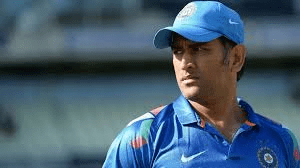
Mahendra Singh Dhoni is the current captain of the Indian Cricket team. He was born on 7 July 1981 in Ranchi, Jharkhand to Pan Singh and Devaki Devi. His paternal village Lvali is in the Lamgarha block of the Almora District of Uttarakhand. Dhoni’s parents, moved from Uttarakhand to Ranchi where Pan Singh worked in junior management positions in MECON. Dhoni has a sister Jayanti and a brother Narendra.

Dhoni studied at DAV Jawahar Vidya Mandir, Shyamali, (now the school is known as JVM, Shyamli, Ranchi) Ranchi, Jharkhand where he initially excelled in badminton and football and was selected at district and club level in these sports. Dhoni was a goalkeeper for his football team and was sent to play cricket for a local cricket club by his football coach. Though he had not played cricket, Dhoni impressed with his wicket-keeping skills and became the regular wicketkeeper at the Commando cricket club (1995 – 1998).

Based on his performance at club cricket, he was picked for the 1997/98 season Vinoo Mankad Trophy Under-16 Championship and he performed well. Dhoni focused on cricket after his 10th standard. Dhoni is an aggressive right-handed batsman and wicket-keeper. The Indian team in the 2000s saw the use of Rahul Dravid as the wicket-keeper to ensure that the wicket-keeper spot didn’t lack in batting talent. The Indian cricket establishment also saw the entry of wicket-keeper/batsmen from the junior ranks with talents like Parthiv Patel and Dinesh Karthik both India U-19 Captains in the test squads.

With Dhoni making a mark in the India-A squad, he was picked in the ODI squad for the Bangladesh tour in 2004/05. Dhoni did not have a great start to his ODI career, getting run out for a duck on debut. In spite of an average series against Bangladesh, Dhoni was picked for the Pakistan ODI series. In the second match of the series, Dhoni in his fifth one-day international scored 148 in Vishakapatnam off only 123 deliveries. Dhoni’s 148 erased the earlier record for the highest score by an Indian wicketkeeper, a record that he would re-write before the end of the year.

Following his good one-day form against Sri Lanka, Dhoni replaced Dinesh Karthik in December 2005 as the Indian Test wicket-keeper. Under his captaincy, India won the 2007 ICC World Twenty20, CB Series of 2007-08 and the Border-Gavaskar trophy 2008 in which they beat Australia 2-0. He also led the team to their first ever bilateral ODI series wins in Sri Lanka and New Zealand.

Dhoni has also been the recipient of many awards including the ICC ODI Player of the Year award in 2008 (the first Indian player to achieve this feat), the Rajiv Gandhi Khel Ratna award and the Padma Shri, India’s fourth highest civilian honour in 2009. Also Dhoni named as Skipper of Wisden’s first-ever Dream Test Team in 2009.

In the history of test match India become first time number one in December 2009, under leadership of Dhoni. Under leadership of M.S. Dhoni, India is continued on the way of success for few years.

And, we hope that India will still on the path of glory in cricket history in future under his brilliant, tactful and marvelous captaincy by means of winning a lot of matches and series and the world cup too.

“If there is a book about cricket finishing chapter would be MS Dhoni”

Jeff Bezos

Jeff Bezos is an American technology entrepreneur and founder of e-commerce giant Amazon.com. Born to Jacklyn Gise and Ted Jorgensen, he was adopted by Miguel Bezos, a Cuban immigrant, after his mother married him. As a child, he spent his summers laying pipes, vaccinating cattle and fixing windmills at his grandfather’s Texas ranch. He attended Miami Palmetto Senior High School, and took his B.Sc. degree in Electrical Engineering and Computer Science from Princeton University graduating ‘summa cum laude’. He worked on Wall Street in companies such as Fitel, Bankers Trust and D. E. Shaw & Co, New York. He became the youngest Vice President at D. E. Shaw & Co. In spite of success, he decided to quit the field of finance. He founded Amazon.com, an online book store, and later introduced features including one-click shopping, customer reviews, and e-mail order verification. He expanded it to include various other items including clothes, CDs, toys, jewellery, watches, electronics and shoes. He has constantly been improving his web site, and introducing improved facilities for his customers. His childhood dream of space travel spurred the founding of Blue Origin, an aerospace company that is developing technologies to offer space travel to customers. Bloomberg Billionaires Index listed Bezos as one of the wealthiest people in the world with an estimated net worth of $28 billion.

Childhood & Early Life

Jeff Bezos was born on January 12, 1964, to Jacklyn Gise and Ted Jorgensen. His mother’s ancestors were settlers who lived in Texas, and had acquired a 25,000-acre ranch near Cotulla over the generations.Bezos’ mother was a teenager when she married his father. After marriage with Ted Jorgensen ended, she married Miguel Bezos, a Cuban immigrant who studied at the University of Albuquerque.After marriage, Miguel Bezos legally adopted Jeff. The family then moved to Houston, Texas, where Miguel became an engineer for Exxon. Jeff attended River Oaks Elementary School, Houston, from fourth to sixth grade.

CareerBezos family moved to Miami, Florida. He attended Miami Palmetto Senior High School. He also attended the Student Science Training Program at the University of Florida, and received a Silver Knight Award in 1982.While in high school, he started his first business venture, the Dream Institute, an educational summer camp for fourth, fifth and sixth graders. He graduated as high school valedictorian.In 1982, he entered Princeton University, where he studied computers. He was elected to the honor societies Phi Beta Kappa and Tau Beta Pi at Princeton.He used to take up summer jobs. In June 1984, he took a summer job as Programmer/Analyst in Norway, and the following year, he improved an IBM Program in California.He served as the President of Princeton’ Students for the Exploration and Development of Space. In 1986, he graduated summa cum laude, with a B.Sc. in Electrical Engineering and Computer Science.After graduation, he worked at several firms on Wall Street, such as Fitel Bankers Trust, and the investment firm D.E. Shaw.He joined D. E. Shaw & Co, New York, in 1990. He became the youngest Vice President there. His career in finance was extremely lucrative, but he decided to quit after four years.In 1995, he founded Amazon.com, an online bookstore. Market analysts were initially sceptical about its success vis-a-vis the traditional stores, but he soon outpaced his competitors. In 1997, the company went publicWith time, Amazon started to diversify its portfolio. In 1998, it started offering CDs and videos and, in 2002, it also included clothes to its portfolio.

In 2003, Amazon formed A9, a commercial search engine focusing on e-commerce web sites. He also launched an online sporting goods store that offered up to 3,000 different brands.The year 2007 saw Amazon introduce a handheld electronic reading device, the Kindle, which uses E-Ink to render text with adjustable font size to enhance ease of reading.In 2010, Amazon signed a deal with The Wylie Agency who gave Amazon the digital rights to works of authors. Publishers were bypassed, and felt angered. However, readership and sales increased, thereby benefitting authors.Competing with Apple iPad, Bezos introduced Kindle Fire, a color touch screen mini tablet computer. With Kindle Paperwhite, Amazon gave e-readers comfort and convenience with illuminated touchscreens that enabled reading in the dark.He launched Amazon Studios apart from Amazon Local, LivingSocial and Amazon Web Services. Amazon plans to present the television programs through an online video service.On August 5, 2013, he purchased The Washington Post and other publications affiliated with The Washington Post Co., for $250 million cash marking the end of the four-generations of reign by the Graham family.In December 2013, Bezos revealed an experimental initiative called Amazon Prime Air that uses drones capable of carrying weight up to 5 pounds, and travelling 10-miles to provide delivery services to customers.

Major Works

Bezos has played a seminal role in the development and growth of e-commerce. He founded Amazon.com, an online book store, in 1995. The company has ushered revolution in online shopping by introducing innovative features, such as one-click shopping, customer reviews, and e-mail order verification.

In 2004, he founded Blue Origin, an aerospace company that is developing technologies to offer space travel to customers, kept a secret until land was purchased to build a launch and test facility.

Awards & Achievements

Bezos was awarded an honorary doctorate in Science and Technology from Carnegie Mellon University in 2008. He was also selected by U.S. News & World Report as one of America’s best leaders.In 2011, The Economist gave Bezos and Gregg Zehr an Innovation Award for the Amazon Kindle. The following year, he was named Businessperson of The Year by Fortune.In December 2012, the National Retail Federation named Amazon as the top retailer of the year, and awarded him the Gold Medal Award, given to an individual who has served the industry with distinction.

Trivia

This innovator funded an expedition that recovered two powerful Saturn V first-stage F-1 rocket engines from the Atlantic Ocean identified as belonging to the Apollo 11 mission’s S-1C stage in July 2013.

How important is taking covid-19 vaccine

The vaccine will help us achieve two things — one, it will further bring down the mortality, and secondly, it will bring down the number of cases. Eighty-four per cent of COVID deaths occur in people above 50, who develop severe illness because of other comorbidities such as diabetes, kidney disease, chronic respiratory diseases. If we reduce the severity of the disease in this group, we will be able to bring down the mortality rate. Besides, if you are able to vaccinate a significant number of people, this together with people who have developed immunity naturally because they have had the disease, will help us acquire herd immunity. This will help us to return to a near normal life.

Do you think COVID-19 can be reduced to common cold and cough disease in the coming time?

With the second wave of the Covid infection showing no respite, our best bet is in getting vaccinated. “In India, the two vaccines approved for use are COVISHIELD and COVAXIN. Recently, the Sputnik V vaccine was also approved for launch in India. It is a Russian two-dose vaccine given 3 weeks apart, having an efficacy of 91 per cent

The currently licensed vaccines — COVISHIELD and COVAXIN — are found to be safe and effective. While COVISHIELD has been found to have almost 70-90 per cent efficacy, COVAXIN shows 81 per cent efficacy, which means if 100 people get the vaccine, around 70-90 of them will not be having asymptomatic COVID disease, the doctor explains. 

Getting vaccinated can decrease the chances of hospitalisation and requirement of supplementation of oxygen with more chances of recovery at-home,”

It’s been suggested vaccinated people have less chance to develop symptomatic Covid infection. She adds, “The data has to be analysed for statistical significance.”

A vaccinated individual may develop antibodies that can neutralise the virus, and break the chain of transmission. This leads to the development of herd immunity once the significant population is vaccinated and has circulating

A vaccinated individual may develop antibodies that can neutralise the virus, and break the chain of transmission. This leads to the development of herd immunity once the significant population is vaccinated and has circulating antibodies for the same.

She also adds, “Vaccinated individuals can have a faster recovery after two doses of vaccine.”

The doctor shares some easy tips to boost your immunity after getting vaccinated. “You should drink adequate lukewarm water throughout the day to keep yourself hydrated. Make sure you practise yoga especially, pranayama and meditate for at least 30 minutes every day. Pranayama helps in increasing our lung capacity.”

Always take light, easily digestible and nutritious food and avoid eating junk food. Take adequate sleep for at least 7-8 hours daily.

Most importantly, maintain personal hygiene. wash hands frequently for a minimum of 20 seconds with soap and water, practise social distancing and use homemade masks/double mask whenever stepping out.

What is 5G

Wireless communications systems use radio frequencies (also known as spectrum) to carry information through the air.

5G operates in the same way, but uses higher radio frequencies that are less cluttered. This allows for it to carry more information at a much faster rate. These higher bands are called ‘millimeter waves’ (mmwaves). They were previously unused but have been opened up for licensing by regulators. They had been largely untouched by the public as the equipment to use them was largely inaccessible and expensive.

While higher bands are faster at carrying information, there can be problems with sending over large distances. They are easily blocked by physical objects such as trees and buildings. In order to circumvent this challenge, 5G will utilise multiple input and output antennae to boost signals and capacity across the wireless network.

The technology will also use smaller transmitters. Placed on buildings and street furniture, as opposed to using single stand-alone masts. Current estimates say that 5G will be able to support up to 1,000 more devices per metre than 4G.

5G technology will also be able to ‘slice’ a physical network into multiple virtual networks. This means that operators will be able to deliver the right slice of network, depending on how it is being used, and thereby better manage their networks. This means, for example, that an operator will be able use different slice capacities depending on importance. So, a single user streaming a video would use a different slice to a business, while simpler devices could be separated from more complex and demanding applications, such as controlling autonomous vehicles.

There are also plans to allow businesses to rent their own isolated and insulated network slice in order to separate them from competing Internet traffic.

Who Invented the Fifth Generation Network?

The first nation to adopt on a large scale was South Korea, in April 2019, at which point there were some 224 operators in 88 countries around the world investing in the technology.

In South Korea, all the 5G carriers used Samsung, Ericsson and Nokia base stations and equipment, apart from one who used Huawei equipment. Of these suppliers, Samsung was the largest, having shipped 53,000 base stations from a total of 86,000 base stations installed in the country at the time.

There are currently nine companies that sell 5G radio hardware and systems for carriers. These are Altiostar, Cisco Systems, Datang Telecom, Ericsson, Huawei, Nokia, Qualcomm, Samsung and ZTE.

Is time travelling possible

Time travel has always been one of the biggest fantasies for all of us. It is generally thought as something fictional. It can be actually defined as the movement between certain points of time. Albert Einstein introduced a theory that if a person can move at a very high speed then time will be slowed down for him. Light moves very fast with a speed as high as 670,616,629 miles per hour. In just one second, light can go around the earth three times. The only way to achieve time travel is by traveling at the speed of light in space. Light always travels at the same constant speed in a vacuum 700 million mph.

Quick Facts: –

  • There are several paradoxes like twin paradox and paradox of a man with no past riddled with the time travel making the concept very complicated.
  • Despite all these complexities, it is believed by physicists that there are chances of time travel in the future.
  • Famous scientist Stephen Hawking claimed that time travel was impossible.
  • In the year of 2000, a person identified himself as John Titor and claimed to be a military time traveler.
  • Time is the fourth dimension along with the other three which are length, height, and width.
  • Going back to the past by time traveling is known as Retrocognition. It is also very much difficult to prove.
  • Travelling to the future using the concept is known as Precognition. It gives you knowledge of future events before they happen.
  • A time traveler was caught on a picture available on the Virtual Museum of Canada website

Stephen Hawking

Stephen Hawking, in full Stephen William Hawking, (born January 8, 1942, Oxford, Oxfordshire, England—died March 14, 2018, Cambridge, Cambridgeshire), English theoretical physicist whose theory of exploding black holes drew upon both relativity theory and quantum mechanics. He also worked with space-time singularities.

Hawking studied physics at University College, Oxford (B.A., 1962), and Trinity Hall, Cambridge (Ph.D., 1966). He was elected a research fellow at Gonville and Caius College at Cambridge. In the early 1960s Hawking contracted amyotrophic lateral sclerosis, an incurable degenerative neuromuscular disease. He continued to work despite the disease’s progressively disabling effects.

Hawking worked primarily in the field of general relativity and particularly on the physics of black holes. In 1971 he suggested the formation, following the big bang, of numerous objects containing as much as one billion tons of mass but occupying only the space of a proton. These objects, called mini black holes, are unique in that their immense mass and gravity require that they be ruled by the laws of relativity, while their minute size requires that the laws of quantum mechanics apply to them also. In 1974 Hawking proposed that, in accordance with the predictions of quantum theory, black holes emit subatomic particles until they exhaust their energy and finally explode. Hawking’s work greatly spurred efforts to theoretically delineate the properties of black holes, objects about which it was previously thought that nothing could be known. His work was also important because it showed these properties’ relationship to the laws of classical thermodynamics and quantum mechanics.

Hawking’s contributions to physics earned him many exceptional honours. In 1974 the Royal Society elected him one of its youngest fellows. He became professor of gravitational physics at Cambridge in 1977, and in 1979 he was appointed to Cambridge’s Lucasian professorship of mathematics, a post once held by Isaac Newton. Hawking was made a Commander of the Order of the British Empire (CBE) in 1982 and a Companion of Honour in 1989. He also received the Copley Medal from the Royal Society in 2006 and the U.S. Presidential Medal of Freedom in 2009. In 2008 he accepted a visiting research chair at the Perimeter Institute for Theoretical Physics in Waterloo, Ontario, Canada.

His publications included The Large Scale Structure of Space-Time (1973; coauthored with G.F.R. Ellis), Superspace and Supergravity (1981), The Very Early Universe (1983), and the best sellers A Brief History of Time: From the Big Bang to Black Holes (1988), The Universe in a Nutshell (2001), A Briefer History of Time (2005), and The Grand Design (2010; coauthored with Leonard Mlodinow).

Steve jobs

Steve Jobs, the American businessman and technology visionary who is best known as the co-founder, chairman, and chief executive officer of Apple Inc, was born on February 24, 1955. His parents were two University of Wisconsin graduate students, Joanne Carole Schieble and Syrian-born Abdulfattah Jandali. They were both unmarried at the time. Jandali, who was teaching in Wisconsin when Steve was born, said he had no choice but to put the baby up for adoption because his girlfriend’s family objected to their relationship.

The baby was adopted at birth by Paul Reinhold Jobs (1922–1993) and Clara Jobs (1924–1986). Later, when asked about his “adoptive parents,” Jobs replied emphatically that Paul and Clara Jobs “were my parents.” He stated in his authorized biography that they “were my parents 1,000%.” Unknown to him, his biological parents would subsequently marry (December 1955), have a second child, novelist Mona Simpson, in 1957, and divorce in 1962.

The Jobs family moved from San Francisco to Mountain View, California when Steve was five years old. The parents later adopted a daughter, Patti. Paul was a machinist for a company that made lasers, and taught his son rudimentary electronics and how to work with his hands. The father showed Steve how to work on electronics in the family garage, demonstrating to his son how to take apart and rebuild electronics such as radios and televisions. As a result, Steve became interested in and developed a hobby of technical tinkering. Clara was an accountant who taught him to read before he went to school.

Jobs’s youth was riddled with frustrations over formal schooling. At Monta Loma Elementary school in Mountain View, he was a prankster whose fourth-grade teacher needed to bribe him to study. Jobs tested so well, however, that administrators wanted to skip him ahead to high school—a proposal his parents declined. Jobs then attended Cupertino Junior High and Homestead High School in Cupertino, California. During the following years Jobs met Bill Fernandez and Steve Wozniak, a computer whiz kid.

Following high school graduation in 1972, Jobs enrolled at Reed College in Portland, Oregon. Reed was an expensive college which Paul and Clara could ill afford. They were spending much of their life savings on their son’s higher education. Jobs dropped out of college after six months and spent the next 18 months dropping in on creative classes, including a course on calligraphy. He continued auditing classes at Reed while sleeping on the floor in friends’ dorm rooms, returning Coke bottles for food money, and getting weekly free meals at the local Hare Krishna temple

In 1976, Wozniak invented the Apple I computer. Jobs, Wozniak, and Ronald Wayne, an electronics industry worker, founded Apple computer in the garage of Jobs’s parents in order to sell it. They received funding from a then-semi-retired Intel product-marketing manager and engineer Mike Markkula.

Through Apple, Jobs was widely recognized as a charismatic pioneer of the personal computer revolution and for his influential career in the computer and consumer electronics fields. Jobs also co-founded and served as chief executive of Pixar Animation Studios; he became a member of the board of directors of The Walt Disney Company in 2006, when Disney acquired Pixar.

Jobs died at his California home around 3 p.m. on October 5, 2011, due to complications from a relapse of his previously treated pancreatic cancer.

Sachin Tendulkar

Full name of ‘Sachin Tendulkar’ is Sachin Ramesh Tendulkar. He was born on 24 April 1973. His father, Ramesh Tendulkar, was a well-known Marathi novelist and his mother, Rajni, worked in the insurance industry. He married with Anjali Mehta, the paediatrician daughter of Gujarati industrialist Anand Mehta, in 1995

Sachin Tendulkar is a former Indian cricketer and captain. He took up cricket at the age of eleven, He is the only player to have scored one hundred international centuries. He is the first batsman to score a double century in a One Day International. He is the only player to complete more than 30,000 runs in international cricket.

Sachin Tendulkar received the Arjuna Award in 1994 for his outstanding sporting achievement. He received the Rajiv Gandhi Khel Ratna award in 1997, India’s highest sporting honour, and the Padma Shri and Padma Vibhushan awards in 1999 and 2008, respectively.

After a few hours of his final match on 16 November 2013, the Prime Minister’s Office announced the decision to award him the Bharat Ratna, India’s highest civilian award. He is the youngest recipient to date and the first ever sportsperson to receive the award. He also won the 2010 Sir Garfield Sobers Trophy for cricketer of the year at the ICC awards. In 2012, Tendulkar was nominated to the Rajya Sabha, the upper house of the Parliament of India.

In December 2012, Tendulkar announced his retirement from ODIs. He retired from Twenty-20 cricket in October 2013 and subsequently announced his retirement from all forms of cricket, retiring on 16 November 2013 after playing his 200th and final Test match, against the West Indies in Mumbai’s Wankhede Stadium.

Sachin Tendulkar is widely acknowledged as one of the greatest batsmen of all time. The Master Blaster is considered one of the complete batsmen ever. He has all the shots in the book. He is the most admired cricketer in the world. Every Indian should be proud of him. None of the batsmen can replace him and no words can express his amazing talent, power and achievement.

It is rightly said that if cricket were a religion, Sachin would be the god.

5 Names of Indian freedom fighters you might not know

The remembrance of our freedom struggle involves a lot of nostalgia – romanticized and commemorated by the country as best as possible. But there are a few names which have been lost over the years. Names which do not enter the hyped mainstream media responses on freedom fighters; which are subaltern and marginalized. Here is a list of some of those names, of people who formed a very important part of our freedom struggle and are yet, not as well known as a few others.

1. Pingali Venkayya

He was a devout follower of Mahatma Gandhi and was also known as Diamond Venkayya for his knowledge on diamond mining. He was an authority in geology, agriculture and also an educationalist. His major contribution to the movement was the design of the national flag of India, which was first modified and adopted as the flag of Indian National Congress and later modified again to be the national flag of India.

2.Tanguturi Prakasam

A politician and a freedom fighter, he was first the Chief Minister of the Madras Presidency and then the Chief Minister of the Andhra state. He started his career as a lawyer, but gave up his practice in 1921 and was drawn to the freedom movement. One of his most famous acts was in 1928 during the protests against Simon Commission in Madras. The police had imposed a ban on protests in some areas, and had warned of shooting people who violated orders. He faced the police, tore open his shirt, bared his chest and dared them to shoot if they could. This singular act of defiance won him the title of Andhra Kesari (Lion of  Andhra).

3.veerapandiya kattapomman

He was a courageous Palyekar chieftain from Tamil Nadu in the 18th century. He waged a war with the British sixty years before the Indian War of Independence (the 1857 rebellion) occurred in the Northern parts of India. He was captured and hanged in 1799 CE. His fort was destroyed and his wealth was looted by the British army. He basically protested against the sovereignty of the East India Company and refused to pay their taxes.

4.The Trio: Benoy, Badal & Dinesh

The trio is mostly remembered together for their attack on the Dalhousie Square in Kolkata. Their full names are Badal Gupta, Dinesh Gupta and Benoy Basu and all of them hailed from Bengal. Col N.S. Simpson, the Inspector General of Prisons, was infamous for brutally oppressing prisoners. The revolutionaries decided not only to murder him, but also to strike terror among British officials by launching an attack on the Secretariat Building – the Writers’ Building  in Dalhousie Square, Kolkata. The three of them were dressed as Europeans when they went and killed Simpson, but they did not wish to get arrested. So, Badal consumed poison, while the other two shot themselves using revolvers. The Dalhousie Square was renamed as the B.B.D. Bagh after them.

5.Surendra Sai

The man died in obscurity despite protecting Western Orissa from the British rule along with a few other comrades. Eligible as the next in line to the throne of Sambalpur after the death of Maharaja Sai in 1827, he helped the lower caste tribal people in Sambalpur against the British by encouraging their language and culture development.  Affectionately called Bira by the local people because of his swordsmanship, he began protesting from the age of 18 and spent some 17 years in jail after that. But he continued the protest till 1862, when he surrendered and went to jail. He spent 20 years in prison after his surrender.  Also, Sambalpur was the last patch of land to be occupied by the British except for the princely state, and it is said that it was largely due to the efforts of Sai.

Veerapandiya kattapomman

Though most historical accounts cite the revolt of 1857 as the ‘first war of independence’ in India against the British, they seem to overlook a valiant chieftain from Tamil Nadu in the late 18th century who refused to align with the sovereignty of the British East India Company, and singlehandedly waged war against the colonialists.

Born to Jagaveera Kattabomman and Arumugathammal on 3 January 1760, Veerapandiya Kattabomman belonged to the Bommu and Aathi Kattabomman clan in the village of Panchalankurichi in Thoothukudi district of Tamil Nadu.

His father was a Palayakarar (a feudal title for a class of territorial administrative and military governors appointed by the Nayaka dynasty in southern India during the 16th and 18th centuries), from whom Veerapandiya assumed the position of the 47th Palayakarar when he turned 30.

So how did the British manage to maintain a stronghold in the region? It was a well-calculated move. They lent huge sums of money to the Nawab of Arcot and demanded to be repaid through taxes and levies from all the Palayakarars under the Nawab’s domain.

As the Nawab was in severe debt, watched as his people were plundered by the British in the name of tax collection.

Except for Veerapandiya, every other Palayakarar yielded to the diktat of the company. In fact, the British were quite crafty and tried to establish cordial alliances with all the regional statesmen, who in turn tried advising Veerapandiya to ally with the former and live in peace.

Emerging as an undesirable element in the plan that the British had for the region, they began working on different conspiracies to bring the rebellious chieftain down. However, they remained unsuccessful in their schemes until the British army suddenly decided to raid Panchalankurichi under the command of Major J. Bannerman in 1799.

As the entire village had been in Thiruchendur for a temple festival, the British hoped to ambush Veerapandiya unawares. But he had already learnt of the attack through his informers and had prepared well in advance.

Right before the attack, Veerapandiya was ordered to surrender unconditionally through a messenger sent by Bannerman. “We are the sons of this soil. We live with prestige, honour and dignity and we let our soul die for the prestige, honour and dignity of our land. We don’t bow down to the foreigners. We will fight until death,” was the smarting message taken back to the army commander.

Veerapandiya and his men held the fort quite valiantly against British troops, who couldn’t quite match up to their expertise and had to withdraw. However, Veerapandiya knew that his fort would not be able to withstand the onslaught if the British were to unleash their cannons.

Upon receiving information about their hideout, the British threatened the king of Pudukottai, Vijaya Raghunatha Tondaiman to trace and handover the elusive chieftain or face similar consequences.

Buckling under pressure, he sent his soldiers to track down Veerapandiya, who was subsequently arrested at Kayathar on October 1, 1799. Following an interrogation stretching over 15 days and a ridiculous trial, Veerapandiya was sentenced to public execution.

Even in the face of death, he didn’t flinch and continued to stand by his ideals of honour, dignity and prestige. He even boldly argued for the right of his homeland and admonished the British for their immoral and illegal occupation.

Veerapandiya Kattabomman was hanged on October 16, 1799, thus putting an end to the first ever known revolt against the Empire.

The remnants of his old fort at Panchalankurichi is protected by Archaeological Survey of India.

On October 16, 1999, a postage stamp commemorating the bicentenary of Veerapandiya’s execution was released by the government of India in his remembrance.

Every year, the district administration of Tirunelveli honours the legend and his heroic deeds by celebrating the ‘Veerapandiya Kattabomman festival’ at Panchalankurichi on his birth anniversary. Besides, there is an Indian Navy communications centre at Vijayanarayanam, which is named INS Kattabomman after the brave freedom fighter.

On his 258th birth anniversary, let’s remember the valiant Palayakarar from Panchalankurichi who refused to bow down to the British and sacrificed his life for his homeland.

Childeren’s day

All the kids

, chin up, smile and celebrate the day dedicated specially to you! November 14 is celebrated as Children’s Day (also called Bal Diwas) in our country and the occasion also commemorates the birth anniversary of Jawaharlal Nehru, the first Prime Minister of India. As the schools and colleges gear up to celebrate this day, here is all you need to know about the history, importance and significance of the occasion.

Nehru was known for his affection and love for kids, whom he regarded as the ‘future of the country’ and was fondly called as Chacha Nehru. “The children of today will make the India of tomorrow. The way we bring them up will determine the future of the country,” he exclaimed once. He always emphasised on the education of children and played a major role in establishment of colleges in the country which are still considered one of the best in the country

After his demise in 1964, his birth date, November 14, was decided to be celebrated as Children’s Day every year.

On this day, schools and colleges organise various programmes like plays, competitions, cultural events etc., and sweets, books, stationary and other gifts are distributed to children. Also, November 20 is celebrated as the Universal Children’s Day, as declared by the United Nations.

The day is a reminder that every child deserves education, nurturing and the best of everything. They are the building blocks of the nation and hence, the future of the nation depends how well they are brought up. To those who are now an adult, keep the kid inside you alive!

In India, 5th September is celebrated as Teachers’ Day as a mark of tribute to the contribution made by teachers to the society.

5th September is the birth anniversary of a great teacher Dr Sarvepalli Radhakrishnan, who was a staunch believer of education and was a well-known diplomat, scholar, the President of India and above all, a teacher.

When some of his students and friends approached him and requested him to allow them to celebrate his birthday, he said, “instead of celebrating my birthday separately, it would be my proud privilege, if 5th September is observed as Teachers’ day”. From then onwards, the 5th of September has been observed as Teachers Day, in India.

In the year 1965, some of the prominent students of Late Dr S. Radhakrishnan organised a gathering to pay obeisance to that Great Teacher of repute.

In that gathering, in his speech Dr Radhakrishnan expressed his deep reservation regarding his birth anniversary celebration and emphasised that his birth anniversary should be celebrated as ‘Teachers’ Day’, by paying homage to other Great Teachers of India and Bangladesh.

Since the year 1967, 5th September is celebrated as Teachers’ Day till date.

Pandit Jawaharlal Nehru, who was one of his closest friends throughout, had many great things to say about Dr. Radhakrishnan: “He has served his country in many capacities. But above all, he is a great teacher from whom all of us have learnt much and will continue to learn. It is India’s peculiar privilege to have a great philosopher, a great educationist and a great humanist as her President. That in itself shows the kind of men we honour and respect.”

ADOLF HITLER

Adolf Hilter was a German politician and leader of the Nazi Party (National Socialist German Workers Party). In 1993, Hilter rose to power as the chancellor of Germany and became the leader in the year 1934. From 1933-1945, under his dictatorship, Hitler initiated World war II and invaded Poland on September 1, 1939. Hilter was also involved in military operations and was responsible for the Holocaust, where six million Jews and another five million non-combatants died. 

Adolf Hilter: Early Life, Family and Education

Adolf Hitler was born on April 20, 1898, to a Christian family as Adolphus Hitler in Braunau am Inn, a town in Austria-Hungary (now Austria). Adolf Hitler was the fourth child born to the couple Alios Hitler and his wife Klara Polzl (Alios’s third wife). Hitler died on April 30, 1945, at the age of 56 years by shooting himself. Hitler lived with Alios’s children from the second marriage in the same house. When Hitler was three years old, his family moved to Germany where he acquired lower Bavarian dialect instead of Austrian German. 

In 1984, Hitler’s family moved to Austria and Hitler attended a state-owned primary school in Fischlham, Austria. Hitler’s father was very strict and beat him up on several occasions. In 1897, after the failure at Hatfield (where Hitler’s father farmed and kept bees), the family moved to Lambach. In 1898, Hitler’s family permanently moved to Leonding and in the 1900s, Hitler’s younger brother died of measles.

Hitler’s father Alois became successful in the customs bureau and wanted Hitler to follow him. However, Hitler was of the opposite view and wanted to become an Artist, which his father Alois dismissed. In September 1900, Alois sent Hitler to Realschule (secondary school in Germany). Hitler in Mein Kampf stated that he rebelled his father’s decision of sending him to Realschule in Linz and did poor in school hoping that his father would look at his grades and would allow him to follow his passion

Like other Austrian Germans, Hitler too was of the German nationalist ideas and would sing “Deutschlandlied” (National Anthem of Germany) instead of  Austrian Imperial anthem.

After his father’s sudden demise on January 3, 2020, Hitler did poor at school and his mother allowed him to leave the school. In September 1904, Hitler enrolled himself at Realschule in Steyr, where his performance improved. In 1905, Hitler passed the repeat of the final examination and left secondary school.

In 1907, Hitler moved to Vienna to study Fine Arts at the Academy of Fine Arts Vienna but was rejected twice. The director of the Academy of Fine Arts Vienna advised Hitler to apply to the  School of Architecture but he couldn’t do so as he didn’t finish his Senior Secondary schooling. 

On December 21, 1907, at the age of 47, Hitler’s mother died of breast cancer. In 1909, 20 years old Hitler ran out of money and spent his life in homeless shelters and a men’s dormitory. He survived by selling his paintings of Vienna. 

Hitler was exposed to racism for the first time in his life in Vienna. Hitler in his book Mein Kampf states that he became anti-Semite (hostility or prejudice or discrimination against Jews) in Vienna while his friends disagree. August Kubizek (Hitler’s friend), claimed that Hitler was a “confirmed anti-Semite” before he left Linz. 

In 1913, Hitler upon receiving the final part of his father’s estate moved to Munich, Germany. On February 5, 1914, Hitler was conscripted into  Austro-Hungarian Army and travelled to Salzburg but was declared unfit for service and returned to Munich. However, Hitler later stated that he didn’t want to serve the Austro-Hungarian Empire due to the mixture of races in the army. 

Adolf Hitler: Personal Life

Hitler dedicated his entire life to his political mission and the nation. In 1929, Hitler met his lover, Eva Braun and married her on April 29, 1945, (a day before the couple committed suicide). In September 1931, Hitler’s half-niece, Geli Raubal, took her own life with Hitler’s gun at his Munich apartment. This gave rise to several rumours that Geli was in a romantic relationship with Hitler and her death was a source of deep, lasting pain. In June 1960, Paula Hitler (younger sister of Hitler), the last living member of his immediate family died. 

Adolf Hitler in World War I

When World War I started in August 1914, Hitler voluntarily joined the Bavarian Army. However, as per a report by Bavarian authorities in 1924, Hitler’s service was an administrative error as he was an Austrian citizen. Hitler was posted to the Bavarian Reserve Infantry Regiment 16. He served as a dispatch runner on the Western Front in France and Belgium and spent half of his time at the regimental headquarters behind the front lines. Hitler was present during the First Battle of Ypres, the Battle of the Somme, the Battle of Arras, and the Battle of Passchendaele and was wounded at the Somme. 

In 1914, Hitler was also awarded the Iron Cross (Second Class) for bravery and in 1918, received Iron Cross (First Class) upon the recommendation of Lieutenant Hugo Gutmann. On May 18, 1918, Hitler received the  Black Wound Badge. While rendering his service at headquarters, Hitler drew cartoons for an army newspaper. 

In October 1916, Hitler was injured during the Battle of the Somme and was wounded in the left thigh. He spent rest two months in the Hospital at Beelitz and returned to the regiment on March 5, 1917. On October 15, 1918, in a mustard gas attack, Hitler became temporarily blind and was admitted in the hospital at Pasewalk. 

INDIRA GANDHI

History of Indira Gandhi

Indira Gandhi was a famous Indian politician and the third Prime Minister of India. She was the daughter of the first Prime Minister of India, Pandit Jawarharlal Nehru. Her charismatic personality and intelligence made her a powerful statesperson and extremely popular amongst the common people.

Birth and Early Life

Indira Gandhi was born on 19 November 1917 in Allahabad to Kamala and Jawaharlal Nehru. Since Indira was born in a family that had roots in politics, she was exposed to politics right from a tender age. Many important leaders, including Mahatma Gandhi, used to visit her house in Allahabad. Indira often used to interact with Mahatma Gandhi and was deeply influenced by his ideologies.

College and Marriage

She garnered her initial education from Pune University and was then sent to Rabindranath Tagore’s educational institute, Shantiniketan, in West Bengal. Later, she went abroad to pursue her higher studies. In 1936, Indira came back to India and joined the Indian National Congress. Here, she met Feroze Gandhi, a young Parsi boy, who was also an important member of the Youth Wing of Congress. In 1941, despite Pandit Nehru’s objections, she married Feroze Gandhi. In 1944, Indira gave birth to Rajiv Gandhi and two years later, Sanjay Gandhi, her second son, was born.

Involvement in Politics

After independence, Pandit Jawaharlal Nehru became the first Prime Minister of India. During this time, Indira remained busy in taking care of her family and became a little less active in politics. Thereafter, one tragedy after another hit her: on 8 September 1960, Feroze Gandhi passed away after suffering a major heart attack and in 1964, Pandit Nehru passed away. After the sudden demise of her husband and father, Indira decided to join the active politics. She contested the next elections and won with a comfortable margin over her opponents. She was appointed as the Information and Broadcasting Minister under the then Prime Minister Lal Bahadur Shastri.

After the death of Lal Bahadur Shastri on 11 January 1966, the Congress high-command unanimously selected Indira as their leader and she thus became the Prime Minister of India. In 1971, in order to stop the infiltration of Bangladeshi refugees, Indira Gandhi extended military support to East Pakistan and helped it achieve freedom from West Pakistan. India’s victory in the 1971 Indo- Pakistan war augmented the popularity of Indira Gandhi as a far-sighted and wise political leader.

In 1975, Indira faced severe resistance and criticism from the opposition over the issues of unchecked corruption, growing inflation and other irregularities in the government set-up. A ruling of Allahabad High Court was released ordering her to vacate her seat with immediate effect. In view of the growing political chaos, on 26 June, 1975, Indira Gandhi declared ‘political emergency’. During this period, her political rivals were arrested, constitutional rights of the citizens were taken away and the press was kept under strict scrutiny. In 1977, fearing military coup, Indira Gandhi called for general elections and, as anticipated, she lost them by a big margin.

Later Life and Death

Indira Gandhi came back to power in 1980 and started working for the welfare of the country.  In September 1981, a Sikh terrorist group demanding a separate state of ‘Khalistan’ entered into the sacred premises of the Golden Temple, Amritsar. Indira Gandhi ordered the army to launch ‘Operation Blue Star’ and barge into the holy shrine in a bid to take out the militants. This action deeply hurt the sentiments of the Sikh community.

On 31 October 1984, Indira Gandhi was assassinated by her own bodyguards and we lost a great leader. Indira Gandhi will always be remembered for her praiseworthy efforts towards the development and progress of science, space exploration, agriculture and implementing several important policies related to the country’s economy.

3 Facts about Indira Gandhi

  1. Indira Gandhi’s middle name was Priyadarshini.
  2. Indira Gandhi was the only woman Prime Minister of India.
  3. In her last public address, Indira had said, “I don’t mind if my life goes in the service of the nation. If I die today every drop of my blood will invigorate the nation”.