The Nervous system

The nervous system is a complex network of nerves and cells that carry messages to and from the brain and spinal cord to various parts of the body.

The nervous system includes both the Central nervous system and Peripheral nervous system. The central nervous system is made up of the brain and spinal cord, and the peripheral nervous system is made up of the Somatic and the Autonomic nervous systems.
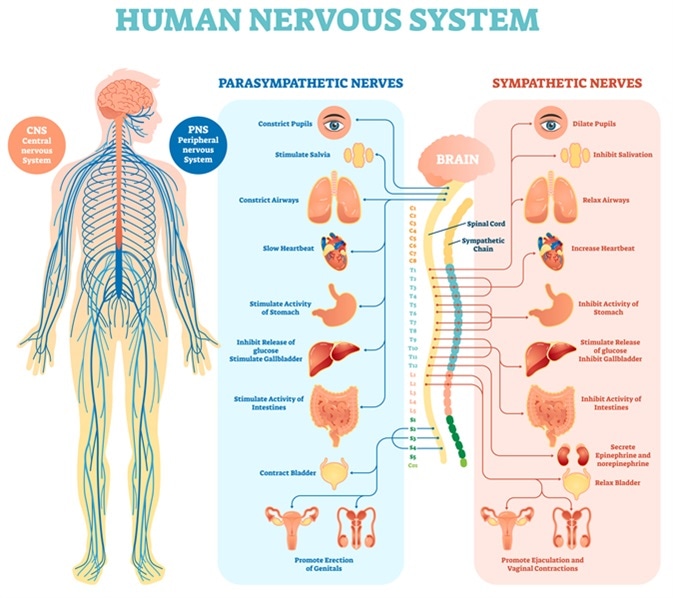
The central nervous system (CNS)

The central nervous system is divided into two major parts: the brain and the spinal cord.

The brain

The brain lies within the skull and is shaped like a mushroom.  The brain consists of four principal parts:

  • the brain stem
  • the cerebrum
  • the cerebellum
  • the diencephalon

The brain weighs approximately 1.3 to 1.4 kg. It has nerve cells called the neurons and supporting cells called the glia.

There are two types of matter in the brain:  grey matter and white matter.  Grey matter receives and stores impulses.  Cell bodies of neurons and neuroglia are in the grey matter.  White matter in the brain carries impulses to and from grey matter.  It consists of the nerve fibers (axons).

The brain stem

The brain stem is also known as the Medulla oblongata. It is located between the pons and the spinal cord and is only about one inch long.

The cerebrum

The cerebrum forms the bulk of the brain and is supported on the brain stem.  The cerebrum is divided into two hemispheres.  Each hemisphere controls the activities of the side of the body opposite that hemisphere.

The hemispheres are further divided into four lobes:

  • Frontal lobe
  • Temporal lobes
  • Parietal lobe
  • Occipital lobe

The cerebellum

This is located behind and below the cerebrum.

The diencephalon

The diencephalon includes the thalamus and hypothalamus. The thalamus is where sensory and other impulses go and coalesce.

The hypothalamus is a smaller part of the diencephalon.

Other parts of the brain

Other parts of the brain include the midbrain and the pons:

  • the midbrain provides conduction pathways to and from higher and lower centers
  • the pons acts as a pathway to higher structures;  it contains conduction pathways between the medulla and higher brain centers

The spinal cord

The spinal cord is a long tube-like structure that extends from the brain. The spinal cord is composed of a series of 31 segments.  A pair of spinal nerves come out of each segment.  The spinal cord region from which a pair of spinal nerves originates is called the spinal segment.  Both motor and sensory nerves are located in the spinal cord.

The spinal cord is about 43 cm long in adult women and 45 cm long in adult men and weighs about 35-40 grams. It lies within the vertebral column, the collection of bones (backbone).

Other parts of the central nervous system

The meninges are three layers of membranes that cover the brain and the spinal cord.  The outermost layer is the dura mater.  The middle layer is the arachnoid, and the innermost layer is the pia mater. The meninges offer protection to the brain and the spinal cord by acting as a barrier against bacteria and other microorganisms.

The cerebrospinal fluid (CSF) circulates around the brain and spinal cord. It protects and nourishes the brain and spinal cord.

Neurons

The neuron is the basic unit in the nervous system. It is a specialized conductor cell that receives and transmits electrochemical nerve impulses. A typical neuron has a cell body and long arms that conduct impulses from one body part to another.
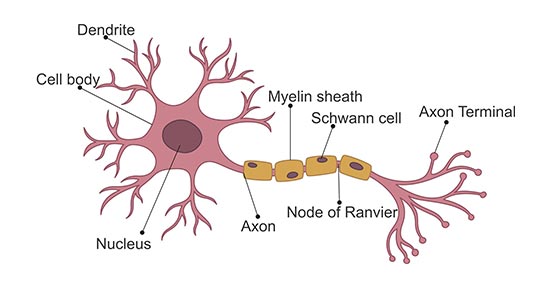
The Typical Structure of a Neuron

There are three different parts of the neuron:

  • Cell body
  • Dendrites
  • Axon

Cell body of a neuron

The cell body is like any other cell with a nucleus or control center.

Dendrites

The cell body has several highly branched, thick extensions that appear like cables and are called dendrites.  The exception is a sensory neuron that has a single, long dendrite instead of many dendrites.  Motor neurons have multiple thick dendrites. The dendrite’s function is to carry a nerve impulse into the cell body.

Axon

An axon is a long, thin process that carries impulses away from the cell body to another neuron or tissue.  There is usually only one axon per neuron.

Myelin sheath

The neuron is covered with the Myelin Sheath or Schwann Cells. These are white segmented covering around axons and dendrites of many peripheral neurons. The covering is continuous along the axons or dendrites except at the point of termination and the nodes of Ranvier.

The neurilemma is the layer of Schwann cells with a nucleus. Its function is to allow damaged nerves to regenerate.  Nerves in the brain and spinal cord do not have a neurilemma and cannot recover when damaged.

Types of neuron

Neurons in the body can be classified according to structure and function. According to structure, neurons may be multipolar neurons, bipolar neurons, and unipolar neurons:

  • Multipolar neurons have one axon and several dendrites. These are common in the brain and spinal cord.
  • Bipolar neurons have one axon and one dendrite.  These are seen in the eye’s retina, the inner ear, and the olfactory (smell) area.
  • Unipolar neurons have one process extending from the cell body. The one process divides with one part acting as an axon and functioning as a dendrite. These are seen in the spinal cord.

The peripheral nervous system

The Peripheral nervous system is made up of two parts:

  • Somatic nervous system
  • Autonomic nervous system

Somatic nervous system

The somatic nervous system consists of peripheral nerve fibers that pick up sensory information or sensations from the peripheral or distant organs (those away from the brain like limbs) and carry them to the central nervous system.

These also consist of motor nerve fibers that come out of the brain and take the messages for movement and necessary action to the skeletal muscles. For example, on touching a hot object, the sensory nerves carry information about the heat to the brain, which in turn, via the motor nerves, tells the muscles of the hand to withdraw it immediately.

The whole process takes less than a second to happen. The neuron’s cell body that carries the information often lies within the brain or spinal cord and projects directly to a skeletal muscle.

Autonomic Nervous System

Another part of the nervous system is the Autonomic Nervous System. It has three parts:

  • The sympathetic nervous system
  • The parasympathetic nervous system
  • The enteric nervous system

This nervous system controls the nerves of the body’s inner organs on which humans have no conscious control. This includes the heartbeat, digestion, breathing (except conscious breathing), etc.

The nerves of the autonomic nervous system innervate the smooth involuntary muscles of the (internal organs) and glands and cause them to function and secrete their enzymes.

The enteric nervous system is the third part of the autonomic nervous system. The enteric nervous system is a complex network of nerve fibers that innervate the abdomen’s organs like the gastrointestinal tract, pancreas, gall bladder, etc. It contains nearly 100 million nerves.

Neurons in the peripheral nervous ystem

The smallest worker in the nervous system is the neuron. There is one preganglionic neuron for each of the chain of impulses, or one before the cell body or ganglion, that is like a central controlling body for numerous neurons going out peripherally.

The preganglionic neuron is located in either the brain or the spinal cord. In the autonomic nervous system, this preganglionic neuron projects to an autonomic ganglion. The postganglionic neuron then projects to the target organ.

There is only one neuron between the central nervous system and the target organ in the somatic nervous system while the autonomic nervous system uses two neurons.

Should student’s textbooks be replaced by notebook computers?


We don’t have to stop using textbooks, each has its pros and cons, and they are better suited to a given situation. We just have to use them in a healthy way, mostly electronic devices that are more likely to get someone added.

We must understand that this can and cannot be replaced, it mainly depends on the person who uses the electronic device and what applications are used. Students should be aware of the potential dangers of using these devices and how to avoid them. Computers should not replace textbooks because the use of computers reduces concentration, increases learning costs, and creates physical health problems.

With so many distractions, using a computer to study has a negative impact on students’ ability to focus on their work. Computers give students a lot of freedom, allowing them to deviate from a lesson planned by teachers, or even access sources with incorrect information. Students with below-average reading skills may find it difficult to keep up when they have to read everything from a textbook.

However, in order to learn effectively, textbooks must always be at the center of a student’s academic journey. Textbooks play an important role in a student’s learning process over the course of many years. Textbooks provide students with a way to learn about physics and help them process information in a way that is easier than on a screen. Each chapter of the textbook builds on what students have learned before so they have all the information they need to understand what is being taught.

Textbooks are limited in what they can offer students beyond the text and images on the page, and tablets offer users the ability to take notes and highlight without ruining the next student’s textbook. Students can easily avoid reading and analyzing text on their own because they can quickly look up passages in e-textbooks and search for answers online. Students are used to finding information electronically rather than manually reading textbooks. But Notepad makes it easier and easier for them to find the information they need, and they can get help with Google Search to find the answer.

You mean, students are willing to carry any outdated textbooks with them if they want to bring a computer or laptop and keep the details they need. The increasing use of tablets in place of printed textbooks will also help students have “light backpacks.” The tablet also offers a built-in dictionary, so students can easily look up words they don’t know without leaving the textbook. There are thousands of educational and instructional apps on the tablet, so teachers can tailor student learning to individual style/personality rather than a one-size-fits-all approach.

As the popularity of tablets grows, many schools are debating whether to move from textbooks to tablets or introduce a personalized program on one computer that all students in the district can use. As tablets become more popular, many schools are debating whether to switch from textbooks to tablets and are also introducing one-on-one (one device per student) programs in their districts. Since everyone is always holding some sort of tech gadget in their hands, the idea that tablets are replacing textbooks in schools makes sense to a lot of people. Our society revolves around technology, so if we replaced textbooks and notebooks with laptops, students would be more motivated to complete their schoolwork because they are using something more modern instead of old and boring books.

While I was reading this, I realized that if students actually use computers instead of textbooks, this could lead to students visiting social networking websites or just other websites that are not recommended in school, such like gaming websites or even inappropriate websites. places. As you can see, the concentration of students would be significantly reduced due to the use of a computer instead of a textbook. On the contrary, it can be assumed that these students who did not use computers as textbooks were probably much more focused and could concentrate and understand the concept contained in the school textbook. Many high school students would agree that using laptops would be easier, more functional, and more efficient than using textbooks and laptops.

Second, if students use laptops instead of notebooks, workbooks, and textbooks, they will be more focused and organized in class because our generation prefers modern technology over old, boring and used ones that aren’t even updated Information textbook. .If students have access to textbooks instead of textbooks, workbooks, and textbooks, they will be more focused and organized in the classroom because our generation prefers modern technology to old, boring textbooks that aren’t updated with new information. Most high school students agree that writing from textbooks is easier, more effective, and more effective than writing from textbooks and notebooks.

With tablets for teaching in schools, students won’t have to learn from old and outdated textbooks, especially in ever-changing areas of study like computer science. With tablets for teaching in schools, students no longer need to learn from old and outdated textbooks, which is especially important for frequently changing fields of study, such as computer science.

Firstly, the amount of paper each school uses each year is killing many trees, and if we continue to use textbooks and paper instead of laptops, we will lose many trees, which will lead to even more air pollution and may deprive many habitats. animals. Therefore, based on these facts, it is recommended to replace textbooks with laptop computers, as this will make work more relaxed and, at the same time, increase the efficiency and effectiveness of the functioning of researchers and home students around the world.

In a school environment, if computers or tablets are used and controlled appropriately, they can greatly improve student achievement. The tablet is more convenient in studying for students. Increased use of tablets instead of printed textbooks could help lighten school backpacks.

In addition to notebooks and binders, students should also bring pencils, pens, and spare paper. What I mean is that students are less willing to carry around any outdated textbooks and instead want to take a lighter notebook where they can store all the information they need. Textbooks usually cost about a hundred dollars or more, but information quickly becomes outdated and schools have to raise more money to buy up-to-date textbooks.

With portable computers, textbook publishers and teachers will be able to more easily edit and update information in electronic copies of texts. Now laptops are designed not only to easily download the latest updates on certain topics, but also to allow students to learn new information without having to buy new books every time.

Using a laptop, students can use computer-based tools such as Microsoft Office documents, Google Docs, PDFs, slide presentations, and infographic tools. They may have up-to-date information, and using laptops is much cheaper than buying expensive books.

JOURNALING FOR MENTAL HEALTH

Mental health is the most important factor in the lives office t everyone unfortunately neglected by many. Since the pandemic the mental health’s importance became gained more prominence. People understood that mental health is as equal as the physical health of an individual. In maintaining good mental health one needs to follow certain practices or steps. Journaling is the most common and import one among these practices. Even though journaling is common, it’s effect are not really understood by people.

In simpler terms journaling is putting writing down one’s thoughts and feelings. There are traditional as well as modern tools for journaling. The traditional tool is paper and book method. But today, many applications are available in the internet for the purpose for journalists. There are no rules to journaling and they are done according to person’s interest.

Journaling is just writing the flow of thoughts and it can also be used as a daily routine, or weekly routine according to one. Journaling is writing our feelings without any filters, because it is the part of the life, which is a judgement free free flow of emotions.

There are various effects of journaling. One gets immediately feel better because it is a process of decluttering the mind. Thus it is good for your mind. While journaling one can also write the solutions to our problems. We can speak with ourselves in journaling. And it gives a conclusion and clears our mind. They are part of our life. Also by answering questions it gives a self awareness.

Gratitude journaling is writing is writing the things that one is grateful for. It’s very effective and each and every action depends on gratitude journaling, even grateful for smaller things. So, writing a genuine, specific grateful thing is important for building this as a routine and makes our life better.

Scripting is a journal method which is scripting a life one wants or visualisation on a piece of paper. This should not include needs but passion. Art journaling includes painting, stickers. Bullet journaling can be used as planner or organizer of life.

THE KITE RUNNER: A STORY OF ETERNAL FRIENDSHIP

Khaled Hosseini’s first novel ‘The Kite Runner’ opens the world of two friends and their never ending friendship. Through the stories of Hassan and Amir Hosseini portrays various themes like the search for redemption, the love and conflicts between father-son relationship, the social, political and racial background of Afghanistan. The way Hosseini portrayed Afghanistan is very much different from the stereotyped images of Afghanistan. For Hosseini Afghanistan was home, with the landscape, pomegranate trees and kite.

Many books have primarily focused on loyalty and friendship. But the friendship and relation between Amir and Hassan is different. The change in the attitude towards Hassan is the point where the search for redemption begins. In the beginning race and religion played a very integral role in their friendship. Hassan being a Hazara boy with a cleft lip, it was very difficult for him to be in that friendship. On the other hand Amir, the Pashtun boy with power and money he easily dominated Hassan. But he was unsuccessful in winning Abba’s heart. Abba’s love flowed to Hassan more than Amir. This also created a kind of hatred in the mind of Amir towards Hassan. Thus the friendship was a kind of master slave relationship back then. Hassan was loyal to Amir, no matter how much he ridiculed Hassan. Hassan gave first priority to Amir by saying that “for you a thousand times over”. But for Amir friendship was a kind of authority.

But towards the second half the relation between Amir and Hassan has a shift. From the hatred evolved from jealous, Amir now has a guilt feeling for Hassan. The guilt rised from the understanding that Amir wasn’t able to stand up for Hassan, when he needed that support. The betrayal questions the loyalty of Hassan every time. Finally the loyalty wins. Hassan not only saves Amir from his childhood, but saves him later also. When Amir struggles with regret and guilt the letter of Hassan saves him and leads to the path of redemption. The struggle faced by Amir on his way to save the son of Hassan, is considered as a kind of punishment for himself for the past betrayal. Finally Amir saves Hassan’s son Sohrab, which is a kind of redemption. The relation between Amir and Hassan is something special which unfold behind the kites.

Styling And Beauty Tips

With expert advice and care tips from a couple of plant experts, we’ve identified 15 beautiful plants that will thrive in even the least plant-friendly places. Getty Images Shine up your look with these in-depth beauty tips drawn from over 75 years of Women’s Day magazines. If you’re out of eyeliner or don’t know how to wash your bathing suits, the following fashion and beauty tricks will make your life easier.

Rip your new shoes by putting on a pair of thick socks, then put on your shoes and blow dry your feet over medium heat for a few minutes. Also, apply a heat protectant setting spray to damp hair to protect the hair. Let your hair dry by sitting in the sun or use a hair dryer – the heat will lighten the strands.

If you often use straighteners and curling irons, spray a heat protectant spray on your hair before styling. Always start with a primer as it helps smooth the skin and creates the perfect base for the rest of your makeup. It will help to apply an even, smooth pencil to the mark the first time. Use a moisturizing body lotion every day and try applying it to damp skin (as this ensures maximum absorption).

The oil can prevent the penetration of surfactants (found in shampoos and other hair care products) that can damage the hair. Constant shampooing will make your hair dry and your scalp will produce more oil to compensate for the loss of moisture. Instead, use dry shampoo and tie your hair into a braid or ponytail when it gets a little thicker. Also, be sure to protect your hair from moisture (rain will definitely ruin your mane) and touch up your hair in the morning with a hairdryer and a round brush.

To keep your hair looking lively, use a sea salt spray or thickener before drying. For quick root coverage, use a dry shampoo spray to color your hair. If you don’t have this product on hand, use eyeshadow (the shade closest to your hair color) for a quick fix. Dip the angled makeup brush into the mascara brush and apply to the lids like a liquid eyeliner.

Blend with your finger or a cotton swab, then apply to the skin as a regular moisturizer. Do not apply moisturizer to your face, as it will take 10 minutes or more for it to absorb into the skin before your face is ready for makeup. Using too much of this product occasionally throughout the day will make your skin look chapped because you’re just layering your makeup on top of other makeup. Take good care of your hair after coloring and use color-protecting shampoos and conditioners to prevent further damage to your color-treated hair.

When your hair is 60%-70% dry, you can blow dry your hair from the roots with a blow dryer. For long-lasting curls, make sure your hair is completely dry before you start using the curling iron. Use a root makeup remover for quick styling, followed by hairspray.

So your jeans will last longer, and the color will not fade as quickly. Constant application of nail polish will make them brittle and brittle. For a perfect nail polish application, apply petroleum jelly to the nail cuticle with a Q-tip and your fingers won’t look dirty.

Getty Images Getty Images 7 of 75 Add shine to your hair Always rinse out conditioner (which should be applied to the ends) with cold water to seal cuticles and enhance shine. Jupiterimages Getty Images 3 of 75 Comb your hair from root to tip Comb your hair from root to tip every night.

It will also help prevent dandruff and other irritating conditions of the hair and scalp. The conditioner will soften the hair on your legs, making it easier to shave (and make your skin silkier). Rinsing your hair with beer helps restore moisture to the strands, while using vinegar will increase light levels.

When using shampoo, dilute it in half a cup of water and use it to wash your hair. Choose a sulfate-free shampoo, as sulfates can irritate and dry out the hair cuticle. Beauty Photo Studio Getty Images 13 of 75 Choose Your Shampoo Carefully If you dye your hair, look for shampoos and conditioners that are sulfate-free and free of harsh detergents.

Thinkstock 15 of 75 Beautiful Brows Soften skin before pinching by dabbing with a cotton swab dipped in warm water or cream. Westend61 Getty Images 16 of 75 Pluck in the direction of hair growth with tweezers. Lena Clara Getty Images 19 of 75 Straight Brow Hair To keep your brows unruly, apply hairspray to an old toothbrush, then comb your brows up and down.

Use tape under your eyes to catch any deposits and keep the color away from your cheeks. Also make sure to wear them correctly, with the waves facing down so your hair stays in place. “Be light on your bronzer and make sure your neck is the same color as your face.

You may like the warm, bronzed skin you get from sunburn, but this will lead to sun spots, wrinkles, and discoloration later on. Make sure the toner is alcohol-free so it doesn’t dry out your skin. To keep your hair color vibrant longer, use shampoos and conditioners designed for color-treated hair.

Coloring your hair in a salon has a number of advantages over having it done in the bath, as professional stylists usually do trials to make sure you get the exact color. Those suffering from sensitivity and hair damage should try a “scalp detox” to cleanse the skin without stripping it of its natural oils, according to Lin. Eugene Davis, celebrity hairdresser, suggests using an avocado oil hair mask. To make the perfume last longer, apply a small amount of Vaseline to the skin where you will be spraying the perfume.

For makeup that lasts all day and night, use a make-up fixer, such as a setting spray. According to makeup artist Kelly Bartlett, this will help the product fully absorb each wipe, starting with the one you use next. Just outline the lips as usual and then fill them in with color. Because exfoliating lips is the key to flawless lipstick application, you won’t want to skip this step of your beauty routine.

If you don’t give your body time to recover, your skin won’t look fresh and radiant. If left uncleaned, dead skin cells can make skin look dull, dark, bumpy, and dry.

You can get makeup brush cleaner from a pharmacy or beauty store, or just use shampoo and conditioner to clean your brushes like you would your own hair. To tame frizzy hair, spray a small amount of hairspray on your toothbrush and then use it to comb through frizzy strands.

Yoga And Mind Healing

Yoga becomes a healing practice once one is exposed to existence. When you practice yoga from the perspective of awareness or presence, your mind begins to calm down and become more connected and present. The more often you consciously practice yoga, the more calm and mirrored your mind and heart will become. Once you get out of the way, life naturally rebalances the mind and body.

To access mindfulness during yoga practice, focus on your breath, not thoughts, feelings, emotions, or maybe even pain. If you try too hard and your mind starts holding your breath, you may end up not hearing what’s going on in your body. When you begin to breathe deeply and focus on your postures, you reduce anxiety.

Meditation at the end of most of the practice can help retrain the mind and body to relax. When we energize the body through yoga and other means, the physical and emotional qualities corresponding to this frequency are also energized, as is our consciousness. Therefore, yoga can promote the healing process and help a person experience symptoms with more focus and less stress. Regular yoga practice can reduce stress levels and inflammation throughout the body, promoting heart health.

According to research analyzed by Harvard Medical School, yoga practice can help reduce symptoms associated with serious mental health issues such as depression, anxiety, and post-traumatic stress disorder (PTSD). Scientists have found that regular yoga practice helps reduce the amount of cortisol, a hormone associated with stress and depression, in the body. In another study, subjects who practiced yoga twice a week reported “marked and significant” improvements in stress, well-being, and fatigue. In one of the studies mentioned above (related to anxiety), subjects who practiced yoga also experienced a statistically significant reduction in depression.

Yoga and meditation can relieve tension and stress while strengthening the mind and body. The benefits of yoga and meditation can improve recovery outcomes and help build lifelong sobriety behaviors.

For many people, the practice of yoga involves simple yet powerful meditative movements that anyone can do. Various styles of yoga combine physical postures, breathing techniques, and meditation or relaxation.

In recent years, it has become popular as a form of posture-based exercise that promotes better control of the mind and body and improves well-being. While it is now a popular form of exercise and meditation, this has not always been the case. Story Share on Pinterest Yoga has long been helping people achieve mental and physical balance.

DISCUSSION Quickly emerging in the Western world as a discipline for bringing mind and body together in unity and harmony, yoga, adopted as a way of life, improves physical, mental, intellectual and spiritual health. According to the National Institutes of Health, scientific evidence shows that yoga promotes stress management, mental health, mindfulness, healthy eating, weight loss, and quality sleep. As part of your daily routine, yoga will most likely make your body more toned, leaner, and stronger.

In addition to these yoga benefits, researchers have also found that yoga poses may have some unexpected benefits to our metabolism, allowing them to improve body shape and help with weight loss. Research shows that yoga can have an invigorating effect on mental and physical energy, improving fitness and reducing fatigue. Aside from the physical benefits, one of the biggest benefits of yoga is how it helps a person deal with stress, which is known to have a devastating effect on the body and mind.

Yoga, which includes meditation and breathing, can help improve a person’s mental well-being. Yoga and meditation promote physical and mental health, improving recovery outcomes. There are many tools used in the recovery process to achieve this goal, and yoga and meditation can help achieve this both at the beginning of recovery and throughout the journey. Yoga is an ideal practice as it combines the healing of all aspects of the body.

Yoga can help improve balance, strengthen muscles, prevent injury, and calm the mind. Yoga should be considered as a complementary therapy or alternative drug therapy in the treatment of stress, anxiety, depression, and other mood disorders, as it has been shown to create a greater sense of well-being, increase feelings of relaxation, increase self-confidence, and improve well-being. body image, increase efficiency, improve interpersonal relationships, increase focus, reduce irritability and encourage an optimistic outlook on life. Yoga is recognized as a form of mind-body medicine that integrates the physical, mental and spiritual components of an individual to improve aspects of health, especially stress-related illnesses. As a powerful form of mind-body medicine, yoga approaches health holistically, recognizing that physical ailments also have emotional and spiritual components.

Health is not just freedom from disease, every system of the body must be in perfect balance and symmetry, which is what yoga does. The genius of yoga is that it keeps us in good physical, mental and spiritual shape. Yoga not only improves the overall quality of life, but also gives meaning to everything we do.

I encourage you to use the power of yoga to improve your mind and body and continue on your path to a healthier and more purposeful life. Develop a clear mind, a calm heart and a free body by combining the therapeutic methods of yoga with the principles of Chinese medicine. Using breathing, meditation, and channeling energy through mindfulness to reduce stress and tension.

Practice yoga every day and repetition will enhance the physical and mental health benefits, creating an even deeper spiritual connection. Yoga is a great way to improve strength, flexibility and balance.

To help you better understand the benefits of yoga, we’ve looked at the many ways your practice can heal the mind, body, and spirit. There is a growing body of research showing that yoga practice can help reduce many types of chronic pain. Other studies have shown that yoga can help improve sleep quality, improve spiritual well-being, improve social function, and reduce symptoms of anxiety and depression in cancer patients (18, 19). Many believe that yoga can also help relieve stress and improve mental clarity.

Yoga is often associated with meditation because it helps relax the mind and encourages participants to rethink. There is no doubt that yoga can fully develop a calm, stress-free mind and body when practiced from the heart and with sincerity. It also helps balance and integrate the mind, body and spirit, improving energy flow and stimulating the body’s natural healing process.

This holistic and powerful mind-heart approach to healing the body is explored through targeted yoga poses known to have beneficial effects on the body. We offer ongoing group yoga classes and private yoga therapy sessions with a focus on the health and wellness of the mind and body.

How to be motivated for any goals!

We feel that comfort and convenience are the necessities of life, while all that we need to make ourselves happy is something to be proud of. ” – Albert Einstein

Dip

In all language courses, company building, and any type of creative project, there is immersion. Dip a long distance between beginner luck and real success.
Extraordinary benefits accumulate a handful of people who can push for longer than most.

Starting Before Immersion

In any goal to be achieved, there is a Beginning. It is often overlooked, as it always is.
Getting started is a big problem as you can only reach The Dip if you don’t finish Start, and many people dream of doing something rather than doing it and quitting.

Motivational management

The biggest problem we face in completing our projects is not production or time management, but motivational management. If you are motivated enough to accomplish something, you will move heaven and earth to do it.

Motivation Explained

Motivation is “the reason or reason for a person to do or behave in a certain way,” or to put it another way, “a common desire or determination.”

“If you stop doing what you want to do, then the reasons for quitting are more than just reasons to keep going. Thus, to maintain your motivation you can strengthen the reasons for continuing or weaken the reasons for quitting. Effective motivation often involves both. ” – Ericsson & Poole

Promotion to Start a Project
  • Increase your reason for starting a project, by increasing the importance of starting it.
  • Increase the time you are expected to succeed in the task.
  • Reduce your reasons for the delay, by increasing urgency, using deadlines.
Parkinson’s Law

It says “work grows to complete the available time for its completion.”

Commitment device

Many people use a dedicated device or play around them to find and stay motivated.
You can help your physical goal with things like throwing away your junk food, just bathing in the gym to get there, and similar activities aimed at focusing on your goal. People also use social responsibility in social media to keep themselves motivated by peer pressure.

Stay Motivated

Set small, climbing goals that are fun enough to motivate you and that you expect to achieve.

How to proceed
  • Keep your Expectancy feeling in the project using minimal winnings and achievements.
  • Reward yourself.
  • Maintain a sense of urgency by finding a way to remind yourself of the big picture of the small daily moments of effort.
  • Develop good habits.
  • Get flow.
  • Set clear goals to follow.
  • Save energy.
reference

https://www.nateliason.com/blog/motivation

Teach yourself anything

“It is better to know how to learn than to know.” – Dr Seuss

False Beliefs About Self-Education

Despite having easy access to information, few people take full advantage of the opportunity we have for self-directed learning.
We still believe that to learn something, we need to be formally educated on it, when in fact we’re able to educate ourselves.

Self-Education In The 21st Century

Self-education is the core skill for the 21st century.
Our ability to respond to changes in the landscape of work and technology will be dictated by how skilled self-educators we are, how well we can take full advantage of the information available to us to grow our skillset.

Learning In The Real World

For 12 years, you’ve been trained to apply information that’s pre-packaged for you.
But if you want to do anything independently (entrepreneurship, creative work, etc.) then you have to be able to figure things out without being handed the knowledge beforehand.

The Sandbox Method for Self-Education

This is an ongoing process of self-development and learning, that recognizes that we don’t need to memorize facts, formulas, instead, we need to develop an intuitive understanding of our skills, expose ourselves to different information about the skill, and constantly push ourselves to improve.

Steps of the Sandbox Method
  • Build an area where you can freely play around with the skill you’re trying to learn – Your Sandbox. It should be: low-cost or free, low stakes and public.
  • Research: Resources exist, you just have to figure out what’s worth reading, watching, or listening to (books, blogs, MOOCs etc).
  • Implement and practise purposefully.
  • Get feedback.
What Practicing the Sandbox Method Means
  • Honestly assessing your limits to figure out where you need to improve.
  • Setting a goal just beyond your current ability to motivate yourself to stretch beyond your comfort zone.
  • Practising with intense focus.
  • Get feedback, in whatever way you can, and incorporate that feedback into your practice.
reference

https://medium.com/the-mission/self-education-teach-yourself-anything-with-the-sandbox-method-a4edfc5e1f8e

AICTE Lilavati Awards 2020 on women empowerment

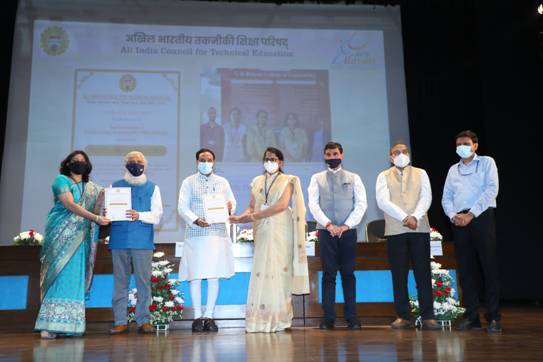
 Union Minister of Education Shri Ramesh Pokhriyal ‘Nishank’ presented the AICTE Lilavati Awards 2020 on women empowerment to the winners in New Delhi today.

Speaking on the occasion Shri Pokhriyal congratulated all the 456 teams who participated in the contest. The Minister said that India is a country where ‘Nari Tu Narayani’ has been an integral part of our ethos and culture. In line with the vision of our Prime Minister, the govt has launched several welfare schemes for the overall development of girls and women in various fields, including Sukanya Samriddhi Yojana, Beti Bachao – Beti Padhao Yojana, etc, he added. Shri Pokhriyal also informed that Government launched Udaan scheme which aims to enable girls of weaker socio-economic status at school level to gain access to higher education. We also started Pragati Yojana to give young women opportunity to further their technical education, he added. Shri Pokhriyal highlighted that the new National Educational Policy has greatly emphasised on gender equality and students should participate in such initiatives to promote women empowerment.

 He welcomed the initiative of AICTE for instituting the Lilawati Awards and stressed that such innovative steps shall be great motivation for girls to join higher education. This initiative will pave a path towards equality in education and innovation, for women

AICTE Chairman Professor Anil Sahasrabudhe said, “I thank Honorable minister Shri Ramesh Pokhriyal ‘Nishank’ for attending the event. AICTE is so happy to present this year’s Lilawati award aimed at empowering womanhood in the nation. Moreover, I congratulate all the teams who submitted the entries. India is a country known for respecting and celebrating the glory of womanhood, and with initiatives like these, AICTE is also contributing its bit to empower the women in our country,” said Sahasrabudhe.

Based on the theme ‘Women Empowerment’, AICTE finalized the winners from a total of 456 entries who competed across 6 sub themes, which include, Women’s Health, Self-Defense, Sanitation and Hygiene, Literacy, Women Entrepreneurship, and Legal Awareness. After analyzing the initial entries, the top 10 entries under each sub-theme were invited for presentation before the two committees headed by Prof Sushma Yadava, Vice-Chancellor, B.P.S. Mahila Vishwavidyalaya Khanpur Kalan, Haryana and Dr. Vinita S. Sahay, Director, IIM Bodh Gaya. 

SWEAT (Sona Women Entrepreneurship and Training) from Sona College of Technology, Tamil Nadu won the contest in the ‘ Women Entrepreneurship’ sub theme. Under the ‘Digital Literacy’ sub theme, Bharatiya Vidyapeeth won the contest. Institute of Management and Entrepreneurship Development Pune won the award under the ‘Literacy’ sub theme. WIT Women Health Coalition from Walchand Institute of Technology, Maharashtra won the award under the ‘Women’s Health’ sub theme. Radiant Seetha from Thiagarajar Polytechnic College won the contest in the ‘Legal Awareness’ sub theme. Finally, Paritrana from St. Joseph’s College of Engineering, Tamil Nadu won the award for the ‘Self Defense’ sub theme. 

Bharatiya Vidyapeeth, who won the award under the digital literacy subtheme suggested that internet revolution that has happened in India post-2014 has played a crucial role in empowering women in the nation. “Post-2014, the internet revolution happened in India, and it has helped women in the country to grow, as information is accessible at their fingertips. However, even now, there are several women in the country who do not have sufficient digital literacy, and we should bring them too to the forefront of the society,” said Bharatiya Vidyapeeth.

LIST OF AWARDEES


Legal Awareness-


Sr. No

Position

Name Of Institute

Name of Team

Team Members

  1.  

Winner

THIAGARAJAR POLYTECHNIC COLLEGE,

TAMIL NADU

RADIANT SEETHA

  1. R. MAHESWARI
  2. M. PONNI
  3. P. KARUNYA DEVI
  4. S. SARANYA
  5. SISTER A.S. CELINE AUGUSTINE MARY
  1.  

1st Runner –Up

NAVODAYA INSTITUTE OF TECHNOLOGY, RAICHIUR, KARNATAKA

WOMEN EMPOWERMENT CELL-NITR


  1. HARSHITA GANGAKHED
  1. M TEJASWINI
  1. GEETA K.M
  1. SHALINI K
  1. CHANNAVEERAMMA E
  1.  

2nd Runner –Up

PONDICHERRY ENGINEERING COLLEGE,

PUDUCHERRY

MALAR

  1. RAJATHY RATHINASAMY
  1. SANTHI GURUSAMY
  1. PALLAVHEE TAMIZHCHELVAN
  1. GUEJALATCHOUMY KOTHANDAPANI
  1. KAVITHA KUMAR RAJENDIRAN
  1.  

LAKSHMI NARAIN COLLEGE OF TECHNOLOGY, MADHYA PRADESH.

UDAAN

  1. AYUSH PURWAR
  1. GARGI DUBEY
  1. MEGHA CHOUBEY
  1. PALAK JAIN
  1. PRAGYA JAIN


Self Defence-

  1.  

Winner

ST. JOSEPH’S COLLEGE OF ENGINEERING,

TAMIL NADU.

PARITRANAS

  1. S. AKSHAYA
  1. DELLECTA JESSY RASHMI
  1. VADAVANNUR CHELLAN RAMAKRISHNAN JAYARAMA PRADEEP
  1. RAMASAMY SREEKANTH
  1. GUNASEKARAN BRINDHA
  1.  

1st Runner –Up

THIAGARAJAR POLYTECHNIC COLLEGE,

TAMIL NADU

SHAKTHI

  1. THEJESWINI V
  1. JAYANTHI C
  1. BHOVANAASHWARI T
  1. UDHAYAKUMAR P
  1. J. AMUL RAJ
 
  1.  

SRI SAI RAM ENGINEERING COLLEGE,

TAMIL NADU.

MAHILA PRATHIRAKSHA ABHIYAAN

  1. K. L. NITHISH RAJA
  1. S. SRIVIDHYA
  1. Dr. M.NITHYA
  1. Dr. K.LATHA
  1. S. SUBHA
  1.  

2nd Runner –Up


VIVEKANANDA INSTITUTE OF TECHNOLOGY,

RAJASTHAN

WARRIORS

  1. DEEPIKA JANGID
  1. TANUSHREE MEHARWAL
  1. RUCHI SHARMA
  1. VANDANA AGARWAL
  1.  

G. H. RAISONI COLLEGE OF ENGINEERING, NAGPUR, MAHARASHTRA

SURAKSHA CHAKRA

  1. MD. AASHIM KHAN
  1. KANCHAN DIYEWAR
  1. VIBHA BORA
  1. BHAKTI PATANKAR
  1. ISHA KHEDIKAR

Sanitation & Hygiene-

  1.  

Winner

SMT. KISHORITAI BHOYAR COLLEGE OF PHARMACY, MAHARASHTRA

SKBCOP ECO CLUB

  1. TANISHKA RANDIVE
  1. PRANJAL TIDKE
  1. DR. RENUKA DAS
  1. SHRUTI NASRE
  2. MR. MANISH AGLAWE
  1.  

1st Runner –Up 

SONA COLLEGE OF TECHNOLOGY, TAMIL NADU

SWSAH (SONA WOMEN SANITATION AND HYGIENE)

  1. PRIYALATHA S
  1. GULSHAN TAJ M N A
  1. PARAMASIVAM S
  1. KANIMOZHI J
  2. RASHMA M
  1.  

ST. JOSEPH’S COLLEGE OF ENGINEERING, TAMIL NADU

VOW –   VIRANGANA OF WASH (WATER SANITATION  HYGIENE)

  1. N HEMAPRIYA
  1. VENKATESAN MUTHULAKSHMI
  1. GANDHIMARUTHIAN LATHASELVI
  1. RENUKA VISWANATHAN
  2. K RAJARAMAN
  1.  

2nd Runner –Up

SRI KRISHNA COLLEGE OF ENGINEERING AND TECHNOLOGY, TAMIL NADU

SKCET SANITATION AND HYGIENE TEAM

  1. KAVIYA S
  1. SUDHIR SOPHIA
  1. KARPAGAM MYLSAMY
  1. R GEETHAMANI R
  2. P A THIRUNAVUKARASU

Women Health-

1.

Winner

WALCHAND INSTITUTE OF TECHNOLOGY,

MAHARASHTRA

WIT WOMEN HEALTH COALITION

  1. DR. RUPALI J.SHELKE
  1. Dr. PRATIBHA YALAGI  ALADEEP
  1. RASHMI DIXIT
  1. DIPALI DILIP AWASEKAR
  2. ROHINI MERGU

2.

1st Runner –Up

POONA COLLEGE OF PHARMACY, MAHARASHTRA

BHARATI PCP SAKHEE

1.VARSHA POKHARKAR

2.ARULMOZHI SATHIYANARAYANAN

3. ASAWARI RAUT

4. MANJUSHA SAJITH

5. SAVITA GOWEKAR

3.

2nd Runner –Up


KUMARAGURU COLLEGE OF TECHNOLOGY,  TAMIL NADU

NATURAL PRODUCTS FOR HEALTHCARE

1. THIYAGARAJAN SATHISH KUMAR

2. KUMARESAN KUPPAMUHTU

3. SOUNDARARAJAN NITHYA PRIYA

4. S. VASUKI

5. S. BHARTHI KAMALA

4.

BIYANI INSTITUTE OF SCIENCE AND MANAGEMENT, RAJASTHAN

BIYANI INSTITUTE OF SCIENCE AND MANAGEMENT

1. SANJAY BIYANI

2. NEETA MAHESHWARI

3. NEHA PANDEY

4. POONAM SHARMA

5. ANJU BHATT

Women Entrepreneurship

1.

Winner

SONA COLLEGE OF TECHNOLOGY TAMIL NADU

SWEAT (SONA WOMEN ENTERPRENURSHIP AND TRAINING)

  1. RAMALINGAM MALATHY
  1. SRINIVASAN PADMA
  1. DHANAKODI RAJA
  1. KRISHNASWAMYPILLAI RANGANATHAN KAVITHA
  2. ARUMUGAM RANJITHKUMAR

2.

1st Runner –Up

ENTREPRENEURSHIP DEVELOPMENT INSTITUTE OF INDIA, GUJARAT

WOMEN EMPOWERMENT

  1. RAJESH GUPTA
  1. BAISHALI MITRA
  1. NIKITA TA
  1. SATYA ACHARYA
  2. RAMAN GUJRAL

3.

2nd Runner –Up

BHILAI INSTITUTE OF TECHNOLOGY

UNMUKTA

  1. MANISHA SHARMA
  1. SHUBHRATA NAGPAL
  1. ARPANA RAWAL

4.

G. H. RAISONI COLLEGE OF ENGINEERING, NAGPUR, MAHARASHTRA.

AATMANIRBHAR

  1. SWAPNA CHOUDHARI
  1. ATUL DESHMUKH

  1. ARCHANA RAUT
  2. BHARGAVI KAKIRWAR
  1. MADHAVI CHAVHAN

Literacy –

1.

Winner

BHARATI VIDYAPEETH ( Deemed to be University) INSTITUTE OF MANAGEMENT & ENTREPRENEURSHIP DEVELOPMENT, PUNE

DIGITAL LITERACY

  1. MS SHWETA TATE
  2. KIRTI GUPTA
  3. ANURADHA YESUGADE
  4. RAJITA DIXIT
  5. HEMA MIRJI

2.

1st Runner –Up

SRI SAI RAM ENGINEERING COLLEGE, TAMIL NADU

SAI STHREE VIDYA ABHIYAAN

  1. S.VASUPRADHA
  2. Dr. SOMA PRATHIBHA
  3. Dr. N. MANI
  4. B. PRIYA
  5. M. SIVA  SANKARI

3.

2nd Runner –Up

HYDERABAD INSTITUTE OF TECHNOLOGY AND MANAGEMENT, HYDERABAD

We-Lit

  1. DEVIKA SUGGUBODI VENKATESWARLU
  1. ARVIND SIDDAPURAM
  1. SURESH AALURI
  1. JOYTHSNA K
  2.    SMT. SUSHEELA DEVI 

4.

SRI MANAKULA VINAYAGAR ENGINEERING COLLEGE, PUDUCHERRY

SUPER SONIC

  1. PAVITHRAN.T
  2. ARVIND.K
  3. BALAMURALI.M
  4. HARINI.G
  5. JASMINE.A


*****

‘SARTHAQ’, the NEP Implementation Plan for School Education

 Union Education Minister chaired a high level meeting on implementation of NEP-2020 in New Delhi today. Secretary, Higher Education, Shri Amit Khare; Secretary , School Education, Smt Anita Karwal and senior officials of the Ministry were present in the meeting.


In pursuance of the goals and objectives of the National Education Policy (NEP) 2020 issued on 29th July, 2020 and to assist States and UTs in this task, the Department of School Education and Literacy has developed an indicative and suggestive Implementation Plan for School Education,called ‘Students’ and Teachers’ Holistic Advancement through Quality Education (SARTHAQ)’. This implementation plan was released today by the Education Minister Shri Ramesh PokhriyalNishank also as a part of the celebrations leading to the AmritMahotsav on 75 years of Indian independence.

In a significant achievement, under the leadership of Prime Minister Shri Narendra Modi, the  Government has rolled out the Plan of Action of National Education Policy 2020 well within one year.

The plan keeps in mind the concurrent nature of education and adheres to the spirit of federalism. States and UTs are given the flexibility toadapt this plan with local contextualization and also modify as per their needs and requirements. This implementation plan delineates the roadmap and way forward for implementation of NEP, 2020 for the next 10 years, which is very important for its smooth and effective implementation.

SARTHAQ has been developed through wide and intensive consultative process with States and UTs, Autonomous bodies and suggestions received from all stakeholders; around 7177 suggestions/inputs were received from them. A teacher’s fest, ‘ShikshakParv’ was especially organized from 8th to 25th September 2020 for discussing various recommendations of NEP 2020 and its implementation strategies, which attracted around 15 lakh suggestions. 

Speaking on the occasion,ShriPokhriyal urged all the stakeholders to use this plan as a guiding star to undertake transformational reforms in the school education sector. He said that like the policy itself, the plan is also interactive, flexible and inclusive. The major focus of SARTHAQ is to define activities in such a manner which clearly delineate goals, outcomes and timeframe i.e., it links recommendation of NEP with 297 Tasks along with responsible agencies, timelines and 304 outputs of these Tasks. Attempt has also been made to propose activities in a manner, such that it will be built upon the existing structure rather than creating new structures. Thus, SARTHAQ takes care of the spirit and intent of the Policy and is planned to be implemented in a phased manner.

SARTHAQ has also been prepared as an evolving and working document and is broadly suggestive/indicative in nature and will be updated from time to time based on the inputs/feedback received from the stakeholders.

Following outcomes have been envisaged for entire education system afterimplementation of SARTHAQ:

  • New National and State Curriculum Frameworks for School Education , Early Childhood Care and Education, Teacher Education and Adult Education will be developed encompassing the spirit of NEP and will pave way for curriculum reforms
  • Increase in Gross Enrolment Ratio (GER), Net Enrolment Ratio (NER), transition rate and retention rate at all levels and reduction in drop outs and out of school children.
  • Access to quality ECCE and Universal Acquisition of Foundational Literacy and Numeracy by Grade 3.
  • Improvement in Learning Outcomes at all stages with emphasis on teaching and learning through mother tongue/local/regional languages in the early years.
  • Integration of vocational education, sports, arts, knowledge of India, 21st century skills, values of citizenship, awareness of environment conservation, etc. in the curriculum at all stages.
  • Introduction of Experiential learning at all stages and adoption of innovative pedagogies by teachers in classroom transaction.
  • Reforms in Board exams and various entrance tests.
  • Development of high quality and diversified teaching-learning material.
  • Availability of text books in Regional/local/home language.
  • Improvement in quality of Teacher Education Programmes.
  • Improvement in quality of newly recruited teachers and capacity building through Continuous Professional Development.
  • Safe, Secure, inclusive and conducive learning environment for students and teachers.
  • Improvement in infrastructure facilities including barrier free access and sharing of resources among schools.
  • Uniform standards in learning outcomes and governance across public and private schools through setting-up of an online, transparent public disclosure system through establishment of SSSA in states.
  • Integration of technology in educational planning and governance and availability of ICT and quality e-content in classrooms.

SARTHAQ will pave the way for our children and youth to meet the diverse national and global challenges of the present and the future and help them to imbibe 21st century skills along with India’s tradition, culture and value system as envisioned in National Education Policy 2020. ShriPokhriyal stated that it is envisaged that the implementation of SARTHAQ would benefit all stakeholders including 25 crore students, 15 lakh schools, 94 lakh teachers, Educational Administrators, Parents, and community as education is the backbone of an equitable and just society.

*****

Life of Pi by Yann Martel

Life of Pi is a Canadian philosophical novel by Yann Martel published in 2001. The novel has sold more than ten million copies worldwide. It was rejected by at least five London publishing houses before being accepted by Knopf Canada, which published it in September 2001. The UK edition won the Man Booker Prize for Fiction the following year. It was also chosen for CBC Radio’s Canada Reads 2003, where it was championed by author Nancy Lee.

Book Summary

This is a story about a young man named Piscine Patel, or Pi, whose family owns a zoo in India.  Growing up, Pi is interested in religion and so he converts to each of the major religions:  Christianity, Islam, and Hinduism. The family decides to move to Canada, but on the way there, their ship sinks and Pi finds himself on a lifeboat with a tiger, Richard Parker, a hyena, a zebra, and an orangutan.  

Pi manages to keep himself separated from the other animals and all he can do is watch as the hyena kills the zebra and orangutan. Pi is afraid that he will be next to be killed, but the tiger kills the hyena. Pi decides to build an adjoining raft that is connected to the lifeboat by rope and luckily finds survival supplies, such as food and water.

Instead of waiting for the tiger to die, Pi decides he must train the tiger to ensure his own personal survival.  Pi learns to fish and begins feeding the tiger, slowly training and taming him.

As food and water supplies dwindle, Pi suffers from health problems such as blisters and dehydration. He also becomes temporarily blind.  Pi encounters another blind man who is also floating on a boat.  However, the man comes aboard and the tiger eats him.

When Pi’s eyesight returns, he sees an island in the distance.  He arrives on the island and finds algae that he can eat.  The island has fresh water and is home to a large meerkat colony who eat fish. Life on the island is great, but then Pi realizes that the algae is carnivorous and so he gets back on the boat with the tiger and heads off.

The boat eventually reaches Mexico and Pi is rescued.  In the end, Pi is questioned by investigators about his journey and despite being skeptical, they believe his story.

Analysis

A lot can be said about this story, but what draws my interest and attention is the idea of how a zoo can actually be more beneficial for a wild animal than the wild.

Pi goes to great lengths to explain how harsh conditions are for wild animals and how nice life in a zoo really is.  We tend to have a romantic sense of what the wild is like for animals, but the reality is that animals in the wild are either looking for food or trying not to be food for something else.

It seems like a stressful existence in the wild, where each day could be your last and you are literally playing a game of life or death.  And most humans wouldn’t be able to survive in the wild, especially since we’ve modernized ourselves to the luxuries of technology and civilization.

This also brings a greater appreciation to what we, as humans, have done with our food and safety needs:  bringing them closer to us in a more controlled environment.

It’s comforting to know that our food is about twenty feet away from us whenever I want and if we run out of food, we can go to a building that has more food for us to buy.

We and our possessions are safe from the weather and we don’t need to worry about being attacked by predators.

So while it may seem lonely that the animals in zoos are confined to a limited space, we are looking at them through the eyes of a species that has, for the most part, everything it needs within reach.  We are smart enough to understand that protecting ourselves and surviving that way is far greater than being free in the wild and nature. 

The Pre-Raphaelite Poetry

The Pre-Raphaelite movement was started by two German painters based in Rome in 1810. The movement drew inspiration from Italian painters before Raphael such as Giotto, Bellini, and Fra Angelico. The movement was concerned with the art of painting. The Pre-Raphaelite Brotherhood was a group of English painters, poets, and art critics. It was formed in England in 1848 by William Holman Hunt, John Everett Millais, Dante Gabriel Rosetti, William Michael Rosetti, James Collinson, Frederic George Stephens, and Thomas Woolner who formed a seven-member “Brotherhood” modeled in part on the Nazarene movement. The Brotherhood was only ever a loose association and their principles were shared by other artists of the time, including Ford Madox Brown, Arthur Hughes, and Marie Spartali Stillman. Later followers of the principles of the Brotherhood included Edward Burne-Jones, William Morris, and John William Waterhouse.

The Pre-Raphaelite Brotherhood, founded in September 1848, is the most significant British artistic grouping of the nineteenth century. Its fundamental mission was to purify the art of its time by returning to the example of medieval and early Renaissance painting. Although the life of the brotherhood was short, the broad international movement it inspired, Pre-Raphaelitism, persisted into the twentieth century and profoundly influenced the aesthetic movement, symbolism, and the Arts and Crafts movement.

Firstly, Dante Gabriel Rossetti’s Girlhood of Mary Virgin (1849), in which passages of striking naturalism were situated within a complex symbolic composition. Already a published poet, Rossetti inscribed verse on the frame of his painting. In the following year, Millais’s Christ in the House of His Parents (1850) was exhibited at the Royal Academy to an outraged critical reception. The master of a brilliantly naturalistic technique, Millais represented biblical figures with closely observed portrayals of the features of real, imperfect models. In 1850 the Pre-Raphaelites also produced a literary and artistic magazine, the Germ, which was something of a manifesto for their artistic concerns and ran for only four issues.

The Girlhood of Mary Virgin by Dante Gabriel Rosetti

From the first, the Pre-Raphaelites aspired to paint subjects from modern life. In The Awakening Conscience (1854), Hunt represented a kept woman realizing the error of her ways, and in 1852 Madox Brown began the most ambitious of all Pre-Raphaelite scenes from modern life, Work (1852–1865). Although the brotherhood included no women, Christina Rossetti, sister of Dante and William, pioneered a Pre-Raphaelite style in poetry, and Elizabeth Siddall-model, muse,
and eventually wife of Dante Gabriel Rossetti-produced distinctive watercolors and drawings that went unrecognized in her lifetime but received critical attention after the advent of feminist art history in the late 1970s.

The Awakening Conscience by Hunt

Another element in Pre-Raphaelite poetry is perceived in love for beauty. The Pre-Raphaelite poets are lovers of beauty. Here they are the followers of the great poetic creed of Keats. In their rich sensuousness, they are also found to carry on the tradition of great romantic poetry. They are also found to be medievalistic in their attachment to the medieval past. This also constitutes another romantic aspect of Pre-Raphaelitism. Their attempt to follow Byron’s revolutionary spirit and Shelley’s inspiration for loveliness does not appear to have much succeeded, yet these elements are not ignorable in them. Pre-Raphaelite poetry, in this respect, appears to be the second phase of Romanticism in the nineteenth century. This, however, appears to lack in humanism and the idealistic vision of human life, so much marked in romantic poetry. The Pre-Raphaelite poets aimed at infusing the art and spirit of the Pre-Raphaelite painters into poetry.


Youth Source Of Endless Energy.

Nathan Thomas, who was president of the Raleigh Midtown Rotary Club at age 23 and will become district governor in 2022-2023, witnessed the joy firsthand. Thomas, now 27, founded All We Are, a non-profit organization that oversees the Solarize Uganda Now (SUN) project. Working together, they secured a $2,000 grant from the clubs committee on international affairs to install LED lighting at a school and shelter for underprivileged young women in Uganda.

He invented the “International Youth Party” because it symbolized the movement and was a good pun. Abby Hoffman and the Yippies first proposed a “Festival of Life” in the park prior to the 1968 Democratic National Convention in Chicago.

First, it was intended to strengthen the reputation of the coal industry. Second, it was designed to secure coal as the main source of energy in today’s post-war society. It is one of nine paintings in a series commissioned in 1945 by the Coal Institute and the Benton and Bowles advertising agency. In this context, we might wonder what place this 1945 work occupies, which supposedly glorifies the power of industry over the common people, the workers.

It’s all about attitude, they say, as if attitude itself isn’t determined by energy. It often turns out that it is energy, strength and motivation that are not enough to achieve goals. Only the right profession can become an endless source of energy and strive for continuous improvement. The dedication, hard work and desire for knowledge of young people will not only help them lead a fulfilling life, but will also become their contribution to society.

It is important to recognize the role of young people in the success story and to educate and motivate them to build a better society. Hence, it is well said that youth is the powerhouse and storehouse of infinite energy and the pride of society. Our budding youth are seen as the future power as the leader of the nation. Needless to say, promising young people are seen as the future power as the leader of the nation.

They make the best decisions in life and are full of spark, courage, and work to bring about positive change in society. Youth activism is participation in a community organization for social change. If anyone can view young people as a national savings account, he should know that today it is like an investment, he will benefit from it in the next few years.

An immense amount of energy, feelings and enthusiasm in the blood, passion in the body, will know that these are the qualities of a young man. But a young person turns these hardships, stresses and problems into responsibility, passion and will, and this is the power of energy that young people have. The burden can be stress at work, money problems, not being able to get the job you want, not being able to do exactly what you want, being rejected, choosing the wrong path, etc.

In the battle of life, problems and difficulties will arise at every moment of life. Only young people can easily deal with these difficulties and win the battle of life. My hope is for you, “Imagine the power of boundless energy that a young man has, a great man putting his hopes in his youth. You can be young, smart, and hopeful, but if you feel it 100% of the time Frustrated and lethargic, then all your youth and potential is meaningless. Without the energy and ability to act and fulfill, all your best intentions don’t count as licking.

Energy is fuel. It inspires all the good things in life, whether it’s creativity, productive work, innovative solutions to life’s problems, personal development, rich relationships with others, or simply having a strong body, a clear mind and intense happiness from emotional well-being. The great thing about energy is that it nourishes and encourages oneself in a certain way. Energy, whether mental or physical, is like your personal life context.

You can think of energy as the most primitive and fundamental type of wealth. After all, we are all living beings; we are all organisms that need energy to work, move, communicate, and live. It doesn’t matter how many other good things happen in your life; if you don’t have the energy to interact with them properly, appreciate them, bring them to life, it’s like there are none of those good things at all.

The idea that you can train, train, or even heal in a constant state of enthusiasm, charisma, and contentment lends an air of devotion to the energy appreciation dance. Individuals endowed with it may attribute this to their virtue, perseverance, or self-discipline, and sometimes use the descriptor “low energy” as mild, as if Eeyore are contagious. Or it could be kindness, consideration, optimism, humor, the ability to make other people feel good.

The energies of B. and M. are of different types that you project or perceive in others, but are related. It is clear that despite our best efforts, energy is not distributed evenly due to heredity or fate, nature or upbringing. Victini (Pokemon) can generate unlimited energy that he can share with others to ensure absolute victory.

By removing his Inhibitor Rings and becoming a Shadow of Chaos, Shadow the Hedgehog (Sonic the Hedgehog) can absorb an infinite supply of Chaos Energy, becoming a raw and uncontrollable dynamo of power. Using food immersion, Toriko can absorb and store more nutrients from food in his body than normal, allowing him to store an almost unlimited amount of energy and survive for abnormal periods of time without food or water. Jugosa’s (Naruto’s) body constantly absorbs natural energy, providing him with an infinite supply of life energy to use at will, although it also corrupts his sanity from time to time.

The energy of this water cycle, which is powered by the sun, can be used to generate electricity or for mechanical activities such as grinding grain. Since the water cycle is an endless and constantly recharged system, hydroelectricity is considered a renewable energy.

There are various types of hydroelectric power plants; they all feed on the kinetic energy of the water flowing downstream. Turbines and generators convert energy into electricity, which is then fed into the power grid for use in homes, businesses, and industries. Aerobic metabolism uses oxygen from the blood as a way to produce energy.

Specifically, the researchers looked at how energy production and recovery rates after exercise differ between children (young male participants aged 8 to 12), endurance athletes, and adults who were not trained athletes.

In the lab, he hooked up subjects to an oscilloscope (one of them was the young Willy Brandt, future chancellor of West Germany) and, using a microscope, discovered pulsating particles he called “bions”, which he said were the source of a mysterious life force called orgone. . Rockwell Kents’ Infinite Energy for Infinite Life presents the vital role of man in turning coal into energy.

Need To Inculcate Healthy Dietary Habits

At the family level, recommendations for feeding infants should include information about their nutritional needs and strategies to promote healthy eating behaviors, including recognizing hunger and satiety cues in children and using appropriate food interactions. by modeling and avoiding stress and conflict while eating. When children switch to a family diet, the recommendations are not only about food, but also about the nutritional context. Healthy eating is not only about including healthy food in children’s diets. Healthy eating is an important part of a healthy lifestyle and should be taught from an early age.

A healthy diet and proper eating habits for your children can help them become stronger, healthier and more immune. Following a weekly meal and snack plan can also instill disciplined eating habits from an early age. Eat with them. Eating healthy, nutritious food like a family with kids can really help instill healthy eating habits in them. In addition, family meals are an opportunity for parents to introduce their children to new foods and become role models for healthy eating.

Kids love the predictability of family meals, and parents have the opportunity to keep up with their kids. Family meals together are how children learn to choose healthy foods and learn table manners. If you insist that the children sit with you, even if they are not ready for solid food or refuse to eat, they will begin to learn the rules of the dinner.

Educate your little eaters about healthy eating and the different types of essential nutrients and let them enjoy their meal. Make it easy for kids to choose healthy snacks by keeping fruits and vegetables ready to eat.

Do not buy single servings of snacks, yogurt and other products that cost more. Instead, buy in bulk or more and divide into smaller portions as needed.

Stick to real foods like vegetables, fruits, nuts, lean meats, low-fat dairy and whole grain pasta, rice, and bread. Eat a diet that is 45% carbs, 30% protein, and 35% fat that is good for you: olive oil, fish, or nuts. While you want to eat 5 to 6 meals and snacks a day, don’t overeat at any of your meals and make sure you choose healthy, nutrient-dense foods. Pay attention to when and what you eat, and pay attention to your behavior and feelings associated with food.

That way, you’ll be more likely to eat healthier foods and less likely to eat unhealthy foods. Instead of focusing on what you shouldn’t eat, think about what you can add to your plate to improve your health, like walnuts for heart-healthy monounsaturated fatty acids or raspberries for fiber and antioxidants. By eating fruits and vegetables rather than overeating less nutritious things, you are sending the right message.

Eating healthy foods and staying physically active can help you achieve and maintain a healthy weight and feel better. You may also find that moving more and eating better can help you cope with the demands of your busy life and be around the people who depend on you. By making healthy lifestyle choices together, you may find it easier to move more and eat better.

You can go for a walk after dinner or play frisbee with your kids. Just 15 minutes of light physical activity within 30 minutes of eating can help you reach your calorie expenditure goal, curb late-night cravings that lead to snacking, and may even help you sleep better. Research shows that optimistic people are more successful at changing their behavior, including healthy eating and weight loss. Your family, friends, and colleagues can be a great source of support as you strive towards healthier habits. Not only can our physical health improve when we prioritize healthy eating. Healthy eating can stabilize children’s energy, sharpen their minds, and even out their moods.

It also helps children feel good, maintain a normal weight, and have enough energy to go to school and play. A balanced diet is the key to a healthy diet because it provides children with the nutrients they need to grow. Regular meals throughout the day are essential to keep your child active and help them focus while they study. Some kids in this age group are still fussy, so offer them a variety of regular foods, meals, and snacks, and let them eat according to their appetites, without forcing or arguing. If children are allowed to eat according to their appetite, they can decide how much food they need for activity and growth.

Meal sizes vary because the amount of food a child needs depends on what else they eat during the day. Children continue to learn new cooking techniques and ideas when dining out. They can participate in the preparation of packed lunches and help their caregivers prepare healthy meals. Their “job” is to ensure that children are served healthy meals on a predictable schedule in a pleasant environment. 39 By developing meal schedules, caregivers can help children learn to predict when they will eat. Babies need three healthy meals and two snacks for physical development and immunity.

However, many can testify that getting children to eat healthy food is not always easy. Parents who teach their children about healthy eating from an early age can have a positive impact on their children’s eating habits later in life. Over the years, researchers have found evidence that eating behaviors and eating habits in early childhood affect the food preferences and eating patterns of children in adulthood.

Healthy eating during adolescence is important because changes in the body during this period affect a person’s nutritional and dietary needs. Instilling good eating habits in children can be very easy for parents if they set the right example. In addition to the level of education, an important element in achieving a healthy diet is the internalization of eating habits that make it possible.

We have seen that these habits increase with the age of the respondents. First, we noticed that with age, the socio-economic and living situation of the respondents stabilizes, which contributes to their eating habits becoming more regular and healthy, and at the same time, the awareness of the respondents of the need to lead a more regulated and healthy lifestyle increases. Thus, as the study “The influence of age and gender identity on the health of university students in eating in Spain”, on which this article is based, shows, all respondents know what a healthy diet is due to their high educational level. In particular, students who are most interested in healthy eating are also most concerned about buying foods that they believe are healthy.

NPST and NMM

 Union Education Minister Shri Ramesh Pokhriyal ‘Nishank’ today launched the “MyNEP2020” Platform of NCTE Web Portal. The platform seeks to invite suggestions/inputs/membership from the stakeholders for preparing draft for development of National Professional Standards for Teachers (NPST) and National Mission for Mentoring Program membership (NMM). The “MyNEP2020” platform will be operational from 1st April 2021 to 15th May 2021.

This exercise of digital consultation envisages the participation of teachers, education professionals, academicians, & other stakeholders in preparing the documents on teacher policy for sustainable and positive change in the Teacher’s Education Sector. For preparing the documents on above two major recommendations of NEP 2020, NCTE will work in close consultation with individuals/organizations.

Expert committee will extensively review the inputs collected during the consultation period and will finally formulate the Drafts for public review. Comments by the reviewers from the stakeholders will then be used to prepare a final Draft for notification.

*****