WHAT IF 1RUPPEE IS EQUAL TO 1 DOLLAR ?

Before we get to that point we need to know the contrast between the two currencies. Dollar is considered as the strongest currency in the World. Each country in this World needs to have their cash as solid as Dollar since it is accepted that Stronger money = Stronger Economy. Be that as it may, is it in every case valid ? Since Countries like Japan and China have lower cash yet they are checked under nations with Strongest Economy.

So how is that conceivable that notwithstanding having the more fragile cash they have solid economy ? Fundamentally it relies upon , regardless of whether a nation is trade(export) orientated or import orientated ? The nations which purchases items or work from different nations are called import situated nations and these nations like to keep their money esteem higher so they can purchase merchandise from different nations at modest expense. Then again , nations which offer merchandise to different nations are called send out(export) orientated nations and these nations like to keep their cash esteem low so different nations purchase more and their creation builds which befits the economy. Nations like USA are import orientated while nations like China are trade orientated.

Currency - Overview, Origin, Foreign Exchange Trading

So what kind of nation is India is it import orientated or trade orientated ? India purchases products from different nations so it is significantly import orientated, yet larger part of India’s economy comes from exportation. India gives best specialists to I.T Sectors . At the point when organizations of different nations visit India they employ our people to work for them which consequently offers advantage to our economy. Numerous financial analyst accept that our economy ought to be more lower , while some accept that it ought to be higher.

india gdp growth: Indian economy to contract by 7 pc in FY21: SBI Research  - The Economic Times

PROS OF THE SITUATION:

*With more grounded rupee imports would be less expensive; you could now get the most recent iPhone for only 1000 INR. So everybody would claim an iPhone if 1 USD rises to 1 INR.

*Purchasing products from different nations in a global market will be less expensive which is advantageous for a non-industrial nation.

*Unrefined petroleum costs would go down significantly which we import the most, in this way the cost of petroleum and diesel will fall making the transportation cost modest if 1 USD approaches 1 INR.

*As the transportation cost would diminish the items that are made in India would be less expensive and effectively accessible to purchase.

*One would not travel abroad for a task. For instance, in the event that they get 3000$ abroad that will simply be equivalent to 3000 INR. So why bother voyaging? Yet, there is another side to it as well.

CONS OF THE SITUATION:

*Full stop on sends out we can trade merchandise due to the money contrast. The fares will become costly and on the off chance that we contrast Indian items if and other cutthroat nations, we will turn out to be far more costly and this will hamper our fares which isn’t useful for our economy.

*No unfamiliar venture: unfamiliar organizations put resources into India because of modest work now if an organization used to pay the laborer Rs20000 that is 300$ now they need to pay them 20000$ so they would begin putting resources into different nations as opposed to in our own if 1 USD approaches 1 INR.

*We will confront financial closure and expansion in joblessness for instance if my organization beneficiaries a designer from India for Rs75000 that is around 1000$ and if 1INR = 1 $ for what reason will I pay quite a lot more to the Indian specialist when I have choices. In this way, the Indian laborers need to deal with less expense or leave the work. The equivalent would occur with different callings too.

*In case they are chipping away at such a lot of lower compensation how might they pay their EMI? They proved unable. Joblessness will influence the banks as advances would be left neglected.

*We will confront financial log jam as cash would not be exchanged at a similar speed if 1 USD approaches 1 INR.

RESOUCES:

  1. https://infokoala.com/what-if-1-usd-equals-1-inr/
  2. https://www.youtube.com/watch?v=tfLd329ovRI

Health and Fitness

Staying healthy and fit are directly proportional to each other. In order to lead a healthy and fit life we need to focus on some prime practices which will not only make us physically fit but will also provide us with peace of mind. Staying heathy and fit keeps us away from diseases and thus its medications and side effects. A healthy body homes a healthy mind, and a healthy mind boosts the productive thoughts help us to deal life with positivity in a healthy way. But staying healthy and fit requires discipline, one must have a balanced diet, eating less never makes someone healthy and fit whereas eating the right nutritious food in the right quantity does so. A healthy diet must constitute of all the five nutrients as well as water and roughage. Starving is highly not recommended, giving the body the required nutrients is important. In order to stay fit and healthy one must also regularly practice yoga and physical exercise; these enables movement of each and every part of the body and thus ensures its flexibility also ensures growth and increases stamina. Staying away from negative environment and people is another major practice which is encouraged in order to ensure a healthy and fit body.

If you want to start your journey a having a better body to feel great, here are some tips :

* Exercise daily for at least an hour

* Eat the Right foods and portion each meal.

* keep track of calories and food intake per day.

* Be sure to get sleep.

* Stay motivated.

5 components of physical Fitness :

* cardiovascular Endurance.

* Musular strength.

* Muscular endurance.

* Flexibility

* Body composition.

* The difference between fitness and health is Health is defined as a state of complete mental, physical and social well- being, not merely the absence of illness or infirmity. Fitness is the ability to meet the demands of the environment.

* The connection between health and fitness is physical fitness, by its very nature, significantly strengthens the bod’s immune system. Therefore, it may substantially reduce the likelihood of liness and disesase, and well as improve the way the body copes with illnesses when they occur.

* The three categories of health fitness and wellbeing is physical, emotional and social wellbeing.

Why is health and fitness so important?

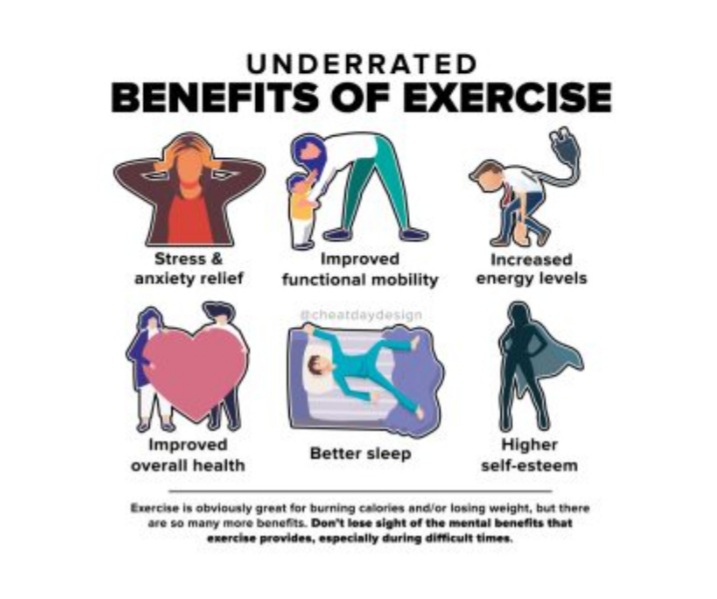
Regular exercise and physical activity promotes strong muscles and bones. It improves respiratory, cardiovascular health, and overall health. Staying active can also help you maintain a healthy weight reduce your risk for type 2 diabetes heart disease and reduce your risk for some cancers.

* There are six skill- related fitness components: agility, balance, coordination speed, power and reaction time. skilled athletes typically excel in all six areas. Agility is the ability to rapidly and accurately change the direction of the body

* The principles of specificity, progression, overload, adaption, and reversibility are why practising frequently and consistenly are so important if you want to improve your performance.

The health benifits of exercise :

* helps you contro your weight.

* Reduce your risk of heart disease.

* Help your body manage blood sugar and insulin levels.

* Help you quiet smoking

* Improve your mental helath and mood.

* Help keep your thinking , learning and judgement skills sharp as your age.

* Exercise prescription is based on 5 priniciples are type, duration, frequency, intensity and volume.

So stay healthy and stay safe . This pandemic days wants more food to our bodies to get more immunity. Be fit and Be happy . We fight with this covid with our lifes . Be strong these are all will helps to us.

IN A NEW PUSH FOR DRONE USE,GOVERNMENT EASES NORMS

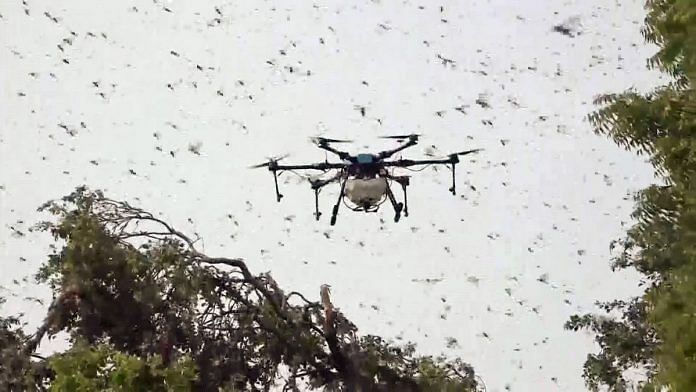
The Ministry of Civil Aviation released certain draft policy for drones on Thursday which brings more safety features and appears to address some problems in India’s nascent unmanned aerial vehicle (UAV) industry regarding the compliance norms outlined earlier.

The draft policy, titled Drone Rules 2021, will replace the Unmanned Aircraft System (UAS) Rules 2021, which came into force in March this year. It is open for public suggestion till August,5. After taking the comments into consideration, the final rules are expected to be issued that will replace the stricter UAS rules.

CHANGES:

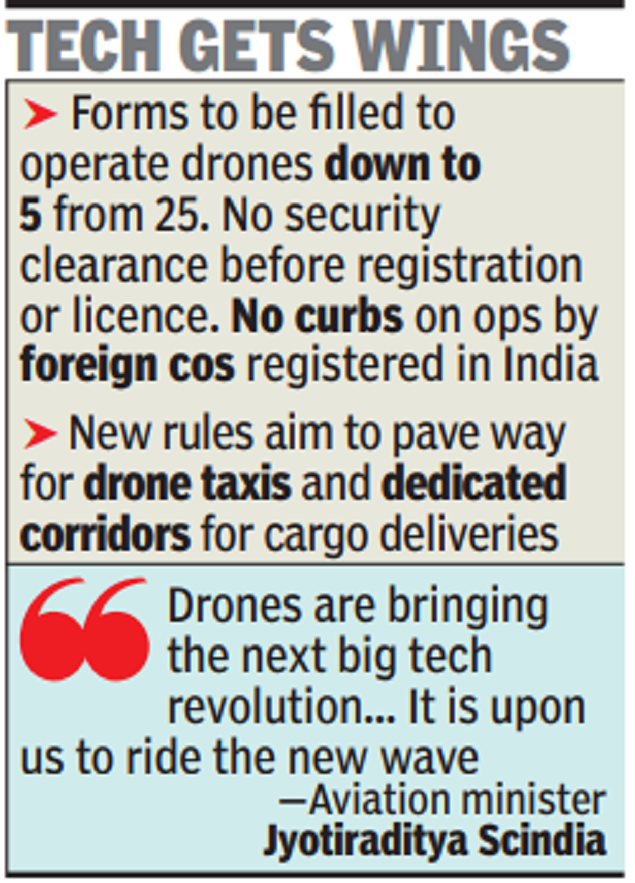
“On the premise of basis of trust, self-certification, and non-intrusive monitoring”, the draft policy reduces the number of approvals required by applicants. It brings down the number of forms from 25 to 6 under the UAS Rules, and reduces fees for certain approvals. Also it proposes mandatory safety features like ‘No permission – no take-off’. It provides easy process for transfer and de-registration of drones. There is no pilot license required for Nano drones Real-time tracking beacon and geo-fencing are to be quipped. Drone owners who don’t have these installed will have to incorporate them within six months of the rules coming into effect, the draft policy states. Under new rules, manufacturer can develop their drone’s unique identification number on digital sky platform through self certification route. According to this new policy, there will be no restriction on drone operations by foreign owned companies in India. The fees for using drones will also be cut short. The maximum penalty under new rules will becaped at rupees 1 lakh.

These changes has got a great thumbs up from the industry.

Arjun Aggarwal, MD of drone major Aero arc, said the change will “give impetus to an ‘aatmanirbhar’ drone eco-system”. Scindia tweeted: “Drones are bringing the next big tech revolution around the globe with reduced costs, resources and time taken for operations. It is upon us to ride on the new wave and facilitate its uptake, especially among our startups”.Dubey said “rules have to evolve” with the “pace of change in drone technology”. “Drone Rules 2021 are just a step in that direction. Drone rules in 2025 and 2030 could be completely different from this. The government works closely with the drone academia and industry. In their success is India’s success,” he added.   

Women in Indian Military

Yes! you read it right! Women are recruited in the Indian Military

Deployment of Women in Armed Forces

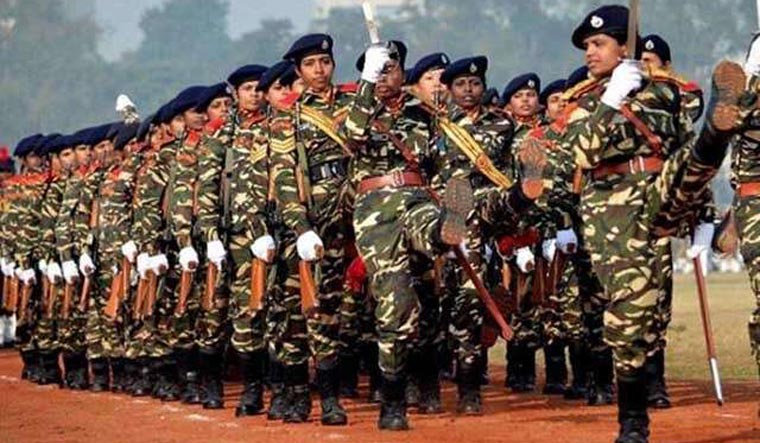
  • The Army, Air Force and Navy began inducting women as short-service commission (SSC) officers in 1992.(This was the first time when women were allowed to join the military outside the medical stream.)
  • One of the turning points for women in the military came in 2015 when Indian Air Force (IAF) decided to induct them into the fighter stream.
  • In 2020, the Supreme Court (SC) ordered the central government to grant permanent commission (PC) to women officers in the Army’s non-combat support units on par with their male counterparts.
  • In early 2021, the Indian Navy deployed four women officers on warships after a gap of almost 25 years. India’s only aircraft carrier INS Vikramaditya and fleet tanker INS Shakti are the warships that have been assigned their first women crews since the late 1990s.
  • In May 2021, the Army inducted the first batch of women into the Corps of Military Police, the first time that women joined the military in the non-officer cadre.

Number of Women in Armed forces

  • There are 9,118 women currently serving the army, navy and air force.
  • According to 2019 figures, women comprise only 3.8% of the world’s second-largest army – compared to 13% of the air force and 6% of the navy.

Why is it Important?

  • Gender is not a Hindrance: As long as an applicant is qualified for a position, one’s gender is arbitrary. In modern high technology battlefield technical expertise and decision-making skills are increasingly more valuable than simple brute strength.
  • Military Readiness: Allowing a mixed gender force keeps the military strong. The armed forces are severely troubled by falling retention and recruitment rates. This can be addressed by allowing women in the combat role.
  • Effectiveness: The blanket restriction for women limits the ability of commanders in theater to pick the most capable person for the job.
  • Tradition: Training will be required to facilitate the integration of women into combat units. Cultures change over time and the masculine subculture can evolve too.
  • Global Scenario: When women officially became eligible for combat positions in the American military in 2013, it was widely hailed as another step towards the equality of sexes. In 2018, the UK military lifted a ban on women serving in close combat ground roles, clearing the way for them to serve in elite special forces.

Conclusion

  • Women were being kept out of command posts on the reasoning that the largely rank and file will have problems with women as commanding officers. Thus, changes have to take place in the culture, norms, and values of not only the rank and file of the Army but also that of society at large. The responsibility to usher these changes lies with the senior military and political leadership.
  • The United States, Israel, North Korea, France, Germany, Netherlands, Australia and Canada are among the global militaries that employ women in front-line combat positions.
  • It is the right of every woman to pursue a career of her choice and reach the top since Equality is a constitutional guarantee.

How to discover what you're obsessed with:

A common theme in most writing on goal setting is that the ought to follow your passions. Do the items that cause you to need to induce up early within the morning. There’s only 1 factor missing:

What if you don’t have any passions?

I’m positive everybody on this planet has interests. however that’s not constant factor. Enjoying enjoying video games isn’t constant as defrayment thousands of hours coming up with your own. Your passion should be one thing you’d work exceptionally arduous for.

So what does one do, if there’s nothing you are feeling that engaged about?

The thanks to begin Isn’t With a Survey…A lot of career steerage involves measure your current skills and temperament, then deciding what you’d be most fitted to. I don’t like this approach as a result of individuals area unit complicated. And any check can ultimately be a gross simplification of what’s necessary to you and what you wish to try to to.

The truth is, I don’t assume any form will tell you what you’re attending to be extremely engaged concerning. I’d rather experiment with dozens of wildly totally different activities, than limit my scope, simply because a check aforesaid I wouldn’t love it.

How to realize Your PassionsThe better approach to finding your passions is truly fairly simple:

strive a great deal of various things See what you relishThe biggest obstacle to beat could be a slender vision of what you’ll do. If I wasn’t turbulently curious about something, I’d attempt to solid a large web to appear at dozens of various activities. Staying safe and acquainted is that the reason I’m bored, thus now could be the time to experiment.

Dabbling is vital to the art of finding what drives you. Dabbling means that committing to one thing for 3-6 months. This quantity of your time isn’t enough to become specific at something. however it’s enough time to induce over the sharp learning curve within the starting.

I didn’t relish programming for the primary few months I worked thereon. I didn’t recognize enough, and it absolutely was too frustrating to continue. however once I got over the frustration barrier, I found that programming is associate activity i actually relish.

If you don’t have any project that creates you wish to come to life early and sacrifice leisure for, you must begin dabbling. realize new activities fully outside your temperature you’ll do for many hours every week, and commit for a minimum of 2 months.

Sometimes you would like a Spark…Sometimes the matter with a passion isn’t the activity, however the goal. I enjoyed functioning on tiny successful comes. however it wasn’t till I saw that individuals truly created self-run businesses out of these efforts that I became extremely engaged. till that time, my goal was simply to dabble in one thing fun. then purpose, i noticed there was area for a difficult goal I hadn’t thought-about before.

Equally necessary to dabbling in activities is to dabble in experiences. Meet individuals from weird and distinctive backgrounds. scan books that don’t commonly seem on your shelf. Randomness will increase the prospect that one amongst your interests are sparked into one thing additional.

Always explore for additional Dabbling could be a continuous method. Committing yourself to at least one goal is sweet. however that ought to still leave time for temporary experiments. If you’re continuously dabbling, you’ve got an outsized base of passions you’ll do attention-grabbing work from. Don’t tolerate tedium.

THE NAME YOU KNOW, THE STORY YOU DON’T

ARUNIMA SINHA

An Indian mount climber and a sportswoman ARUNIMA SINHA is the first female amputee to climb Mount Everest. She is also former seven times Volleyball national player.

As usual she was travelling in local, soon after this some robbers came to her and asked her to give her gold chain, but she refused and after she refused the robbers got vigorous and pushed her from that running rain in the year. This incident resulted in the damaged, in her both legs, she got her left leg amputated below the knee, and got rods in her right leg and her spinal cord got multiple factures.

Climbing each of the continents highest peaks and hoisting the tricolour flag of India was her aim. She has already done climbing seven peaks till 2014. In January 2019 she completed her final summit of Mount Vinson in Antarctica.

She was also honoured with Padma Shri by the government of Indian in 2015, the fourth highest civilian award of India.

EARLY AND CAREER LIFE

Arunima was born on 20 July 1989 in Ambedkar Nagar near Lucknow in U.P. Her father was in the Indian Army and her mother was a supervisor in the health department. She also had an elder sister and a younger brother. After the death of her father, her mother burgeons to look after her family.

Arunima liked to play football and she was a national volleyball player. She always wanted to join paramilitary forces. She also got a call letter from Central Industrial Security Forces (CIFS) but her life did injustice to her and she faced her life-changing accident while she was traveling to Delhi in its response.

THE TARIN ACCIDENT

The former national volleyball and football player Arunima was travelling from Lucknow to Delhi on 12 April 2011 in Padmavati Express, to attend the examination to join the CIFS. She was pushed by the robbers who wanted to snatch her gold chain and bag out of a general coach of the train. Portraying the incident, she said:

“I resisted and they pushed me out of the train. I could not move. I remember seeing a train coming towards me. I tried getting up. By then, the train had run over my leg. I don’t remember anything after that”.

Instantly, she fell on the railway track, a train from the same track crushed her leg below the knee. Due to late at night there were no one to help her at that current situation. Next morning, she was taken to the hospital, with serious leg and genital injuries and with this she lost her leg after doctors amputated her legs it to save her life.

She was brought to the All-Indian Institute of Medical Science (AIIMS) for further treatment. She was provided a prosthetic leg after spending four months at the Institute free of cost by a private Delhi-based Indian company.

An inquiry by the police highlighted the version of the accident turned this in doubt. According to the police, they said was either attempting suicide or met with an accident while crossing the railway tracks. Arunima claimed that the police were lying. With this the Indian Railways paid Arunima a compensation of ₹500,000.

THE MOUNT EVEREST SCALING

At the time of her treatment in the All-India Institute of Medical Sciences, she determined to climb the highest mountain above the sea the Mount Everest. Yuvraj Singh battle with cancer has inspired her in climbing the Everest. She completed her in basic mountaineering course from the Nehru Institute of Mountaineering, Uttarkashi, and her mother supported her to climb the Everest. She did her climbing to Mount Everest with a prosthetic leg. 

After all her efforts and struggles hard of 17 hours, she reached the summit of Mt. Everest on 21 May 2013 on 10:55 am, With this, Arunima became the first amputee female to climb Everest. It took 52 days to reach the summit. She also wrote a small thank you note to Almighty on a wrapped cloth and pressed it in the snow. Recalling the incident, she said:

“It was my tribute to Shankara Bhagawan, and Swami Vivekananda who has been an inspiration throughout my life”.

LAL BAHADUR SHASTRI

OVERVIEW AND EARLY LIFE :-

Lal Bahadur Shastri – A man of words and a man who always followed the path of simple living and high thinking. Only after following this mantra he became the second Prime Minister of the largest Republic of the World that is India.

LAL BAHADUR SHASTRI

Lal Bahadur Shastri was born in a very middle class family on 2nd October, 1904 in Mughalsarai, United Provinces of Agra and Oudh, British India (present-day Uttar Pradesh, India). His father name was Sharda Prasad Srivastava and his mother name was Ramdulari Devi. His father was a teacher in a school and later joined as a clerk in the revenue office located in Allahabad. His mother was also a teacher in a school. He started his education from East Central Railway Inter college and then took admission in Harish Chandra High School. Even from his early days, he fought for the rights of Dalits and other backward communities. He was full with patriotism and even left his studies during his High School and joined movements like Non – Cooperation Movement which were organized at that time to free India from cruel Britishers.

ROLE AS FREEDOM FIGHTER AND EARLY POLITICAL CAREER :-

Lal Bahadur Shastri was deeply influenced by the ideologies of Great Swami Vivekananda, Lala Lajpat Rai and Father of India Mahatma Gandhi. He actively participated in many nationalist movements organized by Mahatma Gandhi against the cruelty of Britishers and to make India independent. He was also a supporter of independent India’s First Prime Minister Jawaharlal Nehru. When India got freedom from the Britishers after more than 200 years then he became the first Railway Minister of India from 1951-56. He gave his services by working as Minister in other departments also.

POLITICAL CAREER AS PM :-

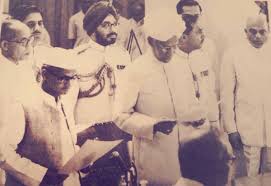
LAL BAHADUR SHASTRI TAKING OATH AS PM OF INDIA.

A major turn around happened in his life and political career when PM Jawaharlal Nehru died on 27 May 1964. As the perception of Lal Bahadur Shastri was a Nehru’s ideology supporter and a soft but balanced speaking person at that time, he was considered as the best successor of Pandit Nehru. He was declared as the second Prime Minister of India on 9 June, 1964. In a speech which he gave after becoming the PM of India, he said :-
“There comes a time in the life of every nation when it stands at the cross-roads of history and must choose which way to go. But for us, there need be no difficulty or hesitation, no looking to right or left. Our way is straight and clear—the building up of a socialist democracy at home with freedom and prosperity for all, and the maintenance of world peace and friendship with all nations.”
But his term as PM was full of obstacles. Just after one year as PM, India was forced to fight a ferocious war against Pakistan. It was a very devastating war. Pakistan started this war considering that Lal Bahadur Shastri was a weak PM and they can easily occupy large territories of India. But that was a big mistake by Pakistan. India fought the war with full dedication under the leadership of Shastri. During the war, there was a shortage of milk and food in India. To overcome this, Shastri fully supported the White Revolution and Green Revolution and gave the historic slogan “Jai Jawan, Jai Kisan” to increase the production of milk and food respectively in India. It was fruitful and production increased significantly in India and made India “Atmanirbhar” in this field.

TASHKENT AGREEMENT AND MYSTERIOUS DEATH :-

DURING SIGNING OF TASHKENT AGREEMENT

India won the war and ceasefire was declared. Shastri and Ayub Khan from Pakistan attended a summit in Tashkent (now in modern Uzbekistan). On 10 January 1966, Shastri and Ayub Khan signed the Tashkent Declaration.
But after signing of this declaration, the next day he died in his room. Still it is unclear that how he died and many theories about his death are still available. It is still a mystery that what was the main reason of his death. But it is sure that India lost a gem like him. His memorial is located at Vijay Ghat in New Delhi.

Links :-

  1. https://www.pmindia.gov.in/en/former_pm/shri-lal-bahadur-shastri/
  2. https://en.m.wikipedia.org/wiki/Lal_Bahadur_Shastri

Profitable pearl farming

  • All farmers do farming, but nowadays Pearl farming trend is rising rapidly. Fewer labor and greater benefits are proving to be a bargain. Earlier, training for Pearl farming was given at Central Institute of Fresh Water Aquaculture, Bhubaneswar (Odisha), but now many other organizations are providing the training in the state.
  • The most advantageous season for pearl cultivation is the time of autumn i.e. October to December. Beads can be cultivated in a pond of at least 10 x 10 feet or larger. For pearl cultivation, pearls can be generated from a maximum of 25000 oysters in a tiny pond like 0.4 ha. To start farming, the farmer has to gather oysters from pond, river etc. or they can also be purchased.
  • After this, after every minor operation in each oyster, simple or designed beads with diameter of four to six mm like Ganesha, Buddha, floral shape etc. are put inside it. The oyster is then closed. These oysters are kept in nylon bags for 10 days on anti-biotic and natural feed. These are scrutinized daily and dead oysters are eliminated

Profits of pearl farming

  • A single oyster costs around 20 to 30 rupees at a lesser cost. The price of one mm to 20 mm oyster pearl in the market is around Rs 300 to Rs 1500. Nowadays designer beads are being liked very much, which get good price in the market place. Much better income can be earned by trading pearls in overseas market than Indian market. After eliminating the pearl from the oyster, the oyster can also be marketed. Many decorative items are made by oyster. The work of obtaining fragrance oil from oysters in Kannauj is also done on a huge scale. Due to which oyster can also be sold in the local market instantly. The water of streams and ponds is also filtered by oysters, so that the problem of water contamination can be dealt with to a great extent as oysters are voracious filter feeders, they keep the water clear of pelagic algae & floating detritus
  • It is a Source of income for pearl farmers
  • While pearl oysters are edible, they are rarely consumed. This means they can be bred in murky, possibly polluted water to achieve points 1 & 2
  • If they are to be eaten as well as to produce pearls, then they need to be bred in unpolluted water. However, selling them as food, if not for humans then at least as pet food, after harvesting the pearls provide the farmers with an additional source of income
  • It usually takes 20 to 24 months to give you results but if cultivated properly it usually gives you an income of 10-12 lakhs that is around a profit of 8 lakhs.
  • Pearl cultivation gives you a large amount of profit while only requiring your skill and will to give you such good results.

Other prospects of pearl farming

  • For handling a pearl farm effectively, one needs to check the farm consistently. By doing so, you will know if there are any broken or missing lines. Also, check for any absent shells from the site. 
  • Next step is to regularly clean the site since of the amount of useless organisms that breed on the lines, shells and other hanging materials. While cleansing, you have to take special care as pearl oysters tend to get stressed out after cleaning is done. Frequent cleaning can be prevented and should be done once in a month. 

reference- https://agrifarmingtips.com/profitable-pearl-moti-farming-info-and-guide-for-beginners/

https://link.springer.com/chapter/10.1007/978-3-319-96776-9_5

Live Poker How TO Win Tournament Games

Presently, in case you are keen on being the best player, getting great cash and knowing a few stunts and advices of what to do in a live competition games, here is the best spot to learn them.

1) Try not to become inebriated

A portion of individuals that are playing, and that have not many rounds to play in the competition don’t tally the beverages they have during their games and at the day’s end they don’t have ability to proceed till the last game, which is a pity to free a major chance, along these lines, don’t drink a ton and be get ready for the last round, additionally concoct every one of your faculties all together. On the off chance that you drink, do it quantifiable and just to free the nerves before the games yet additionally have some different beverages like pop, water, espresso and others to hydrate your self.

2) Is it significant where I sit?

Indeed it is, in a competition make an effort not to sit close to the seller, have a spot in where you will feel that you are before the vendor to have the inclination that he is giving you a game. Likewise in where you will feel alright with your self and you will have a point of view of different players.

3) Make your self agreeable while playing

Try not to show different players with your position what you cards are advising you. Try to situate back and unwind, don’t receive places that will cause you move excessively or to feel awkward during the hour of the game. A few parts in the competitions show their game with the position they embrace while playing either putting the elbows on the table or resting in the guard.

4) Do the main thing in the brake.

Try not to get diverted from what you truly need to do in the brake. Take as much time as is needed to go to the restroom and rest, in some cases the conversations about the past game or lines for getting some R&R will burn through your time for what is truly significant.

5) Also your words and copy are significant during the game.

At whatever point you are playing don’t reveal your hand to the next part in the manner you talk or look, is significant that they will have other impression, for instance in your grasp Is acceptable you can take a stab at making countenances or saying words that show that your hand isn’t acceptable, then, at that point individuals will think you have an awful game and you will astonish them toward the end. This doesn’t work constantly so attempt to discover distinctive approaches to conceal your game.Also you can peruse the other player’s developments and words to see it is possible that they are lying or coming clean in the hand.

Steps Of Nature Conversation

Our nature consists of the green trees, plants, various animals, humans and even the non-living elements such as air, water, soil together all these constitutes of the nature in which we live in. But recently human development adversely affects the nature and toxifies it through pollution. But things cannot go this way if it continues soon our nature and environment will become unworthy to sustain life, thus we need to take steps to conserve our nature and natural resources. Steps which we can take in order to conserve our nature are:

  1. Deforestation is the practice of cutting down of trees for human needs, we need to reduce this practice as it reduces the oxygen supply in the environment, it is also the major cause of soil erosion also.
  2. We should engage and more into planting trees as it will increase the greenery, improve the oxygen supply, regulate the rain cycle and meet other human needs.
  3. We should use more of public transport or try to walk or cycle to nearby destinations, this will reduce the emission of fossil fuels.
  4. Waste materials before being dumped into soil or water bodies should undergo treatment.
  5. The use of air conditioners should either be reduced or replaced as they emit CFC’s which is very harmful for the nature.

The Holocaust

The Nazis came into power in Germany in 1933. They believed that the Germans were superior and the Jews were Inferior. During this era, the population of Jews was around nine million. During World War II, the Nazis came up with “The Final Solution”. “The Final Solution” was a plan in which they brutally killed over six million European Jews i.e. three out of two jews. They killed Jew men, women, and even children. This mass murder conducted by the Nazis is known as The Holocaust or Shoah in Hebrew. The word holocaust comes from ancient Greek which means ” whole burnt”.

The main cause of the holocaust is believed to be the ideology of the Nazis. They wanted to terminate the Jews and they were able to do so.
The Nazis blamed Jews for Germany’s defeat in World War I too.
Before World War II, the Nazis tried various ways to remove the Jews from Germany by allowing them to emigrate. The Jews were robbed, beaten, and even killed at times. They were banned at public parks and pubs. They were not allowed to work in certain professions. In 1935, Nuremberg Racial Laws came into force in which the Jews were forbidden to marry non-Jews. The Nazis burnt their houses, food, etc, and made their survival difficult. Later, they decided to move the Jews to the islands of Madagascar but the war made it impossible. Therefore, they came up with a mass murder plan. They not only killed the Jews but also others like the political opponents, Roma, Sinti, handicapped, homosexuals, etc. They established killing spots and executed millions of Jews.
In the end, it all went down as Adolf Hitler wanted. Everything worked according to him, he decided to murder, just because he thought the lives of Jews were unimportant.

BIODIVERSITY IN INDIA

India is one of the world’s most biologically and culturally diverse countries. It is also one of the poorest in terms of per capita income. The existence of mass poverty and enormous scale lies upon two important facts; first that the country exports natural products that command highly prices in overseas market, such as Basmati rice and Darjeeling tea, as well as products like medicinal and aromatic plants that are major inputs in rapidly expanding industries, and second that India has achieved significant capabilities in Industrial chemistry and life sciences. India is one of the world’s mega diversity countries. It is ranked ninth in the world in terms of higher plant species richness. At the ecosystem level, India is also well endowed, ten distinct bio-geographic zones. India is considered to be the center of origin for the following crop species, pigeon, eggplant cucumber, possibly cotton and sesame. But for millennia, numerous other crop species have been introduced to India and adapted to localized conditions. As a consequence of both the diversity of these conditions and of the various ethnic populations living in India, the country has become and important center of diversity of a great many domesticated species, including various cereals, millets, legumes, vegetables, temperate tropical fruits, fiber crops, medicinal and aromatic plants.

MORE SPECIFICALLY, THE THREATS ARE INTER ALIA DUE TO THE FOLLOWING:

  1. Large scale development products such as mining and dam and road construction
  2. Conversion of biodiversity rich ecosystems, such as tropical forests to farm lands and industrials and residential sites
  3. Poaching of wild life and over harvesting of forest products

While there has been no comprehensive assessment of biodiversity laws, 3 of 4 mammal species have been lost since 1950, and so also 15-20 plant species have become extinct. In one district of the state of Andhra Pradesh Odessa and West Bengal, 95% rice varieties previously cultivated are no longer found. Although the causes are various, the situation is primely due to the replace of low input poly cultural agricultural system with higher input monocultures.

ENDANGERED PLANTS AND ANIMALS: Due to rapid habitat loss, and over exploitation in particular large number of epiphytes, herbs, climbers, disappear from their native regions over the years. Many orchids, tree, ferns, medicinal herbs of hills, cicadas were considered as major endangered plant species. Identically large number of mammals, birds, reptiles, corals, and fishes were demarked as threatened in our country. A good number of conversation sites were declared for protection of such endangered plants and animals. It includes country wide 28 tiger project sites, several crocodile conservation programs, elephant conservation sites and various bird conservation sites. International union for conservation of nature categorized different pretend species of the world for the better recognition and subsequent action plan for their conservation. On the basis of survey carried out by botanical survey of India and also by zoological survey of India, the red data book with respect to endangered plants and animals were already published.

Ethics

Ethics is a branch of philosophy dealing with the issue of morality. It implies the concepts of what right and wrong conducts are. Ethics define how a person should act in some specific situations. It is not a new term, but it has been there since the Stone Age. Different religions and many philosophers have also made a substantial contribution to ethics.

There are different branches of ethics. First of all, comes descriptive ethics. Descriptive ethics include what people actually consider right and wrong. Accordingly, laws are made regarding that and if they are even acceptable or not. The moral principles of society keep on changing from time to time. However, the basic ethics remain the same. Descriptive ethics are also called comparative ethics. They are given the name comparative ethics as they are used to compare the ethics of past and present scenarios. Also, they are used to compare the ethics of different societies as well.

Then comes the next branch of ethics- Normative Ethics. Normative Ethics deals with some specific norms or a set of considerations. These norms indicate how people should act in some given situations. These ethics set out the rightness or wrongness of people’s actions. Normative Ethics are also known as prescriptive ethics. This name is given as there are principles involved with these ethics and those principles determine whether the actions of people are right or wrong in different situations.

Types of ethics :

1. Deontological Ethics :

* In moral philosophy, deontological ethics or deontology is the normative ethical theory that the morality of an action should be based on whether that action itself

* Deontology is an ethical theory that uses rules to discern the moral course of action. Diffusion of responsibility. Diffusion of responsibility occurs when people fail

* Deontology morality is about following a system of rules, like ” Do Not Lie ” or ” Do Not Steal” .

* Ethics or moral philosophy is a branch of philosophy that involves systematizing, defending Deontological ethics.

2. Utilitarianism :

* The most common example of normative ethical theories are utilitarianism, kantian duty- based ethics and divine command theory.

* utilitarianism means, act in your own self- interest. Utilitarianism is that which is moral only if the act produces the greatest.

* Utilitarianism is a moral theory that implements fair choices is an effort to ensure the least amount of harm is done to all parties involved.

* However, some contemporary utilitarians , such as peter singer, are concerned with maximizing the satisfaction of preferences, hence prefernce utilitarianism.

* utilitarianism is an ethical theory that asserts that right and wrong are best determined by focusing on outcomes.

3. Consequentialism :

* consequentialism refers to moral theories that hold the consequences of a particular action form the basis for any valid moral judgment about that action.

* consequentialism is a class of normative, teleological ethical theories that holds that the consequences of one’s conduct are the ultimate basis for any judgment.

* consequentialism is an ethical theory that judges an action’s moral correctness by its consequenes. Corporate social Responsibility.

* on our definition of consequentialism, only the direct view is a genuinely consequentialist position, and rule consequentialism.

4. Professional Ethics :

* Rules imposed on an employee in a company, or as member of a profession. For instance, journalists, doctors, lawyers. Etc.

* professional ethics encompass the personal and corporate standards of behavior expected by professionals.

5. Applied ethics :

* Applied ethics is the branch of ethics which consists of the analysis od specific, controversial moral issues such ad abortion, animal rights, or euthanasia.

*Applied Ethics includes a philosophical examination of certain public and private life problems. The examination of those issues generally takes place from a moral standpoint. This branch of ethics is generally used by professions like doctors, teachers, etc.

* Applied ethics which deals with the actual application of ethical priniciples to a particular situation. While it is helpful to approach the field of ethics.

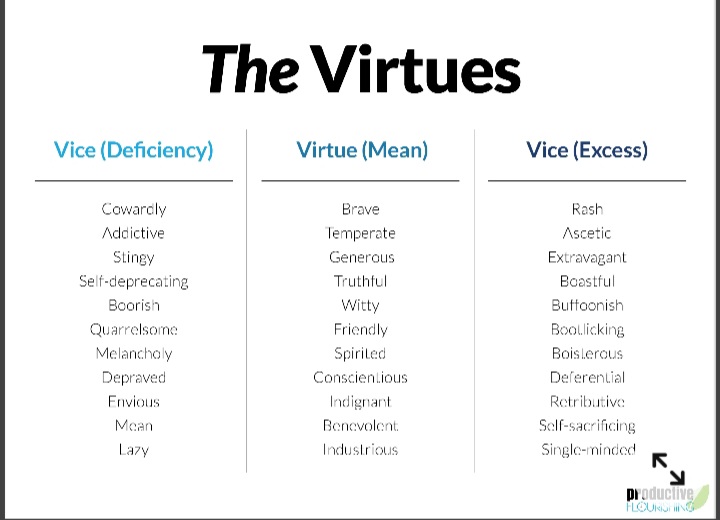
6. Virtue Ethics :

* virtue ethics is an approach to ethics that emphasizes an individual’s character as the key element of ethical thinking, rather than rules about the acts themselves.

* virtue ethics not only idea deals with the rightness or wrongness of individual actions, it provides guidenece as to the sort of characteristics and behaviour a good person will seek to achieve.

An abstract way of analyzing ethics is called Meta-Ethics. They do not deal with whether the actions are right or wrong, rather they question what morality is.

Biodiversity In India

Biological diversity’ means the variability among living organisms from all sources including, inter alia, terrestrial, marine and other aquatic ecosystems and the ecological complexes of which they are a part; this includes diversity within species, between species and of ecosystems. The word Biodiversity means Gk. Bios- Life, diversity- forms. The occurrence of difference species of organisms with the whole range of their variants (Biotypes) & genes adapted to different climates, environments along with their interactions & processes. This term was coined by Walter G. Rosen- 1985. Biodiversity refers to the numbers, variety and variability of living organisms and ecosystem. It includes all terrestrial, marine and other aquatic organisms. Also covers diversity within species, between species as well as variations among ecosystems.

Biodiversity has contributed in many ways to the development of human culture, and, in turn, human communities have played a major role in shaping the diversity of nature at the genetic, species, and ecological levels.

Types of Biodiversity

  • Genetic diversity – Diversity of genes within a species. i.e. genetic variability among the populations and the individuals of the same species. Genetic diversity is the total number of genetic characteristics in the genetic makeup of a species. Ex. Domestic Dogs. Humans have created distinct breeds of dogs within the species by selectively breeding individuals.
  • Species diversity – Diversity among species in an ecosystem. “Biodiversity hotspots” are excellent examples of species diversity. Species diversity is defined as the number of species and abundance of each species that live in a particular location. Each species is distinct from other species in form & character such as cow & goat. Species diversity is the most common level to describe biodiversity of any area.
  • Ecosystem diversity – Diversity at a higher level of organization, the ecosystem. To do with the variety of ecosystems on Earth. Ecosystem diversity deals with the variations in ecosystems within a geographical location and its overall impact on human existence and the environment. EX. deserts, forests, grasslands, wetlands and oceans. Ecological diversity is the largest scale of biodiversity, and within each ecosystem, there is a great deal of both species and genetic diversity.

VALUES OF BIODIVERSITY

1. Consumptive value : The most important point of consumptive use is that some rural communities closets to the forests or other natural areas can prosper through the sustainable harvesting of wildlife species. Hunting, Direct consumption-herbs, plants, mushrooms are all consumptive uses.

2. Productive Value : Products that are commercially harvested for exchange in formal markets. Each species is valuable to human. The global collection of genes, species, habitat & ecosystems is a resource that provides for human needs. It is also essential for human survival in the future. This is often then only value of biological resources that is reflected in the income accounts.

3. Social Value : Social value of biodiversity refers to religious and cultural importance. Trees are worshiped as God. ex. Banyan tree, Peepal Tree. Flowers, Tulsi leaves are offered during pooja.

4. Ethical Value : ‘All life must be preserved’ based on ‘Live & let live’. This means we don’t use the species directly or indirectly, but we feel sorry about the loss of species. They have a existence value.

5. Aesthetic Value : It is related to the beauty of biodiversity. The pleasure, excitement & visual peace of any area. Concept of Eco- tourism & willingness to pay are gaining grounds, leading to monetary estimate for aesthetic value of biodiversity.

6. Option Value : The option values of biodiversity suggests that any species may be proved to be a valuable after someday. At present the potentials/ uses/ values are unknown. Ex. Growing technology field is searching new species for causing the diseases of cancer & AIDS.

HOT SPOTS OF BIODIVERSITY

biodiversity hotspot is a bio-geographic region that is both a significant reservoir of biodiversity and is threatened with destruction. The term biodiversity hotspot specifically refers to 25 biologically rich areas around the world that have lost at least 70 percent of their original habitat. The original 25 hotspots covered 11.8% of the land surface area of the Earth.

The Role of Media in the Business Sector

 The media platform is considered to be strong because it is the sole reason through which various different business opportunities are flourished by providing them many wide opportunities in the process. Thus, to conclude in simple words media contributes a lot and it helps to improvise the conditions of many businesses and such media laws are very much crucial and relevant. They are required to be Amended as and when needed in the business sector. Different ways through which media can heavily benefit businesses are –:

  • : Advertisements which are preparing in educational advertisements are a logical way of spreading the voices in masses concerning the particular business. As the spheres of media are growing and are branching out, the most important branch of it is social media which has the potential to uplift businesses from a root level. With addition to the standard media sources and social media strategies many customers can be invited and give people what they want and deliver their services.
  • Better Responsiveness: The method of input and distribution by way of media is made simpler. If the clients have queries, questions, or any issues with, what the company does, they will let the company know in a prompt way. Social networking in businesses provides people a possible means to convey their thoughts and it allows businesses an incentive to react accordingly. Through such sources companies will see lawless stuff and verify to their clients that their questions and queries can be answered.
  • Information: Social networking which is presently emerging to be the most helpful source for new business opportunities is insightful and allows individuals to see an insight to what the target audience is and what other consumers share in terms of goods and services share online. This offers a better insight into the industry and many variables that impact the business.
  • Branding and Communication: Communication is the most crucial aspect for any businesses success and if they frequently engage with customers it helps to improve the company’s image. On can connect and handle their clients in a private level through social networks mediums. When the company is engaged in debates, the consumer finds the company as available, free and sensitive. The way that the company is viewed and consumers are gradually linked to the information that one gets, is largely impacted by this type of presentation. Both personal tales and social media can help boost the technology retail.
  • Social Media for growth in business sector: One has to make sure that their social media approach and presence is suitable for mobile phones which helps to guarantee a useful user experience to the consumers. Social media advertising sites generally generate popularity at a very fast pace, and the use of those particular websites in advertising and is used to promote what they have offered will also be beneficial for them.