Shantivan Complex of Brahma Kumaris in Abu Road, Rajasthan

 The Prime Minister, Shri Narendra Modi visited the Shantivan complex of Brahma Kumaris in Abu Road, Rajasthan today. He laid the foundation stone for a Super Speciality Charitable Global Hospital, the second phase of Shivmani Old Age Home and the extension of the Nursing College. The Prime Minister also witnessed a cultural performance on the occasion. 

Addressing the gathering, the Prime Minister recalled getting the opportunity to visit the Shantivan complex of Brahma Kumaris on numerous occasions and said a spiritual feeling emerges from within whenever he visits the place. He informed that it is the second time in the last few months that he got the opportunity to take part in programs related to Brahma Kumaris. Recalling the opportunity to inaugurate the Jal Jan Abhiyan in February this year, the Prime Minister emphasized his continuous affinity with the Brahma Kumaris organization and credited the blessing of Param Pita and the affection of Rajya Yogini Dadiji. The Prime Minister informed that the foundation stone of Super Speciality Charitable Global Hospital has been laid down while the expansion work of  Shivmani Old Age Home and  Nursing College is also being carried out, and congratulated the Brahma Kumaris organization for this.

The Prime Minister said that in this epoch of Amrit Kaal, all the social and religious institutions have a big role to play. “This Amrit Kaal is Kartavya Kaal for every citizen of the country. This means that we should fulfill our responsibility completely”, the Prime Minister emphasized. This, he continued, should be accompanied by the expansion of our thinking and responsibilities in the interest of the society and country. He said Brahma Kumaris as an institution, work for strengthening moral values in the society. He also noted their contribution towards the promotion of science, education and social awareness.  He also praised their intervention in the field of health and wellness. 

“The nation is undergoing the transformation of health facilities”, said the Prime Minister elaborating on the role of Ayushman Bharat in spreading the feeling of access to medical treatment among the poor sections. It has opened the doors of not only the government but also the private hospitals for the poor citizens, he said. He informed that more than 4 crore poor patients have already availed of the benefits under the scheme helping them save 80 thousand crore rupees. Similarly, Jan Aushadhi Scheme saved about 20 thousand crore rupees of poor and middle-class patients. He requested units of Brahma Kumaris to spread awareness about the government schemes. 

Underlining the unprecedented developments in the country to address the lack of doctors, nurses and medical staff in the country, the Prime Minister informed that one medical college has been inaugurated every month on average in the last 9 years. He pointed out that less than 150 medical colleges had been inaugurated in the decade before 2014 whereas, in the last 9 years, the government has inaugurated more than 350 medical colleges. Drawing comparisons before and after 2014, the Prime Minister noted that the country had roughly 50 thousand seats for MBBS every year whereas that number has gone up to more than 1 lakh today, while the number of Post Graduate seats has gone up to more than 65 thousand from roughly 30 thousand. “When intentions are clear and there is a sense of social service, then such resolutions are taken and also accomplished”, he added. 

“The number of doctors produced in India in the next decade will be the same as the number of doctors produced in the last 7 decades after independence”, the Prime Minister remarked as he highlighted the opportunities arising in the field of nursing. He informed that acceptance to more than 150 nursing colleges has been given in the country and more than 20 nursing colleges will come in Rajasthan itself which will also benefit the upcoming Super Speciality Charitable Global Hospital

Touching upon the social, and educational role played by the religious and spiritual bodies in Indian society, the Prime Minister recalled the contribution of Brahma Kumaris in cases of natural calamities and his personal experience of witnessing the dedication of the institution for the service of humanity. He praised Brahma Kumaris for making issues like Jal Jeevan Mission and the deaddiction people’s movement. 

The Prime Minister highlighted that the Brahma Kumari organization has always exceeded the expectations laid down by him and gave the example of the programs organized during the Azadi Ka Amrit Mahotsav, Yog Shivir being organized all over the world, Didi Janki becoming the ambassador of Swacch Bharat. He said that such actions by the Brahma Kumaris have multiplied his faith in the organization and thereby set a new bar of higher expectations. 

The Prime Minister also touched upon Shree Anna and India’s push given to millets on the global scale. He emphasized that the nation is taking forward campaigns like natural farming, cleaning our rivers and conserving groundwater and said that these subjects are linked to the thousand years old cultures and traditions of the land. Concluding the address, the Prime Minister urged the Brahma Kumaris to take forward new topics related to nation-building in an innovative way. “The more cooperation you get in these efforts, the more the country will be served. By building a developed India, we will live up to the mantra of ‘Sarve Bhavantu Sukhinah’ for the world”, the Prime Minister concluded.

Background

The Prime Minister’s special focus has been giving impetus to spiritual rejuvenation across the country. Continuing with the endeavor, the Prime Minister will visit the Shantivan complex of Brahma Kumaris. He will lay the foundation stone of a Super Speciality Charitable Global Hospital, the second phase of Shivmani Old Age Home and the extension of the Nursing College. The Super Speciality Charitable Global Hospital will be set up in Abu Road, spread across 50 acres. It will offer world-class medical facilities and will prove especially beneficial for the poor and the tribal people in the region.


***

6th India-Canada Ministerial Dialogue on Trade & Investment

 India and Canada held the sixth Ministerial Dialogue on Trade & Investment (MDTI) in Ottawa on May 8, 2023, co-chaired by Shri Piyush Goyal, Union Minister of Commerce and Industry, Consumer Affairs and Food, and Public Distribution and Textiles, Government of India and the Hon’ble Mary Ng, Minister of International Trade, Export Promotion, Small Business and Economic Development, Government of Canada. The Ministers emphasised the solid foundation of the trade and economic relationship between India and Canada and recognized the significant opportunity to deepen bilateral ties and economic partnership.

The Ministers touched on the important discussions taking place at the various meetings of the G-20 being held in India this year under the Indian Presidency. In this context, Minister Ng noted India’s role as a global economy of the future and congratulated the Government of India and the Indian business organizations on the successes enjoyed so far at the G-20 events in India. She expressed her support for India as G20 Chair, and the priorities pursued by India in the G20 Trade and Investment Working Group. Minister Ng indicated that she is looking forward to participating in the upcoming G-20 Trade and Investment Ministerial meeting in India scheduled to take place in August 2023.

In recognition of the critical importance of the Indo-Pacific region for Canada’s prosperity, security, and its capacity to address environmental challenges, Minister Ng noted the rolling out of Canada’s Indo-Pacific Strategy and noted India’s importance in the region.

The Ministers noted the resilience of bilateral trade in 2022 following the challenges of the COVID-19 pandemic and the disruptions caused by the war in Ukraine. Canada-India bilateral trade in goods reached nearly C$12 billion in 2022, a substantial 57% increase over the previous year. The Ministers also underlined the contribution of the services sector in furthering the bilateral relationship and noted the significant potential for increasing bilateral services trade which stood at C$8.9 billion in 2022. Ministers recognized the significant growth of two-way investments and their contribution to deepening economic and trade ties, appreciative of the improvements made by both countries to facilitate business growth and attract investment.

The Ministers noted that the trade-related strengths of India and Canada are complementary and real potential exists for trade in both goods and services to expand significantly in both traditional and emerging sectors. With that goal in mind, the Ministers called for boosting the commercial ties between the two countries through enhanced cooperation and by forging partnerships to take advantage of the complementarities in such sectors as agricultural goods, chemicals, green technologies, infrastructure, automotive, clean energy, electronics, and minerals and metals. The Ministers further asked their officials to discuss trade remedy issues of bilateral importance on a regular basis.

The Ministers emphasized the key institutional role that the MDTI can play to promote bilateral trade and investment ties and to strengthen economic cooperation between the two countries. Recognising the need for a comprehensive trade agreement to create vast new opportunities for boosting trade and investment flows between India and Canada, in 2022 the Ministers formally re-launched the India-Canada Comprehensive Economic Partnership Agreement (CEPA) negotiations. In pursuit of that goal, negotiations towards an Early Progress Trade Agreement (EPTA), as a transitional step towards the CEPA, have been underway and several rounds of discussions have already taken place. The EPTA would cover, among others, high level commitments in goods, services, investment, rules of origin, sanitary and phytosanitary measures, technical barriers to trade, and dispute settlement, and may also cover other areas where mutual agreement is reached.

The two sides also agreed to explore enhanced cooperation through measures such as coordinated investment promotion, information exchange and mutual support between the two parties in near future. This cooperation between India and Canada will be finalized by way of a Memorandum of Understanding (MoU) preferably in Fall 2023.

The Ministers noted that global supply chains remain under the threat of disruption from the fallout of the COVID-19 pandemic, as well as the effects of the ongoing war in Ukraine. In this context, they discussed the continued importance of working together to promote the international rules-based order and supply chain resiliency in critical sectors. They emphasised enhancing cooperation in sectors such as clean technologies for infrastructure development, critical minerals, electric vehicles and batteries, renewable energy/hydrogen, and AI.

Recognising the importance of critical minerals for the future economy and green economy, the Ministers agreed on the importance of government to government coordination to promote critical mineral supply chain resiliency. Ministers also agreed to explore options for business to business engagement on critical minerals between the two countries, and have committed to an annual dialogue between the appropriate points of contact at the officials level on the margins of the Prospectors and Developers Association Conference in Toronto to discuss issues of mutual interest.

Both sides discussed the potential for strengthening the cooperation in the field of science, technology and innovation in priority areas by building on the ongoing work in the Joint Science and Technology Cooperation Committee (JSTCC) and seeking enhanced collaboration in the areas of start-ups and innovation partnerships. The Ministers agreed that there is significant potential to strengthen such cooperation and to enhance collaboration between their research and business communities in support of a sustainable economic recovery and the prosperity and wellbeing of their citizens.

The Ministers recognised the value of further deepening the India-Canada commercial relationship through initiatives such as organized fora for SMEs and women entrepreneurs.

Minister Mary Ng appreciated the visit of the Indian business delegation at the sidelines of the 6th MDTI which has enhanced B2B engagement. To continue the momentum of B2B engagement, both Ministers look forward to the relaunch the Canada-India CEO Forum with renewed focus and a new set of priorities. The CEO Forum could be announced at a mutually-agreed early date. Further, Minister Mary Ng announced that she looks forward to leading a Team Canada trade mission to India in October 2023 which was welcomed by Minister Goyal.

The Ministers noted the significant movement of professionals and skilled workers, students, and business travelers between the two countries, and its immense contribution to enhancing the bilateral economic partnership and, in this context, noted the desire for enhanced discussions in the area of migration and mobility. Both sides agreed to continue to discuss ways to deepen and strengthen the bilateral innovation ecosystem through an appropriate mechanism to be determined. In addition, in accordance with Canada’s Indo-Pacific Strategy, further investments will be made to support industrial research and development partnerships.

In line with the announcement made in the National Education Policy 2020 of India for facilitating foreign universities and educational institutions, India also invited top Canadian Universities to set up their campuses in India.

The Ministers noted that India and Canada have agreed to an expanded air services agreement in 2022 which enhances people to people ties through enhanced commercial flights by carriers of both the countries.

The Ministers reaffirmed their commitment to the rules-based, transparent, non-discriminatory, open, and inclusive multilateral trading system embodied by the World Trade Organization and concurred to work together to further strengthen it.

The Ministers agreed to remain engaged to provide sustained momentum including having an annual work plan which is reported on a regular basis to build linkages and strengthen cooperation across sectors to harness the full potential of the trade and investment relationship between India and Canada.

***

Dhokla


 Dhokla

Savory Steamed Chickpea Flour Cake

Ingredients:

2 cups chickpea flour (besan)
1 cup yogurt
1 cup water
1 tablespoon ginger paste
2 teaspoons green chili paste
1 teaspoon turmeric powder
1 teaspoon salt
2 teaspoons lemon juice
2 teaspoons Eno fruit salt
1 tablespoon oi
l
Directions:
Grease a 7
-inch round cake pan or thali and set aside.
In a mixing bowl, combine chickpea flour, yogurt, and water. Whisk well to form a smooth batter without any lumps.
Add ginger paste, green chili paste, turmeric powder, salt, and lemon juice. Mix until well combined.
Add Eno fruit salt to the batter and mix it in one direction until the batter turns light and frothy.
Pour the batter into the prepared pan or thali and place it in a steamer. Steam for 15-20 minutes on medium heat or until a toothpick inserted in the center comes out clean.
Remove the pan from the steamer and let it cool for 10 minutes.
Cut the dhokla into squares or diamond shapes.
Heat oil in a small pan and add mustard seeds. When the seeds splutter, add curry leaves and green chilies. Fry for a few seconds and pour the tempering over the dhokla pieces.
Serve the dhokla with green chutney and tamarind chutney.
Prep Time: 15 minutes | Cooking Time: 20 minutes | Total Time: 35 minutes
Kcal: 144 kcal | Servings: 4 servings
#Dhokla #Savory #ChickpeaFlour #Vegan #GlutenFree #IndianCuisine #Breakfast #Snacks #Steamed #Spongy #Fluffy #HealthyEating #Homemade #Yummy #FoodPhotography #FoodBloggers #Foodgasm #Foodie #FoodiesofInstagram
SOCIAL MEDIA POSTS
Time to enjoy some savory steamed dhokla made with chickpea flour, a perfect vegan and gluten-free snack for your afternoon cravings! 🌱😋 #Dhokla #SavorySnack #ChickpeaFlour #GlutenFree #Vegan #HealthyEating #Homemade #Yummy #FoodPhotography #FoodBloggers #Foodgasm #Foodie #FoodiesofInstagram
#EasyRecipe #QuickMeals #IndianCuisine #Breakfast #Snacks #Steamed #Spongy #Fluffy #TastyTreats #Tasty #Flavors #Vegetarian #Satisfying #Mouthwatering #HealthySnack #ComfortFood #Spices #Deliciousness
Satisfy your taste buds with this mouthwatering recipe for Dhokla, a savory steamed chickpea flour cake that is perfect for breakfast, lunch or a snack! 🌶️🥢 #Dhokla #Savory

x

President of India Graces 12th Convocation of Maharaja Sriram Chandra Bhanja Deo University

 The President of India, Smt Droupadi Murmu graced and addressed the 12th convocation of Maharaja Sriram Chandra Bhanja Deo University at Baripada, Odisha today (May 6, 2023). 

Speaking on the occasion, the President said that Maharaja Sriram Chandra Bhanja Deo University has made a unique identity in the field of higher education and research in a short span of its history.

The President appreciated the University for establishing the ‘Sacred Grove’ in its campus with the aim to preserve the bedrock of tribal practices and cultural traditions. She said that the ‘Sacred Grove’ is important for the conservation of environment and local biodiversity. It is also one of the best examples of community-based management of natural resources.

The President said that the world is facing huge challenges of global warming and climate change. India has set an example for the world to adopt a nature-friendly lifestyle, which is called Lifestyle for the Environment or LiFE. In our tradition, it is believed that trees, plants, mountains, rivers all have life and not only humans but also all living beings are children of nature. Therefore, it is the duty of all human beings to live in harmony with nature. She said that the Similipal National Park located in this region holds a globally important place in terms of biodiversity. She expressed confidence that the students and teachers of the university would find a way to protect biodiversity through their research and innovation.

Addressing the graduating students, the President said that receiving degree does not mean that education process has been completed. Education is a continuous process. She said that after getting higher education some of them would do a job, some would do business and some would also do research but thinking of giving a job is better than thinking of doing a job. She was happy to note that this University has set up an Incubation Centre and provides assistance to the students, alumni and common people in setting up start-ups.

The President said that competition is an inevitable side of life. One has to face competition in every walk of life. She said that students should always keep trying to succeed in the competition and for that they should keep acquiring higher skills and move towards greater efficiency. They can turn the impossible into possible with their will-power. 

The President said that competition is a natural side of life, but cooperation is the beautiful side of life. She told students that while moving forward in life, when they would look back, they would find that some people of the society are not very capable of competing with them. She advised students to hold the hands of deprived ones and bring them forward. She said that a healthy society can be built through generosity and cooperation. She urged students to think not only of their own happiness and interest but also about the welfare of the society and country.

***

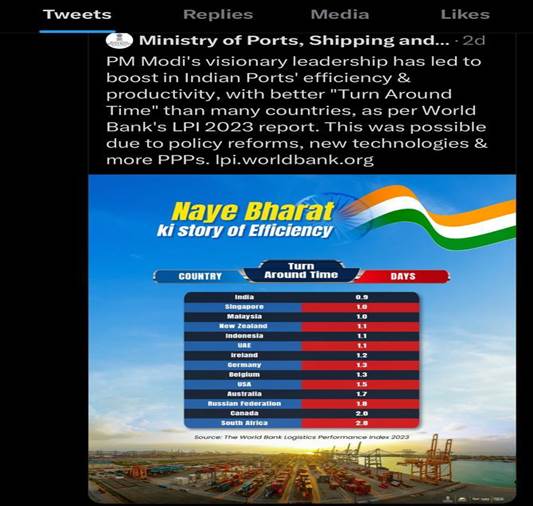
JNPA posts an impressive turnaround time (TAT)

 A month after the record handling performance for the last FY, Jawaharlal Nehru Port Authority (JNPA), India’s premier container port, has achieved another feat when it set a global benchmark in container cargo handling. According to the Logistics Performance Index (LPI) Report, 2023, published by the World Bank, JNPA has an impressive turnaround time (TAT) of just 22 hours (equal to 0.9 days), putting India amongst the top performers.


JNPA was able to achieve the feat due to various measures taken in reducing the dwell time. Most importantly the operational efficiency of the terminal operators has been the biggest contributor along with the better landside- rail and road connectivity, introduction of Centralised Parking Plaza (CPP), Digitization of the processes; streamlining berthing and unberthing of vessels; deploying more tugs for smooth transition of the vessel etc. are some of the other initiatives that JNPA has undertaken to facilitate efficient functioning of the port.

Shri Sanjay Sethi, Chairman of JNPA said, “This is exciting news for all of us at JNPA. Just last month, we achieved a record of handling 6.05 million TEUs in 2022-23, the World Bank data reiterates that our efficiency parameters are better than many countries as per LPI 2023 report and we as a team are committed to further reduce the logistics cost and time for the EXIM trade.”

 Chairman of JNPA and Deputy Chairman, JNPA  congratulated the team for this remarkable achievement.

*****

New way to track particles in soft colloids using optical tweezers

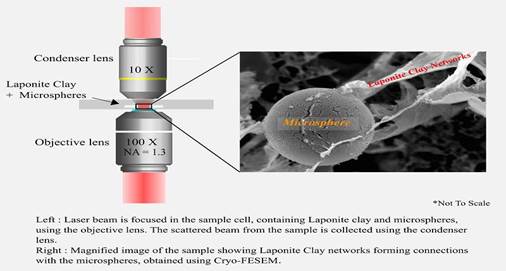
 Scientists have found a way to track minute clay particle movements within soft clay colloids using optical tweezers — the application of which in biological systems brought the Nobel Prize in Physics in 2018. This new way to track particles and manipulate them as desired can be applied in areas like targeted drug delivery.

Using optical tweezers, researchers at Raman Research Institute (RRI), an autonomous institute funded by the Department of Science and Technology, Govt. of India, attempted to study the dynamics and hidden structural details of Laponite, a synthetic clay. As these clay particles are the same size (monodisperse) and transparent, so they are best suitable for performing advanced studies under light. Laponite is a widely used raw material in the pharmaceutical and cosmetics industries. This clay comprises disk-shaped particles sized 25 to 30 nanometres (nm) and one nm in thickness.

Polystyrene beads dispersed in Laponite clay suspension were used for the experimental setup. With time, microstructures were noted to have developed due to the electrostatic interactions between the clay particles. These microstructures grew stronger with time, with their network size dependent on the concentration of Laponite particles.

“These structures are responsible for the material’s elasticity, enabling adjustment of elasticity by tuning the microstructures. These microstructures also form connections with micron-sized polystyrene particles, which are used to probe these suspensions in such studies,” said Anson G. Thambi, a third-year Ph.D. student at RRI.

In a study published in the journal ‘Soft Matter, Ranjini Bandyopadhyay, faculty, RRI, and her team used optical tweezers as they wanted to measure movements of the probe in nanometres scales, where the properties of the medium evolve with passing time. Optical tweezer is a popular tool in an optics laboratory, used to measure minute forces and manipulate tiny dielectric beads trapped at the tight focus of an intense laser beam over length scales down to a few nanometers. It allows the inducement of movement in the trapped probe particle, and its response is analysed to extract previously inaccessible local viscoelastic properties of the underlying medium.

“These attachments between the probe (PS) and Laponite clay particles are necessary to understand the properties of the suspension if the internal networks are of sizes greater than the probe itself,” said Bandyopadhyay.

Furthermore, the team used cryogenic field emission scanning electron microscopy (cryo-FESEM) to examine the average pore areas formed by the Laponite microstructures.

“Interestingly, the collective observations obtained using an optical tweezer and cryo-FESEM experiments revealed an intriguing and previously unknown correlation. We found that beads trapped by the optical tweezer moved much slower in denser network structures,” added Bandyopadhyay.

The RRI team thus concluded the prevalence of a direct relation between the morphologies of the clay suspension structures and the probe particle dynamics at micrometre length scales.

Publication link: https://pubs.rsc.org/en/content/articlelanding/2023/SM/D2SM01457B

Chief Minister of the Punjab Late Shri Parkash Singh Badal

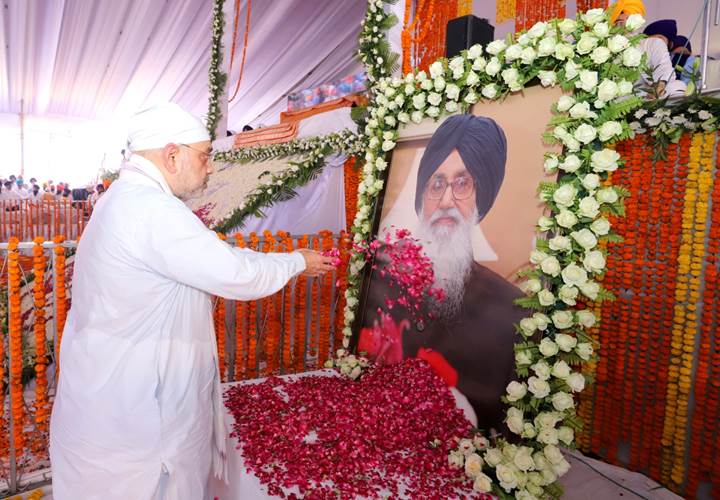
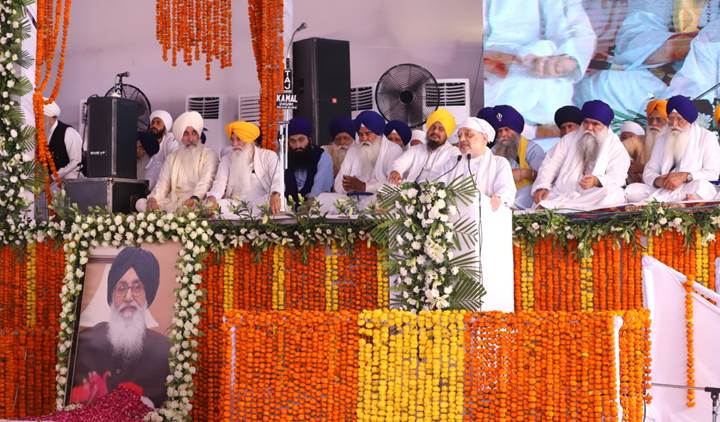
 Union Home Minister and Minister of Cooperation, Shri Amit Shah took part in the ‘Antim Ardas’ of former Chief Minister of the Punjab Late Shri Parkash Singh Badal and paid his last respects at Shri Muktsar Sahib in Punjab.

https://static.pib.gov.in/WriteReadData/userfiles/image/image001U30J.jpg

Shri Amit Shah said that due to passing away of Shri Parkash Singh Badal, the political and social leadership of not only Punjab but the entire country has suffered an irreparable loss. He said that it would be very difficult to fill the vacuum created by the demise of Shri Badal. Shri Shah said that with the passing away of Shri Badal, the Sikh community has lost a true soldier, the country has lost a patriot, the farmers have lost a true sympathizer and politics has lost a great man who set high standards.

https://static.pib.gov.in/WriteReadData/userfiles/image/image002D723.jpg

The Union Home Minister said that Shri Parkash Singh Badal had a long public life of 70 years, no person except Badal Sahab could live such a life without making any opponent. Shri Shah said that he always learnt from his meeting with Shri Badal and he always tried to show the true path. No one except great man like Shri Badal can give advice in political life with such transparency.

https://static.pib.gov.in/WriteReadData/userfiles/image/image003HB3V.jpg

Shri Amit Shah said that Shri Parkash Singh Badal was the longest serving member of the Punjab Legislative Assembly and Shri Badalserved as the Chief Minister of Punjab for 5 times and laid the foundation of New Punjab. With his demise, the Sardar of brotherhood has also left us. Shri Parkash Singh Badal devoted his whole life to Hindu-Sikh unity and despite facing many oppositions in politics, Badal Sahab always tried to keep everyone united. Shri Shah said that it is impossible to find such a person in public and political life.

https://static.pib.gov.in/WriteReadData/userfiles/image/image004L62O.jpg

The Union Home Minister and Minister of Cooperation said that from 1970 till today, whenever there was an opportunity to stand for the country, Badal Sahab never backed down. He said that Sardar Parkash Singh Badal fought for principles and creedand spent longest time of his public life on jail. During the Emergency, Shri Parkash SinghBadal firmly stood to protect democracy, whether it was the Kargil war or the fight against terror, on every front, Badal Sahab, always stood like a shield for the national interest. Shri Shah said that the passing away of Badal Sahab is a huge loss for the entire country. Shri Amit Shah said that we all should take inspiration from the life of Shri Parkash Singh Badaland may Waheguru give us all the strength to walk on his path.

*****

20 Tips for Good Website Design

  1. Keep it Simple: A simple and minimalist design is easier for users to navigate and will make your website more accessible.
  2. Use a Clear and Legible Font: Choose a font that is easy to read and is legible on both desktop and mobile devices.
  3. Use a Consistent Color Scheme: Choose a color palette and stick with it throughout your website to create a cohesive look and feel.
  4. Make it Mobile-Friendly: Your website should be optimized for mobile devices since more than half of all internet traffic now comes from mobile devices.
  5. Use High-Quality Images: Use high-quality images that are optimized for web use to enhance the visual appeal of your website.
  6. Ensure Fast Load Times: Ensure your website loads quickly by optimizing images, compressing files, and reducing HTTP requests. You can learn more from opsite.biz
  7. Make Navigation Easy: Make sure your website’s navigation is easy to use, clear, and consistent.
  8. Use White Space Effectively: Use white space effectively to make your content more readable and visually appealing.
  9. Ensure Accessibility: Make sure your website is accessible to all users, including those with disabilities.
  10. Include Social Sharing Buttons: Include social sharing buttons to encourage visitors to share your content on their social media channels.
  11. Use Calls-to-Action: Use clear and concise calls-to-action to guide visitors through your website.
  12. Keep Content Fresh: Keep your website’s content up-to-date and relevant to keep visitors engaged.
  13. Optimize for Search Engines: Optimize your website’s content for search engines to improve its visibility in search engine results pages.
  14. Include Contact Information: Make it easy for visitors to get in touch with you by including contact information on your website.
  15. Make it Scannable: Use headings, bullet points, and short paragraphs to make your content more scannable and readable.
  16. Use Responsive Design: Use responsive design to ensure your website looks great on all devices.
  17. Ensure Consistency: Ensure consistency in design and layout throughout your website to create a seamless user experience.
  18. Use Whitespace: Use whitespace effectively to break up content, draw attention to important elements, and create a sense of balance and harmony.
  19. Test Your Website: Test your website on different devices and browsers to ensure it works well across all platforms.
  20. Make it Easy to Share: Make it easy for visitors to share your content on social media by including social sharing buttons.
Photo by Pixabay on Pexels.com

Why home loan?

 Protection from future price increases

A home loan is an instrument that helps you buy residential property at today’s prices rather than waiting until you’ve saved enough and then buy at typically a multiple of today’s property prices.
Peace of mind
Peace of mind cannot be quantified. And there are very few people who would prefer to keep staying on rented property all their lives. What happens when income ceases after retirement? Why invite the unnecessary burden of rentals post-retirement? And hence, most people purchase their own property during their working lives. For many, paying EMIs means owning your own home at the end of the loan tenure while paying rent means owning nothing in the end.
Establishing a credit record
Also, as you pay your EMIs on time, you create your track record of being a responsible borrower. Which means you can seek substantially lower interest rate (and hence lower EMIs) a few years into your loan tenure. Quite simply, your new credit profile would want many banks to entice you to transfer your outstanding loan balance. This pressure itself can force your existing lender to reduce rates – often at the end of a simple phone call.
Tax benefits
Moreover, there are several tax benefits available on loan repayment that you may become eligible for depending on your specific income bracket. You can claim deduction on home loan interest up to Rs 2 lakh under Section 24(b) and tax deduction on the principal repayment up to Rs 1.5 lakh under Section 80C.
Subsidy
And now, there is also a home loan subsidy. Under the Credit Linked Subsidy Scheme (CLSS) of the Pradhan Mantri Awas Yojna (PMAY), eligible borrowers can avail a home loan and save up to ₹ 2.67 Lakh
Prepayment flexibility
Today’s home loans also offer great flexibility. You have an option to pre-pay your outstanding balance (or a part of it) when you earn a higher income – thereby reducing your loan tenure.
Risk assessment opinion
While one must always do one’s own due diligence before purchasing any property, when one applies for a home loan, one gets a helping hand from the bank. RERA has reduced risks of buying under-construction property that has a RERA registered number but the risks are not completely eliminated and depend at least partly on the builder’s financial position. Who better than a seasoned bank to lend a helping hand in assessing these risks?
Most likely avenue to leverage
Unlike companies, individuals have limited avenues to leverage their future income and use it for making other investments (stocks, bonds and other assets). Often the best option is to seek a home loan. Because the purpose here is to borrow money for one’s family to stay in a home, banks perceive a significantly lower risk of default and hence give their best rates. This is also why home loans are substantially cheaper than loan against property (whose purpose is often unknown).

Why Chainlink is Critical for the Future of Smart Contracts

 As the blockchain industry continues to grow, smart contracts have emerged as one of its most promising applications. These self-executing contracts allow for secure and automated transactions between parties, without the need for intermediaries. However, for smart contracts to reach their full potential, they must be able to connect to real-world data sources and external systems. This is where Chainlink comes in. If you are interested in bitcoin trading, then you can start your trading journey by (Official App)

Chainlink is a decentralized oracle network that provides reliable, tamper-proof inputs and outputs for smart contracts. In other words, it acts as a bridge between smart contracts and the outside world, enabling them to access real-world data and execute accordingly. In this article, we will explore why Chainlink is critical for the future of smart contracts, how it works, and what benefits it offers.

Photo by RODNAE Productions on Pexels.com

What is Chainlink?

Chainlink is a decentralized oracle network that provides secure and reliable inputs and outputs for smart contracts. Oracles are essential for smart contracts because they enable them to access data outside of the blockchain, such as stock prices, weather reports, and sports scores. Without oracles, smart contracts would be limited to executing only within the blockchain, which would significantly reduce their usefulness.

Chainlink is unique in that it is a decentralized oracle network, meaning that it is not controlled by a single entity or authority. Instead, it uses a network of nodes to provide inputs and outputs for smart contracts. These nodes are run by independent operators, who are incentivized to provide accurate data by receiving payment in LINK, Chainlink’s native cryptocurrency.

How Does Chainlink Work?

Chainlink works by connecting smart contracts to real-world data sources and external systems. It does this by using a three-step process:

  • Aggregation: Chainlink aggregates data from multiple sources to ensure accuracy and reliability. This helps to mitigate the risk of a single point of failure or a single source of data being compromised.
  • Validation: Chainlink validates the data using multiple nodes to ensure that it is accurate and tamper-proof. If a node provides inaccurate data or fails to respond, it is penalized by losing LINK.
  • Delivery: Chainlink delivers the data to the smart contract in a format that it can understand and execute accordingly. This enables the smart contract to execute autonomously and securely, without the need for intermediaries.

Why is Chainlink Critical for the Future of Smart Contracts?

Chainlink is critical for the future of smart contracts because it enables them to access real-world data and external systems. Without Chainlink, smart contracts would be limited to executing only within the blockchain, which would significantly reduce their usefulness.

Chainlink also offers several other benefits for smart contracts, including:

  • Security: Chainlink’s decentralized oracle network provides a high level of security for smart contracts. By using multiple nodes to validate data, Chainlink helps to mitigate the risk of a single point of failure or a single source of data being compromised.
  • Reliability: Chainlink’s aggregation process ensures that data is accurate and reliable. This helps to ensure that smart contracts execute correctly and as intended.
  • Flexibility: Chainlink can connect smart contracts to a wide range of data sources and external systems, making them more versatile and adaptable to real-world use cases.
  • Cost-effectiveness: Chainlink’s decentralized oracle network reduces the cost of accessing real-world data for smart contracts. This is because it eliminates the need for intermediaries and reduces the risk of data tampering.

Use Cases for Chainlink

Chainlink has a wide range of use cases in various industries. Some of the most promising use cases include:

Finance

Chainlink can be used in the finance industry to connect smart contracts to financial data sources, such as stock prices and interest rates. This can enable the creation of decentralized financial products, such as prediction markets, insurance products, and decentralized exchanges.

Supply Chain

Chainlink can be used in the supply chain industry to provide real-time data on shipments, inventory levels, and other key metrics. This can enable more efficient and transparent supply chain management, as well as reduce the risk of fraud and counterfeiting.

Gaming

Chainlink can be used in the gaming industry to provide real-time data on in-game events, such as scores, achievements, and rewards. This can enable the creation of more immersive and interactive games, as well as provide players with more control over their in-game assets.

Insurance

Chainlink can be used in the insurance industry to provide real-time data on weather events, traffic patterns, and other key metrics. This can enable more accurate and automated insurance products, such as parametric insurance and microinsurance.

Conclusion

Chainlink is critical for the future of smart contracts because it enables them to access real-world data and external systems. It offers several benefits, including security, reliability, flexibility, and cost-effectiveness. With its decentralized oracle network and wide range of use cases, Chainlink has the potential to revolutionize various industries, from finance to gaming to insurance. As blockchain technology continues to evolve, Chainlink will undoubtedly play a vital role in its development and adoption.

FAQs

What is the LINK token?

The LINK token is Chainlink’s native cryptocurrency. It is used to incentivize node operators to provide accurate data and penalize them for providing inaccurate data. It can also be used to pay for data feeds and other services on the Chainlink network.

How is Chainlink different from other oracles?

Chainlink is unique in that it is a decentralized oracle network, meaning that it is not controlled by a single entity or authority. This helps to ensure that the data provided to smart contracts is accurate and tamper-proof.

What are some examples of companies using Chainlink?

Several companies are currently using Chainlink, including SWIFT, Google, Oracle, and Web3 Foundation.

How can businesses integrate Chainlink into their operations?

Businesses can integrate Chainlink into their operations by using the Chainlink API or partnering with a Chainlink node operator. They can also develop their own Chainlink nodes if they have the necessary technical expertise.

What is Chainlink and How Does it Work? A Comprehensive Guide

 In the world of blockchain, smart contracts are becoming increasingly popular. These self-executing contracts allow for trustless transactions to take place without the need for intermediaries. However, one of the main challenges with smart contracts is accessing real-world data. That’s where Chainlink comes in. You can go for crypto trading and investment by Register Today and logging into Bitcoin smarter.

Chainlink is a decentralized oracle network that connects smart contracts to real-world data and events. In this comprehensive guide, we’ll explore what Chainlink is, how it works, and its many use cases.

What is Chainlink?

Chainlink is a decentralized oracle network that provides smart contracts with secure access to off-chain data. In simpler terms, it’s a bridge between blockchain and the real world.

Chainlink was founded in 2017 by Sergey Nazarov and Steve Ellis. Its native cryptocurrency, LINK, is used to incentivize the network’s nodes to provide accurate and reliable data.

Photo by Karolina Grabowska on Pexels.com

How Does Chainlink Work?

Chainlink works by using a decentralized network of nodes to retrieve data from various sources, such as APIs, websites, and other blockchains. These nodes are called oracles, and they are responsible for retrieving and validating the data before sending it back to the smart contract.

Here’s a step-by-step breakdown of how Chainlink works:

  • A smart contract requests data from Chainlink by creating a job.
  • The job is then assigned to one or more oracles.
  • The oracles retrieve the data from various sources.
  • The oracles validate the data to ensure its accuracy and reliability.
  • The oracles then send the data back to the smart contract.
  • The smart contract can then execute based on the received data.

Chainlink’s decentralized network ensures that the data provided to smart contracts is secure, reliable, and tamper-proof. It also allows for customization, as smart contract creators can choose which nodes to use and which data sources to access.

Why is Chainlink Important?

Chainlink is important because it solves a critical problem in the world of smart contracts. Smart contracts are only as good as the data they rely on, and Chainlink provides a reliable and secure way to access real-world data.

Without Chainlink, smart contracts would be limited to on-chain data only, which severely limits their potential use cases. With Chainlink, smart contracts can access data from virtually any source, opening up a world of possibilities.

Use Cases for Chainlink

Chainlink has many potential use cases across various industries. Here are just a few examples:

Finance

Chainlink can be used to provide secure and reliable price feeds for financial applications, such as decentralized exchanges and derivatives platforms. It can also be used to access credit scores and other financial data for lending platforms.

Gaming

Chainlink can be used to provide verifiable randomness for gaming applications, such as lotteries and online casinos. It can also be used to provide real-world data for sports betting platforms.

Supply Chain Management

Chainlink can be used to provide real-time tracking of goods and materials throughout the supply chain. This can help prevent fraud and ensure that products are authentic and ethically sourced.

Insurance

Chainlink can be used to provide real-world data for insurance applications, such as weather data for crop insurance and flight data for travel insurance.

Conclusion

Chainlink is a critical component of the blockchain ecosystem, providing reliable and secure access to real-world data for smart contracts. Its decentralized network and customizable options make it a powerful solution with many potential use cases.

Whether you’re a developer looking to integrate Chainlink into your application or a user curious about its potential, understanding what Chainlink is and how it works is essential. With this comprehensive guide, you’re now equipped with the knowledge to explore the world of Chainlink and its many possibilities.

FAQs about Chainlink

What is the difference between Chainlink and other oracle solutions?

Chainlink differs from other oracle solutions in several ways. First, it’s decentralized, which means that there’s no single point of failure. This makes it more secure and reliable than centralized solutions.

Second, Chainlink provides a wide range of customization options. Smart contract creators can choose which data sources to access and which nodes to use. This allows for greater flexibility and can result in more accurate and relevant data.

What is the LINK token used for?

The LINK token is used to incentivize nodes to provide accurate and reliable data. Nodes are paid in LINK tokens for their services, and smart contract creators must pay in LINK tokens to use the Chainlink network.

How does Chainlink ensure the security of its network?

Chainlink uses a combination of cryptographic protocols, secure hardware, and tamper-resistant software to ensure the security of its network. Nodes are required to stake LINK tokens as collateral, which incentivizes them to behave honestly.

Is Chainlink easy to use?

Chainlink can be complex for non-technical users, but there are tools and resources available to make it easier. The Chainlink documentation provides detailed instructions on how to use the network, and there are third-party tools available to simplify the process.

How Chainlink is Solving the Oracle Problem in Cryptocurrency Markets

 Cryptocurrency markets have been expanding at a tremendous rate in recent years, with the total market capitalization of cryptocurrencies reaching over $2 trillion in April 2021. However, one of the most significant challenges that these markets face is the lack of a reliable source of external data. This is where Chainlink, a decentralized oracle network, comes into play. In this article, we will explore how Chainlink is solving the oracle problem in cryptocurrency markets.

To understand the significance of Chainlink in the cryptocurrency market, it is essential to first understand what oracles are. Oracles are a third-party service that provides external data to smart contracts on blockchain networks. In simpler terms, they act as bridges between blockchain networks and the outside world. If you’re searching for something recognizable to trade, the www.btceer.de platform operates similarly to other cryptocurrency exchange platforms available on the market.

The Oracle Problem in Cryptocurrency Markets

The oracle problem refers to the issue of reliability and security of external data sources used by smart contracts. In the context of cryptocurrency markets, this problem arises when smart contracts rely on unreliable or manipulated external data sources, leading to inaccurate execution of contracts and potential financial losses for investors.

Photo by RODNAE Productions on Pexels.com

Chainlink’s Solution to the Oracle Problem

Chainlink is a decentralized oracle network that aims to solve the oracle problem in cryptocurrency markets by providing a secure and reliable source of external data. The network consists of independent nodes that retrieve external data from multiple sources, aggregate it, and deliver it to smart contracts.

How Chainlink Works

Chainlink uses a combination of cryptography, blockchain technology, and smart contracts to ensure the security and reliability of the external data it provides to smart contracts.

Node Operators

Chainlink relies on independent node operators to retrieve external data and deliver it to smart contracts. These nodes are incentivized to provide accurate and reliable data through a system of staking and reputation.

Data Aggregation

Chainlink aggregates data from multiple sources to ensure accuracy and reliability. This is done through a process called aggregation, which involves combining data from different sources to create a single, more reliable data point.

Smart Contract Integration

Chainlink can be integrated with any smart contract-enabled blockchain network, allowing smart contracts to securely and accurately retrieve external data.

Benefits of Chainlink in Cryptocurrency Markets

Chainlink provides several benefits in cryptocurrency markets, including:

Reliability and Security

Chainlink’s decentralized oracle network provides a secure and reliable source of external data, reducing the risk of financial losses due to inaccurate execution of smart contracts.

Flexibility

Chainlink can be integrated with any smart contract-enabled blockchain network, making it a versatile solution for a wide range of applications.

Scalability

Chainlink’s decentralized network of nodes can handle large amounts of data and requests, making it a scalable solution for cryptocurrency markets.

Chainlink’s Future in Cryptocurrency Markets

Chainlink’s innovative solution to the oracle problem has gained significant attention in the cryptocurrency community, with several blockchain networks already integrating Chainlink into their smart contracts. The demand for reliable and secure external data sources in cryptocurrency markets is only expected to grow, and Chainlink is well-positioned to become a leading solution in this space.

Conclusion

The lack of a reliable source of external data has been a significant challenge for cryptocurrency markets, leading to potential financial losses for investors. Chainlink’s decentralized oracle network provides a secure and reliable solution to this problem, making it a valuable addition to the cryptocurrency ecosystem.

FAQs

What is Chainlink?

Chainlink is a decentralized oracle network that provides external data to smart contracts on blockchain networks.

What is the oracle problem?

The oracle problem refers to the issue of reliability and security of external data sources used by smart contracts.

How does Chainlink solve the oracle problem?

Chainlink solves the oracle problem by using a decentralized network of independent nodes to retrieve external data from multiple sources and deliver it to smart contracts securely and reliably.

What are the benefits of using Chainlink in cryptocurrency markets?

The benefits of using Chainlink in cryptocurrency markets include reliability and security, flexibility, and scalability.

What is the future of Chainlink in cryptocurrency markets?

Chainlink is well-positioned to become a leading solution in the cryptocurrency ecosystem, as the demand for reliable and secure external data sources is expected to grow.

Understanding the Benefits of Chainlink for Decentralized Finance

 Blockchain technology has revolutionized the world of finance by creating a decentralized system that removes the need for intermediaries, reduces costs, and increases efficiency. One of the most exciting innovations in the blockchain space is decentralized finance (DeFi), which has seen explosive growth in recent years. In DeFi, smart contracts automate financial transactions, allowing for more transparent, secure, and accessible financial services. However, one major challenge for DeFi is the lack of reliable and secure data feeds, which are essential for executing smart contracts. This is where Chainlink comes in – a decentralized oracle network that provides a secure and reliable bridge between smart contracts and external data sources. In this article, we will explore the benefits of Chainlink for DeFi. If are you interested in bitcoins trading then Join Immediate Edge Trading Platform.

Photo by Anna Tarazevich on Pexels.com

What is Chainlink?

Chainlink is a decentralized oracle network that connects smart contracts with external data sources, such as price feeds, weather reports, sports scores, and more. In other words, it acts as a bridge between on-chain and off-chain data, allowing smart contracts to access and use information from the real world. Chainlink was founded in 2017 by Sergey Nazarov and Steve Ellis, and it has since become one of the most popular oracle networks in the blockchain space.

How does Chainlink work?

Chainlink works by connecting smart contracts with decentralized oracles, which are nodes that retrieve and verify data from off-chain sources. These oracles are incentivized to provide accurate and timely data through a system of staking and reputation. When a smart contract needs to access external data, it sends a request to the Chainlink network, which then selects a set of oracles based on their reputation and availability. The oracles retrieve the data from the external sources, verify its accuracy, and then send it back to the smart contract. This process ensures that the data used by smart contracts is reliable and tamper-proof.

Benefits of Chainlink for DeFi

Reliable Data Sources

One of the biggest challenges for DeFi is the lack of reliable and secure data feeds. Smart contracts rely on accurate and up-to-date information to execute financial transactions, such as trading, lending, and insurance. Chainlink solves this problem by providing a network of decentralized oracles that retrieve and verify data from multiple sources, ensuring that the data used by smart contracts is accurate and tamper-proof.

Decentralized Oracle Network

Chainlink’s decentralized oracle network is one of its key strengths. Unlike centralized oracles, which are controlled by a single entity and can be subject to manipulation or censorship, Chainlink’s oracles are distributed across multiple nodes, making it highly resistant to attacks and failures. This also ensures that there is no single point of failure, which makes the network more reliable and secure.

High Level of Security

Security is paramount in DeFi, as the value of assets at stake is often significant. Chainlink’s oracle network uses a combination of cryptographic techniques and economic incentives to ensure that data used by smart contracts is secure. The system uses a reputation-based model, where oracles with a good track record are rewarded, while those that provide inaccurate data are penalized. Additionally, the system uses advanced cryptography to ensure that the data is not tampered with or manipulated during transmission.

Flexibility and Customization

Chainlink is highly customizable, allowing developers to create their own oracle networks and customize them to their specific needs. This flexibility means that developers can design their own data sources and customize the parameters of their smart contracts to fit their requirements. This allows for more complex and sophisticated smart contracts, which can perform a wide range of functions.

Cross-Chain Interoperability

One of the most exciting features of Chainlink is its ability to work across different blockchain networks. This means that developers can create smart contracts that interact with multiple blockchains, which increases the flexibility and scope of DeFi applications. Additionally, Chainlink can integrate with traditional financial systems, providing a bridge between the old and new financial worlds.

Use Cases for Chainlink in DeFi

Chainlink has a wide range of use cases in DeFi, including:

Decentralized Exchanges (DEXs)

Decentralized exchanges (DEXs) rely on accurate and up-to-date price feeds to execute trades. Chainlink provides a reliable and secure source of price data, which ensures that trades are executed at the correct price.

Insurance

Insurance is an important application of DeFi, but it requires accurate and reliable data to assess risk and calculate premiums. Chainlink provides a secure and tamper-proof source of data, which can be used to create innovative insurance products.

Lending and Borrowing

Lending and borrowing are key functions of DeFi, but they require accurate and up-to-date information to assess creditworthiness and calculate interest rates. Chainlink provides a reliable source of data, which can be used to create sophisticated lending and borrowing platforms.

Prediction Markets

Prediction markets rely on accurate and timely data to make predictions about future events. Chainlink provides a secure and reliable source of data, which can be used to create prediction markets for a wide range of events.

Gaming

Gaming is an emerging application of DeFi, but it requires secure and tamper-proof data to ensure fairness and prevent cheating. Chainlink provides a reliable and secure source of data, which can be used to create innovative gaming platforms.

Challenges and Criticisms of Chainlink

While Chainlink has many benefits, it is not without its challenges and criticisms. Some of the key challenges include:

  • Centralization: While Chainlink is decentralized in theory, the reality is that a few large nodes control a significant portion of the network. This could potentially lead to centralization and reduce the security and reliability of the network.
  • Complexity: Chainlink is a complex system that requires significant technical expertise to understand and use. This could limit its adoption and make it less accessible to developers with limited experience.
  • Cost: Chainlink’s decentralized oracle network can be expensive to use, particularly for small-scale applications. This could limit its adoption and make it less accessible to developers with limited resources.

Conclusion

Chainlink is an important innovation in the DeFi space, providing a secure and reliable source of data for smart contracts. Its decentralized oracle network and reputation-based model ensure that the data used by smart contracts is accurate and tamper-proof, while its flexibility and customization allow for sophisticated and complex applications. While there are challenges and criticisms, Chainlink has the potential to transform the DeFi landscape and create new opportunities for financial innovation.

FAQs

What is Chainlink?

Chainlink is a decentralized oracle network that connects smart contracts with external data sources, allowing for more reliable and secure financial transactions in DeFi.

How does Chainlink ensure the security of its data feeds?

Chainlink uses a reputation-based model and advanced cryptography to ensure that the data used by smart contracts is secure and tamper-proof.

What are some of the use cases for Chainlink in DeFi?

Chainlink has many use cases in DeFi, including decentralized exchanges, insurance, lending and borrowing, prediction markets, and gaming.

What are some of the challenges facing Chainlink?

Chainlink faces challenges with centralization, complexity, and cost, which could limit its adoption and accessibility.

How does Chainlink compare to other oracle networks in the blockchain space?

Chainlink is one of the most popular and widely used oracle networks in the blockchain space, but there are other competing oracle networks, such as Band Protocol and API3.

FooDi52

FooDi52…

Welcome to Foodi52, the ultimate destination for foodies! Whether you’re a beginner cook or an experienced chef, we have something for everyone. At Foodi52, you’ll find recipes, cooking tips and tricks, food history, and more to help you become a true foodie. Our mission is to provide you with the best resources and tools to become a master in the kitchen.

Cooking is an art and Foodi52 is the perfect place to learn it.”

Discover new recipes and ingredients to make your meals truly unique. We feature a variety of dishes from all over the world, from classic Italian dishes to Asianinspired creations. Plus, we provide stepbystep instructions and photos to make each dish simple and easy to follow. With our indepth guides and tutorials, you‘ll learn how to make the most of every ingredient and cooking technique.


Take the time to savor the flavors of life


At Foodi52, you‘ll find everything you need to become a successful home cook. From our comprehensive database of recipes to our helpful tips and tricks, you‘ll never be bored in the kitchen. So, what are you waiting for? Head over to Foodi52 today and start exploring the world of food. With our resources, you‘ll be able to become the master chef you‘ve always wanted to be!

Cooking is an act of love.”

Visit us today at https://foodi52.blogspot.com/ and start discovering the delicious recipes and helpful tips we have to offer. With our resources, you‘ll have all the tools you need to become a successful home cook. Start cooking today and make your meals truly unique!


Rinku Singh: Sweeper to A Budding Genius Cricketer

As games and sports lover, I normally watch cricket and other my favourite games and sports. Presently Indian Premiere League (IPL) is going on which I am enjoying. On April 9, 2023, while watching Gujrat Titans (GT) vs Kolkata Knight Riders (KKR) match held at the Narendra Modi Stadium in Ahmedabad, Gujarat, I was fascinated to observe wonderful batting by a budding genius cricketer originally from Uttar Pradesh Rinku Singh, played for KKR. The match came to a dramatic end at the stadium because Kolkata Knight Riders needed 29 runs to win against Gujarat Titans in the last over (20 overs match) which was almost impossible for KKR but Rinku Singh made it possible by hitting five sixes in five balls in a row. He has become the hero of victory overnight.
He was born on October 12, 1997, in Aligarh, Uttar Pradesh and he is the third of five siblings. He hails from an ordinary family as his father supplies LPG gas cylinders door to door as a worker and one elder brother ekes out his livelihood by driving an auto. So, the family was not economically sound and from his childhood, he struggled. Rinku was not good in education also as he was a dropout after class 9th standard. In spite of all these, Rinku was a great cricket lover and used to play cricket. In his teenage, he was employed as a sweeper by his elder brother to earn income for their family, Rinku did not like it as he desired to be a cricketer. At the age of 17 (2014), he got the opportunity to play for the first time in the Uttar Pradesh state cricket team. After that, Rinku was introduced in first-class cricket on November 5, 2016. He scored four fifties in the seven matches and in those days many predicted ‘he is the budding genius cricketer’. This left-handed batsman scored 91 runs off 44 balls against Tripura in Vijay Hazare Trophy in 2018. In 2017, Rinku was bought by Kings XI Punjab for Rs 10 lakh, however, he did not get a chance to play in the tournament so he could not bat in any match. In 2018, Rinku was bought by KKR for Rs. 80 lakh. Since then, he has been with the KKR team. According to various media sources, Rinku’s total assets are around Rs. six crore and he has become a millionaire by playing IPL. Wishing the cricketer, a bright future with more and more laurels.
(Basic inputs collected from anandabazar.com/photogallery/kolkata-night-riders, 10 April 2023).

(Rinku with his father and mother)