ALTERNATE DISPUTE RESOLUTION:

Alternative Dispute Resolution
The concept of Alternative Dispute Resolution (ADR) mechanism is capable of providing a
substitute to the conventional methods of resolving disputes. ADR offers to resolve all type
of matters including civil, commercial, industrial and family etc., where people are not being
able to start any type of negotiation and reach the settlement. Generally, ADR uses neutral
third party who helps the parties to communicate, discuss the differences and resolve the
dispute. It is a method which enables individuals and group to maintain co-operation, social
order and provides opportunity to reduce hostility 1 .

Various modes of Alternative Dispute Resolution

Arbitration
The process of Arbitration cannot exist without valid arbitration agreement prior to the
emergence of dispute. In this technique of resolution parties refer their dispute to one or more
persons called arbitrators. Decision of arbitrator is bound on parties and their decision is
called ‘Award’. The object of Arbitration is to obtain fair settlement of dispute outside of
court without necessary delay and expense.

Any party to a contract where arbitration clause is there, can invoke arbitration clause either
himself or through their authorized agent which refer the dispute directly to the arbitration as
per the Arbitration clause. Here, arbitration clause means a clause that mention the course of
actions, language, number of arbitrators, seat or legal place of the arbitration to be taken
place in the event of dispute arising out between the parties.

Procedure

 Initially, applicant initiates an arbitration by filing a statement of claim that
specifies the relevant facts and remedies. The application must include the
certified copy of arbitration agreement.

1 https://blog.ipleaders.in/adr-alternative-dispute-resolution/

 Statement of claim is a written document filed in the court or tribunal for judicial
determination and a copy also send to the defendant in which claimant described
the facts in support of his case and the relief he seeks from the defendant.
 The respondent reply to the arbitration by filing an answer against the arbitration
claim of claimant that specifies the relevant facts and available defences to the
statement of claim.
 Arbitrators selection is the process in which the parties receive lists of potential
arbitrators and select the panel to hear their case.
 Then there is the exchange of documents and information in preparation for the
hearing called ‘Discovery’.
 The parties meet in persons to conduct the hearing in which the parties present the
arguments and evidences in support of their respective cases.
 After the witnesses examined and evidences are presented, then there in
conclusion arbitrator gives an ‘Award’ which is binding on the parties. 2

Mediation
Mediation is an Alternative Dispute resolution where a third neutral party aims to assist two
or more disputants in reaching agreement. It is an easy and uncomplicated party centered
negotiation process where third party acts as a mediator to resolve dispute amicably by using
appropriate communication and negotiation techniques.  This process is totally controlled by
the parties. Mediator’s work is just to facilitate the parties to reach settlement of their dispute.
Mediator doesn’t impose his views and make no decision about what a fair settlement should
be.

Conciliation
Conciliation is a form of arbitration but it is less formal in nature. It is the process of
facilitating an amicable resolution between the parties, whereby the parties to the dispute use
conciliator who meets with the parties separately to settle their dispute. Conciliator meet
separately to lower the tension between parties, improving communication, interpreting issue
to bring about a negotiated settlement  There is no need of prior agreement and cannot be
forced on party who is not intending for conciliation. It is different from arbitration in that
way.
2 http://lexisnexis.in/law-and-practice-of-alternative-dispute-resolution-in-india-a-detailed-analysis.htm

Lok Adalat
Lok Adalat is called ‘People’s Court’ presided over by a sitting or retired judicial officer,
social activists or members of Legal profession as the chairman. National Legal Service
Authority(NALSA) along with other Legal Services Institutions conducts Lok Adalats on
regular intervals for exercising such jurisdiction.  Any case pending in regular court or any
dispute which has not been brought before any court of law can be referred to Lok Adalat.
There is no court fees and rigid procedure followed, which makes the process fast. If any
matter pending in court of referred to the Lok Adalat and is settled subsequently, the court fee
originally paid in the court when the petition filed is also refunded back to the parties.   

Parties are in direct interaction with the judge, which is not possible in regular courts. It
depends on the parties if both the parties agree on case long pending in regular court can be
transferred to Lok Adalat. The persons deciding the cases have the role of statutory
conciliators only, they can only persuade the parties to come to a conclusion for settling the
dispute outside the regular court in the Lok Adalat. Legal Services Authorities (State or
District) as the case may be on receipt of an application from one of the parties at a pre-
litigation stage may refer such matter to the Lok Adalat for which notice would then be
issued to the other party. Lok Adalats do not have any jurisdiction to deal with cases of non-
compoundable offenses.

LEGISLATIONS OF ADR IN INDIA
Code of Civil Procedure
 The Code of Civil Procedure, 1859 in its sections 312 to 325 dealt with arbitration in suits
while sections 326 and 327 provided for arbitration without court intervention. The Code of
Civil Procedure (Act 5 of 1908) repealed the Act of 1882. The Code of Civil Procedure, 1908
has laid down that cases must be encouraged to go in for ADR under section 89(1). 3  Under
the First Schedule, Order XXXII A, Rule 3 a duty is cast upon the courts that it shall make an
endeavor to assist the parties in the first instance, in arriving at a settlement in respect of the
subject matter of the suit. 4  The second schedule related to arbitration in suits while briefly
providing arbitration without intervention of a court. Order I, Rule 1 of the schedule says that
where in any suit, all the parties agree that any matter in difference between them shall be
referred to arbitration, they may, at any time before judgment is pronounced; apply to the
court for an order of reference. This schedule, in a way supplemented the provisions of the
Arbitration Act of 1899.
Arbitration and Conciliation Act, 1996:
 The government enacted the Arbitration and Conciliation Act, 1996 in an effort to modernize
the 1940 Act. In 1978, the UNCITRAL Secretariat, the Asian African Legal Consultative
Committee (AALCC), the International Council for Commercial Arbitration (ICCA) and the
International Chamber of Commerce (ICC) met for a consultative meeting, where the
participants were of the unanimous view that it would be in the interest of International
Commercial Arbitration if UNCITRAL would initiate steps leading to the establishment of
uniform standards of arbitral procedure. The preparation of a Model Law on arbitration was
considered the most appropriate way to achieve the desired uniformity. The full text of this
Model Law was adopted on 21 st  June 1985 by UNCITRAL. 5 This is a remarkable legacy
given by the United Nations to International Commercial Arbitration, which has influenced
Indian Law. In India, the Model Law has been adopted almost in its entirety in the 1996
Act. This Act repealed all the three previous statutes. Its primary purpose was to encourage
arbitration as a cost-effective and quick mechanism for the settlement of commercial
disputes. It covers both domestic arbitration and international commercial arbitration.It
marked an epoch in the struggle to find an alternative to the traditional adversarial system of
litigation in India.
The changes brought about by the 1996 Act were so drastic that the entire case law built up
over the previous fifty-six years on arbitration was rendered superfluous. Unfortunately, there
was no widespread debate and understanding of the changes before such an important
legislative change was enacted. The Government of India enacted the 1996 Act by an
3 Civil Procedure Code, 1908 as amended and implemented in 2002.
4 Civil Procedure Code 1908, Order XXXII A Rule 3
5 P.C. Rao & William Sheffield, Universal Law Publishing Co. Pvt. Ltd., Alternative Dispute Resolution: What
is it and how it works, at 26(1997 ed., 2006).

ordinance, and then extended its life by another ordinance, before Parliament eventually
passed it without reference to Parliamentary Committee.
Arbitration, as practiced in India, instead of shortening the lifespan of the dispute resolution,
became one more “inning” in the game. Not only that, the arbitrator and the parties’ lawyers
treated arbitration as “extra time” or overtime work to be done after attending to court
matters. The result was that the normal session of an arbitration hearing was always for a
short duration. Absence of a full-fledged Arbitration Bar effectively prevented arbitrations
being heard continuously on day-to-day basis over the normal working hours, viz. 4-5 hours
every day. This resulted in elongation of the period for disposal.
Veerappa Moily also said in the ADR congress held in the year 2010 that the 1996 Act,
although modeled along international standards, has so far proved to be insufficient in
meeting the needs of the business community, for the speedy and impartial resolution of
disputes in India.The Law Commission of India prepared a report on the experience of the
1996 Act and suggested a number of amendments. Based on the recommendations of the
Commission, the Government of India introduced the Arbitration and Conciliation
(Amendment) Bill, 2003, in the Parliament. The standing committee of law ministry felt that
provisions of the Bill gave room for excessive intervention by the courts in arbitration

SHARES

SHARES:

A unit of ownership that represents an equal proportion of a company’s capital. It entitles its holder (the shareholder) to an equal claim on the company’s profits and an equal obligation for the company’s debts and losses.
Two major types of shares are (1) ordinary shares (common stock), which entitle the shareholder to share in the earnings of the company as and when they occur, and to vote at the company’s annual general meetings and other official meetings, and (2) preference shares (preferred stock) which entitle the shareholder to a fixed periodic income (interest) but generally do not give him or her voting rights.


TYPES OF SHARES :

 Ordinary shares

Ordinary shares are the most common type. They carry one vote per share and they entitle the owner to participate equally in the company’s dividends. If the organisation is wound up, the proceeds are again allocated equally.

Ordinary shares carry voting rights but rank after preference shares with regards to rights to capital, in the event that the business is wound-up. It’s possible to break these shares down into different classes, which will be explained later.

2. Non-voting shares

Non-voting ordinary shares usually carry no right to vote and no right to attend general meetings. These shares are usually given to employees so that remuneration can be paid as dividends for the purposes of tax efficiency for both parties.

3. Preference shares

Preference shares entitle the owner to receive a fixed amount of dividend every year. This is received ahead of individuals that hold ordinary shares. It is also usually as a percentage of the nominal value (the value stated when the shares were issued).

4. Redeemable shares

Redeemable shares are issued on the terms that the company will/may buy them back at a future date. This is either fixed or, set at the director’s discretion. It’s usually done with non-voting shares given to employees so that if the employee leaves, the shares can be taken back at their nominal value.

Transfer and Transmission of Shares

Shares are like any other goods. A purchaser gets no better title than the seller .

The capital of a company is divided into a number of undividable units of a preset amount called ‘shares ‘. The Supreme Court of India in CIT v. Standard Vacuum Oil Co, observed, that a share is an interest measured by a sum of money and made up of diverse rights conferred on it.  It implies the existence of some person entitled to the rights, which are rights in action as distinct from rights in possession, and until the share is issued the person does not exist. 

Transferability is an important feature of a share in a company registered under the Companies Act, from which emanates another feature of a company- perpetual succession. It endows a company with perpetual and uninterrupted existence. Upon incorporation, a company acquires its own independent legal personality and legal entity in the company. Section 82  states that the share shall be a movable property and transferable in a manner provided by the articles of the company. It has, however, been consistently held by the courts that subject to restrictions imposed by the articles, a shareholder is free to transfer shares to a person of his own choice and that the articles cannot put a complete ban or unreasonable restriction on the transfer. While shares in a private company are not freely transferable and are subject to the restrictions imposed by the articles of the company, shares in a public company are freely transferable  . There are different types of transfer such as transfer of share by gifts, in case of joint holdings and transfer in private companies. 

Transfer of shares is a transaction resulting in a change of share ownership. A shareholder, whether in public or private company, has a property in his share which he has a right to dispose of, subject only to any express restriction which may be found in the articles of the company .

Transmission is the automatic process; when a shareholder dies, his shares immediately pass to the personal representatives or, if a member is declared bankrupt, their shares will vest in the trustee in bankruptcy .

The Depositories Act, 1996 provides for an alternate mode of effecting transfer of shares. Investors have the choice of continuing with the existing share certificates (i.e., in physical form) and adopt the existing mode of effecting their transfer. Every depository is registered with the SEBI and receives a certificate of commencement of business on fulfillment of such conditions. Upon entry into the system, share certificates belonging to the investor will be dematerialized and their names entered in the books of participants as beneficial owners. The investor’s names in register of companies concerned will be replaced by the name of the depository as the registered owner of the securities. The investors will, however, continue to enjoy the economic benefits from the shares as well as voting rights on the shares concerned

HOW IS SHARE DIFFERENT FROM DEBENTURES:

BASIS FOR COMPARISONSHARESDEBENTURES
MeaningThe shares are the owned funds of the company.The debentures are the borrowed funds of the company.
What is it?Shares represent the capital of the company.Debentures represent the debt of the company.
HolderThe holder of shares is known as shareholder.The holder of debentures is known as debenture holder.
Status of HoldersOwnersCreditors
Form of ReturnShareholders get the dividend.Debenture holders get the interest.
Payment of returnDividend can be paid to shareholders only out of profits.Interest can be paid to debenture holders even if there is no profit.
Allowable deductionDividend is an appropriation of profit and so it is not allowed as deduction.Interest is a business expense and so it is allowed as deduction from profit.
Security for paymentNoYes
Voting RightsThe holders of shares have voting rights.The holders of debentures do not have any voting rights.
ConversionShares can never be converted into debentures.Debentures can be converted into shares.
Repayment in the event of winding upShares are repaid after the payment of all the liabilities.Debentures get priority over shares, and so they are repaid before shares.
QuantumDividend on shares is an appropriation of profit.Interest on debentures is a charge against profit.
Trust DeedNo trust deed is executed in case of shares.When the debentures are issued to the public, trust deed must be executed.

admisibility of eletronic evidence

The Information Technology (IT) Act 2000 was amended to allow for the admissibility of digital evidence.  The Information Technology Act, 2000 and its amendment are based on the United Nations Commission on International Trade Law (UNCITRAL) model Law on Electronic Commerce. An amendment to the Indian Evidence Act 1872, the Indian Penal Code 1860 and the Banker’s Book Evidence Act 1891 provides the legislative framework for transactions in electronic world. The e-EVIDENCE can be found in e-mails, digital photographs, ATM transaction logs, word processing, documents, instant message histories, files saved from accounting programs, spreadsheets, internet browser histories databases, Contents of computer memory, Computer backups, Computer printouts, Global Positioning System tracks, Logs from a hotel’s electronic door locks, Digital video or audio files. Digital Evidence tends to be more voluminous, more difficult to destroy, easily modified, easily duplicated, potentially more expressive and more readily available.

Indian evidence act : concerning sections

Sec 3- talks about the documentary and all form of electronic evidence

Sec 59

Sec65a,65b

Section 65B of the Evidence Act details this special procedure for adducing electronic records in evidence. Sub-section (2) lists the technological conditions upon which a duplicate copy (including a print-out) of an original electronic record may be used:

  1. At the time of the creation of the electronic record, the computer that produced it must have been in regular use,
  2. The kind of information contained in the electronic record must have been regularly and ordinarily fed in to the computer,
  3. The computer was operating properly; and,
  4. The duplicate copy must be a reproduction of the original electronic record.

The Section 65B of the Evidence Act makes the secondary copy in the form of computer output comprising of printout or the data copied on electronic/magnetic media admissible. It provides:21 Notwithstanding anything contained in this Act, any information contained in an electronic record which is printed on a paper, stored, recorded or copied in optical or magnetic media, produced by a computer shall be deemed to be also a document, if the conditions mentioned in this section are satisfied in relation to the information and computer in question and shall be admissible in any proceedings, without further proof or production of the original, as evidence of any contents of the original or of any fact stated therein of which direct evidence would be admissible.

Sec. 65B (2)

The computer from which the record is generated was regularly used to store or process information in respect of activity regularly carried on by a person having lawful control over the period, and relates to the period over which the computer was regularly used; Information was fed in computer in the ordinary course of the activities of the person having lawful control over the computer; The computer was operating properly, and if not, was not such as to affect the electronic record or its accuracy; Information reproduced is such as is fed into computer in the ordinary course of activity.22

Sec.65 B (3)

The following computers shall constitute as single computer

  1. By a combination of computers operating over that period; or
  2. By different computers operating in succession over that period; or
  3. By different combinations of computers operating in succession over that period; or
  4. In any other manner involving the successive operation over that period, in whatever order, of one or more
  5. In any other manner involving the successive operation over that period, in whatever order, of one or more computers and one or more combinations of computers.

Sec. 65B (4)

Regarding the person who can issue the certificate and contents of certificate, it provides the certificate doing any of the following things: identifying the electronic record containing the statement and describing the manner in which it was produced; giving the particulars of device, dealing with any of the matters to which the conditions mentioned in subsection ﴾ 2 ﴿ relate and purporting to be signed by a person occupying a responsible official position in relation to the operation of the relevant device or the management of the relevant activities ﴾whichever is appropriate ﴿ shall be evidence of any matter stated in the certificate and for the purposes of this subsection it shall be sufficient for a matter to be stated to the best of the knowledge and belief of the person stating it.23 This contention is further strengthened by the insertion words “Notwithstanding anything contained in this Act” to Section 65A & 65B, which is a non obstante clause, further fortifies the fact that the legislature has intended the production or exhibition of the electronic records by Section 65A & 65B only. A non obstante clause is generally appended to a Section with a view to give the enacting part of the Section, in case of conflict, an overriding effect over the provision in the same or other act mentioned in the non obstante clause. It is equivalent to saying that despite the provisions or act mentioned in the non obstante clause, the provision following it will have its full operation or the provisions embraced in the non obstante clause will not be an impediment for the operation of the enactment or the provision in which the non obstante clause occurs. The aforesaid principles of interpretation with respect to the non obstante clause in form of “Notwithstanding anything contained in this Act” is further supported by the Hon’ble Apex Court in Union of India and Anr., v. G.M. Kokil and Ors.24 observed “It is well known that a non obstante clause is a legislative device which is usually employed to give overriding effect to certain provisions over some contrary provisions that may be found either in the same enactment or some other enactment, that is to say, to avoid the operation and effect of all contrary provisions.” Further, the Hon’ble Apex Court in the case cited as Chandavarkar Sita Ratna Rao v. Ashalata S. Guram,25 explained the scope of non obstante clause as “It is equivalent to saying that in spite of the provision of the Act or any other Act mentioned in the non obstante clause or any contract or document mentioned tahe enactment following it will have its full operation”.

when electronically stored information is offered as evidence, the following tests need to be affirmed for it to be admissible:

  1. Is the information relevant.
  2. Is it authentic.
  3. Is it hearsay.
  4. Is it original or, if it is a duplicate, is there admissible secondary evidence to support it; and
  5. Does its probative value survive the test of unfair prejudice?

Cases:

Anvar vs basheer

In this regard, relevant oral evidence as to the genuineness of the record can be offered by the Examiner of Electronic Evidence, an expert witness under section 45A of the Evidence Act who is appointed under section 79A of the IT Act. In Sanjaysinh Ramrao Chavan vs. Dattatray Gulabrao Phalke.45 The court relying upon the judgment of Anvar case while considering the admissibility of transcription of recorded conversation in a case where the recording has been translated, it was held that as the voice recorder had itself not subjected to analysis, there is no point in placing reliance on the translated version. Without source, there is no authenticity for the translation. Source and authenticity are the two key factors for electronic evidence.

Admissibility of whats app messeges in the court

 In the case of Mok Yii Chek v Sovo Sdn Bhd & Ors [2015] MLRHU 196, the High Court held that print-outs of e-mails and Whatsapp messages fall within the wide meaning of “document” under the Evidence Act. As such, those print-outs can be treated as any other printed document when it comes to admissibility.

The High Court went on to hold that even if a party disputes the genuineness of a print-out of a Whatsapp message, the Whatsapp message may still be admitted as evidence if the following criteria is met:

  • The party who adduces the Whatsapp message must prove that the Whatsapp message concerns the existence or non-existence of a fact in issue, or that it is otherwise relevant to the proceedings; and
  • The party who adduces the Whatsapp message must meet the procedural requirements of admitting a document produced by a computer (eg: through oral evidence that the print out was produced by the computer in the course of the ordinary use of the computer, or by providing a certificate under Section 90A of the Evidence Act 1950).

In this case, the High Court not only found the Whatsapp messages to be admissible, but added that they should be given “great weight” because of the contemporaneous nature of the Whatsapp messages with the key events in that case.  The High Court also found that the Whatsapp messages can be used to corroborate the oral testimonies of the witnesses, giving them more credibility.

Have there been situations where Whatsapp messages were not admissible?

In the recent Industrial Court case of Mohamad Azhar Abdul Halim v Naza Motor Trading Sdn Bhd [2017] 1 MELR 383, the court refused to attach any weight to a snapshot image of a Whatsapp conversation.  This was the snapshot in question:

In this case, there was a dispute as to whether the Claimant was the person who sent the alleged Whatsapp message. The Industrial Court held that the snapshot did not conclusively prove that the Claimant was the sender, since the image did not show these particulars:

  • The Claimant’s name
  • The date of the Whatsapp message
  • The Claimant’s handphone number
  • The Claimant’s profile picture

Further, through a demonstration in Court, the Claimant was able to show the Court that a Whatsapp message can be fabricated, resulting in a fabricated Whatsapp snapshot image of that message.

In another recent case, Nazaruddin Mohd Shariff @ Masari & Ors v Samsyem Saam & Ors [2017] 1 MLRH 594, the High Court found it was “wholly unsafe at this stage of the proceedings to rely on Whatsapp messages as conclusive evidence”.  Here, the Defendants attempted to rely on some Whatsapp messages with the Plaintiffs to prove that the Plaintiffs had allegedly admitted that they were not the rightful beneficiaries of the estate. The High Court concluded that this issue could easily be proven by adducing the “Sijil Faraid”, a formal document which would have conclusively shown the rightful beneficiaries of the estate, which the Defendants failed to do. As such, the High Court refused to admit the Whatsapp messages as evidence.

Commentary

The general principle is that Whatsapp messages can be admissible as evidence.  This is especially where there is no dispute as to the authenticity of the Whatsapp message, and no dispute as to the identity of the parties to the Whatsapp conversation.  Bearing in mind the findings of the cases above, parties who intend to adduce Whatsapp messages as evidence in their court cases should still ensure that:

  • the snapshots of their discussions contain the necessary information to identify the sender/recipient of the messages; and
  • they don’t wholly rely on Whatsapp messages to build their case, especially when there are other documents available that would be able to conclusively prove the factts

authencticity of documents.:

the documents must be admitted in the court by providing a certificate of autencticity as prescribed  under Section 90A of the Evidence Act 1950. In that that expert issues a certificate after examining the document carefully. These expert are appointed by the government on the basis of expertise in that field.

Fear of failures

It’s almost impossible to go through life without experiencing some kind of failure. People who do so probably live so cautiously that they go nowhere. Put simply, they’re not really living at all.
But, the wonderful thing about failure is that it’s entirely up to us to decide how to look at it.

We can choose to see failure as “the end of the world,” or as proof of just how inadequate we are. Or, we can look at failure as the incredible learning experience that it often is. Every time we fail at something, we can choose to look for the lesson we’re meant to learn. These lessons are very important; they’re how we grow, and how we keep from making that same mistake again. Failures stop us only if we let them.
Many of us have probably experienced this at one time or another. The fear of failing can be immobilizing – it can cause us to do nothing, and therefore resist moving forward. But when we allow fear to stop our forward progress in life, we’re likely to miss some great opportunities along the way.
Causes: To find the causes of fear of failure, we first need to understand what “failure” actually means.

We all have different definitions of failure, simply because we all have different benchmarks, values, and belief systems. A failure to one person might simply be a great learning experience for someone else.

Many of us are afraid of failing, at least some of the time. But fear of failure (also called “atychiphobia”) is when we allow that fear to stop us doing the things that can move us forward to achieve our goals.

Fear of failure can be linked to many causes. For instance, having critical or unsupportive parents is a cause for some people. Because they were routinely undermined or humiliated in childhood, they carry those negative feelings into adulthood.

Experiencing a traumatic event at some point in your life can also be a cause. For example, say that several years ago you gave an important presentation in front of a large group, and you did very poorly.

Experience fear of failure:
◆A reluctance to try new things or get involved in challenging projects.
◆Self-sabotage – for example, procrastination, excessive anxiety , or a failure to follow through with goals.
◆Low self-esteem or self-confidence – commonly using negative statements such as “I’ll never be good enough to get that promotion,” or “I’m not smart enough to get on that team.”
◆Perfectionism – A willingness to try only those things that you know you’ll finish perfectly and successfully.
Failure can also teach us things about ourselves that we would never have learned otherwise. For instance, failure can help you discover how strong a person you are. Failing ouat something can help you discover your truest
friends, or help you find unexpected motivation to succeed.

How to stop living in fear.
If you are afraid of failure, you might be uncomfortable setting goals . But goals help us define where we want to go in life. Without goals, we have no sure destination.

Many experts recommend visualization as a powerful tool for goal setting. Imagining how life will be after you’ve reached your goal is a great motivator to keep you moving forward.

However, visualization might produce the opposite results in people who have a fear of failure. Research shows that people who have a fear of failure were often left in a strong negative mood after being asked to visualize goals and goal attainment.

flood:it affects

as we know that flood is the natural disaster which can knock the door anytime and specially in the monsoon it goes gallant . it is well said that we can overcome over the fire but controlling the water is the biggest challenge . the lives after the flood gets completely changed i am not talking about te lavish buildings of the allied class i am just talking about the poor rural humans more focusing on the people of the bihar and the assam states the flood goes wilder in these areas . in the districts of bihar such as east and west chaparan nepal realeases the water resulting in sudden rise in the water level leaving no chance of preperation for the survival during the time . in the recent case in assam nearly 20 villages drained off by the water sudenly in the night and caused death of 22 people from the region . the grief and pain of those family can not be expressed in the words who lost ther near ones . the main assests of the rural people is the cattles wich includes cow ,ox, goat etc which was also blown by the water forces during the time . in the current scenario the govt has failed to look in to the matter leraning from the past records of floods . every year these things happens and there is no absolute measures which is initiated by the govermenet to eradicate the problems of the flood. during the pandemic time the world is most affected by the novel corona virus which has gained the attention of the whole world including india but let me tell truefacts that in floodhitareas lives are more affected than that of the covid 19 . if we talk of bihar there are 15 lakhs people who got affected and about 9.5 lakhs people were rescued by the national disater relief force frorm the down areasand had been shifted to upper areas .

ccording to the disaster management department’s daily flood bulletin, altogether 64 blocks have been affected by floods across 10 districts, including East Champaran, West Champaran, Gopalganj, Muzaffarpur, Sitamarhi, Sheohar, Supaul, Kishanganj, Darbhanga, and Khagaria. However, Thursday saw a reduction in the intensity of rainfall in the region as well as a falling trend in the water level.
The state government has initiated several steps for flood rescue and rehabilitation, including deployment of 13 NDRF teams and eight teams of eight State Disaster Response Force.
The Bagmati and Adhwara are flowing above the danger level at all 10 flood gauges in Sitamarhi, Madhubani, Darbhanga, Muzafarpur and Samastipur districts. Kosi was also flowing above the danger level at four places in Supual, Khagaria, Bhagalpur and Saharsa districts on Thursday.

. here are the steps which needs to taken up:

introduce better flood warning system

increase spending on h flood defence

Protect wetlands and introduce plant trees strategically

tacle climate change efficently

restore rivers to thier natural courses

improve soil conditins which can hold water

construct water barriers efficiently like dams and barrage

if this measures could e taken then it could be surely be helpful in the matters which is curse on the life of the human beings and more on the helpless and needy people who gets affected most during the time of the flood emergency

thanks …

5 Ways to achieve faster typing speed on your fingertips

1) Accuracy
I have been trying to improve my speed for months and I have not seen much progress. I said when I slowed down and started to be more precise instead of trying to type faster I started to see an increase in my typing speed. I feel in control again. I still have a way to go about achieving my own goal but I am happy to see that I am now making progress and relaxing more.
Learn accuracy first and then improve speed. Because if you make mistakes all the time for a long time it will take you to type. Every time you go back it takes a long time if you slow down just to type accurately. I still make a lot of mistakes but I find that when I slow down to understand, I tend to type a little faster.

Photo by Artem Podrez on Pexels.com

2) Practice
For new writers: Practice. Familiarize yourself with the function of the home keys until you get to the point where you don’t need to look at both typing, or your fingers on the keyboard.

For key writers: Practice. Improve memory for typing specific types of symbols used to write letters. Identify the combination of letters of certain words that give you trouble and practice typing them especially when you no longer need to think when you do.
My tip to improve your typing speed is not just practice it many times, but do it well. Try to eliminate bad typing habits and replace them with good ones. For example, you should use every single finger when typing instead of relying on the use of very comfortable fingers. Full use of both hands is essential to achieve your highest typing ability.

3) Stretching
When my wrists tighten with a typewriter, I hold my fingers with one hand and stretch my arm at full length and pull my fingers back slightly. As for me, I stretched out my fingers and opened them, folded my arms back and forth, and wrapped my arms around them.
if you feel a small sore on your legs or knees, just put your arms up, and fold your fingers (do this only if your fingers feel sore.) and if your sticks hurt just put your left hand on your wrist and do the same with your right hand. At the bottom of your left fist, tap the arrows to your right and vice versa.

4) Know your keyboard
My tip to improve your typing speed is “F” and “J”. As you know most, those characters you feel for the first time on the keyboard. As time goes on, and you learn to type without looking, I won’t even say the “feel” of the “F” and the “J” will only read the keyboard.
It is also important that you are familiar with the keyboard you are using. – This is important as, if you can calculate the keyboard in your mind, you do not need to look away from the screen to find the key you need. This will reduce the time spent between putting many of your thoughts on the screen before releasing it (again).
If you type 60 wpm or more, and you want to improve, and you don’t get a carpal tunnel buy a functional keyboard. I use the red switch I bought for both games / typing, and after an hour of typing, my fingers still feel right. I would not recommend the red for the most active ones – There is no answer other types of switches have, and it takes a while to get used to not releasing the buttons all the time.

5) Rhythm
The key is to increase the pace, not just the speed, but the accuracy, the priorities. Speed ​​comes naturally with practice and time. In addition, one has to operate on oneself to do better, but acknowledge that only efficiency is established, as well as efficiency. In closing, one must learn to type only what one sees/reads never change words, unless, of course, it is planning exercise/testing.

Child Trafficking


Trafficking of children is a form of human trafficking and is defined as the “recruitment, transportation, transfer, harboring, and/or receipt” of a child for the purpose of exploitation. The first major international instrument dealing with the trafficking of children is part of the 2000 United Nations Palermo protocols, titled the Protocol to Prevent, Suppress and Punish Trafficking in Persons, especially Women and Children. Article 3(a) of this document defines child trafficking as the “recruitment, transportation, transfer, harboring and/or receipt” of a child for the purpose of exploitation. The definition for child trafficking given here applies only to cases of trafficking that are transnational and/or involve organized criminal groups; in spite of this, child trafficking is now typically recognized well outside these parameters. The International Labour Organization expands upon this definition by asserting that movement and exploitation are key aspects of child trafficking. The definition of “child” used here is that listed in the 1989 U.N. Convention on the Rights of the Child which states, “a child means every human being below the age of 18 years, unless, under the law applicable to the child, majority is attained earlier.” The distinction outlined in this definition is important, because some countries have chosen to set the “age of majority” lower than 18, thus influencing exactly what legally constitutes child trafficking. Though statistics regarding the magnitude of child trafficking are difficult to obtain, the International Labour Organization estimates that 1.2 million children are trafficked each year. The trafficking of children has been internationally recognized as a serious crime that exists in every region of the world and which often has human rights implications. Yet, it is only within the past decade that the prevalence and ramifications of this practice have risen to international prominence, due to a dramatic increase in research and public action. A variety of potential solutions have accordingly been suggested and implemented, which can be categorized as four types of action: broad protection, prevention, law enforcement, and victim assistance.


OBJECTIVE OF CHILD TRAFFICKING IS OFTEN FORCED LABOUR


Children are trafficked for various reasons like children are trafficked for sexual exploitation, begging, child labour, etc.The objective of child trafficking is often forced child labour. Child labour refers specifically to children under a stipulated minimum age, usually 14 at the lowest, being required to work. UNICEF estimates that, in 2011, 150 million children aged 5–14 in developing countries were involved in child labour. Within this number, the International Labour Organization reports that 60% of child workers work in agriculture. The ILO also estimates that 115 million children are engaged in hazardous work, such as the sex or drug trade. Overall, child labor can take many forms, including domestic servitude, work in agriculture, service, and manufacturing industries. Also, according to several researchers, most children are forced into cheap and controllable labor, and work in homes, farms, factories, restaurants, and much more. Trafficked children may be sexually exploited, used in the armed forces and drug trades, and in child begging. In terms of global trends, the ILO estimates that in 2004–2008, there was a 3% reduction in the incidence of child labor; this stands in contrast to a previous ILO report which found that in 2000–2004, there was a 10% reduction in child labor. The ILO contends that, globally, child labour is slowly declining, except in sub-Saharan Africa, where the number of child workers has remained relatively constant: 1 in 4 children aged 5–17 work in this region. Another major global trend concerns the number of child laborers in the 15-17 age group: in the past five years, a 20% increase in the number of these child workers has been reported. A surprised example has occurred in the United States as McCabe (2008) indicates that in the 1990s, huge companies such as Gap and Nike were using industries “sweatshops” that use trafficked children to make their desired products.


CHILD LABOUR


Child labour refers to any work or activity that deprives children of their childhood. In effect, these are activities that are detrimental to the physical and mental health of children and that hinder their proper development. The International Labour Organization (ILO) defines child labor as work that is mentally, physically, socially or morally dangerous and harmful to children; and interferes with their schooling by: depriving them of the opportunity to attend school; obliging them to leave school prematurely; or requiring them to attempt to combine school attendance with excessively long and heavy work.
Child labour includes:
• Child labour before the minimum legal age : The basic minimum legal age at which children are authorized to work is 15 years (14 in developing countries). For light work (only a few hours from time to time) the limit is fixed at 13 to 15 years (12-14 in developing countries). Finally, for hazardous work, the limit is pushed up to 18 years (16 years under certain conditions in developing countries).
• The worst forms of child labour :This encompasses all forms of slavery or similar practices such as forced labour, trafficking, debt bondage, serfdom. It also includes illicit activities and/or activities likely to endanger the safety, health, and morals of children, such as prostitution, pornography, forced or compulsory recruitment for armed conflict, drug trafficking, etc.
• Hazardous work : This encompasses domestic tasks carried out over long hours in an unhealthy environment, in dangerous places requiring the use of dangerous tools or materials, or forcing the child to carry objects that are too heavy.
Certain activities are not considered labour or exploitation. Activities which simply involve helping parents to complete everyday family chores, to which children can dedicate a few hours a week and which permit them to earn some pocket money, are not considered child exploitation because they do not hinder their well being.


Child labour in India:
The use of child labour is very prevalence in India and the cause is deep rooted with poverty. UNICEF India has estimated 28 million children aged five to fourteen involved in work (UNICEF,2011) Child labour is not a new phenomenon in India where children has always worked. During the industrial revolution child labour increased, due to the shift of labour movements to colonial countries. Children can be found in every sector of the informal economy (Molanka,2008).The incidence of working children in India are engaged in hazardous occupations such as factories manufacturing diamonds, fireworks, silk and carpets, glass and bricks. There are several factors that force children to work such as inadequate economic growth, poverty, unemployment over population and lack of education and health care.
On school attendance in India a large number of children between ten to fourteen years of age are not enrolled in school because of household economic condition. Attendance in school or dropout differs for male and female while boys are more likely to provide financial income for the family, girls are more involved in household chores (Kakoli & Sayeed ,2013).High illiteracy and dropout rates are high in India due to inadequacy of the educational system. Even through many poor families don’t see education as a benefit to society, they consider that work develops skills that can be used to earn income (Ahmed, 2012).


NEGATIVE EFFECTS OF CHILD LABOUR


The difficulty of tasks and harsh working are the following:
• Working conditions create a number of problems such as premature ageing, malnutrition, depression, drug dependency etc.
• From disadvantaged backgrounds, minority groups, or abducted from their families, these children have no protection. Their employers do whatever necessary to make them completely invisible and are thus able to exercise an absolute control over them. These children work in degrading conditions, undermining all the principles and fundamental rights based in human nature.
• Additionally, a child who works will not be able to have a normal education and will be doomed to become an illiterate adult, having no possibility to grow in his or her professional and social life.
• In certain cases, child labour also endangers a child’s dignity and morals, especially when sexual exploitation is involved, such as prostitution and child pornography.
• Furthermore, a child who works will be more exposed to malnutrition. These children are often victims of physical, mental, and sexual violence.

INTERNATIONAL INSTRUMENTS CONCERNING THE TRAFFICKING OF CHILDREN
Some international instruments have specific provisions concerning the trafficking of children. The Convention on the Rights of the Child (1989), and the Optional Protocol on the Sale of Children, Child Prostitution, and Child Pornography (2000), prohibit trafficking in children for any purpose, including for exploitive and forced labour. Article 39 of the CRC requires States to “take all appropriate measures to promote physical and psychological recovery and social reintegration of a child victim of: any form of neglect, exploitation, or abuse.” The CRC also requires States to recognize the right of every child to education (Article 28) and “to facilities for the treatment of illness and rehabilitation of health” (Article 24). The Optional Protocol to the Convention on the Sale of Children specifies particular forms of protection and assistance to be made available to child victims.
Additionally, the ILO’s Worst Forms of Child Labour Convention (Convention No. 182 of 1999) prohibits perpetrators from using children under 18 years of age for all forms of slavery or practices similar to slavery, trafficking, debt bondage, serfdom, forced or compulsory labour, and prostitution. Article 7(2)(b) and (c) requires States to take effective and timely measures to provide for the rehabilitation and social integration of former victims of the worst forms of child labour, including trafficking, as well as to ensure their access to free basic education, and, wherever possible and appropriate, vocational training.


NATIONAL CONCERN FOR PREVENTION OF CHILD TRAFFICKING


Constitutional Provision
The Indian Constitution specifically bans the traffic in persons. Article 23, in the Fundamental Rights section of the constitution, prohibits “traffic in human beings and other similar forms of forced labor”. Though there is no concrete definition of trafficking, it could be said that trafficking necessarily involves movement /transportation, of a person by means of coercion or deceit, and consequent exploitation leading to commercialization. The abusers, including the traffickers, the recruiters, the transporters, the sellers, the buyers, the end-users etc., exploit the vulnerability of the trafficked person.
Anti Child Trafficking Laws
The 1949 Convention against trafficking gave rise to the first Indian law against trafficking-
The Suppression of Immoral Traffic Women & Girls Act 1956. Other legislation relations to child trafficking are:

1. Children (Pledging of Labor) Act, 1933

2. Immoral Trafficking (Prevention) Act 1956

3. Child Labor (Prohibition And Regulation) Act, 1986

4. Section 366,360B,372,373,370 of Indian Penal Code.

The judiciary has interpreted the aforesaid laws, in following landmark cases. It was categorically stated in Public at Large Vs. The State of Maharashtra and Ors by H’onble High Court of Bombay that the traffic in children is not confined only to what larger scale than innocent Members of this House may be aware – in what is known as White Slave traffic, namely, the buying and selling of young women including minor girl for export or import, from one set of countries to another; and their permanent enslavement or servitude to an owner or proprietor of the establishments of commercialized. In addition to this it was held by H’onble Supreme Court that a proper cell be created by Women and Child Welfare Department of the State of Maharashtra in order to rehabilitated victim of trafficking in society. On the same thought of line, it was observed in the Prerana Vs. State of Maharashtra & Ors that children who are being likely to be grossly abused, tortured or sold for the purpose of sexual abuse or illegal acts they will have to be produced before the Child Welfare Committee. Furthermore, the H’onble High Court of Bombay gave directions to state for Rehabilitation these victims of trafficking. In Vishal Jeet vs. Union of India H’onble Supreme Court issued directions to the state Government for setting up rehabilitate homes for children found begging in streets and also the minor girls pushed into ‘flesh trade’ to protective homes.

LEGAL FRAMEWORK AND POLICIES TO CONTROL CHILD LABOUR IN INDIA


The India government has established various proactive policies towards elimination of child labour. India has not yet ratified ILO Conventions 138 and 182 on banning child labour and eliminating the worst forms of exploitation. However the government of India implemented a child labour law in 1986(The Child Labour Prohibition and Regulation Act) the legislation sets a minimum age for employment of children at fourteen years and forbid child labour in dangerous sectors. The Government prohibits forced and bonded child labour but is not able to enforce this prohibition. The Child Labour Prohibition and Regulation Act does not forbid child labour but consider about regulating it.But indeed the law does not eliminate all forms of child labour specially when the vast majority of children under the age of fourteen are working in family farms or doing households (Venkatarangaiya Foundation;2005).


India has a number of child labour projects which have been implemented to help children from hazardous occupations and provide them an education. Including the National Child Labour Policy (NCLP) started in 1987. The aim of NCLP is to help children in hazardous activities and provide non-formal education, vocational training, supplementary nutrition etc. The ILO IPEC (International Programme on the Elimination of Child Labour) is also another progarmme which eliminate child labour, the programme sponsors 175 projects in India(Padmanabhan,2010 )
Furthermore, several NGOs like Care India, Child Rights and You, Global March against Child Labour, etc. have taken up the task to get the children back to school and also volunteers along with villagers. The MV Foundation is non-governmental organisation (NGO) whose mission is to tackle child labour through promoting elementary education, even approaching parents to send their children to school. In spite of various laws regarding child labour and much efforts done by the non-governmental organizations, nonetheless children continue to work on a massive scale in most parts of the country. This is a problem because most child labour laws in India do not cover all types of work such as agriculture, wholesale trade, restaurants and domestic works. Usually these children are the most vulnerable child labourers (Venkatarangaiya Foundation;2005).
Despite these efforts, child labour legislation to protect children has been unsuccessful, this is because of the majority of Indian population lives in rural areas with lack of infrastructure and is difficult to enforcement of laws and policies in rural areas. Many of the policies and legislative tools in India are rooted deeply in defection, allowing for illegal behaviours to take advantage of flaws. Many people believe that the cause of these behaviours is something technical, it will be shown that there is a relative heavy percentage of human omitting factor involved, often arising from the mentioned attitudes.

Happiness is unfaltering , or is it?

Science of happiness shenanigans is crazy. Well , apparently the human tendency says it actually is. The things you think make you happy but don’t actually. It’s lot more than just what we stick to the conceptual process side of it. Technically, what you’ll see is many of the things we think are going to make us happy don’t. And so, why are we not accurate about the kinds of things that are going to make us happy? Why are we singling out these things that aren’t going to help us? When we try to connect the dots with the star, are ones where your happiness is statistically different from baseline , the actual spark when you realize that happiness isn’t something that can rationally be measured or limited to a point. We’re all just happily sad humans living under a myth or misconceptions whatever we love to address it as. We’re disguising every exaggeration to be happiness and every tension between fine line to be sad. Most of us don’t want to have our misconceptions cleared once and for all. As of how human tendency works they love to live under a myth and doubt their self worth every now and then. To have the air cleared up it takes real guts to confront , to validate each and every moment , to show up with utmost courtesy at every situation they face. It actually takes more than that. Happiness isn’t symmetrical and it isn’t meant to know its limit. If happiness was supposed to be a resolute subject you wouldn’t be reading this right now or till now.

The ultimate stratagem –

Rational tactics work in a healthy state of logical persuasion which uses rational aspects and persuasive reasoning to convince people and it is what it is suited for those situations in which there are shared goals. People like hard data feel that the rational approach will work best to attain the objectives. This case works best when the leader enjoys respect and credibility. In contrast to logical arguments that rely on rationality, the influence tactic of common vision is an inspirational approach that involves emotional and value-laden appeal. It shows how one’s ideas support the vision of the organization. In order to work effectively and produce more of productive hours the cycle of the working community has to undergo few challenges which includes mutual views of subordinates under the firm.

Play all cool and subtle : Stages of working several tactics have the tricks of impact management, where the leader thinks carefully of how to present ideas in an impactful manner, and create a positive impression.The effectiveness of your influence approach also has implications for your future dealings. There are also other approaches of bargaining or exchanging favors or applying pressure that managers employ to deal with specific challenges. If there is overuse of any influence tactic, it tends to make the tactic ineffective. The whole mixture works thoroughly when the audience has the ability and interest, and the goals are shared. The other influence tactics may be called as organizational awareness or coalition-building.All the tactics and the ways to grasp it work when the superior of the organization is open to rational and decent amount of discussion hours , constructive criticism , patient enough , listens to ideas and responds in a supportive fashion.

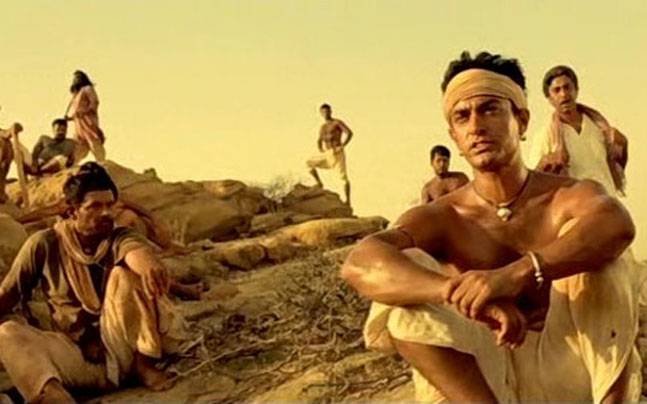
Performance Management lessons from LAGAAN

Released in the year of 2001, this sports-based iconic movie was based on a small number of people in a village in the Victorian India where they challenged the British for a game of cricket so as to avoid paying of taxes. The movie is an iconic one because it depicts how the protagonist, Amir Khan as Bhuvan took the responsibility to rescue his fellow villagers and how he taught them to play cricket. And the best part of the movie is that, how in spite of all the major and minor obstacles, Amir Khan won the game against the British and managed to secure an opportunity to not pay taxes for the coming three years.

That being said, this movie is quite extensively used by the B-Schools to teach about the various performance management lessons that can be derived from this movie. So after watching this movie again and following an extensive analysis, I have noticed certain instances which can provide exemplary examples of performance management. Below depicted are some of the instances:

World Water Day: From Lagaan to Well Done Abba, films that ...
  1. At the time when the villagers were unable to pay back the taxes, Bhuvan took the responsibility of all the villagers and acted as a leader to carve out a way of glory for them.
  2. After challenging the British over a game of cricket, Bhuvan took it upon himself to learn the game and then to teach all the fellow members.
  3. During the selection of the cricket team members, Bhuvan believed in instilling diversity and inclusion policy. Kachra was selected in the team because of a deformity in his hand which made him a good bowler, in spite of all the caste based differences. Bhura was selected because he was an expert in running to catch his hens which was identified as a major parameter to catch the ball. Even the drummer who could not speak, was selected because he spent most of his lifetime playing the drums and hence had a good upper body strength. So from these instance, Bhuvan was recognized to identify the differences in the team which can be a source of competitive advantage.
  4. At the onset of the game, Bhuvan and his team did not have the necessary resources. But he was more concerned about the performance of his team than about the scarcity of resources. He gave directions to build the necessity from the scratch and that too by the local folks. Being a leader, Bhuvan turned out to be innovative.
  5. Bhuvan did not just made the team, but he did a good job in allocating roles and responsibilities to each of the team members based on their strengths.
  6. One of the note-worthy point is that Bhuvan set some measurable goals and he supervised and improved the performance of his team members. His mantra was pure hard work but with empathy and compassion, which shows a good sign of performance management.
  7. At the end of the movie, even when Kachra facing the last ball, Bhuvan did not give up. He ran for that single run but then it was turned out to be ‘no-ball’. So as a leader of a team, Bhuvan showed immense amount of trust in his team members and a ‘never give up’ attitude.

Lagaan is definitely a movie to watch if one is trying to understand what it is that a leader truly believes in and does. So next time when you watch this movie, you can watch out for these instances of performance management.

Source: Movie ‘LAGAAN’

Mini-lockdown in West Bengal

5 days back on July 20, the Chief Minister of West Bengal, Mamata Bannerjee and the Home Secretary, Alapan Bandopadhyay conducted a meeting where it was jointly decided to impose a 2-day lockdown for every week in West Bengal. The sole reason for this lockdown is community transmission at some places in West Bengal. Due to such high rise of spread of infection, it was came as a verdict that offices, transports services and all the local shops will be closed on these 2 days. For this week 19th July to 25th July, those 2 days were Thursday (23rd July) and Saturday (25th July).

Due to the increase in the number of positive cases in west Bengal, our state minister had to take such a drastic step to contain the transmission. It was also decided that there will be further reviews if there arises any change in decision. To promote the mandatory 2-day lockdown, the city police have also undertaken quite a few steps to ensure compliance. They have released a mask-wearing awareness anthem, sung by Usha Utthup. At the same time, an awareness campaign ‘Mask-up Kolkata’ was promoted by Anuj Sharma, Police Commissioner.

West Bengal Lockdown 4.0 Guidelines: State to issue notification ...
Police raiding the streets of Kolkata

For one, the cases in West Bengal have been rising at an alarming rate. Apparently, Monday recorded 2,282 new cases, taking the total to 44,769. So to take this under control, the West Bengal police is also taking very strict steps to ensure that the citizens are following the lockdown rules. Around 10,000 policemen have hit the streets of West Bengal at around 5:30 am to curb the normal trends. Throughout the day, multiple cases came out where the house maids were trying to reach their places of work, shop owners even tried to open their shops with much disregard for the policemen and so much so, people just wandered off to the street saying that they were not aware of the rules of this new lockdown. But sadly, this time the police was there to check their behaviour and to make sure that there is no relaxation of the rules. The state ensured to circulate drones so as to prohibit people from leaving their homes. Cases arose where the bike riders tried to get away from the situation or where the shop owners forcefully tried to open their shops, ultimately resulting in police booking.

Yes at the end of the day, police cases arose from the places which had been declared as containment zones. As per Thursday’s report, 256 FIRs were registered, 1,273 people were arrested, 19 vehicles were seized, 665 people were booked for not wearing the masks and 128 people were caught for spitting openly on the roads. But in most of the cases, the victims complained that they were not aware of the exact conditions of this 2-day lockdown.

West Bengal, especially Kolkata, is doing a great job while trying to combat the increased transmission. But it is very necessary for Kolkata to stick to its own words to achieve success in this mission. And more importantly, we, the citizens should be cooperative enough to make this mission successful.

Source: https://www.timesnownews.com/kolkata/article/kolkata-west-bengal-govt-imposes-2-day-lockdown-every-week-after-community-transmission-detected-in-few-areas/625057

https://timesofindia.indiatimes.com/city/kolkata/kolkata-all-boxes-ticked-for-lockdown-day-ii/articleshow/77161203.cms

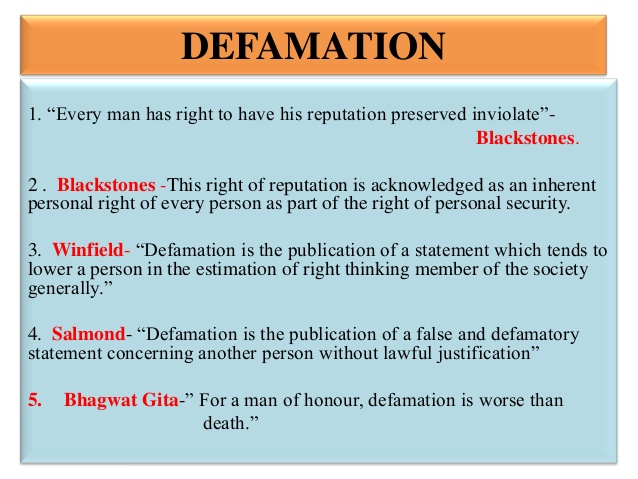
Defamation

Defamation (sometimes known as calumnyvilificationlibelslander ) is the oral or written communication of a false statement about another that unjustly harms their reputation and usually constitutes a tort or crime.

Under common law, to constitute defamation, a claim must generally be false and must have been made to someone other than the person defamed. Some commmon law jurisdictions also distinguish between spoken defamation, called slander and defamation in other media such as printed words or images, called libel.

Libel and slander are the legal subcategories of defamation. Generally speaking, libel is defamation in written words, pictures, or any other visual symbols in a print or electronic (online or Internet-based) medium. Slander is spoken defamation. The advent of early broadcast communications (radio and television) in the 20th century complicated this classification somewhat, as did the growth of social media beginning in the early 21st century.

Generally, defamation requires that the publication be false and without the consent of the allegedly defamed person. Words or pictures are interpreted according to common usage and in the context of publication. Injury only to feelings is not defamation; there must be loss of reputation. The defamed person need not be named but must be ascertainable. A class of persons is considered defamed only if the publication refers to all its members—particularly if the class is very small—or if particular members are specially imputed.

Usually, liability for a defamation falls on everyone involved in its publication whose participation relates to content. Thus, editors, managers, and even owners are responsible for libelous publications by their newspapers, whereas vendors and distributors are not.

Right to Freedom of speech and expression

Article 19 (1) (a) of the Constitution of India guarantees to every citizen of India the right to freedom of speech and expression. The Supreme Court has recognised that the liberty of press is an essential part of this freedom. Article 19 (2) of the Indian Constitution, which lists out those subjects on which reasonable restrictions can be made on the right to free speech, includes defamation. And, in India, the law recognises both civil and criminal defamation as valid restrictions.

The law on defamation

Sections 499 and 500 of the Indian Penal Code, 1860 (“IPC”) collectively criminalize defamation. Section 499 is the charging section and the punishment is prescribed under Section 500. Section 499 stipulates that whoever, by words either spoken or intended to be read, or by signs or by visible representations, makes or publishes any imputation concerning any person intending to harm, or knowing or having reason to believe that such imputation will harm, the reputation of such person, is said, except in the cases provided, to defame that person. It provides three exceptions to the offence: one, imputation of truth which public good requires to be made or published; two, public conduct of public servants; and, three, conduct of any person touching any public question.

Section 500 says that whoever defames another shall be punished with simple imprisonment for a term, which may extend to two years, or with fine, or with both. Both of these provisions were challenged as unconstitutional before the Supreme Court. However, their validity was upheld in Subramanian Swamy v. Union of India & Ors (2016). This judgment has been widely criticized, because, among other things, it ignores the chilling effect that criminalizing defamation has on free speech and the free press. The judgment also ignores the fact that in almost no other constitutional democracy is defamation a criminal offence.

But as a result of this judgment in Subramanian Swamy, and, as a result of the development of the law of criminal defamation, over the years, an onerous burden has come to be placed on persons who are charged with the offence and courts have been reluctant to quash proceedings at the first instance. At the same time, though, the scope of civil defamation in India has been narrowed with a view to advancing the value of free expression. 

In R. Rajagopal v. State of Tamil Nadu (1994). In this case, a popular Tamil magazine, Nakkheeran, field a writ petition under Article 32 of the Constitution, seeking to restrain the state government and the prison authorities from taking action that might halt the publication of an autobiography of Auto Shankar, who, while on death row, had written a letter to the magazine. Here, the Court was specifically concerned with the question of how to balance the freedom of press vis-à-vis the right to privacy of the Indian citizens. In this context, questions also arose over the scope of the right of the press to criticize and comment on the acts and conduct of public officials. The Supreme Court referred to various decisions of American courts, including New York Times v. Sullivan, on the freedom of press, and, finally, amongst other things, held that the State or its officials cannot impose a prior restraint on the press/media, and that, Government or its other organs cannot maintain a suit for damages. Through this judgment, the Court also effectively adopted the test in Sullivan for proceedings of civil defamation. This was recognised by a division bench of the Madras High Court in R. Rajagopal v. J. Jayalalitha(2006)

Women in batterfield

           In today’s world women are showing their interest in every field, especially the army Many females soldiers like Kristen Marie Griest, Jessica lynch, Lisa Jaster, Mary, Margaret Burcham, Sherri Gallagher, Lynndie England, Sabrina Harman, Megh ambuni, Michael s.jones, Linda l.singh, Mitali Madhumita, Madhuri Panikkar are showing their love towards the country by joining the battlefield. Not female army soldiers many female nurses are joining the military hospitals, Behind every successful man there is a woman”. 

         Lakshmibai, also known as rani of Jhansi, the women of every Indian’s heart and bravery.

In the year 1851, the entire country suffering for independence, the first Indian women rebel fought for independence, the name for the bravery.

    Mitali Madhumita is the first woman officer in the Indian army to receive a gallantry award and sena medal in 2011.

    Prime Minister Narendra Modi said “I am looking at women soldiers in front of me.on the battlefield at the border, this view is inspiring…..Today I speak of your glory and commend you” in Ladakh 

  Every woman in India should join the military because women are the faces of the country, people usually define women are weak and never tolerate the pain but while giving birth women are facing the pain that even a dead person can’t

 In rural towns in India are also not encouraging women because of backward and thinking of women are only fit for household works.PV Sindhu, Sudha Murthy was the inspiration for every woman

  Padma Bandopadhyay is the inspiration person because she is the first women joins India army

  India as women as prime minister, chief ministers as women but in the 150 million polluted countries, India army has only a few for the female army officers because some women are not getting chance and some women are not getting support, this makes the women far from the battlefield, Mom mission also called mars orbital mission, this mission is prepared by women of India with less cost of 450 crores, this is a big opportunity to a country.india women made mom but not war because of people thinking, everyone’s ideology is should change to make a country strong the women should be strong.

      “The bravery that you and your compatriots showed, a message has gone to the world about India’s strength… Your courage is higher than the heights where you are posted today,” PM Modi said.

     If anyone thinks women are weak, then need to know a story of Jhansi rani Lakshmi bai, on the last day of her fight for independence only 100 members left for the fight every solider ran off because of a feat but Lakshmi bai fought for freedom even she knows she will die but she never feared for her death, she fought and died as a women

               Being a woman, living like women, dying as a woman is not easy, it’s like fighting a war 

      Divya Kumar is first India women lady cadet 

Women and battlefield are not two separate words they are both are same being a woman and battlefield everything is the same in the current society, every one ideology should be change because ideology is something rules the mankind, it’s the cause of good and bad, and if it’s changed then everyone will change and we can see a new India

Let’s aim for a new India with women as an army that can change a country, that can even change a good country

    New India with new force should be the tagline for every person that can make a better country

If women won the battlefield of birth they can even win a war because wining a birth it’s not easy and winning a war is something that can win with strategy but birth can not win with any strategy 

Most of the women are fearless like stars sunny leone they even faced the camera, they do not even have fear of society if you just believe about you then you can win, if you believe others then you can win a war

Never think of society just think of yourself because society never gives respect to the feelings it just gives priority to useless knowledge,I believe women can taken this country to the next level because I believe “Behind every successful men there is a women”

DEFAMATION

Introduction 

Every Person has right to maintain and preserve his reputation. The Right of reputation is more valuable than right to property. Law gives protection to a man’s reputation. Chapter XXI, Section  499 to 502 of Indian Penal Code relates to offenses of Defamation. 

Meaning of Defamation 

   When injury caused to the reputation of a person it can be termed as defamation. Defamation is both a crime and civil wrong

Definition of defamation

Section 499 of Indian Penal Code defines defamation with for Explanations and ten exceptions and number of illustrations

 Defamation 

 “whoever by words either spoken or intended to be read, or by signs or by visible representations, makes or publishes any imputation concerning any person intending to harm, or knowing or having reason to believe that such imputation will harm, the reputation of such person, is said, except in the cases hereinafter excepted, to defame that person.

The definition of the Defamation contains three essential elements

i) the person

ii) his reputation, and

iii) the harm to reputation of the person with necessary mens rea  (guilty mind)

Essential Ingredients

                         The offence of defamation consists of the following essential Ingredients :

1) Making or Publishing of an Imputation concerning person. 

2) Such Imputation must have made by

     i) words either Spoken or

     ii) signs or

     iii)  visible representations;

3)  offender intends to harm, or knows or has reson to believe that such imputation will harm the reputation of that person.

Explanations 

  1. It may amount to defamation to impute anything to a deceased person, if the imputation would harm the reputation of that person if living, and is intended to be hurtful to the feelings of his family or other near relatives.
  2. It may amount to defamation to make an imputation concerning a company or an association or collection of persons as such.
  3. An imputation in the form of an alternative or expressed ironically, may amount to defamation.
  4. No imputation is said to harm a person’ reputation, unless that imputation directly or indirectly, in the estimation of others, lowers the moral or intellectual character of that person, or lowers the character of that person in respect of his caste or of his calling, or lowers the credit of that person, or causes it to be believed that the body of that person is in a loathsome state, or in a state generally considered as disgraceful.

Examples 

  1. A says-“Z is an honest man; he never stole B’ watch”, intending to cause it to be believed that Z did steal B’ watch. This is defamation, unless it fall within one of the exceptions.
  2. A is asked who stole B’ watch. A points to Z, intending to cause it to be believed that Z stole B’ watch. This is defamation, unless it fall within one of the exceptions.
  3. A draws a picture of Z running away with B’ watch, intending it to be believed that Z stole B’ watch. This is defamation, unless it fall within one of the exceptions.

Exceptions 

1) Imputation of truth which public good requires to be made or published –

                  It is not defamation to impute anything which is true concerning any person, if it be for the public good that the imputation should be made or published. Whether or not it is for the public good is a question of fact.

2) Public conduct of public servants – 

                   It is not defamation to express in good faith any opinion whatever respecting the conduct of a public servant in the discharge of his public functions, or respecting his character, so far as his character appears in that conduct, and no further.

3) Conduct of any person touching any public question. –

                   It is not defamation to express in good faith any opinion whatever respecting the conduct of any person touching any public question, and respecting his character, so far as his character appears in that conduct, and no further.

Example

It is not defamation in A to express in good faith any opinion whatever resepting Z’ conduct in petitioning Government on a public question, in signing a requisition for a meeting on a public question, in presiding or attending at such meeting, in forming or joining any society which invites the public support, in voting or canvassing for a particular candidate for any situation in the efficient discharge of the duties of which the public is interested.

4) Publication of reports of proceedings of courts –

                 It is not defamation to publish a substantially true report of the proceedings of a Court of Justice, or of the result of any such proceedings.

         Explanations – A Justice of the Peace or other officer holding an inquiry in open Court preliminary to a trial in a Court of Justice, is a Court within the meaning of the above section.

5) Merits of case decided in Court or conduct of witnesses and others concerned –

                  It is not defamation to express in good faith any opinion whatever respecting the merits of any case, civil or criminal, which has been decided by a Court of Justice, or respecting the conduct of any person as a party, witness or agent, in any such case, or respecting the character of such person, as far as his character appears in that conduct, and no further.

Examples – 

a) A says-“I think Z’ evidence on that trial is so contradictory that he must be stupid or dishonest.” A is within this exception if he says this in good faith, inasmuch as the opinion which he expresses respects Z’ character as it appears in Z’ conduct as a witness, and no farther.

b) But if A says-“I do not believe what Z asserted at that trial because I know him to be a man without veracity”; A is not within this exception, inasmuch as the opinion which expresses of Z’ character, is an opinion not founded on Z’ conduct as a witness.

6) Merits of public performance –

                    It is not defamation to express in good faith any opinion respecting the merits of any performance which its author has submitted to the judgment of the public, or respecting the character of the author so far as his character appears in such performance, and no farther .

Explanation  –

          A performance may be submitted to the judgment of the public expressly or by acts on the part of the author which imply such submission to the judgment of the public .

Examples –

a) A person who publishes a book, submits that book to the judgment of the public.

b) A person who makes a speech in public, submits that speech to the judgment of the public.

c) An actor or singer who appears on a public stage, submits his acting or singing to the judgment of the public.

d) A says of a book published by Z -“Z’ book is foolish; Z must be a weak man. Z’ book is indecent; Z must be a man of impure mind.” A is within the exception, if he says this in good faith, inasmuch as the opinion which he expresses of Z respects Z’ character only so far as it appears in Z’ book, and no further.

e) But if A says -“I am not surprised that Z’ book is foolish and indecent, for he is a weak man and a libertine.” A is not within this exception, inasmuch as the opinion which he expresses of Z’ character is an opinion not founded on Z’ book.

7) Censure passed in good faith by person having lawful authority over another –

                         It is not defamation in a person having over another any authority, either conferred by law or arising out of a lawful contract made with that other, to pass in good faith any censure on the conduct of that other in matters to which such lawful authority relates .

Example –

       A Judge censuring in good faith the conduct of a witness, or of an officer of the Court; a head of a department censuring in good faith those who are under his orders; a parent censuring in good faith a child in the presence of other children; a schoolmaster, whose authority is derived from a parent, censuring in good faith a pupil in the presence of other pupils; a master censuring a servant in good faith for remissness in service; a banker censuring in good faith the cashier of his bank for the conduct of such cashier as such cashier are within this exception .

8) Accusation preferred in good faith to authorized person –

                       It is not defamation to prefer in good faith an accusation against any person to any of those who have lawful authority over that person with respect to the subject-matter of accusation .

Example – 

       a) If A in good faith accuses Z before a Magistrate; if A in good faith complains of the conduct of Z, a servant, to Z’ master;if A in good faith complains of the conduct of Z, a child, to Z’ father-A is within this exception .

9) Imputation made in good faith by person for protection of his or other’ interests –

                         It is not defamation to make an imputation on the character of another provided that the imputation be made in good faith for the protection of the interest of the person making it, or of any other person, or for the public good.

Examples 

a) A, a shopkeeper, says to B, who manages his business-“Sell nothing to Z unless he pays you ready money, for I have no opinion of his honesty.” A is within the exception, if he has made this imputation on Z in good faith for the protection of his own interests.

b) A, a Magistrate, in making a report to his own superior officer, casts an imputation on the character of Z. Here, if the imputation is made in good faith, and for the public good, A is within the exception.

10) Caution intended for good of person to whom conveyed or for public good –

                      It is not defamation to convey a caution, in good faith, to one person against another, provided that such caution be intended for the good of the person to whom it is conveyed, or of some person in whom that person is interested, or for the public good.

Punishment for defamation (Section 500 I.P.C) –

       Whoever defames another shall be punished with simple imprisonment for a term which may extend to two years, or with fine, or with both.

        The offence under Section 500 is non-cognizable, bailable, compoundable, with the permission of the Court, and triable by the Court of Session.  

 Printing or engraving matter known to be defamatory Section 501 – 

           Printing or engraving matter known to be defamatory – Whoever prints or engraves any matter, knowing or having good reason to believe that such matter is defamatory of any person, shall be punished with simple imprisonment for a term which may extend to two years, or with fine, or with both.

Sale of printed or engraved substance containing defamatory matter Section 502 – 

          Sale of printed or engraved substance containing defamatory matter – Whoever sells or offers for sale any printed or engraved substance containing defamatory matter, knowing that it contains such matter, shall be punished with simple imprisonment for a term which may extend to two years, or with fine, or with both.

    The offence under section 502 is non-cognizable, bailable, compoundable and triable by the Court of Session

Succession Planning

One of the hardest task of an HR manager in any organization is talent management. It is the process of identifying the existing talent in the organization and then assessing the talent needs, followed by talent acquisition, talent engagement and finally by talent retention. The hardest part of this is not the process of talent acquisition or engagement, but rather it is the supply of talent itself. Most of the business and operating managers are of the notion that there exist an ample amount of talent in the labour market and that talent identification or acquisition would be easy. But the bitter truth is that, talent with the specific skill set and qualities is in scarce quantity in the talent market and thus the talent acquisition strategies should be very streamlined and well-defined so as not to lose out on the desired candidates. But on top of all this, one very important way that should be followed by each and every organization is Succession Planning.

Succession Planning is the process of identification and development of new leaders, usually at the executive level, with the intention to replace the old leaders when they die, retire or they leave the organization abruptly. This is a practice which is followed so that the existing capable leaders develop themselves so that they can assume the positions of the higher authorities as and when that become vacant. Succession planning is extremely important in an organization because of multiple reasons:

  1. Talent resource with the desired skill set is very scarce in the labour market.
  2. If an executive leaves the organization abruptly, there would be no qualified candidate to become the successor of the vacant position.
  3. Even if a candidate is selected to fill the vacant position, there would be loss in terms of acquisition costs, loss of productivity and hence un-productive costs and then the cost of upskilling among the few direct costs.

Considering the fact that talent is scarce in this unpredictable talent market, it is important for every organization to take strategic decisions as to how to implement the succession planning. It is a way by which an organization can plan for the future in case of uncertain events.

Now, while planning on how to conduct succession planning, an organization can follow a few steps. Some of the steps are:

  1.  At first, try to understand that how the organizational structure is going to be affected if some executive at the key position abruptly leaves the organization. And then while charting out the organizational hierarchy structure, identify the employees who play a critical role in the organization.
  2. Try to identify which are the key positions in your organization which if left vacant even for a single day will create a he dent in your organization.
  3. Scanning the organizational hierarchy, try to identify the top and the bottom players, by looking at their performance records, their career growth and majorly by discussing with their managers.
  4. For any single key position, always try to keep more than one option open.
  5. One of the most crucial step is to communicate who is selected and what is the purpose of selection. This communication should be done to both the new selects as well as the key position holders.
  6. After selection of the individuals, provide them the required training so as to make them ready to occupy the upper positions as and when required.

These is the backbone of succession planning which should be followed by every organization so that the entire organizational structure does not crumble down for a key member leaving the organization.

Source: https://www.insperity.com/blog/5-ways-your-org-chart-can-kick-start-your-succession-plan/