

Shareholders: The Companies Act 2013 has introduced new concept of class action suits with a view of making shareholders and other stakeholders, more informed and knowledgeable about their rights.More power for Shareholders: The Companies Act 2013 provides for approvals from shareholders on various significant transactions.Women empowerment in the corporate sector: The Companies Act 2013 stipulates appointment of at least one woman Director on the Board (for certain class of companies).Corporate Social Responsibility: The Companies Act 2013 stipulates certain class of Companies to spend a certain amount of money every year on activities/initiatives reflecting Corporate Social Responsibility.National Company Law Tribunal: The Companies Act 2013 introduced National Company Law Tribunal and the National Company Law Appellate Tribunal to replace the Company Law Board and Board for Industrial and Financial Reconstruction. They would relieve the Courts of their burden while simultaneously providing specialized justice.Fast Track Mergers: The Companies Act 2013 proposes a fast track and simplified procedure for mergers and amalgamations of certain class of companies such as holding and subsidiary, and small companies after obtaining approval of the Indian government.Cross Border Mergers: The Companies Act 2013 permits cross border mergers, both ways; a foreign company merging with an India Company and vice versa but with prior permission of RBI.Prohibition on forward dealings and insider trading: The Companies Act 2013 prohibits directors and key managerial personnel from purchasing call and put options of shares of the company, if such person is reasonably expected to have access to price-sensitive information.Increase in number of Shareholders: The Companies Act 2013 increased the number of maximum shareholders in a private company from 50 to 200.Limit on Maximum Partners: The maximum number of persons/partners in any association/partnership may be upto such number as may be prescribed but not exceeding one hundred. This restriction will not apply to an association or partnership, constituted by professionals like lawyer, chartered accountants, company secretaries, etc. who are governed by their special laws. Under the Companies Act 1956, there was a limit of maximum 20 persons/partners and there was no exemption granted to the professionals.One Person Company: The Companies Act 2013 provides new form of private company, i.e., one person company. It may have only one director and one shareholder. The Companies Act 1956 requires minimum two shareholders and two directors in case of a private company.Entrenchment in Articles of Association: The Companies Act 2013 provides for entrenchment (apply extra legal safeguards) of articles of association have been introduced.Electronic Mode: The Companies Act 2013 proposed E-Governance for various company processes like maintenance and inspection of documents in electronic form, option of keeping of books of accounts in electronic form, financial statements to be placed on company’s website, etc.Indian Resident as Director: Every company shall have at least one director who has stayed in India for a total period of not less than 182 days in the previous calendar year.Independent Directors: The Companies Act 2013 provides that all listed companies should have at least one-third of the Board as independent directors. Such other class or classes of public companies as may be prescribed by the Central Government shall also be required to appoint independent directors. No independent director shall hold office for more than two consecutive terms of five years.Serving Notice of Board Meeting: The Companies Act 2013 requires at least seven days’ notice to call a board meeting. The notice may be sent by electronic means to every director at his address registered with the company.Duties of Director defined: Under the Companies Act 1956, a director had fiduciary (legal or ethical relationship of trust)duties towards a company. However, the Companies Act 2013 has defined the duties of a director.Liability on Directors and Officers: The Companies Act 2013 does not restrict an Indian company from indemnifying (compensate for harm or loss) its directors and officers like the Companies Act 1956.Rotation of Auditors: The Companies Act 2013 provides for rotation of auditors and audit firms in case of publicly traded companies.Prohibits Auditors from performing Non-Audit Services: The Companies Act 2013 prohibits Auditors from performing non-audit services to the company where they are auditor to ensure independence and accountability of auditor.Rehabilitation and Liquidation Process: The entire rehabilitation and liquidation process of the companies in financial crisis has been made time bound under Companies Act 2013.  ReplyForward ReplyForward |
Author: News Updates
Track2Training is a online training and skill development forum. Visit us at https://track2training.com/
Lifting Of The Corporate Veil
From the juristic point of view, a company is a legal person distinct from its members.This principle may be referred to as the ‘Veil of incorporation’. The courts in general consider themselves bound by this principle. The effect of this Principle is that there is a fictional veil between the company and its members. That is, the company has a corporate personality which is distinct from its members. But, in a number of circumstances, the Court will pierce the corporate veil or will ignore the corporate veil to reach the person behind the veil or to reveal the true form and character of the concerned company. The rationale behind this is probably that the law will not allow the corporate form to be misused or abused. In those circumstances in which the Court feels that the corporate form is being misused it will rip through the corporate veil and expose its true character and nature disregarding the Salomod principal as laid down by the House of Lords. Broadly there are two types of provisions for the lifting of the Corporate Veil- Judicial Provisions and Statutory Provisions. Judicial Provisions include Fraud, Character of Company, Protection of revenue, Single Economic Entity etc. while Statutory Provisions include Reduction in membership, Misdescription of name, Fraudulent conduct of business, Failure to refund application money, etc. This article at first introduces to the readers the concept of “Veil of incorporation”, then it explains the meaning of the term-‘Lifting Of The Corporate Veil’, it then points out the Judicial as well as the Statutory provisions for Lifting of The Corporate Veil with the help of various case-laws.
Introduction-
Incorporation of a company by registration was introduced in 1844 and the doctrine of limited liability of a company followed in 1855. Subsequently in 1897 in Salomon v. Salomon & Company, the House of Lords effected these enactments and cemented into English law the twin concepts of corporate entity and limited liability. In that case the apex Court laid down the principle that a company is a distinct legal person entirely different from the members of that company. This principle is referred to as the ‘veil of incorporation’.
The chief advantage of incorporation from which all others follow is the separate entity of the company. In reality, however, the business of the legal person is always carried on by, and for the benefit of, some individuals. In the ultimate analysis, some human beings are the real beneficiaries of the corporate advantages, “for while, by fiction of law, a corporation is a distinct entity, yet in reality it is an association of persons who are in fact the beneficial owners of all the corporate property.” And what the Salomon case decides is that ‘in questions of property and capacity, of acts done and rights acquired or, liabilities assumed thereby…the personalities of the natural persons who are the companies corporators is to be ignored”.
This theory of corporate entity is indeed the basic principle on which the whole law of corporations is based. Instances are not few in which the Courts have successfully resisted the temptation to break through the corporate veil.
But the theory cannot be pushed to unnatural limits. “There are situations where the Court will lift the veil of incorporation in order to examine the ‘realities’ which lay behind. Sometimes this is expressly authorized by statute…and sometimes the Court will lift its own volition”.
Meaning Of Lifting Or Piercing Of The Corporate Veil-
The human ingenuity however started using the veil of corporate personality blatantly as a cloak for fraud or improper conduct. Thus it became necessary for the Courts to break through or lift the corporate veil and look at the persons behind the company who are the real beneficiaries of the corporate fiction.
Lifting of the corporate veil means disregarding the corporate personality and looking behind the real person who are in the control of the company. In other words, where a fraudulent and dishonest use is made of the legal entity, the individuals concerned will not be allowed to take shelter behind the corporate personality. In this regards the court will break through the corporate shell and apply the principle of what is known as “lifting or piercing through the corporate veil.” And while by fiction of law a corporation is a distinct entity, yet in reality it is an association of persons who are in fact the beneficial owners of all the corporate property. In United States V. Milwaukee Refrigerator Co., the position was summed up as follows:
“A corporation will be looked upon as a legal entity as a general rule……but when the notion of legal entity is used to defeat public convenience, justify wrong, protect fraud or defend crime, the law will regard the corporation as an association of persons.”
In Littlewoods Mail Order Stores Ltd V. Inland Revenue Commrs, Denning observed as follows:
“The doctrine laid down in Salomon v. Salomon and Salomon Co.Ltd, has to be watched very carefully. It has often been supposed to cast a veil over the personality of a limited liability company through which the Courts cannot see. But, that is not true. The Courts can and often do draw aside the veil. They can and often do, pull off the mask. They look to see what really lies behind”.
Judicial Provisions Or Grounds For Lifting The Veil-
FRAUD OR IMPROPER CONDUCT- The Courts have been more that prepared to pierce the corporate veil when it fells that fraud is or could be perpetrated behind the veil. The Courts will not allow the Salomon principal to be used as an engine of fraud. The two classic cases of the fraud exception are Gilford Motor Company Ltd v. Horne and Jones v. Lipman. In the first case, Mr. Horne was an ex-employee of The Gilford motor company and his employment contract provided that he could not solicit the customers of the company. In order to defeat this, he incorporated a limited company in his wife’s name and solicited the customers of the company. The company brought an action against him. The Court of appeal was of the view that “the company was formed as a device, a stratagem, in order to mask the effective carrying on of business of Mr. Horne” in this case it was clear that the main purpose of incorporating the new company was to perpetrate fraud. Thus the Court of appeal regarded it as a mere sham to cloak his wrongdoings.
In the second case of Jones v. Lipman, a man contracted to sell his land and thereafter changed his mind in order to avoid an order of specific performance he transferred his property to a company. Russel judge specifically referred to the judgments in Gilford v. Horne and held that the company here was “a mask which (Mr. Lipman) holds before his face in an attempt to avoid recognition by the eye of equity” .Therefore he awarded specific performance both against Mr.Lipman and the company.
FOR BENEFIT OF REVENUE-“The Court has the power to disregard corporate entity if it is used for tax evasion or to circumvent tax obligations. A clear illustration is Dinshaw Maneckjee Petit, Re;
The assesse was a wealthy man enjoying huge dividend and interest income. He formed four private companies and agreed with each to hold a block of investment as an agent for it. Income received was credited in the accounts of the company but the company handed back the amount to him as a pretended loan. This way he divided his income into four parts in a bid to reduce his tax liability.
But it was held that, “the company was formed by the assessee purely and simply as a means of avoiding super tax and the company was nothing more than the assessee himself. It did no business, but was created simply as a legal entity to ostensibly receive the dividends and interests and to hand them over to the assessee as pretended loans”.
ENEMY CHARACTER-A company may assume an enemy character when persons in de facto control of its affairs are residents in an enemy country. In such a case, the Court may examine the character of persons in real control of the company, and declare the company to be an enemy company. In Daimler Co.Ltd V. Continental Tyre And Rubber Co.Ltd, A company was incorporated in England for the purpose of selling in England, tyres made in Germany by a German company which held the bulk of shares in the English company. The holders of the remaining shares, except one, and all the directors were Germans, residing in Germany. During the First World War, the English company commenced action for recovery of a trade debt. Held, the company was an alien company and the payment of debt to it would amount to trading with the enemy, and therefore, the company was not allowed to proceed with the action.
WHERE THE COMPANY IS A SHAM- The Courts also lift the veil where a company is a mere cloak or sham (hoax).
COMPANY AVOIDING LEGAL OBLIGATIONS- Where the use of an incorporated company is being made to avoid legal obligations, the Court may disregard the legal personality of the company and proceed on the assumption as if no company existed.
SINGLE ECONOMIC ENTITY- Sometimes in the case of group of enterprises the Salomon principal may not be adhered to and the Court may lift the veil in order to look at the economic realities of the group itself. In the case of D.H.N.food products Ltd. V. Tower Hamlets, it has been said that the Courts may disregard Salomon’s case whenever it is just and equitable to do so. In the above-mentioned case the Court of appeal thought that the present case was one which was suitable for lifting the corporate veil. Here the three subsidiary companies were treated as a part of the same economic entity or group and were entitled to compensation.
Lord Denning has remarked that ‘we know that in many respects a group of companies are treated together for the purpose of accounts, balance sheet, and profit and loss accounts. Gower too in his book says, “There is evidence of a general tendency to ignore the separate legal group”. However, whether the Court will pierce the corporate veil depends on the facts of the case. The nature of shareholding and control would be indicators whether the Court would pierce the corporate veil. The Indian Courts have held that a ‘single economic unit’ argument could work in certain circumstances. These circumstances would depend on the factual control exercised. This view is strengthened by the Supreme Court decision (cited in Novartis v. Adarsh Pharma) in New Horizons v. Union of India. State of UP v. Renusagar was decided in 1988. Back in the year 1988 also, in Renusagar case, the Court proceeded, on the basis of prior English law which had accepted the ‘single economic unit’ argument. Thus, Renusagar case seems to support the conclusion that a ‘single economic entity’ argument would succeed in India for lifting the corporate veil.
AGENCY OR TRUST- Where a company is acting as agent for its shareholder, the shareholders will be liable for the acts of the company. It is a question of fact in each case whether the company is acting as an agent for its shareholders. There may be an Express agreement to this effect or an agreement may be implied from the circumstances of each particular case. In the case of F.G.Films ltd, An American company financed the production of a film in India in the name of a British company. The president of the American company held 90 per cent of the capital of the British company. The Board of trade of Great Britain refused to register the film as a British film. Held, the decision was valid in view of the fact that British company acted merely as he nominee of the American Company.
AVOIDANCE OF WELFARE LEGISLATION- Avoidance of welfare legislation is as common as avoidance of taxation and the approach of the Courts in considering problems arising out of such avoidance is generally the same as avoidance of taxation. It is the duty of the Courts in every case where ingenuity is expended to avoid welfare legislation to get behind the smokescreen and discover the true state of affairs.
PUBLIC INTEREST- The Courts may lift the veil to protect public policy and prevent transactions contrary to public policy. The Courts will rely on this ground when lifting the veil is the most ‘just’ result, but there are no specific grounds for lifting the veil. Thus, where there is a conflict with public policy, the Courts ignore the form and take into account the substance.
Statutory Provisions For Lifting The Veil-
REDUCTION OF NUMBER OF MEMBERS- Under Section 45 of The Indian Companies Act, 1956, if a company carries on business for more than six months after the number of its members has been reduced to seven in case of a public company and two in case of a private company, every person who knows this fact and is a member during the time that the company so carries on business after the six months, becomes liable jointly and severally with the company for the payment of debts contracted after six months. It is only that member who remains after six months who can be sued.
FRAUDULENT TRADING- Under Section 542 of The Indian Companies Act, 1956, if any business of a company is carried on with the intent to defraud creditors of the company or creditors of any other person or for any fraudulent purpose, who was knowingly a party to the carrying on of the business in that manner is liable to imprisonment or fine or both. This applies whether or not the company has been or is in the course of being wound up. This was upheld in Delhi Development Authority v. Skipper Constructions Co. Ltd. (1997).
MISDESCRIPTION OF THE COMPANY- Section 147 (4) of The Indian Companies Act, 1956, provides that if any officer of the company or other person acting on its behalf
signs or authorizes to be signed on behalf of the company any bill of exchange, promissory note, endorsement, cheque or order for money or goods in which the companies name is not mentioned in legible letters, he is liable to fine and he is personally liable to the holder of the instrument unless the company has already paid the amount.
PREMATURE TRADING- Another example of personal liability is mentioned in Section 117 (8) of The English Companies Act. Under this section a public limited company newly incorporated as such must not “do business or exercise any borrowing power” until it has obtained from the registrar of companies a certificate that has complied with the provisions of the act relating to the raising of the prescribed share capital or until it has re-registered as a private company. If it enters into any transaction contrary to this provision not only are the company and it’s officers in default , liable to pay fines but if the company fails to comply with its obligations in that connection within 21 days of being called upon to do so, the directors of the company are jointly and severally liable to indemnify the other party in respect of any loss or damage suffered by reason of the company’s failure.
FAILURE TO REFUND APPLICATION MONEY-According to Section 69(5) of The Indian Companies Act, 1956, the directors of a company are jointly and severally liable to repay the application money with interest if the company fails to refund the money within 130 days of the date of issue of prospectus.
HOLDING AND SUBSIDIARY COMPANIES- In the eyes of law, the holding company and its subsidiaries are separate legal entities.
But in the following two cases the subsidiary may lose its separate entity-
Where at the end of its financial year, the company has subsidiaries, it must lay before its members in general meeting not only its own accounts, but also attach therewith annual accounts of each of its subsidiaries along with copy of the board’s and auditor’s report and a statement of the holding company’s interest in the subsidiary.
The Court may, on the facts of a case, treat a subsidiary as merely a branch or department of one large undertaking owned by the holding company.
Conclusion-
Thus it is abundantly clear that incorporation does not cut off personal liability at all times and in all circumstances. “Honest enterprise, by means of companies is allowed; but the public are protected against kitting and humbuggery”. The sanctity of a separate entity is upheld only in so far as the entity is consonant with the underlying policies which give it life.
Thus those who enjoy the benefits of the machinery of incorporation have to assure a capital structure adequate to the size of the enterprise. They must not withdraw the corporate assets or mingle their own individual accounts with those of the corporation. The Courts have at times seized upon these facts as evidence to justify the imposition of liability upon the shareholders.
The act of piercing the corporate veil until now remains one of the most controversial subjects in corporate law. There are categories such as fraud, agency, sham or facade, unfairness and group enterprises, which are believed to be the most peculiar basis under which the Law Courts would pierce the corporate veil. But these categories are just guidelines and by no means far from being exhaust
IMPACT OF THE CONSTITUTION OF NCLT AND NCLAT ON COMPANY LAW LITIGATION
The Ministry of Corporate Affairs (‘MCA’) on 1st June 2016 notified the constitution of National Company Law Tribunal (‘NCLT’) and National Company Law Appellate Tribunal (‘NCLAT’) in exercise of powers conferred under §408 and §410 of the Companies Act 2013 (‘Companies Act‘). This notification has been in abeyance for almost 14 years since it was first introduced by the Companies (Second Amendment) Act 2002 based on the recommendations of Eradi committee. However, in recent times the Government of India has been emphasising on easing the process of carrying out business in India. Thus, in recent times, various legal reforms have been carried out and the constitution of the NCLT and the NCALT is one more step in this direction.
The newly setup NCLT will, initially, have 11 benches including two benches in the national capital, New Delhi. Retired Supreme Court judge Hon’ble Justice SJ Mukhopadhaya will be the first Chairperson of NCLAT and Retired Justice MM Kumar will be the first President of the NCLT.
The constitution of the NCLT is likely to have a fundamental impact as far as company law litigation is concerned. Some of the more important consequences of this development are enumerated below:
- Single Window: The most significant benefit likely to arise from the constitution of the NCLT and the NCLAT is that the tribunals will, effectively, act as a single window for settlement of all company law related disputes. The newly constituted tribunals will replace the existing Company Law Board (‘CLB’), the Board of Industrial and Financial Reconstruction (‘BIFR’) and its appellate authority. Thus, the unnecessary fragmentation and multiplicity of the proceedings before various courts and tribunals in the same matter will be now be curbed.
The constitution of the NCLT is in consonance with the recently enacted Insolvency and Bankruptcy code and the liquidation process of companies and corporate debtors will now be considerably simplified.
Further, in the previous regime most powers were reserved either for the Central Government, the CLB or the High Courts. However, with the formation of the NCLT, the intent is to consolidate these powers and jurisdiction and assign them to a single authority, thereby simplifying the dispute adjudication process as far as companies are concerned. - Class Action Claims: Shareholders are allowed to file class action suits before the NCLT, against the company for the breach of provisions of the Companies Act. Per this provision, if 100 or more shareholders or depositors find that the company’s affairs are not being managed in its best interests, they may approach the NCLT. In a class action suit, shareholders can collectively sue directors or auditors of the company for their misconduct or unwarranted acts. This remedy will be crucial for the minority shareholders who seek redressal against arbitrary/oppressive decisions of their management. In addition, with the increase of shareholder activism in India such a remedy would be a valuable remedy in the hands of shareholders against their boards.
- Greater Field Impact: Under the old law, the CLB was operating through only 5 benches. However, the NCLT will commence with 11 benches, with the Principal Bench being in New Delhi. This will undoubtedly aid in ensuring a wider reach for adjudicating company law matters in India.
- Speedy Disposal of Cases: The NCLT has been given the powers to regulate its own procedure which will assist them in disposing matters in a simplified manner. Further, the NCLT and the NCLAT are under a mandate to dispose of cases before them as expeditiously as possible. In this context, a time limit of 3 months has been provided to dispose of cases, with an extension of 90 days for sufficient reasons to be recorded by the President or the Chairperson, as the case maybe. This time limit is expected to ensure the speedy disposal of cases by the NCLT and the NCLAT.
- Limitations and Unanswered Questions: The notification does not expressly specify the manner or procedure for transferring pending cases from the CLB and High Courts to the NCLT. It is likely the process of transfer will be commenced and implemented as a gradual process. The objective may be to transfer the matters to the new body in a gradual manner, so as to give the NCLT ample amount of time to structure itself in the company law litigation of the country. However, effective steps will need to be taken to prevent unnecessary confusion amongst litigants.
In addition, provisions relating to the winding up of the companies and those under Chapter XV of the Companies Act have not yet been notified. Therefore, these matters will continue to be governed by the provisions of Companies Act 1956. There is no updated information available in terms of when the provision of Chapter XV are likely to be brought into force.
IT LAWS –is it a restriction of fundamental right?
After the sc has declared right to privacy is fundamental right then how can it laws in the country be full operative and meet its objectives in last few years threre has been several cases related to the right to privacy and one of the most eminent is adhar card issue .
A nine-judge bench of the Supreme Court pronounced this verdict on Thursday morning of 24 aug 2017 .It was a unanimous decision with all the nine judges in favour of the Right to Privacy. The constitutional bench headed by Chief Justice JS Khehar ruled that “right to privacy is an intrinsic part of Right to Life and Personal Liberty under Article 21 and entire Part III of the Constitution.”
the judgement certainly gives incentives to work towards a strong data privacy policy. “There will be a need to set up appropriate and detailed standards of care regarding what is done with your data and how it is used. There is already a Data Protection Bill in consideration. Legislation will be required to implement the fundamental rights, so that in the future even private parties are subjected to regulation.
What privacy includes
Preservation of personal intimacies, the sanctity of family life, marriage, procreation, home and sexual orientation.
A right to be left alone.
Safeguards individual autonomy, recognises the ability of the individual to control vital aspects of his or her life.
Personal choices governing a way of life are intrinsic to privacy.
Protection of heterogeneity and recognition of plurality and diversity of our culture.
——. Privacy is not surrendered when a person is in public place
By being in public place doesn’t mean an individual has surrendered privacy, even as the legitimate expectation of privacy may vary from the intimate zone to the private zone and from the private to the public arena.
Privacy attaches to the person since it is an essential facet of the dignity of the human being
——- What Right to Privacy doesn’t mean
Not an absolute right: Like other rights which form part of the fundamental freedoms protected by Part III, including the right to life and personal liberty under Article 21, privacy is not an absolute right.
——Can law/state encroach upon privacy?
According to SC, a law which encroaches upon privacy will have to withstand the touchstone of permissible restrictions on fundamental rights.
In the context of Article 21, an invasion of privacy must be justified on the basis of a law which stipulates a procedure which is fair, just and reasonable.
The law must also be valid with reference to the encroachment on life and personal liberty under Article 21.
An invasion of life or personal liberty must meet the three-fold requirement of (i) legality, which postulates the existence of law; (ii) need, defined in terms of a legitimate state aim; and (iii) proportionality which ensures a rational nexus between the objects and the means adopted to achieve them; and
—— Privacy has both positive and negative content.
The negative content of privacy restrains the state from committing an intrusion upon the life and personal liberty of a citizen.
Positive content of the right to privacy imposes an obligation on the state to take all necessary measures to protect the privacy of the individual.
——-Robust regime needed for data protection
Informational privacy is a facet of the right to privacy. The court observed that dangers to privacy in an age of information can originate not only from the state but from non-state actors as well. The Union Government, hence, needs to examine and put into place a robust regime for data protection. The creation of such a regime would require a careful and sensitive balance between individual interests and legitimate concerns of the state.
—— For what reasons state can encroach upon individual’s privacy?
According to the judgement, the legitimate aims of the state should be “protecting national security, preventing and investigating crime, encouraging innovation and the spread of knowledge, and preventing the dissipation of social welfare benefits.” These matters should be considered by the Union government while designing the regime for the protection of the data.
How the IT laws be improved —
India’s existing data privacy framework dates only to the year 2009, introduced to address growing concern relating to ‘data protection’ and ‘data privacy’. This framework was primarily introduced through Sections 43-A and 72-A of the Information Technology Act 2000. Subsequently, the Information Technology (Reasonable Security Practices and Procedures and Sensitive Personal Data or Information) Rules 2011 were issued. These regulate the collection, disclosure, transfer and storage of sensitive personal data and information.
Unfortunately, the above-mentioned legislative framework does not extend to government agencies, and also stops short of imposing an obligation upon the data collector to mandatorily report any data compromises to data subjects. Further, it imposes a stiff requirement to establish intent to cause wrongful gain or loss before an enforceable remedy against a data breach would be available to data subjects.
A well-functioning data privacy regime should ideally set the rules of the game for all actors, cut out any regulatory uncertainty and strike a balance between protecting the right of privacy of data subjects with the business needs of data collectors.
In 2012, the AP Shah report studied global best practices with a view to rebooting the existing domestic framework; it identified transparency, consent, and accountability as the fundamental building blocks of the ideal data protection regime. The report also observed that any new data privacy framework must aim to harmonise principles such as the principle of notice, choice and consent, limitation on collection and purpose, disclosure, openness, security, and accountability. These would also be relevant today.
Moreover, with technology constantly evolving, an approach based on standards would enable the law to keep pace with rapid changes in technology, as against objective rules that would fail to be relevant with constant technological developments.
Perhaps the biggest shift required from the existing regime is with respect to its applicability. It is imperative to bring government agencies within the ambit of the new framework. Although drafting a legislation that is applicable to both the private sector and the Government alike is a daunting task, it may be a streamlined method of ensuring that data subjects are adequately safeguarded.
While ‘consent’ is the cornerstone of any data privacy regime, the adequacy of such consent from the data subjects is sometimes debatable, especially in the context of standard-form contracts such as click wrap agreements. Recent studies show that this problem has been exacerbated manifold; people are often forced to accept unfavourable terms of service since most apps are designed to quit immediately if one does not click on the ‘I agree’ button.
Behavioural research also points to the inability of data subjects to manage their own data. This is attributed to a combination of lack of understanding and general disinclination.
To counter this, researchers have argued that perhaps regulating only the collection of data may not be enough, its use by data collectors and data processors could also be regulated such that there is a prohibition on using certain data in a manner that is detrimental to data subjects. This could be a useful supplement to temper the current prior consent-based approach where data subjects often surrender their data without truly understanding the wider ramifications of exploitation of such data.
Several stops and starts and multiple draft privacy Bills later, the Government has now taken the step to constitute a committee under Justice (Retd) BN Srikrishna to suggest and draft a new data protection Bill. While the Supreme Court continues to deliberate whether the right to privacy should be elevated to a separate fundamental right, a robust and well-functioning data privacy legislation will go a long way in complementing the constitutional right to privacy in not only creating the right incentives for all stakeholders but also providing an efficient redress mechanism for data subjects.
How to register a company?
Know the basics first: What is mean by company, the private company and public company?
In India, there are about 7 lacks registered companies and every month thousands of firms apply for registration. company is a legal entity; According to Section 3 of companies act company means a legal entity formed and registered under Companies Act 1956. Under the ministry of corporate affairs, every company is to be registered by the registrar of companies for the state. This act maintains two types of companies called private and public companies. The ‘Limited’ is the most commonly used corporate form at the end of the company name. First you need to know what are these public and private companies and decide how you want your company to get registered.
When it comes to company registration, Every firm will have following two options:
Private company
Public company
Lets start the registration procedure: 4 Steps
Step 1: Acquire Director Identification Number(DIN)
This is the first process in registration that each director of the company should obtain their identification number. As per the amendment act 2006, acquiring a DIN is compulsory for every director i.e. as such every existing and intending directors have to obtain their DIN. To get DIN one need to file a eForm DIN-1. The DIN-1 form is available on Official site of the ministry of corporate affairs
Register yourself on mca website first and have a login id. After filling DIN-1 Form, one should upload the filled form by clicking to eForm upload button on MCA website and should pay applicable fees.
After getting generated DIN one should intimate their company about DIN. The director can intimate their company about DIN
Then company should intimate the Registrar of Corporates(ROC) about all director’s DIN
If there is any change in DIN or need for any updation like change of address, personal details etc, then director should intimate this change by submitting the eForm
Step 2: Acquire Digital Signature Certificate(DSC):
In order to ensure the security or authenticity of documents filed electronically the information act 200o demands a valid digital signature on the documents submitted electronically. This is the only and safest way that one can submit their documents electronically. The digital signature certificate should be acquired by only those agencies which are appointed by the controller of certification agencies (CCA). One should not use DSC given by any other agency which is not approved and it’s illegal to use others DSC as yours or the false one.
If you already have a digital signature then you can use the same, no need to apply for another. But do check for your digital signature validity, agencies issue DSC’s with one or two year validity after expiry you have to renew it.
One can acquire his/her Digital Signature certificates from these government listed agencies like TCS, IDBRT, MTNL, SAFESCRYPT, NIC, nCODE Solutions etc. to check out their price details of these Govt approved agencies
Step 3: Create a account on MCA Portal – New user registration
This is about having a registered user account on MCA Portal for filing a eForm, for online fee payment, for different transactions as registered and business user. Creating an account is totally free of cost. To register yourself on the MCA portal, click on the register link.
Step 4: Apply for the company to be registered.
This is the final major step in a registration of your company which includes incorporating company name, Registering the office address or notice of situation of office and notice for appointment of company directors, manager and secretary. And also regarding the take and pay for their qualification shares.
Form-1:
Form-1A: Application form for availability or change of a company name. Once you apply for new company name, the MCA will suggest four different form of your company name; you have to choose one among them. To do the same you have you have to fill Form-1A and submit.
Form-1: This is for application or declaration for incorporation of a company, in this form you have to fill the same name which you have chosen during application of form-1A.
Form-18:
This form is for notice of the situation of a new company office or change of situation of previously registered office.
For a new company you have to fill the form with genuine office address and submit.
Form-32:
For a new company, this form is for notice for appointment of new Directors, Managers and Secretary.
For an existing company, this form is for a change of directors, Manger, Secretary or company head.
After submitting these forms, once the application has been approved by MCA, you will receive a confirmation email regarding the application for incorporation of a new company, and the status of the form will get changed to Approved.
Detailed procedure for approval of the proposed company name:
For obtaining name for your new company, An application in Form-1A needs to be filed with the Registrar of Companies (ROC) of the state in which the Registered Office of the proposed Company is to be situated to ascertain the availability of a name along with an official service fee of Rs.500/-.
You have to provide four alternative names for the proposed company. Your company name shall not resemble the name of any other company already registered or violate the provisions according to Act, 1950.
In this form you have to fill name and addresses of directors (minimum 2 for a private company and 7 for a public company). You have to mention main objects of the company and authorized capital.
In about 10 days, the ROC will inform you about approval or objections. If there are any objections then ROC will suggest you with some available names and let you choose among them. If your company name is approved then you will receive a formal letter regarding the confirmation of the same. Keep the same which will be required during registration process of the proposed company.
If you find any difficulty or encounter any problem while obtaining the company name then do contact us, We will help you to sort out your problem.
Check these documents before submission of a company:
DIN of all those directors of a proposed company.
DSC – Digital Signature Certificate
Original copy the of formal letter issued by ROC regarding availability of Company name.
Form-1 for incorporation of a company.
Form-18 for situation or address of the proposed company.
Form-32 for particulars of proposed directors, managers and secretary.
Formalities to be followed while incorporation of a company:
Obtain a TAN card
Obtain a Permanent account number (PAN) from income tax dept. India
If required: Documents obeying shop and establishment acts.
If required: For foreign trade, Registration documents of import export code from Director General of foreign trade.
If required: Registration documents of Software technologies Parks of India (STPI).
If required: RBI approval for foreign companies investing in India and FIPB approval.
Both Indian and foreign directors need to have valid Digital Signature Certificates from authorized agencies.
BILLS
> bills: in a very simple term or say in a lay man languane it could be defined as “A bill is proposed legislation under consideration by a legislature. A bill does not become law until it is passed by the legislature and, in most cases, approved by the executive. Once a bill has been enacted into law, it is called an act of the legislature, or a statute.
> a bill is neccessery because to control the vast country effectively and because of dynamic nature of the society this because to control the huge population through imposing the law for better functioning of the country
> Types of Bills Introduced in the Indian Parliament
> Bills introduced in the Indian Parliament can be classified into 4 types of bills. They are as follows:
> 1. Money Bills
> 2. Financial Bills
> 3. Ordinary Bills
> 4. Constitutional Amendment Bills
> lets talk about how it could be introduced ;character and procedure of different types of bills:
> 1. money bills : These are defined in Article 110. These Bills deal with the taxes, borrowings, consolidated and contingency funds, audit and accounting, etc.
> Article 109 of Indian Constitution gives special procedure regarding Money Bills.
> A money Bill can originate only in Lok Sabha after the recommendations of the President. Through the Bill is sent to Rajya Sabha also but even Rajya Sabha rejects/returns the Bill (within days necessarily), the Bill is deemed to be passed.
> The Appropriation Bill and Annual Financial Bill (Budget) are Money Bills.
Power to decide whether a Bill is a Money Bill or not
> Article 110 (3) of the Constitution of India lays down that “if any question arises whether a Bill is a Money Bill or not, the decision of the Speaker of the House of the People thereon shall be final”. It is the Speaker of the Lok Sabha who decides whether a Bill is a Money Bill or not. Further, once the Speaker has certified a Bill as a Money Bill, its nature cannot be questioned in a court of law, in the Houses of Parliament, or even by the President.
> Procedure for Passing of the Money Bills
> A money bill can be introduced / originated only in Lok Sabha {or in legislative assembly in case of bicameral legislature in states}.
> A money bill can be introduced only on prior recommendations of the President {or governor in case of state}
> Once a money bill is passed in Lok Sabha, it is transmitted to Rajya Sabha for its consideration. But Rajya Sabha has limited powers in this context. It can neither reject nor amend the money bill. It can make only recommendations and has to return the bill with or without recommendations to Lok Sabha in 14 days.
> The Lok Sabha may or may not accept the recommendations of Rajya Sabha. Whether or not accepted those recommendations, thus returned bill is considered passed in both houses.
> If Rajya Sabha does not return the bill in 14 days, it is deemed to have been passed by both the houses at the expiration of the 14 days in the form in which it was passed by the Lok Sabha.
> President can withhold assent to money bill but cannot return it for reconsideration of the Lok Sabha.
> Whether there can be a joint sitting of both the Houses in case of Money Bill
> There cannot be a joint sitting of both the Houses in case of money bills.
> 2. financial bills : Any Bill dealing with revenues or expenditure but not certified as Money Bill by the Speaker is a Financial Bill.
> Financial Bill can only be introduced in Lok Sabha on the recommendations of the President & should be passed by both Houses of Indian Parliament (Lok Sabha or Rajya Sabha) by Simple majority.
> The proposals of the government for levy of new taxes, modification of the existing tax structure or continuance of the existing tax structure beyond the period approved by Parliament are submitted to Parliament through this bill.
> The Finance Bill is accompanied by a Memorandum containing explanations of the provisions included in it. The Finance Bill can be introduced only in Lok Sabha.
> However, the Rajya Sabha can recommend amendments in the Bill. The bill has to be passed by the Parliament within 75 days of its introduction.
> 3.Ordinary Bills : Ordinary bills are concerned with any matter other than Financial Bills, money Bills and Constitutional Amendment Bills.
> Such Bills can be introduced in either House of Indian Parliament (Lok Sabha or Rajya Sabha) without the recommendations of President of India. These bills are passed by Simple Majority in both Houses.
> 4: Constitutional Amendment Bills : Under Article 368 of Indian Constitution with the powers of parliament to amend the constitution, this bill can be introduced in any of the two Houses without recommendations of the President.
> Such Bills must be passed by each house (Lok Sabha and Rajya Sabha) separately with a special majority (two third of the members present and voting which must be more than absolute majority).
> By 24th Constitution amendment Act, 1971 it is obligatory for the president to give his assent to the Constitutional Amendment Bills.
DYNAMICS OF HUMAN RIGHTS IN CHANGING WORLD: PERSPECTIVE AND PROSPECTS
Human rights are inherent to all human beings, regardless of nationality, sex, national or ethnic origin, colour, religion, language, or any other status. They cannot be given or taken away.
Human rights are the foundation for freedom, justice and peace in the world.
They have been formally and universally recognised by all countries in the 1948 Universal Declaration on Human Rights. Since then, many treaties have been adopted by states to reaffirm and guarantee these rights legally.
International human rights law sets out the obligations of states to respect, to protect and to fulfil human rights for all. These obligations impose specific duties upon states, regardless of their political, economic and cultural systems.
All human rights are universal, indivisible, interdependent, and interrelated (Vienna Declaration and Programme of Action,
Equality and non-discrimination are cross-cutting principles in international human rights law that guarantee the full enjoyment of human rights to everyone.
he right to education ensures access to quality schools and to an education that is directed towards the full development of the human personality. NESRI uses six priority human rights principles in our work that are fundamental to guaranteeing the right to education and are of particular relevance to education reform efforts in the United States:
Individual Rights: Every individual child must have equal access to a quality education adapted to meet his or her needs.
Aims of Education: The aims of education must be directed toward the development of each child’s personality and full potential, preparing children to participate in society and to do work that is rewarding and reasonably remunerative, and to continue learning throughout life.
Dignity: Schools must respect the inherent dignity of every child creating an environment of respect and tolerance in the classroom, preventing practices and disciplinary policies that cause harm or humiliation to children, and promoting self-confidence and self-expression.
Equity: There must be equitable distribution of resources in education across communities according to need.
Non-Discrimination: The government must ensure that the human right to education “will be exercised without discrimination of any kind as to race, colour, sex, language, religion, political or other opinion, national or social origin, property, birth or other status.”
Participation: Students, parents and communities have the right to participate in decisions that affect their schools and the right to education.
The Right to Education is protected by:
- Article 26 of the Universal Declaration of Human Rights
- Articles 13 & 14 of the International Covenant on Economic Social and Cultural Rights
- Articles 28,29 & 40 of the Convention on the Rights of the Child
- Article 5 of Convention on the Elimination of All Forms of Racial Discrimination
- Articles 10 & 14 of Convention on the Elimination of All Forms of Discrimination Against Women
- Article 12 of American Declaration on the Rights and Duties of Man
ROLE OF NATIONAL HUMANRIGHTS COMMISON :
NHRC was constituted under Section 3 of the 1993 Act for better protection of human rights. The term ‘human rights’ is defined in Section 2(d) of the 1993 Act, which reads as follows:
“2. (d) “Human rights” means the rights relating to life, liberty, equality and dignity of the individual guaranteed by the Constitution or embodied in the International Covenants and enforceable by courts in India.”
• It is autonomous i.e. it has been created by an Act of Parliament.
• NHRC is committed to provide independent views on issues within the parlance of the Constitution or in law for the time being enforced for the protection of human rights. The Commission takes an independent stand.
• NHRC has the powers of a civil court.
• Authority to grant interim relief
• Authority to recommend payment of compensation or damages
• Over seventy thousand complaints received every year reflects the credibility of the Commission and the trust reposed in it by the citizens.
• NHRC has a very wide mandate
• NHRC has unique mechanism with which it also monitors implementation of its various recommendations.
ROLE OF UN
The United Nations (UN) system has two main types of bodies to promote and protect human rights: Charter Bodies and Treaty Bodies.
Charter Bodies are established under the UN Charter in order to fulfil the UNs general purpose of promoting human rights. They have broad mandates that cover promoting human rights in all UN member states.
The Human Rights Council
The principal UN Charter Body responsible for human rights is the Human Rights Council (HRC). The General Assembly established the HRC in 2006, in the hope that it would be more efficient and effective than its predecessor, the Human Rights Commission. Forty-seven UN member states sit on the HRC. One of its main purposes is to review the human rights record of every UN member state once every four years and to make recommendations for improvement. Australia is not currently a member of the Human Rights Council.
Office Of The United Nations High Commissioner For Human Rights
The Office of United Nations High Commissioner for Human Rights (OHCHR), a department of the United Nations Secretariat was established following the World Conference on Human Rights in 1993. Its role is to prevent human rights violations and secure respect for human rights by promoting international cooperation and coordinating the United Nations’ human rights activities. The OHCHR conducts a very broad range of activities from is headquarters in Geneva. It also works directly in areas where there are severe human rights violations though field offices and as part of UN peace missions.
Treaty Bodies have responsibility for monitoring and promoting compliance with a particular human rights treaty. As such they are only concerned with countries that are a party to that treaty.
A number of human rights treaties have established treaty-monitoring bodies to supervise the implementation of treaty obligations by State Parties:
- the Committee on the Elimination of Racial Discrimination monitors State Parties compliance with ICERD;
- the Human Rights Committee monitors State Parties compliance with the ICCPR;
- the Committee on Economic, Social and Cultural Rights monitors State Parties compliance with the ICESCR;
- the Committee against Torture monitors State Parties compliance with CAT;
- the Committee on Migrant Workers monitors State Parties compliance with the International Convention on the Protection of the Rights of Migrant Workers and their Families;
- the Committee on the Elimination of Discrimination against Women monitors State Parties compliance with CEDAW; and
- the Committee on the Rights of the Child monitors State Parties compliance with the CRC.
Treaty Bodies consider reports from State Parties on their compliance with the treaty and some treaty bodies can receive individual complaints of treaty body violations.
Reporting obligations and monitoring
Treaty Bodies consider periodic reports from States parties about the measures they have adopted to carry out their obligations under each treaty.
When Treaty Bodies assess reports from State Parties they may also consider information contained in ‘shadow reports’. Shadow reports are those submitted to the Treaty Bodies by NGOs and National Human Rights Institutions (rather than government).
After considering the reports, Treaty Bodies make recommendations (often called Concluding Comments or Recommendations) about how the State Party can improve its compliance with its treaty obligations.
Individual complaints
Some Treaty Bodies have additional powers to receive and consider complaints from individuals who allege they are the victims of human rights violations by the State. The bodies with the power to hear individual complaints are:
- the Human Rights Committee;
- the Committee on the Elimination of Racial Discrimination;
- the Committee against Torture; and
- the Committee on the Elimination of Discrimination Against Women.
A finding of a Treaty Body that a State Party has violated a person’s human rights under the treaty is not legally binding.
Individuals can only make complaints to Treaty Bodies if they have exhausted all domestic remedies and if the relevant State Party has recognised the competence of the Treaty Body to hear their complaint.
By ratifying the ICERD, the CAT and the First Optional Protocol to the ICCPR, Australia has recognised the competence of Committee on the Elimination of Racial Discrimination, the Committee against Torture and the Human Rights Committee to hear individual complaints about violations of the relevant treaty provisions.
The United Nations is currently considering proposals to reform the treaty bodies and make reporting obligations easier for States, by establishing a single, unified Treaty Body to monitor implementation of all the principal human rights treaties.
COMMITTEE REPRESENTATION
UN Treaty Bodies are committees of experts in the relevant area who serve in their personal capacity, not as representatives of their countries. Emeritus Professor Ivan Shearer and Elizabeth Evatt, former Chief Justice of the Family Court of Australia, are two examples of recent Australian representatives.
Other UN organs that do important human rights work include:
- UN High Commissioner for Refugees
- Commission on the Status of Women
- United Nations Development Fund for Women (UNIFEM)
- United Nations Children’s Fund (UNICEF)
- UNAIDS.
NATIONAL COMMISION FOR WOMEN
The objective of the NCW is to represent the rights of women in India and to provide a voice for their issues and concerns. The subjects of their campaigns have included dowry, politics, religion, equal representation for women in jobs, and the exploitation of women for labour. They have also discussed police abuses against women.[4]
The commission regularly publishes a monthly newsletter, Rashtra Mahila in both Hindi and English.[5]they also fight against the problems of women for progress and happiness
Controversies
Section 497 of the Indian Penal Code
In December 2006 and January 2007, the NCW found itself at the center of a minor controversy over its insistence that Section 497 of the Indian Penal Code not be changed to make adulterous wives equally prosecutable by their husbands.
But the grounds on which Ms. Vyas resists the logic of making this a criminal offence — particularly for women, as often recommended — are not as encouraging. She is averse to holding the adulterous woman equally culpable as the adulterous man because women, she believes, are never offenders. They are always the victims.
The NCW has demanded that women should not be punished for adultery, as a woman is “the victim and not an offender” in such cases. They have also advocated the amendment of Section 198 of the CrPC to allow women to file complaints against unfaithful husbands and prosecute them for their promiscuous behaviour. This was in response to “loopholes” in the Indian Penal code that allowed men to file adultery charges against other men who have engaged in illicit relations but does not allow women to file charges against their husbands.
The Commission has also worked to guarantee women security in unconventional relationships.
Mangalore pub attack controversy
2009 Mangalore pub attack
The NCW came under sharp criticism for their response to the attack by forty male members of the Hindu right-wing Sri Ram Sena on eight women in a bar in Mangalore in late January 2009. Video from the attack shows the women were punched, pulled by their hair, and thrown out of the pub.
NCW member Smt Nirmala Venkatesh was sent to assess the situation, and said in an interview that the pub did not have adequate security and that the women should have protected themselves. Venkatesh said, “If the girls feel they were not doing anything wrong why are they afraid to come forward and give a statement? On 6 February, the NCW said they decided not to accept Venkatesh’s report but would not be sending a new team to Mangalore. On 27 February, The Prime Minister’s Office approved the removal of Nirmala Venkatesh on disciplinary grounds.
Guwahati molestation controversy
The NCW came under fire again after the molestation of a 17-year-old girl by a gang of men outside a pub in Guwahati on 9 July 2012. NCW member Alka Lamba was accused of leaking the name of the minor victim to the media, and was subsequently removed from the fact-finding committee, though she remains a member of the commission. The following week, NCW chairperson Mamta Sharma made comments suggesting that women “be careful how you dress”, which invited criticism that she was guilty of victim blaming. The controversy led activists to call for a restructuring of the commission.
Sex trafficking is a grave violation of human rights and a form of violence against women and children
Sex trafficking violates women’s right to life, liberty and security of person. The fundamental individual right to life, liberty and security of person is reflected in Article 3 of the Universal Declaration of Human Rights (UDHR) and Article 6 of the International Covenant on Civil and Political Rights (ICCPR).
The Inter-American Convention on the Prevention, Punishment and Eradication of Violence Against Women (Convention of Belém do Pará), Chapter II, Article 3 provides for the right of women to be free from violence within both the public and private spheres, specifically listing “trafficking in persons” as a form of violence against women regardless of whether it involves the knowledge or acquiescence of state agents.
Sex trafficking is often referred to as modern-day slavery. Many countries have ratified various international conventions that create obligations to prohibit slavery and slavery-like practices. While some sex trafficking situations may not involve the permanent ownership historically associated with slavery, they can involve exploitation and deprivations of liberty that render the situation tantamount to slavery. Slavery-like practices that can manifest in sex trafficking situations, including servitude, forced labor, debt bondage, and forced marriages, are also prohibited.(See also the section on Forced and Child Marriage in this module)
Some acts of sex trafficking involve conduct that can be understood as a form of torture, inhuman or degrading treatment, which is prohibited under the Convention Against Torture and Other Cruel, Inhuman or Degrading Treatment or Punishment (CAT), Article 5 of the UDHR and Article 7 of the ICCPR, and has attained the status of a jus cogens norm. The failure to protect women from sex trafficking also represents a failure to ensure women’s right to equal protection under the law. This is a well-enshrined principle of international law.
The Convention on the Rights of the Child, Article 35 states that “States Parties shall take all appropriate national, bilateral and multilateral measures to prevent the abduction of, the sale of or traffic in children for any purpose or in any form.”
CASES OF HUMAN RIGHT VOILATION
AFGANISHTAN
Fighting between the Taliban and government forces in Afghanistan escalated in 2015, with the Taliban seizing control of Kunduz and holding the city for nearly two weeks before Afghan National Security Forces (ANSF), with United States air and ground support, regained control. The Taliban also seized a number of district centers and threatened other provincial capitals. The United Nations deemed nearly half of the country’s provinces as being at high or extreme risk.
The upsurge in violence had devastating consequences for civilians, with suicide bombings, improvised explosive devices (IEDs), and targeted attacks by the Taliban and other insurgents causing 70 percent of all civilian casualties. The number of civilians killed during government military operations, particularly ground offensives, increased too.
While both President Ashraf Ghani and Chief Executive Abdullah Abdullah publicly affirmed the government’s commitment to human rights, their National Unity Government (NUG) failed to address longstanding concerns, including violations of women’s rights and attacks on journalists. The government launched an action plan to curb torture and enacted legislation criminalizing the recruitment of child soldiers, but impunity for both continued.
Parliamentary and provincial elections scheduled for 2015 were postponed indefinitely pending contested electoral reforms. More people became internally displaced due to conflict than in any previous year since 2002; the 100,000 new IDPs in 2015 brought the nationwide total to almost 1 million.
Targeted attacks on civilians by the Taliban also increased in 2015. In statements released in April and May, the Taliban vowed to kill government officials, specifically judges, prosecutors, and employees of the Ministry of Justice. The Taliban also identified Afghans and foreigners working for aid organizations as targets, a policy that helped make Afghanistan the world’s most dangerous country for humanitarian aid workers.
The UN also reported a significant increase in attacks against schools between April and June, mostly by the Taliban. Threats from both pro-government militias and insurgents led to school closures in Kunduz, Ghor, and Nuristan. In May, Afghanistan endorsed the global Safe Schools Declaration, thus committing to do more to protect students, teachers, and schools during times of armed conflict, including through implementing the Guidelines on Protecting Schools from Military Use.
Early in the year, the new Ghani administration publicly affirmed its commitment to preserving and enhancing protections for women’s rights. However, the government failed to take steps to improve enforcement of the Elimination of Violence against Women Law (EVAW) and to stop prosecutions of so-called moral crimes, which lead to imprisonment of women fleeing domestic violence and forced marriages.
A February report by the United Nations Assistance Mission in Afghanistan, UNAMA, concluded that 65 percent of cases filed under EVAW that involved battery and other kinds of serious abuse were resolved through mediation, while only 5 percent led to criminal prosecution.
According to a UNAMA report in February 2015, one-third of detainees in Afghan detention facilities are tortured and unofficial detention centers continue to function, with four such centers in Kandahar alone. There were no reported investigations into incidents of torture documented by UNAMA, and no reported prosecutions.
A September 2015 amendment to the Criminal Procedure Code, imposed by presidential decree, allows Afghan authorities to detain for a renewable one-year period anyone suspected of “crimes against internal or external security,” or believed “likely to commit such a crime.”
INDIA
n May, the northeastern state of Tripura revoked the draconian Armed Forces Special Powers Act (AFSPA), citing a decline in insurgency. However, it remains in force in Jammu and Kashmir and in other northeastern states. AFSPA has been widely criticized by rights groups and numerous independent commissions have recommended repealing or amending the law, but the government has not done so in the face of stiff army opposition.
A May report by the United Nations special rapporteur on extrajudicial, summary, or arbitrary executions noted that “impunity remains a serious problem” and expressed regret that India had not repealed or at least radically amended AFSPA.
LGBT individuals continue to face harassment, extortion, intimidation, and abuse, including by the police. In December 2013, the Supreme Court upheld the constitutionality of section 377 of the Indian penal code, which criminalizes same-sex conduct between consenting adults. An appeal was pending at time of writing.
The upper house of parliament approved a proposed law in April that, if enacted, would protect the rights of transgender people. In 2014, the Supreme Court mandated legal recognition of transgender people as a third gender and ruled them eligible for special education and employment benefits.
Despite its democratic traditions, however, India has not yet emerged as an effective proponent of human rights. For instance, in October, when India invited all 54 leaders of the African Union to a summit in New Delhi, it ignored calls by the International Criminal Court (ICC) to arrest Sudan’s president, Omar Hassan al-Bashir, who faces charges of war crimes and genocide in Darfur.
India was a weak proponent of human rights at the UN in 2015. In March, India voted in support of a Russian-backed resolution to remove benefits for same-sex partners of UN staff. India abstained on Human Rights Council resolutions on Syria, North Korea, and Ukraine, and voted against resolutions on Iran and Belarus.
In July, India abstained on a UN Human Rights Council resolution that called for Israeli accountability in the 2014 Gaza conflict. The Indian government said it had abstained from voting because the resolution included a reference to bringing Israel before the ICC, which India considered “intrusive.
Few months back in Kashmir capt. Major gogoi arrested a person who was throwing stone and he tied by major gogoi as a result of which state human rights commission directed the central govt. to pay 10 lacs rs to the victim
BALOCHISTAN
Human rights violations in the Balochistan province of Pakistan have drawn concern and criticism in the international community, being described by Human Rights Watch (HRW) as having reached epidemic proportions.The violations have taken place during the ongoing Balochistan conflict between Baloch nationalists and the Government of Pakistan over the rule of Balochistan, the largest province by land area of modern-day Pakistan.
Violations have a fairly low profile in Pakistan. According to Declan Walsh in The Guardian newspaper, “newspaper reports” in Pakistan about civilian killings in Balochistan are “buried quietly on the inside pages, cloaked in euphemisms or, quite often, not published at all”.Journalist Ahmed Rashid writes that “so many journalists have been killed in Balochistan” that “journalists are too scared” to cover the issue.
The Frontier Corps, the anti-Shia group Lashkar-e-Jhangvi, Inter-Services Intelligence (ISI) agency and other groups have been accused of “a decade-long campaign” of “pick up and dump” in which “Baloch nationalists, militants or even innocent bystanders are picked up, disappeared, tortured, mutilated and then killed”. Pakistan’s Inter-Services Intelligence (ISI) agency has been accused of massive human rights abuses in Balochistan by Human Rights Watch, with the enforced disappearance of hundreds of nationalists and activists. In 2008 alone, an estimated 1102 people were disappeared from the region. There have also been reports of torture. An increasing number of bodies are being found on roadsides having been shot in the head. In July 2011, the Human Rights Commission of Pakistan issued a report on illegal disappearances in Balochistan which identified ISI and Frontier Corps as the perpetrators. According to journalist Malik Siraj Akbar, as of May 2015, “dozens of people are losing their lives every day” in “extra judicial killings committed by the Pakistani security forces” in the province of Balochistan.
According to the Human Rights Commission of Pakistan (HRCP)and Al Jazeera, there has been a surge in religious extremism in Balochistan, with banned terrorist organizations such as Lashkar-i-Jhangvi and Pakistani Taliban targeting Hindus, Shias (including Hazaras) and Zikris, resulting in the migration of over 210,000 Shias, Zikris, and Hindus from Baluchistan to other parts of Pakistan.[30] A further 90,000 ethnic Punjabis have also fled due to campaigns against Punjabis by Balochi militants.[31]
REPUBLIC OF CONGO
Dozens of armed groups remained active in eastern Congo. Many commanders controlled forces responsible for war crimes, including ethnic massacres, killing of civilians, rape, forced recruitment of children, and pillage.
In Beni territory, North Kivu, unidentified fighters continued to commit sporadic massacres of civilians, killing dozens. Further north, in Ituri province, the Patriotic Resistance Front in Ituri (FRPI) rebel group also committed serious human rights abuses, particularly rape and pillage. In Rutshuru territory, North Kivu province, bandits and armed groups kidnapped dozens of civilians for ransom.
In January, security forces brutally suppressed demonstrations in the capital, Kinshasa, and other cities by those opposed to proposed changes to the electoral law requiring a national census before national elections could be held, effectively extending Kabila’s term for several years.
At time of writing, human rights defender Christopher Ngoyi, youth activists Fred Bauma and Yves Makwambala, and political party leaders Jean-Claude Muyambo, Ernest Kyaviro, and Vano Kiboko remained in detention at Kinshasa’s central prison. On September 14, Kiboko was convicted and sentenced to three years in prison on trumped up charges of racial hatred, tribalism, and spreading false rumors. On September 18, Kyaviro was convicted and sentenced to three years in prison for provoking and inciting disobedience toward public authorities. Trials based on politically motivated charges were ongoing for the others at time of writing.
WEB REFERENCES
- http://www.endvawnow.org
- https://en.wikipedia.org/wiki/Human_trafficking
- http://www.ohchr.org
- http://www.un.org/documents/st.htm
- www.nesri.org
- www.hrw.org
BOOK REFFERENCES:
- HUMAN VALUES AND HUMAN RIGHTS : justice dharmadhikar
RIGHTS OF COPYRIGHT OWNER AND RIGHTS OF PERSON WHO GIVES IT
Moral rights.
Moral rights are the things that people can do or have unalienable access to as defined to the prevailing societal conventions of the time. Everyone has the right to the protection of the moral and material interests resulting from any scientific, literary or artistic production of which he is the author.[i]
Moral rights are representative of social values concerning authorship, creativity and artistic creation is something more than an attempt to earn a livelihood. These rights flow from the fact that a literary or artistic work reflects the personality of the creator, just as much as the economic rights reflect the author’s need to keep body and soul together.[ii]
Moral rights or ‘droit moral ‘originated in French law. The Rome Act of 1928 added the droit moral to the Bern Convention of 1886. Moral rights finds expression in section 57 of the Copyright Act , 1957 which is in accordance with Article 6bis of the Berne Convention. They are the author’s or creator’s special right which includes the right to paternity (the right to claim authorship of a work) and the right to integrity (the right to protect author’s honor and reputation). The Berne Convention requires these rights to be independent of author’s economic rights. Moral rights are only accorded to individual authors and in many national laws they remain with the authors even after the authors have transferred their economic rights.
Moral right is different from other rights such as legal right.
Moral rights are ones that are determined by a moral system which are declared by a religion, philosophy, cultural values, or personal code while legal rights are those that are declared by a legal body and set as law.
Legal rights are enforceable by law but moral rights are not enforceable by law.
Example for moral right: if you are a student and paid the examination fee of a classmate without his request so as to save him from losing his chance in the examination, and if he doesn’t return the amount to you, you cannot go to court.
Example of legal right: In the above example, if you have helped your friend on his request, you can go to court to make him pay back the amount as it was a contract formed out of one’s request and other’s acceptance.[iii]
Moral rights of copyright owners.
Copyright refers to the legal right of the owner of intellectual property. In simpler terms, copyright is the right to copy. This means that original creators of the product and anyone they give authorization are the only ones with exclusive rights. A copyright is an exclusive rights granted by law for a limited period to an author, designer, etc. for his/her original work.
A “copyright owner” or “copyright holder” is a person or a company who owns any one of the exclusive rights of copyright in a work.
- The right to reproduce and make copies of an original work;
- The right to prepare derivative works based on the original work;
- The right to distribute copies to the public by sale or another form of transfer, such as rental or lending;
- The right to publicly perform the work;
- The right to publicly display the work, and
The reproduction right is perhaps the most important right granted by the Copyright Act. Under this right, no one other than the copyright owner may make any reproductions or copies of the work.
According to the Copyright Act, a derivative work is a work based upon one or more preexisting works, such as a translation, musical arrangement, dramatization, fictionalization, motion picture version, sound recording, art reproduction, abridgment, condensation, or any other form in which a work may be recast, transformed, or adapted.
The distribution right grants to the copyright holder the exclusive right to make a work available to the public by sale, rental, lease, or lending
Under the public performance right, a copyright holder is allowed to control when the work is performed “publicly.”
The public display right is similar to the public performance right, except that this right controls the public “display” of a work.[iv]
Rights of person who gives copyrighted work.
The Copyright Act, 1957 provides copyright protection in India in following forms:
a. Economic rights of the author
b. Moral Rights of the author.
Economic rights of the author:
The rights are mainly, in respect of literary, dramatic and musical, other than computer program, to reproduce the work in any material form including the storing of it in any medium by electronic means, to issue copies of the work to the public, to perform the work in public or communicating it to the public, to make any cinematograph film or sound recording in respect of the work, and to make any translation or adaptation of the work.
Moral Rights of the author:
Moral rights are rights that the creator of work is automatically entitled to and which no one else can claim. The moral rights of work can even remain with the creator after their death. Under Section 57 of the Act defines the two basic ‘moral rights of an author as follows:
a. Right of paternity
b. Right of integrity
The right of paternity refers to a right of an author to claim authorship of work and a right to prevent all others from claiming authorship of his work.
Right of integrity empowers the author to prevent distortion, mutilation or other alterations of his work, or any other action in relation to said work, which would be prejudicial to his honor or reputation.[v]
Case law:
Case I.
The first case pertaining to authors’ moral rights- Mannu Bhandari v Kala Vikas Pictures Ltd.
In this case , the court examined the substance of the protection granted by the integrity right under section 57 of the act. The case pertained to the adaptation of the novel “Aap Ka Bunty “into the defendants’ film “Samay Ki Dhara”. The court had to consider whether the adaption amounted to multination or distortion of the author’s work. Parties eventually reached a settlement among themselves. The court observed that section 57 is the statuatory recognition of an author’s intellectual property and must be protected with special care .
Case II.
Delhi High Court’s Verdict in Amar Nath Sehgal v Union of India(1987):
This case deals with the issue of an author exercising their moral rights after assigning copyright.
In1957 the government commissioned Mr. Sehgal to create a bronze mural sculpture, which was to be displayed in Vigyan Bhawan. In 1979 the government removed the mural and stowed it away without Sehgal’s consent. Consequently, Sehgal filed suit seeking to enforce section 57 of the act and hold the government liable for its violations of his moral rights. Further , the court interpreted the integrity right broadly enough to encompass the protection of India’s culture heritage and deemed the mural to be an Indian national treasure and thus applied section 57 of the act.
Case III.
Delhi high court judgement Sartaj singh Pannu v Gurbani Media Pvt. Ltd :
This case addressed the issue of the waiver of moral rights where question was whether film directors can be considered authors and waive their moral rights. In this case Sartaj Singh Pannu a young film Director seeks orders restraining Gurbani Media Pvt. Ltd. from releasing the film ‘Nanak Shah Fakir’ without giving credit as the ‘sole Director’ of the film.
Initially court concluded that at the present stage, without further evidence being led, it is not possible to conclusively hold that Pannu is the sole Director of the film. The Court further concluded that the question whether a Director of a film could be considered an ‘author’ of an ‘artistic work’ would also depend on the facts of each case. Again, at the present stage, without evidence being led, the Court is unable to conclude that Pannu was coerced or otherwise compelled into waiving his rights to be acknowledged as a Director of the film ‘Nanak Shah Fakir’.[vi]
Conclusion.
Copyright laws are meant to protect the person efforts and skills. It act as an obstruction for the infringement of the same. However, the moral rights are such right which cannot be licensed like economic one. The moral value of a person is attached and no one has right to deteriot the condition of a person. These rights are acting as a preserving measure of skill and interest of such person and hence their hardwork deserve to be protected
References.
[i]http://www.legalserviceindia.com/article/195-Copyright-Law-in-India.html
[ii] https://www.wipo.int/edocs/pubdocs/en/wipo_pub_909_2016.pdf
[iii]Chawla, alka”Law of copyright”,Lexis nexis, Fourth Edition. Pg. no.121
[iv] https://www.lawctopus.com/academike/moral-rights-author/
[v]https://www.mondaq.com/india/copyright/537094/moral-rights-under-copyright-law
[vi] https://www.lexology.com/library/detail.aspx?g=0e35276b-9737-47dd-9c1a-94ef6d25036d
legality of lockdown
Lockdown is the situation of restricting movements of individual for any security or safety measures .it aims to control the physical roaming of the persons.
Provisions related to the lockdown in india :
The term lockdown is common from past few months in country due to epidemic covid 19 .the country has never witnessed such longer restriction in the history of india .it is harsh reality that term lockdown has nowhere defined in the Indian legislation or act but there are certain law which makes this lockdown possible legally.
Epidemic disease act ,1897
Section 2 of the act enables the government to secure its people when it feels threat to them from an epidemic outbreak. Section 3 states for penal provision for disobeying the laws whereas section 4 says that the persons which are acting under the act and in good faith shall not be liable or punished .the latest amendment through the ordinaces in april 2020 has protected medical and healthcare staff from being attaked and recovery of damages done to their vehicles or premises .
Disaster management act 2005:
Section 3 of the act gives power to formulate he guidelines and rules for managing the disaster .section 8 ,11,12,24,35 are the some important provisions of the act .
Crpc section 144 and Ipc sction 188:
Section 144 probihits assembly of 5 or more person in a public place ,while section 188 of Indian penal code describes as disobedience to order duly promulgated by public servant that causes danger to human life, health or safety and can be punished with imprisonment or a fine. disobedience to order duly promulgated by public servant” that causes danger to human life, health or safety and can be punished with imprisonment or a fine.
Hence the term lockdown ,quarantine has not been defined anywhere in the Indian statutes but the above propision includind some more make this possible to show the effects of lockdown .
PROTECTION OF ANIMAL RIGHTS UNDER INDIAN LEGAL SYSTEM: EVERY LIFE MATTERS
India has performed well in the global animal protection index and had secured grade ‘C’ this year but still we are lacking in saving and protecting animals as passing a legislation or provision doesn’t ensure that the problems will be solved unless the implementation of those provisions will be done strictly and seriously .There is no room for developments in domain related to animal welfare there are many things that are lacking behind such as animals which are used in the scientific researches are exempted from prevention of cruelty to animals act 1960,lack of regulations regarding the raring of farm animals. Cow is considered as deity in our country, but they are subject to cruelty at many places. The threat to animals is due to many things such as climate change, human exploitation and ill practices, habitat loss. according to a data climate change threatens about 43% of amphibians 37% of reptiles and 21% of birds. The recent case of an elephant in Kerala carrying a baby in her womb died due to consumption of crackers which was kept in a pineapple by persons of that area which shows a big irresponsible and shameless act by humans. does the life of animals doesn’t matter at all? the legal provisions for safeguarding interest of animals are broder in paper but narrower in thoughts. there are several laws such as prevention of cruelty to animals act 1960, wildlife protection act 1972,animal birth control policy , article 51 a (g) of constitution , section 428 and 429 of Indian penal code but that is enough to safeguard those speechless creatures or we need something new ? the faith in the Indian legislations are getting diminished day by day as there is rarely anybody getting punished egarding any of so here i had provided some suggestions regarding the same .
solutions to carve out the problem regarding the coservation and the protection of the animals :
appointing a forest inspection officer at each level could may reduce the smuggling of the animals and prevent them from being killed .
strict and more strict rules can only be meaningful if apllied and enforced truly.
special courts to tackle the cases of animal protection disputes may relief in the efforts of animal protection.
geographical and animal diversification is a must go process in the step toward s the animal protection.
there shuld be systematic check to the persons whos entering the woods fot any purpose they should be examined before the entry .
there should be awareness and encourage programme organised to create a social knowledge liieracy about the need and importance of the wildlife culture in conserving the nautre .
providing oppourtunity to locals for the protection of wildlife as they are better knowing the place and it could be more efficient and realistic view of treating the wildlife environment.
last but not the laest the person should be self motivted not to harm the animals as it for the own benifits .
HOME UNDER JUVENILE JUSTICE ACT
Addressing the lack of safe shelters for children in conflict with the law, the court urged every state to evaluate the condition of their Child Care Institutions as well as to provide education, healthcare, and proper nutrition to its residents. The court reiterated that government registration in accordance with the provisions of the Juvenile Justice Act was compulsory for child care institutions run by individuals or NGOs to avoid incidents of trafficking or child sexual abuse.
Shelter Homes
While a large number of urban marginalized children are in need of day care services, there are many others who require residential care for a temporary period for one or more reasons. These include children without parental care, run away children, migrant children, and child substance abusers etc. The Juvenile Justice (Care and Protection of Children) Act 2000 empowers State Governments to recognize reputed and competent voluntary organizations, to cater to the needs of such children. The State Government shall provide financial assistance to set up and administer
Shelter Homes for such children. At least one such Shelter Home in the State is to be notified and designated by the States/UTs as a Home for the care, detoxification and counselling of children affected by substance abuse. These Shelter Homes shall offer day and night shelter facilities to the children in need of support services for a temporary period, while efforts are made to rehabilitate them. In order to facilitate and expedite the setting up of Shelter Homes in every district or group of districts, the scheme shall provide financial support to the State Governments and Union Territories.
Children’s Homes
A large number of children in need of care and protection who enter the juvenile justice system through the Child Welfare Committees (CWCs) are in need of residential care and protection during the pendency of any inquiry and subsequently for their long-term care, treatment, education, training, development and rehabilitation. The Juvenile Justice (Care and Protection of Children) Act 2000 empowers the State Government either by itself or in collaboration with voluntary organizations to set up Children’s Homes in every district or group of districts for the reception and residential care of such children. These homes shall serve as a home away from home and provide comprehensive child care facilities to children for ensuring their all-round development. They shall work towards enhancing the capabilities and skills of children and work with their families with the view of facilitating their reintegration and rehabilitation into mainstream society.
Children in conflict with law who enter the juvenile justice system through the Juvenile Justice Boards (JJBs) are in need of adequate residential care and protection during the pendency of any inquiry regarding them under the Juvenile Justice (Care and Protection of Children) Act 2000. The Act empowers the State Governments to establish and maintain either by itself or under an agreement with voluntary organizations, observation homes in every district or group of districts for their temporary reception. In order to facilitate and expedite setting up of Observation Homes in every district or group of districts, the scheme shall provide financial support to the State Governments and Union Territory Administrations.
Observation homes
The State Government shall establish and maintain in every district or a group of districts, either by itself, or through voluntary or non-governmental organisations, observation homes, which shall be registered under section 41 of this Act, for temporary reception, care and rehabilitation of any child alleged to be in conflict with law, during the pendency of any inquiry under this Act Where the State Government is of the opinion that any registered institution other than a home established or maintained under sub-section (1), is fit for the temporary reception of such child alleged to be in conflict with law during the pendency of any inquiry under this Act, it may register such institution as an observation home for the purposes of this Act. The State Government may, by rules made under this Act, provide for the management and monitoring of observation homes, including the standards and various types of services to be provided by them for rehabilitation and social integration of a child alleged to be in conflict with law and the circumstances under which, and the manner in which, the registration of an observation home may be granted or withdrawn. Every child alleged to be in conflict with law who is not placed under the charge of parent or guardian and is sent to an observation home shall be segregated according to the child’s age and gender, after giving due consideration to physical and mental status of the child and degree of the offence committed.
Special Homes
Children in conflict with the law committed by the Juvenile Justice Boards (JJBs) for long term rehabilitation and protection require institutional services. The State Governments are empowered to establish and maintain either by itself or under an agreement with voluntary organisations, special homes in every district or group of districts for the reception and rehabilitation of juveniles in conflict with law.
In order to facilitate and expedite setting up of Special Homes in every district or group of districts, the scheme shall provide financial support to the State Governments and Union Territory Administrations.
Place of Safety
As per section 16, of the Juvenile Justice (Care and Protection of Children) Act, 2000, the Juvenile Justice Board is empowered to place a juvenile above the age of 16 years in a Place of Safety, if the Board is of the opinion that the seriousness of the offence and/or the said juvenile’s behaviour, makes it unsuitable for them to be placed in a Special Home. A ‘Place of Safety’ is any place or institution, (not being a police lockup or jail), established separately or attached to an observation home or a special home, the person in-charge of which is willing to receive and take care of the juvenile in conflict with law placed there, by order of the Board, for a period and purpose as defined in the order.
The Act also states that the State Government may arrange to place a juvenile referred to it by the Board, in a ‘Place of Safety’, which has been declared fit by the State Government for such purpose, and may order such juvenile to be kept under protective custody, at such place and on such conditions, as it deems proper. The State Government may, by rules, prescribe the types of places that can be designated as ‘Place of Safety’ and the facilities and services that may be provided therein.
Electric Cars vs Regular Cars
Electric cars are becoming increasingly popular, and you are probably not alone in wondering if the electric car is right for you. As the technology that supports electric vehicles (EVs) and batteries continues to improve, barriers such as high cost, limited distance, operational issues, long charging time, and the difficulty of charging stations will disappear.
Car giants like Volvo are expressing their commitment to the transformation of automotive manufacturing only recently; and luxury luxury cars like Tesla offer less expensive options to the consumer, transforming the public perception of electric cars as the only thing accessible by management.
Electric cars cost less than electric cars.
Electric cars cost less than conventional gas cars each year. Since the cost of electric cars is the same or less than the existing cars the choice of ‘electric ride’ will be clear. Electric cars are already less expensive. The cost of using an electric car will only save you money for a car life.
In almost every major way, an electric car costs much less to operate and maintain than a gas car. No electricity to buy, no oil change, no smog testing, and a few advanced components for burglary or exhaustion. In fact, many electric car owners go through years without any repairs or bills.
Electric cars are better for the air we breathe.
Since electric cars have less than zero emissions, we can look forward to cleaning up the air if there are more electric cars on the road. Clean air means fewer diseases in the world, which means less pressure on public health systems, hospitals, and so on. In addition, a small amount of greenhouse gas emissions will save the ozone layer and reduce our carbon footprint.
Jump to the gas station, you can ‘fill’ the house and work.
Since there is no gas to buy, or oil can change. To get up, simply connect at home, at work, or on a pay rise. As an added bonus to EV charging, the power that goes into your batteries increases with the production of non-renewable resources. Non-renewable electricity bills for your electric car are made internally. Add a list of the day to your home or work and your travel can pay off.
Electric cars are the future of travel.
If you drive an electric car you are obviously planning for the future. In addition to being counted among the “coolest” people, you will be making a difference in the environment, and saving money.
EVs must pass the same test for electric vehicles.
EVs have passed the same safety tests as electric vehicles, you can be sure they are completely safe to operate. In fact most EVs reach the top of safety standards, the Tesla Model X for example has perfect scores. Widespread concern for EV safety focuses on the risk of fire, but in reality, EVs are much less likely to catch fire than fuel vehicles. On average, gasoline vehicles will generate an average of 1 fire every 20 million.2 For EVs, the value is 1 fire out of 120 million driven. That’s 80% when you take notes.
Importance of outdoor games
It’s really important to let today’s generation understand how valuable and enjoyable it is to play outdoor games, as today’s generation is just involved in playing new online games on their computers , ipads, laptops, psp, etc.Developing these habits from the beginnings is just damaging their lives, because they don’t recognize how interesting it is to play outdoor with friends, loose with friends but still appreciate, create new friends, etc. The introduction of tv, film, video gaming just tends to turn kids couch potatoes.
We used to get so engrossed in playing outdoor games with friends from morning till night that we never get bored or had to go home soon. Outdoor games like kabaddi, cricket, langdi, kho and many more only made our childhood so unforgettable that we’re always looking forward to that period.
Outdoor game is really useful and provides a substantial value. The brain has been functioning for a long time. We are very changed out from the digital environment. The wellbeing is enhanced. We grow our personalities. We know how to function with harmony and cohesion. We understand that losing with friends is enjoyable as well.Learning how to ride or bike is a ability that lasts a lifetime, making it possible to indulge in other sports such as mountain biking, roller hockey, cycling and skateboarding. They strive to meet lifelong connections and socialize with others.There is never a disadvantage of playing outdoor games .Instead parent these days force their child to play outdoors with friends rather than sitting infront of computers or phones everyday.
Let us hear about the advantages of these outdoor games;
1. It gives them an opportunity to learn new things.
Outdoor sports will be a great opportunity to develop children’s social abilities. They will learn valuable lessons and skills in life, cultivate a problem-solving mindset, get to experience nature, discover new knowledge, and appreciate science in its fundamentals.In fact, as children practice outdoors, they believe that it is an active and enjoyable experience and not a boring task they will conduct in the classrooms.
2. It can help in their physical development.
Outdoor play keeps children healthy, which will increase their physical stamina and health. Playing outdoor games will also improve the muscles and organs, develop immunity and reduce the possibility of many diseases such as diabetes, cardiac attacks and obesity..Living in the fresh air and sunlight will actually supply them with Vitamin D. Children’s vision may be affected from being connected to technological devices for prolonged time. Yet outdoor activity will make their vision much stronger.
3. Its imagination can be improved.
Enjoying outdoor games will make kids more imaginative, and improve their creativity abilities. Out in the open and surrounded by plants and trees, as well as other things will enhance the imaginative potential of a child and unlock its creativity.
4. It can help them acquire social skills.
Children who spend time outdoors and play games with each other try to communicate more with other adolescents, as opposed to children who live indoors and become separated and taken away. If your kid spends the most time indoors and lives inside his own shell, you should strongly encourage him to go out and enjoy with other kids.As children meet new companions, turn around to play without parental guidance, or simply talk to each other, they learn and develop their social and cognitive abilities without understanding. So in the future, this ability will benefit them.
5. It can help them develop a positive attitude.
Children playing outdoors tend to develop a positive attitude to life and have a relatively calm and joyful personality. Additionally, outdoor environment offers a perfect chance to manage their creativity in a positive way.
6. It helps in personality development.
Outdoor games help in a children’s development. They learn to be self-reliant. They learn to cope with emergency incidents, losses, etc., without adult supervision. This builds trust in them and empowers them to cope with life problems further on.Outdoor play also lets children establish values such as patience, sportsmanship and leadership – both of which later in life would be useful.
7. It helps improve the attention span in children.
Outdoor sports will also boost children’s attention span. While playing outside games the attention and analytical and thinking abilities of your child would be improved. Kids with ADHD (attention deficit hyperactivity disorder) can also gain from physicality-it may also boost their periods of concentration.
8. It strengthens their motor skills.
Devoting to outdoor games will help children improve their gross and fine motor skills. By practicing outdoor games they achieve greater strength , flexibility, and equilibrium.
9. It improves their love for nature.
Children who spend substantial amount of time outdoors may be more likely to develop a lifelong connection with nature.
10. It makes them lead a healthier lifestyle.
Children who engage productively in physical activities are more likely to live a stable and well-balanced lifestyle later in adulthood. They do have good ability to make decisions. They learn to educate themselves and overcome their limits at risk evaluation while being stronger.
Boon of the Mid-Day Meal
The very concept of Mid-Day Meal scheme was introduced on the year of 2000 by Akshaya Patra Foundation and was later passed as a mandate by Supreme Court of India on the year 2001. The sole purpose of the scheme is to provide wholesome freshly cooked hot lunch to all the students in the government and government aided schools in India. Usually the meal should be a whole mix of carbohydrates, proteins and various vegetables as per the bodily requirements of the children. The goal of such a scheme was to encourage the parents to send their wards to schools, to increase the school attendance and to do away with the norm of child labour, to prevent the child from being hungry at the time of attending the classes and thus to avoid malnutrition, and finally to improve the socialisation among the castes and last but not the least, to promote women empowerment.
The ultimate goal – to provide at least one of the three daily meals required for the proper growth of the children.
The scheme was institutionalized by the designated states and the schools and things were going fine until the pandemic hit the world. During the month of March, the lockdown was declared by the nation and there rose comprehensions among the low wage workers. They were worried about one of the most important thing on earth – what will happen to our mid-day meal and how can we arrange food for our children? The reason being the mid-day meal was one of the main reason as to why their parents sent their wards to school and they were worried about how to relinquish their daily requirements. But, like a godsend, the Government of India declared that even though the schools will be closed owing to the social distancing, the schools will still have to arrange the benefit of mid-day meal or any other substitute of equal value to the children and their families. Not only that, the Government also passed that if and when necessary, required assistance will be rolled out for the underprivileged.
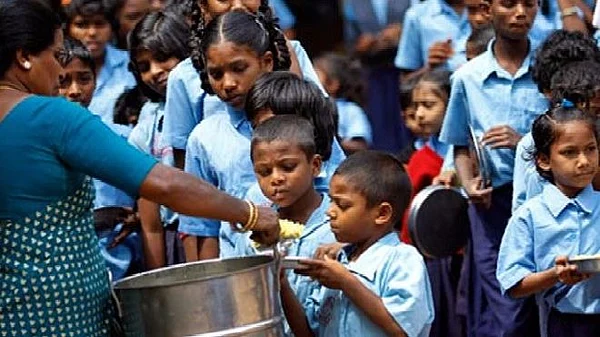
The Government of India rolled out various schemes under which various states had to provide the mid-day meal scheme to the students. Some of such initiative are:
- West Bengal – Ensured the distribution of the meals to their wards’ home amidst the curfew.
- Odisha – Facilitation of Public Distribution System (PDS).
- Chhattisgarh – Provision of mid-day meal to the parents of the children for about 40 days, with the difference in quantity by the primary and higher secondary school.
- Kerala – Delivery of meal supplies to homes of their children.
- Bihar – Transfer of the monetary amount of the mid-day meal, as a substitute of the food, to the accounts of their parents.
- Maharashtra – Provision of the meals only to rural children.
- Assam – Provision of mid-day meals to about 40 lakhs students.
Each and every state has taken the initiative to make sure that the meal reaches their students at times of distress. There also exists an underlying fear among the administration that if the meal is stooped, then it will automatically lead to the un-enrolment of the students whose attendance is already irregular and this will definitely push up the levels of illiteracy and unemployment.
States are putting in continuous efforts to make this journey smooth for the students. For instance, West Bengal has announced the decision to provide masks, sanitizer, as well as basic protein items such as pulses, soya bean which will be handed to the parents. They are going an extra length by providing stationery items to those students affected by Amphan.
It is very responsible on the part of Government of India to ensure the provision of mid-day meal and this help will definitely go a long way to build the future of India.
https://www.biharedpolcenter.org/post/covid-19-how-are-states-ensuring-midday-meals
Impulsivity , what’s the tendency?
Excessive composed mental illness can cause impulsiveness and route to several toxic and unlikely scenarios which create room for apprehensive behavior and self harm. Sensitive matters as such are meant to be dealt with utmost captivating mindsets , in brief people who can actually listen and just not hear. Hearing out someone differs from listening to their anxiety subjects. Delicate tone of things like mental health are always lined up in a very thin statements of secrets , confidential thing but the question arises that why such sensitive matters are to be seen in such views. What’s the apparent tendency of twenty first century facing peak times in these cases of impulsiveness effecting in absurd change in graphs of their thoughts. There is a fine line of communication and thoughts that a certain person bottles up in a very exaggerated moments.
Taken care of or seriously ?
Either ways can’t be chosen by one particular individual because , the problem sometimes comes with the listener and not the teller. How seriously is the listener taking the teller in the contexts and views of his mental illness? People , if put in brief , the listeners who are oblivious of what depression , anxiety and panic attacks can do to a person think that mental illness isn’t even a thing. For them , it’s just a made up thing to flex on excuses and sorts. The more seriously listener takes the teller , the better mental health. Keep listening.
 Eduindex
You must be logged in to post a comment.