Higher Educational Institutions to take part in NAAC accreditation process

Union Human Resource Development Minister Shri Ramesh Pokhriyal Nishank  interacted with Heads of more than 45,000 Higher Educational Institutions across the country today through Webinar hosted by National Assessment and Accreditation Council (NAAC), Bengaluru. The Minister addressed and Interacted with a Galaxy of Academicians comprising participation from Vice Chancellors / Registrars / Professors / IQAC heads / Principals / Faculty from across the Nation.

While lauding the initiatives taken by NAAC at this time of the Pandemic, Shri Pokhriyal called upon the HEIs in the country to treat the current situation as an opportunity to overcome limitations in the system. He called upon the educationists, students, parents to switch-over to the online method and make the most of the situation so that the academic session of the students and the HEIs are not interrupted. He said there is an urgent need to improve and enhance the Online ecosystem in India & educators should contribute to enhance the reach so that online education reaches even the rural areas.https://platform.twitter.com/embed/index.html?dnt=false&embedId=twitter-widget-0&frame=false&hideCard=false&hideThread=false&id=1265938551075532802&lang=en&origin=https%3A%2F%2Fpib.gov.in%2FPressReleasePage.aspx%3FPRID%3D1627487&theme=light&widgetsVersion=c4096c4b%3A1589303485003&width=500px

In the hour long interaction and address, the Union Minister reflected on various issues and concerns raised by educationists related to Academic Calendar, Online Education, examinations, Fees, Mental health of students, problems of students, fellowships, NEET, entrance examinations etc. He dwelt upon at length on the initiatives taken by the Government with regard to Swayam Prabha, Deeksharambh, Paramarsh and a host of other special initiatives taken during the pandemic period. He also urged all Higher Educational Institutions to take part in NAAC accreditation process. He reiterated that the Prime Minister of India Shri Narendra Modi is very concerned about the well being of Higher Educational Institutions and assured of all help in furthering the academic activities of student fraternity.

The Union Minister asked all Universities to constitute a special cell which will be empowered to address the issues of students related to academic calendar and examinations arising out of special circumstances due to Covid 19. He said that a task force has been created in UGC and NCERT to resolve the different issues of students. Shri Nishank assured that Ministry is committed to provide all assistance to students in the time of crisis. During the interaction the Union Minister highlighted the process of how the new session will be commenced, at the same time he specified that the priority will be given to the safety of the students. 

Shri Nishank called educational fraternity as Corona Warriors because in this extraordinary situation they are working round the clock to provide quality education to students.

The event was also graced by Chairman, UGC, Prof D P Singh, Prof Virander S Chauhan, Chairman, EC, NAAC. Prof S C Sharma, Director, NAAC spoke & coordinated the event.

*****

CIPET renamed as Central Institute of Petrochemicals Engineering &Technology

Central Institute of Plastics Engineering & Technology (CIPET) has been renamed as Central Institute of Petrochemicals Engineering & Technology (CIPET), a premier national institution under the Ministry of Chemicals and Fertilizers, Govt. of India.

The changed name has been registered under the Tamil Nadu Societies Registration Act 1975 ( Tamil Nadu Act 27 of 1975)

Union Minister for Chemicals and Fertilizers DV Sadananda Gowda has said  that now CIPET will be in a position to fully devote itself  for the growth of entire petrochemical sector with a focus on Academics, Skilling, Technology Support and Research. 

The primary objective of CIPET has been contributing towards the growth of the plastics industry through a combined program of education and research. The Institute has evolved through the years, creating closer ties with industries with the intent to create innovative plastic based solutions which are resource efficient and marketable.

Types of Internships for Communications Majors

With their ability to communicate effectively in almost any situation, communications majors are some of the most sought after candidates in all sorts of professional fields. With so many opportunities available, you might be wondering how to find a job that’s a good fit for you. The best way to do that is through an internship where you can get exposure to a specific field or position.

Here are some of the best internships for communications majors:

Marketing intern

As a marketing intern, you’ll assist the marketing team with projects and find out how marketers help brands connect with their audience. During your internship, you’ll be taking on a number of tasks such as collaborating on blog post ideas, developing social media strategy and writing email copy. As a result, you’ll be gaining lots of hands-on experience and also getting exposed to all of the different elements involved in crafting a successful marketing campaign.

Editorial intern

From sharpening your SEO skills to shadowing an editorial meeting, an editorial internship can be a great and enriching experience. Depending on the type of company you intern with, you could be writing blog or news articles, learning how to research and fact-check news stories, or learning the ins and outs of copy editing and AP style.

Public relations intern

As a public relations intern, you’ll assist the PR team with campaign strategy, pitches and handling client relationships. You’ll also likely get to attend publicity events including sporting events and product launches. Best of all, you’ll learn the basics of writing a press release and assisting in the development of a full-scale PR campaign.

Content marketing intern

Content marketing internships give you direct exposure to drafting content for the company website, as well as copy for ads and blog posts. In addition, you’re likely to also get hands-on experience with other things such as managing social media accounts. Best of all, you’ll get to sit in meetings where ideas for new content are developed.

Social media intern

As a social media intern, you’ll engage your company’s followers, commenters and readers, while also attempting to grow the community. From coming up with funny memes to post on Instagram to crafting a great Snapchat story, a social media internship is a wonderful opportunity to learn more about engagement and about how to use social media as a powerful tool for business.

Copywriting Intern

As a copywriting intern, you’ll be trained in researching, drafting and editing copy for all types of content including blog posts, news articles and email campaigns. You’ll also learn how to match your writing style to a specific brand and fine-tune your copywriting skills. This internship is a great opportunity to get a feel for what’s required to thrive as a full-time copywriter.

Broadcast intern

A broadcast internship is a wonderful opportunity to learn the ins and out of working for a TV or radio station. From shadowing staff to fact-checking, researching and assisting with different aspects of production, you’ll be getting exposure to the whole world of broadcasting. Best of all, internship experience in broadcasting is essential and valued when it comes to applying for full-time jobs in the field after graduation.

In addition to the critical skills communications majors develop during college, they also benefit from the more specialized hands-on experience that can only result from an internship. By taking on one or more internships during your time in college, you’ll be able to learn more about your options and find a career path that’s right for you.

Next, learn more about this college major such as What is a Communications Major and is it Right for Me? 

If you are looking for internship in above categories then Eduindex News will welcome you. Write mail to career@eduindex.org or visit job opening page at https://eduindexnews.com/tag/work-with-eduindex-news/

What is a Communications Major and is it Right for Me?

Do you enjoy talking to people and figuring out what makes them tick? Are you an outgoing person who is comfortable connecting with diverse groups of people and getting your message across effectively? If you answered yes to these questions, then being a communications major might just be for you.

The modern age and future in journalism and mass communication is about use of communication and information technology. With the digital onslaught suddenly the power has landed in the hands of a media person. The overall perception of a media person in a khadi kurta, black rimmed thick glasses and a loose bag with a pen has blown. Now emerges a person who is young, savvy, smart and up to date and has an access to a load of gadgets that will give an IT person a run for its money. 

What is a communications major?

A communications major is a major designed to teach you about effective communication and how to apply it to fields like media, law and business. Coursework for this major is very similar to coursework for related majors such as public relations, advertising and journalism. As a communications major, you’ll be taking a broad range of classes including marketing, sociology and business as well as more traditional communications classes like media studies and journalism.

Is it right for me?

Majoring in communications means having a broad understanding of how this field impacts others such as business and media. Here are some key questions to ask yourself before embarking on this major:

Do I feel confident in my writing and communication skills?
Do I like studying a broad range of subjects including sociology, psychology and media studies?
Am I able to handle and incorporate criticism and feedback from my professors and peers?
Am I good at multitasking and working on multiple projects and subjects at once?
Will I dedicate myself to getting internships and jobs through college that will further my level of experience?

What can I do with a communications major?

Since communications is a broad major with significant overlap to other majors, there are plenty of available career options. Some of the most common ones include:

  • public relations
  • journalism
  • law
  • marketing
  • copywriting
  • … and more

What do communications majors earn?

Salaries for communications majors are as varied as the career paths they take after graduation. While public relations specialists can expect to earn starting salaries between ₹40,000-₹45,000, entry-level salaries for attorneys start at ₹55,000-₹60,000 and quickly go up from there.

Quality Education and Educational infrastructure for students of the North –Eastern States

Union HRD Minister Shri Ramesh Pokhriyal ‘Nishank’ said that Government is committed to provide quality education and infrastructure improvement in educational institutions all over India and especiallyto the students of the North –Eastern States of the country. He informed that in this regard, the government has taken some major decisions this year. The government has granted permission for the establishment of permanent campus of Sikkim University (a Central University) at Yangyang at a cost of Rs. 986.47 crore. The government of Sikkim has allotted 300 acres of land at cost of Rs. 15 crore, out of which 265.94 acres of land has already been handed over to the University. The handing over of remaining land is under process.

The Minister also informed that Government has already sanctioned revised cost estimates of 6 NITs at Arunachal Pradesh, Mizoram, Meghalaya, Nagaland, Delhi and Puducherry at Rs. 4371.90 crore. With the approved Revised Cost Estimates, these NITs will be fully functional from their respective permanent campuses by 31st March, 2022. The overall student capacity in these campuses will be 6320.

We used to home school

After twenty-five years of service, the Salvageable Family Home School has closed its doors. That’s not bad news—we celebrate the high school graduation of our youngest child and the successful educational paths they all have chosen.

All have been accepted into colleges. All who are not currently enrolled have completed their Bachelor’s degrees in four years or less. They graduated with honors. Two went on to complete Master’s degrees. All of them are currently employed, even during the virus crisis.

Our decision to home school was not made lightly, but in a sense we were led into it. At the time, I was associated with a church that had a private school, and our children were aware of school children outside the house at various times. They were interested in school, and they were mentally ready, but their birthdays put them just past the starting age as set by the state. I knew that schools sometimes made exceptions regarding those dates, but the school leaders said, “If we make an exception for you, we have to make an exception for anyone else who asks.” They did offer a compromise—two years of half-day kindergarten meant for four-year-olds before entering the full day kindergarten meant for five-year-olds. We declined.

We knew a family in the neighborhood who homeschooled. Two of their daughters sometimes watched our children. They were doing well, and we took advice from them. We agreed that we would evaluate the situation year by year and not commit to home schooling all the way through high school. Little did we know that we would be educating our children for the next twenty-five years.

Starting with a book called Teach Your Child to Read in 100 Easy Lessons, we began to assemble a home school library.  Saxon Math met our needs in that department, and we found other books that did the job. The summer after we started home schooling I had a job offer and we moved, so there was no pressure to put our children into the church’s school. From time to time we participated in home school cooperatives, but it often seemed that we could accomplish as much at home as we could gain from a cooperative.

One advantage of home schooling is being able to work at the child’s pace. Students who pick up a concept easily do not have to wait for their classmates before moving on to something new; students struggling with a concept can have extra explaining and practice before moving on without hampering anyone else’s education. Also, no time is consumed traveling to and from school or waiting for a bus; that gain in time allows more instruction, more leisure time, or more time to contribute to family chores. Life skills such as cooking and laundry become part of the educational plan. Interesting conversations at mealtime are part of home schooling, and field trips are easy to arrange with little or no planning required.

One concern some people have about home schooling is “socialization”: how will home schooled children learn to make friends among their peers? Home school cooperatives are one answer, church activities are another, and organized athletic events are a third. Several of my daughters took up Irish dancing and have reached the championship level. Moreover, not only in my family but in other home school families I have known, the children are more natural at socializing with people of different ages. They have not spent their days in a room with one adult and a couple dozen children their age.

Not every family should home school. Doing so requires a massive commitment of time as well as a financial investment. Public schools and private schools provide a valuable service for our communities. The irony has not escaped me that we finished home schooling at a time when many families are having their first experience of home schooling. Most will return their children to the public or private schools as soon as they open, but some families—including the students—may be finding value in home schooling. They may be considering continuing the home school experience even when schools reopen. For those in that position, I offer encouragement and best wishes. J.

Students can avail credits by online courses per UGC’s regulations

Union Human Resource Development Minister Shri Ramesh Pokhriyal ‘Nishank’ informed that the Students enrolled in Universities and affiliated colleges may undertake SWAYAM courses and avail credits by completing these courses as per University Grants Commission (UGC)’s present regulations on credit framework for online learning courses.

Shri Pokhriyal further informed that UGC has shared a list of 82 Under Graduate & 42 Post Graduate Non-Engineering MOOCs courses  with University Vice Chancellors and College Principals,  which will  be offered in July Semester 2020 on SWAYAM Platform(www.swayam.gov.in).

He added that these courses cover subject areas such as Biochemistry/Biotechnology/Biological Sciences & Bioengineering, Education, Law, Computer Science and Engineering, Commerce, Management, Pharmacy , Mathematics , History, Hindi, Sanskrit, etc.

The Minister further said that in the prevailing COVID-19 pandemic scenario, Students, Teachers, Life-long learners, Senior Citizens and Homemakers may enrol and avail the benefits of SWAYAM courses to widen their horizon of learning.

SWAYAM (Study Webs of Active–Learning for Young Aspiring Minds) is a programme initiated by Government of India and designed to achieve the three cardinal principles of Education Policy viz., access, equity and quality.

Economic viability is crucial for higher educational institutions

Transport and Highways, Shri Nitin Gadkari today  said that economic viability is crucial for higher education institutions. These institutions need to reduce their operating cost without compromising on quality.

He was addressing a meeting via video conferencing with the representatives of MIT ADT University on future of higher education.

The Minister said that upgradation of universities is required, and value based education is the strength of the society. He further shared that our youth should understand their strengths and weaknesses and problems faced by them can be converted into opportunities. He added that enhancing capability of the youth is critical for the country at this stage.

Shri Gadkari  emphasised the need for integrated approach, effective coordination and team spirit among stakeholders and urged the industry to have self-confidence and positive attitude to overcome this challenging phase.

He opined that industry should focus more on innovation, entrepreneurship, science and technology, research skill and experiences to convert the knowledge into wealth.

The Minister recalled that Government of Japan has offered special package to its industries for taking out Japanese investments from China and move elsewhere. He mentioned that it is an opportunity for India which should be leveraged. 

He opined that there is need to work on decentralization of industries and focus on rural, tribal and backward areas of the country. He added that there is need to explore Agro MSME sector.

The Minister also stated that the government is planning to introduce vehicle scrappage policy. Recycling clusters may be started near the ports, which will boost automobile manufacturing industry in the country.

The Minister responded to the questions from participants which were about qualities needed for an entrepreneur and guidance on decision making.

CBSE on Cybersecurity for students, 21st Century Skills and Principals’

Union Human Resource Development Minister Shri Ramesh Pokhriyal ‘Nishank’ today released through video conferencing three handbooks prepared by the Central Board of Secondary Education (CBSE) on measures taken by the Board to adopt value-based global standards of education, in New Delhi today.

cyber security

Releasing  these three booklets, the Union Minister informed that the Handbook  ‘Cyber safety-A Handbook for Students of Secondary & Senior Secondary Schools’ ‘ is prepared to  create awareness about cyber security among the students  from class IX to XII. He said that the booklet will be a perfect guide for  teenagers who use internet and other digital platforms frequently may face variety of security risks.

Shri Pokhriyal further informed that through the booklet  ‘In Pursuit of Excellence- A Handbook for Principals’,  the principals of schools will be made aware of the Board’s systems and other useful information. It will ensure  better coordination between schools and CBSE administration. He added that the  third booklet  is ’21st Century Skills : A Handbook’ through which CBSE will make everyone  aware of 21st century skills and motivate them to use them in their daily life.

Shri Pokhriyal lauded the efforts of CBSE for preparing the booklets to benefit all the stakeholders under the entire education system of the country. The Minister hoped that these booklets will help in developing better understanding of the cybersecurity, improving efficiency,  gaining skills and leadership experience.

Click here to see the link of Cyber ​​Security Handbook : http://cbseacademic.nic.in/web_material/Manuals/Cyber_Safety_Manual.pdf

Click here to see the link of Prinicipal Handbook : http://cbseacademic.nic.in/web_material/Manuals/Principals_Handbook.pdf

Click here to see the link of  21st Century Skills Handbook : http://cbseacademic.nic.in/web_material/Manuals/21st_Century_Skill_Handbook.pdf

*****

Examinations will be announced by UPSC after 5th June meeting

The Union Public Service Commission held a special meeting today to review the situation after the third phase of the nation-wide restrictions, due to COVID-19. Taking notice of the extension of several restrictions, the Commission decided that it will not be possible to resume examinations and interviews, for the present.

exam alert from Eduindex News

The Commission, however, took note of the progressive relaxations being announced by the Central Government and various States and has decided to review the situation once more, after the fourth period of lockdown. With a view to giving some clarity to candidates of various examinations and interviews, which have been deferred over the last two months, the Commission will issue a revised schedule of examinations in its next meeting to be held on June 5, 2020. Details of the new calendar of examinations will be published on the UPSC website, after the Commission’s meeting on June 5, 2020.

                                      <><><><><>

Online Master’s Programme in Hindi of IGNOU

Union HRD Minister Shri Ramesh Pokhriyal ‘Nishank’ launched IGNOU’s Online Programme, MA (Hindi) through Facebook Live session today. Speaking on the occasion the Minister said that this would strengthen our “Padhe India Online” initiative and commended IGNOU’s role in promoting online education. He stressed on the role Hindi language plays not in India but in other countries including Mauritius, Fiji, Surinam etc.,

The Minister also said that the initiatives like National Digital Library (NDL), Swayam, Swayam Prabha, Diksha among other platforms are providing digital education to lakhs of learners across India and IGNOU’s step in the same direction will give impetus to this. He reiterated government’s commitment to promoting online education to reach the unreached with affordable education and IGNOU’s part cannot be overemphasized, he added.

Prof. Nageshwar Rao, VC IGNOU gave the introduction of the other online programmes launched by IGNOU and also briefed the minister of the other initiatives taken by the University in the online space for higher education.

Prof. Satyakam, Pro-VC IGNOU said that MA Hindi online programme would not have been possible without the guidance of the the Minister and his constant encouragement. He said that it gives him and his team great pleasure that our education minister is a great proponent of Hindi and its literature.

Apart from MA in Hindi, the university has also launched programmes in MA in Gandhi and Peace Studies, BA in Tourism Studies, certificate course in Arabic, certificate in information technology, certificate programme in Library and Information Science.

IGNOU offers the online courses through its portal www.iop.ignouonline.ac.in. The online programme will include video and audio lectures, tutorials etc. which will be available at a click on the website.

The session was broadcast live through IGNOU’s Gyan Darshan TV Channel, Gyan Dhara, and Facebook page.

******

Dates of remaining examinations for class X and XII in 2020

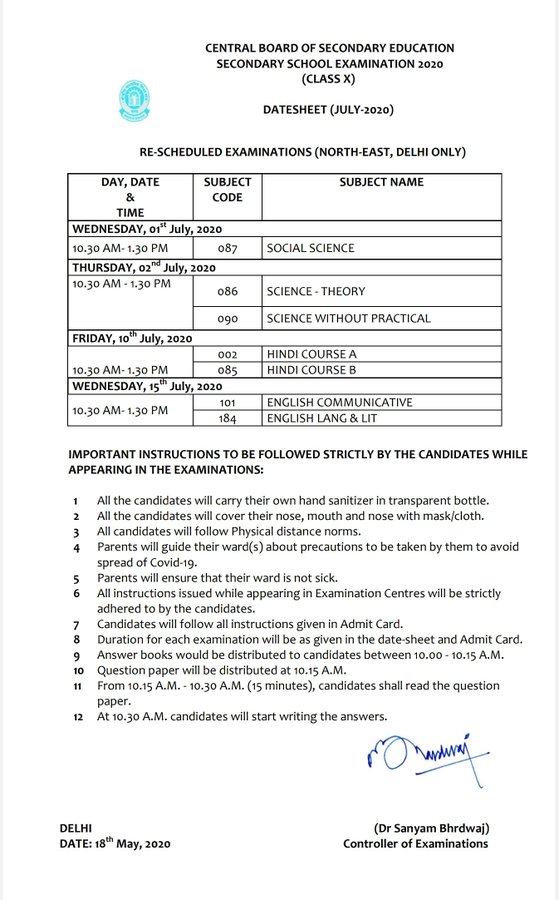
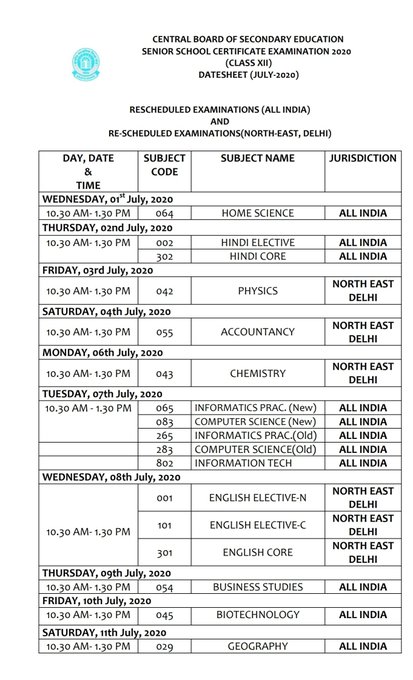
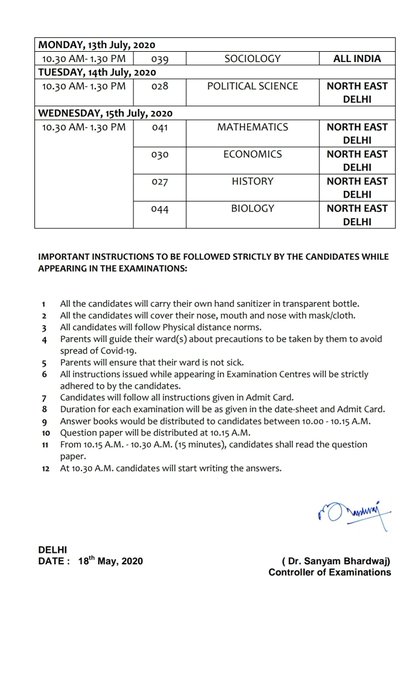
Union Human Resource Development Minister Shri Ramesh Pokhriyal ‘Nishank’  announced the dates of remaining examinations of CBSE Class X and XII in New Delhi today. The Minister said that the examinations of Class X will be conducted for the students of North East Delhi only, while the exams of class XII will be held for students across the country including North-east Delhi. All examinations will be between 10:30 am to 1:30 pm.

Photo by Andrea Piacquadio on Pexels.com

View image on Twitter

Earlier during a webinar interaction with the students on May 5, Shri Pokhriyal  had said that the remaining exams of CBSE X and XII  will be conducted between July 1-15.

On this occasion Shri Pokhriyal  said that the ministry of HRD was fully committed to the fact that while announcing the exam dates, special care will  be taken that the students get plenty of time for exam preparation and now students will be able to concentrate on their preparations. The Minister added that apart from this we have also instructed CBSE to take care of social distancing while conducting examinations so that the health of students and teachers can be ensured. The Minister also extended his best wishes to the students for the examination.

Click here for class X exam date sheet 

Click here for class XII exam date sheet

More about my family

When I composed yesterday’s post, I got so excited sharing the history of my family that I forgot part of what I wanted to say. Here it is:

This month I have been posting historic family pictures on FaceBook each day. Sometimes it’s a single picture, sometimes it’s two or three pictures. I’ve been getting good reactions from family—including cousins I almost never see anymore—as well as from other friends.

Why am I doing this? Well, as a historian and an archivist, I want to promote the business. Especially those weeks that I had to work from home, trying to do the same things I would be doing at work, I knew that I had to do the full job of an archivist—not merely to preserve and to organize, but also to share. Archivists don’t digitize the entire collection and put it online—we digitize a small amount of material that is interesting or informative. Real researchers don’t stop at surfing the internet; when they find something of interest, they identify where it is located and come to that place to look at the rest of the collection.

Beyond that, I have gotten major fatigue scrolling through FaceBook and other social media. It feels like a game of dodgeball back in junior high school, trying to avoid all the mentions of disease and politics and the intersection of the two. So I thought I’d change the subject—give myself and other people something different to talk about and think about. And that has worked.

It has worked so well that my sister and some of my cousins commented over the weekend that I ought to take all this family information I’ve been gathering and write a book. I’ve handled books written by genealogists. They tend to be dry as dust—recording vital information, but often omitting the interesting and unusual family stories about these various individuals.

So I’m considering a book on the Salvageable family. The first question is: how much of the family do I want to cover? Am I writing for my children and their descendants—do I want to include my wife’s side of the family? Do I want to focus on me and my ancestors? Or do I want to stick to my mother’s side of the family, which contains most of the interesting stories that have come to light thus far. (And includes those cousins who are suggesting that I write a book.)

Even though that matter is not settled, I have made two other decisions. If I write this book, I will start each family line with the immigrant who came to the United States. Where I know names and dates for ancestors who remained in Europe, I might include them in an appendix or sidebar, but I want this to be an account of the Salvageables in America. Also, rather than focusing on one line at a time, with chapters relating to different streams that entered the river, I want to make the book chronological. I would like to write a chapter for each decade, describing where the various ancestors were during that decade and what they were doing.

Moreover, I want to include some historic context in each chapter. Think how much fun the 1860s will be—men fighting each other in the Civil War (and I have ancestors who fought for the Union and ancestors who fought for the Confederacy). Wouldn’t it be cool to find two great-great grandfathers involved in the same battle, shooting each other? (And, if either of them had been a better soldier, I would never have been born.)

I can only guess how long it will take to complete the family research and begin writing. This project likely will be years in the making. And it will not be lucrative—we’re not talking Roots here. I don’t care to dabble in historical fiction, creating conversations that may have happened. I want to include verifiable facts, along with family stories and mysteries.

And this is much more fun than slogging through the current international crisis and thinking only about it night and day. J.

Photographs and genealogy

Years ago, when I first saw this picture in the family collection, it puzzled me. I knew that the little girl to the left was my grandmother, and I suspected the other two children on the floor were her brother and sister. I assumed that the man to the left was her father and that the woman in back was her grandmother? But who is the other boy in the room? My family and I dubbed him Heathcliff, remembering that he joined the Earnshaw family by adoption when he was a young boy (Wuthering Heights).

This spring I’ve had the opportunity to go through family photographs and also to research my family tree. I deduced that this picture was taken Christmas 1905. The extra boy is a cousin to my grandmother. These same people were still in the same household at the 1910 census. The grandmother, by the way, is the mother of my grandmother’s mother, mother-in-law to the man in the picture.

Here’s another picture of the same family taken a few months earlier. The younger woman is my great-grandmother; she died in June of 1905. The man with the cigar is probably Heathcliff’s father, and the two additional girls are Heathcliff’s sisters.

Why are those sisters missing from the Christmas picture? According to the 1910 census, they were boarding at the Chicago Industrial School for Girls. Later records show that both grew up, had jobs as clerks, and got married.

Here’s Heathcliff and his sisters—possibly taken at their school. On the desk is a cube with the date: Wednesday December 27. Historians, archivists, and genealogists love clues like that hiding in photographs. (December 27, 1905, was a Wednesday.)

And what became of Heathcliff? He also got married. He and his wife had a son who lived only three months and a daughter who eventually grew up and married. In 1917, when Heathcliff registered for the Great War, he was a clerk supporting wife and mother (possibly mother-in-law). In 1920, he was living with his wife, in-laws, and infant son. In 1930, though, he was divorced and living alone in Chicago. October 1930 saw him incarcerated at Leavenworth, Kansas—I have no idea why. By 1942, when he registered because of the second World War, he was back in Chicago, working for Keller & Sons. He died in 1959, at the age of 63.

“Heathcliff’s” real first name was the same as his father and his grandfather. By coincidence, my wife and I chose the same name for our son. After skipping several generations, it’s nice to have the name return to the family, even though the previous holder of that name was a crook. J.

4 Steps to Becoming a Physical Therapist Assistant

If you have a passion for helping those in need and an interest in healthcare, a career as a Physical Therapist Assistant (PTA) could be the right fit for you

Physical therapist assistants (PTAs) help patients of all ages – from newborns to the elderly – improve strength and mobility through a range of therapeutic exercises and training. PTAs are not only an important member of the healthcare team, but they’re also an asset to their community, helping people lead healthier and more productive lives.

“A lot of people think that physical therapy is only for people who are in pain, but it really is to help ensure general wellness,” says Nicole Felkl, a PTA student at Herzing University.

The role of the PTA is becoming increasingly important as the population ages, which has created a growing need for physical therapy services. U.S. News and World Report ranked PTA as the 3rd Best Healthcare Support Job of 2019, and the Bureau of Labor Statistics predicts that employment for PTAs will grow by 31 percent through 2026, adding 27,400 new jobs.

OTA vs. PTA? There are a few primary differences. Consider OTA vs. PTA and what makes each career path different.

If you have a passion for helping those in need and an interest in the healthcare field, a career as a PTA could be the right fit for you.

Follow these steps to start your PTA career:

1. Enroll in a PTA program

To become a PTA, you’ll need to earn an associate degree from a physical therapist assistant program. These programs typically take around 20 months to complete and are designed to provide you with the foundational knowledge and skills you’ll need to pursue entry-level roles in the field. Your coursework will include classes on kinesiology, patient care, orthopedics, anatomy and more.

“PTAs need to be well-versed in how the human body works in order to effectively provide safe treatment. If your interest is piqued when flipping through the Discovery Channel or in a biology class, PTA might be a great step for you professionally,” says Kim DeChant, a physical therapy instructor.

2. Gain experience in a clinical environment

As a PTA student, you’ll also participate in clinical and laboratory experiences that will provide a hands-on approach to classroom learning. Many students enjoy their clinical externships and welcome the opportunity to practice their patient care skills and apply their knowledge in a real-world environment.

“I enjoy being able to teach others different exercises and healthy habits that will allow them to take better care of themselves,” says Felkl. “At the clinic, we see clients with postural misalignments, chronic pain issues, spinal cord and other neurological deficits and more. It is a great learning experience.”

3. Become certified

After you have graduated from a PTA program, you will sit for the National Licensing Examination for Physical Therapist Assistants, administered by the Federation of State Boards of Physical Therapy (FSBPT). Employers require you to pass this exam before you can practice as a PTA.

While your courses will help prepare you for this certification test, studying early and often is recommended. The FSBPT offers a variety of test prep materials on its website, including a study guide and a timed practice exam.

4. Advance your career

Once you’re a certified PTA, you can work in a variety of healthcare settings, including hospitals, schools, sports and fitness facilities, and nursing homes. As a PTA, you’ll work under the direction and supervision of a physical therapist, helping your patients achieve their individualized goals.

“In the rehabilitation profession, the ultimate objective is to help people realize their goals,” says DeChant. “PTAs have the awesome responsibility of supporting people on their journey to reaching their potential, and that is the most rewarding component of physical therapy practice.”

With experience, PTAs can advance to administration positions, such as managing all the assistants in a large physical therapy organization, or leading specific departments such as sports medicine. They can also go on to teach in an accredited academic PTA program, or lead community fitness and risk reduction activity programs.

As a PTA, you can make a difference and help others live their lives to the fullest. Learn more about what it takes to be a great physical therapist assistant, and see how Herzing University’s PTA programs can help you get a jumpstart on your career.