Fellowship Opportunities for Researchers

1. Extra Mural Research Funding (Individual Centric)

Individual centric competitive mode of funding will be provided under the EMR funding schemes. SERB supports potential scientists for undertaking research in frontier areas of S&T in Life Sciences, Physical Sciences, Chemical Sciences, Engineering Sciences, Earth & Atmospheric Sciences & Mathematical Sciences.

Read More

2.Scheme for funding High Risk -High Reward Research

The Scheme for funding High Risk – High Reward Research aims at supporting proposals that are conceptually new and risky, and if successful, expected to have a paradigm shifting influence on the S&T. This may be in terms of formulating new hypothesis, or scientific breakthroughs which aid in emergence of new technologies.

Read More

3.Empowerment and Equity Opportunities for Excellence in Science

The scheme, Empowerment and Equity Opportunities for Excellence in Science (EMEQ) is aimed at providing research support to scientists belonging to the Scheduled Caste and Scheduled Tribe in undertaking research in newly emerging and frontier areas of science and engineering and thus to involve them in the National Science and Technology development process.

Read More

4.Start-Up Research Grant (Young Scientists)

Start-up grant for Young Scientists is restructured w.e.f. 1st September, 2015 into two new schemes:    Early Career Research Award (ECRA), National Post-Doctoral Fellowship (NPDF)

Read More

5. J C Bose National Fellowship

Nominations are invited for the J C Bose National Fellowships. The fellowship is meant to recognize active scientists and engineers for their outstanding performance and contributions. The fellowships are scientist-specific and very selective.

Read More

6. Ramanujan Fellowship

The fellowship is meant for brilliant scientists and engineers from all over the world to take up scientific research positions in India, i.e. for those scientists who want to return to India from abroad. The fellowships are scientist-specific and very selective. The Ramanujan Fellows could work in any of the scientific institutions and universities in the country and they would be eligible for receiving regular research grants through the extramural funding schemes of various S&T agencies of the Government of India.

Read More

7.National Post Doctoral Fellowship

The SERB-National Post Doctoral Fellowship ( N-PDF) is aimed to identify motivated young researchers and provide them support for doing research in frontier areas of science and engineering. The fellows will work under a mentor, and it is hoped that this training will provide them a platform to develop as an independent researcher

Read More

8.Early Career Research Award

Early Career Research Award scheme aims to provide quick research support to the young researchers who are in their early career for pursuing exciting and innovative research in frontier areas of science and engineering.

Read More

9.SERB Overseas Postdoctoral Fellowship

SERB Overseas Postdoctoral fellowship (SERB-OPDF) aims to build national capacity in frontier areas of Science and Engineering, which are of interest to India by providing postdoctoral fellowship for a period of one year extendable to one more year subject to good performance. The applicant should have completed PhD degree in science and engineering not earlier than the preceding two years from recognized institutions in India. For researchers who are in regular employment, the 2 years� period may be relaxed. The Program admits candidates in *identified areas and sends them to top institutions around the globe, other than USA and also to institutions where internationally acclaimed scientists are working. The applicant should himself/herself correspond with the proposed host institution abroad for their postdoctoral work. He/she is required to produce evidence, in the form of a letter of acceptance from the host institution along with merits/uniqueness of the host institute in the proposed area.

Read More

10.CSIR Young Scientists Awards

11. Scheme for Young Scientists & Technologist (SYST)

12. IYBA Innovative Young Biotechnologist Award

13. Sponsored Research (RESPOND)

The Indian Space Research Organisation (ISRO) has evolved a programme through which financial support is provided for conducting research and development activities related to Space Science, Space Technology and Space Application to academia in India. This programme of Research Sponsored by ISRO is called RESPOND. In special cases research and development projects proposed by non-academic R & D laboratories can also be supported through this programme. The aim of RESPOND is to encourage quality research in areas of relevance to the Indian space programme.

Read More

14. Research Programmes and Projects –  Ministry of Earth Sciences

Read More

15. Indo-U.S. Fellowship for Women in STEMM

Indo-U.S. Fellowship for Women in STEMM (Science, Technology, Engineering, Mathematics and Medicine) is aimed to provide opportunities to Indian Women Scientists, Engineers & Technologists to undertake international collaborative research in premier institutions in U.S.A, to enhance their research capacities and capabilities in global perspective. DST has launched the fellowship (WISTEMM)” jointly with Indo-U.S. Science and Technology Forum (IUSSTF).

Read more
16. 2019-2020 Fulbright-Kalam Climate Fellowship (Announcement[PDF]47.8 KB)

In a September 2014 Joint Statement, the President of the United States of America and the Prime Minister of the Republic of India launched U.S.-India Climate Fellowship Program to build long-term capacity to address climate change related issues in both countries.

In pursuance of the Joint Statement, the Government of the United States of America and the Government of the Republic of India – desiring to promote further mutual understanding between the two peoples by a wider exchange of knowledge and professional talents – intend to partner to build long-term capacity in the United States and India by engaging scientific and technical research scholars from both countries related to climate research and education through the Fulbright-Kalam Climate Fellowship.

The United States-India Educational Foundation (USIEF) administers the Fulbright-Kalam Climate Fellowship on behalf of both the governments.

Read more

Research Awards to promising “Young Scientist” by various Organisation Public and Private

The Scheme provides Opportunities to Young Scientists for pursuing exciting and innovative research in frontier areas. The scheme is focused on young scientists & technologist who have adequate background and training in fields of science and technology and show inclination to undertake socially relevant action research projects. This is also to encourage academic institutions, national labs and other S&T institutions.

Creating Logos With Students – Understanding Visual Metaphor And Symbolic Meaning

Source: DesignMantic (click for full-size image)

Logos are short-hand, visual cues that companies use to evoke their brands. Effective logos represent automatic associations between a corporation and a customer. They connect a unique icon with an emotional reaction.

This type of tidy pictorial design can also be employed to winning effect in the classroom. Students can use logos to study visual metaphors and symbolic meanings. They can experiment with thesis and synthesis, in boiling down a range of meanings into a concise, original image.

Source: ASIDE 2015

History students, for example, can sketch logos to embody specific presidents or time periods. We had our U.S. history classes brainstorm logos for the era of the Great Depression. The designs featured in this post range from a juxtaposition of the Empire State Building going up while the stock market goes down, to a financial Dust Bowl of lost dollars.

In studying literature, learners can similarly design logos to accompany a book or a character. It’s no surprise that the Hunger Games mockingjay pin became so popular among fans. Science students can draft logos for key principles or elements, or global thinkers can draw emblems to capture current events.

Source: ASIDE 2015

By translating their understanding into self-created icons, students can climb a level in their comprehension, from decoding to encoding. They can capture the essential significance or recurring tropes via clever designs that will in turn help educate their peers.

Steps for creating logos with students:

  1. Begin by having learners identify logos and brands from current media. We use these sheets of letters and symbols as games to get students excited and to introduce the range of possibilities.
  2. Invite students to rank their favorite logos and explain why some stand out in their minds. For example, we had children rate the logos of presidential candidates in 2012.
  3. Introduce some tips for contemporary design. DesignMantic has a helpful infographic of the “10 Commandments Of Logo Design.” FastPrint also offers a terrific infographic about “How To Design The Perfect Logo.”
  4. Ask them to brainstorm the key characters, themes, or takeaways that they would want a logo to evoke.
  5. Finally, give them a range of tools to use, from hands-on pen and paper to visual apps like Pencil by FiftyThree.
Source: FastPrint

Above all, a logo should present a clear, somewhat unexpected relationship between picture and subject. The video below, “49 Years Of Super Bowl Logos,” reveals how images can evolve with the times to add layers of significance.

For further ideas, we recommend:

Design Principles For Students As They Create Visual Projects And Digital Stories

Source: DesignMantic (click for full-size image)


Students are producing more projects than ever before. The proliferation of visual apps and the access to easy tech tools have allowed learners to create all sorts of digital stories and custom graphics. Yet, as Marvel Comics teaches us, with great power comes great responsibility.

It is tempting to assume that because children are growing up in a visual world, they automatically know how to decode and encode optical inputs. This proficiency is known as graphicacy, which is the key to visual thinking in a differentiated classroom. If educators are going to ask students to design posters and slideshows, then they also need to guide young learners in the skills of effective design. Any teacher who has seen children layer neon pink fonts on top of vertiginous purple backgrounds knows that kids don’t innately grasp the keys to clean layouts.

Source: DesignMantic (click for full-size image)


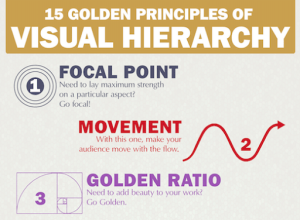
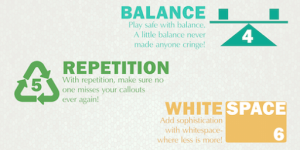
The logo design firm DesignMantic has published a series of extremely helpful infographics to help budding artists generate successful visuals. Even though these placards are intended for marketing and business purposes, they perfectly suit the needs of teachers looking for classroom resources.

DesignMantic‘s graphic of the “15 Golden Principles Of Visual Hierarchy” marches through a framework for art and imagination. As the firm notes:

“Visual hierarchy … offers to your eyes visual assistance, suggesting to them, what information to linger on to, as your vision glides through it. It lays down a path for the data to flow in, to get absorbed into the brain smoothly. It guides the human eye from one element of the data to the next, like an invisible pointer moving through the data, to keep the reader free of any visual fatigue.”

Source: DesignMantic (click for full-size image)

The company also offers a primer in “The 10 Commandments Of Visual Communication.” Much like its tenets for quality logos, these guidelines range from line and font choices to arrangement and sizing tips. In essence, it provides “a layperson’s handbook of visual communication.” It reminds us of similar advice from “The Design Of Project-Based Learning – Color Theory For Web 3.0.”

Heart-Shaped Maps – Valentine Primary Sources

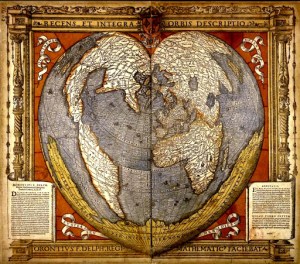
Source: Wikipedia – Oronce Fine, 1531

It wasn’t until our students started making heart-shaped worlds as part of a way to promote peace that we wondered if there were any historical references. To our surprise, there were plenty. One of the earliest heart-shaped (cordiform) map projections by Oronce Fine, a French mathematician and cartographer, was created in the sixteenth century. According to Wikipedia, this might have been his most famous illustration and one that influenced other cartographers, such as Peter Apian and Gerardus Mercator.

We love when something our learners do triggers a curiosity in us. Instead of showing our students the many infographics we’ve collected about Valentine’s Day that tabulate the amount of money spent by men and women on items such as flowers, chocolate, and jewelry, we chose to show these beautiful heart-shaped maps that so wholly connected to their designs. As expected, our students delighted in seeing the connection to their creations, especially since they had no idea of their connections to history.

We uncovered other examples of cordiform map projections that obviously take their influence from Oronce Fine’s beautiful cartographic design. The maps below, illustrated by Giovanni Cimerlino and Pierre Moulart Sanson, were done more than a century apart.

Source: Rare Maps (Left) and Britain (Right)

Two more recent uses of the heart-shaped map appeared on stamps issued in the United States (1991) and Venezuela (1972). We wonder if the graphic artists knew of Oronce Fine’s hand-drawn map of 1531.

Source: Dan’s Topical Stamps

The “Love” stamp from the United States does not necessarily represent a cordiform projection, whereas the stamp from Venezuela celebrating World Health Day more closely resembles the heart-shaped designs from the fifteenth century.

Source: Biographile

As we probed the Internet for other examples, we discovered a heart-shaped map of Seattle from 1905 and one of the New York City subway system from 2008.

These maps clearly illustrate the change in design from one era to another. The map of Seattle represents a more typical illustration at the turn of the twentieth century, whereas the subway map, completed more than a century later, closely follows the style of a modern visual illustration or infographic.

Source: Zero Per Zero


Sometimes it’s the innocence of children that triggers inquiry in adults. We attribute our curiosity to them. Finding other models based on their creativity led to the discovery of historical references. Connecting history through primary sources reinforced their global view of the world.

With the continued onslaught of violence and terrorism in the news, we could all use a little more heart.

If Parents Can Work From Home, Why Can’t Students? A Snow Day Doesn’t Have To Be A “No” Day

Source: ASIDE 2015
We have another snow day today. The relentless snow this winter has forced many schools into crisis mode. Teachers are panicking about missed curriculum and make-up days. But with today’s access to mobile technology, shouldn’t there be a middle ground between all or nothing learning? Genuine remote learning should be a regular practice, not just a prediction. Even amid record-breaking blizzards, a snow day shouldn’t have to be a “no” day.

Students frequently get sick and miss school. Consider, too, how many times you’ve seen a kid in your classroom who really shouldn’t be there. He has his head down, or has bags under his eyes, or has his mind clearly elsewhere. How many times have you noticed a student who truly needs a break? She’s been burning the candle at both ends, or has been bearing the weight of a bully, or has been negotiating a tough family situation.

Source: ASIDE 2015

A kid sometimes needs a personal day. It used to be that a student’s absence meant a day of missed learning. Today, this not only seems strange, it seems unforgivable.
For parents, “working from home” is a common occurrence. Many companies have no problem with their employees telecommuting at a distance, staying in contact via phone, email, and instant message. With all of the dynamic digital tools available to schools today, why can’t students work from home? Many teachers post all of their assignments online anyway.
Source: ASIDE 2015

Video conferencing and social media and collaborative documents all offer easy avenues to engage a class of home-bound learners. Many teachers use these resources daily inside of the classroom. Why can’t these tools also be tapped to coordinate a corps of kids, either in real-time or at the students’ own paces? 

Backchanneling, for example, has emerged as a valuable way to invite feedback and questions during an in-class lesson. If we can turn backchannels into forechannels, then we can transform these supplemental tools into primary vehicles for distance education.

Tools for remote learning:

Sources: Company Logos

  • TodaysMeet – The leading real-time channel, TodaysMeet creates discussion groups for instant message communication.
  • Twitter – The ultimate social media tool for education, Twitter mimics the classroom environment with chats, text, links, images, and videos.
  • Croak.it – Both teachers and students can create a 30-second audio file with a url that can be embedded in a backchannel, website, or tweet.
  • Remind – This free way for teachers to text students protects everyone’s privacy and instantly reaches kids on their phones.
  • Cel.ly – Cel.ly creates individual social networks via its texting feature that can be moderated directly from a smartphone.

    Sources: Company Logos

    • Verso – Flipped learning with Verso can include videos, images, or links in self-contained classes with rich commenting features.
    • eduCanon – This site collects videos from across the web and allows teachers to add flipped learning elements.
    • EDpuzzle – Teachers can crop videos and add questions and explanations to fit any age group.
    • Zaption – Zaption makes videos interactive by adding assessments.
    • audioBoom – Teachers can record podcasts to pass lessons on to students, and kids can capture their own answers, readings, or projects.
    Sources: Company Logos

    • Nearpod – The teacher guides the presentation, and students on their own devices see the slides progress as they interact from anywhere with polls and assessments.
    • Issuu – Intended to publish webzines, Issuu turns any .pdf into a scrolling web document for students to read and save at their leisure.
    • iBooks Author – The ability to publish customized content on iBooks is becoming easier and easier.
    • Wikispaces – Still one of the most flexible platforms for a class website, Wikispaces accepts any media and any embedded content.
    Sources: Company Logos

    • Skype – Teachers can broadcast themselves in full video and audio to reach students in their homes.
    • Facetime – As more and more schools opt for iPads and Apple TVs, Facetime provides an easy way to videoconference.
    • Google+ Hangouts – Multiple participants from any device can come together in a live-streaming video chat.
    Sources: Company Logos

    • Google Docs – Google Drive keeps getting better and better, and the real-time collaboration is still the industry standard for essays, presentations, and spreadsheets.
    • Padlet – Padlet is an infinitely customizable public space with customized urls to post text, links, images, videos, and student projects.
    • Dropbox – The larger storage capacity of Dropbox makes it ideal for file-sharing.
    • Email – When in doubt, simple email can allow students and teachers to swap instructions, questions, and assignments.

    SXSWEdu 2015: Education For All – How Far Have We Come?

    Source: TES Global


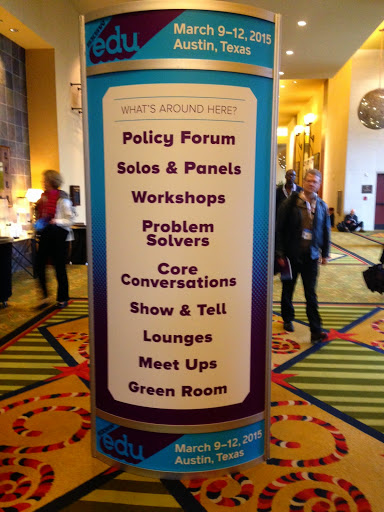
    An important and undeniable thrust of the 2015 SXSWEdu conference has been the attempt to reconcile the nation’s educational inequalities. Marquee panels and sofa conversations alike have centered on this notion of access – access to college, to technology, to careers, to mentors, to professional development, to contemporary learning tools.

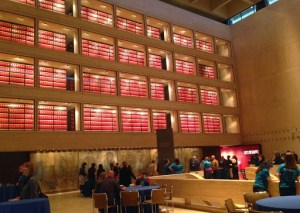
    Last night’s reception at the Lyndon Baines Johnson Presidential Library made this theme immediate in bringing together historians and educators to commemorate the 50th anniversary of the Voting Rights Act.

    Source: LBJ Presidential Library, ASIDE 2015


    This morning, Second Lady Of The United States Dr. Jill Biden kept this dialogue moving forward in leading a summit by the Bill & Melinda Gates Foundation about redesigning higher education to fuel student success. Dr. Biden noted that education is the great equalizer, the basis for a better life. For this reason, she stressed, “Teaching is not what I do. It’s who I am.”

    A panel discussion later with Jamie CasapTimothy Jones, and Isis Stephanie Cerda focused more intently on the need for diversity within educational technology. Similar messages emerged in workshops on “Equal Opportunity For Deeper Learning,” “My Brother’s Keeper: One Year Later,” and “Teaching A New Narrative For Black Male Achievement.”

    Source: ASIDE 2015


    An equally critical thread appeared in the number of talks about empowering girls and women in technology and entrepreneurship. For example, EdTechWomen was named this year’s official SXSWEdu Change Maker. Other titles included: “Women Disruptors 2.0,” “Paying It Forward: Leveraging Today’s Female Voice,” “Empowering Girls And Women To Lead,” “Digital Diversity: Minority Women In EdTech,” and “EdTech For Educational Inclusion.”

    Another highlight of the day was Kristin Ziemke’s and Cheryl Boes’ presentation of innovative project examples to engage young learners with voice, choice, and audience. Their use of easy apps and elementary blogging revealed the many avenues that let children demonstrate understanding in exciting, authentic ways.

    A later workshop featured a panel of thought leaders who promoted creativity in schools. They championed “less talking and more doing.” The speakers paraded both theoretical and tangible ways to inspire kids as imaginative thinkers. As Jonathan Plucker, Professor at the University Of Connecticut, noted, “creativity is about constraints.” A teacher’s task, therefore, is to help students identify constraints and then decide which ones to get rid of, which ones to ignore, and which ones to live with.

    Ultimately, after a day of education and introspection, of creativity and contemplation, we recalled John Ashbery’s lines from Three Poems, which speak to the impossibility of certainty and the elusiveness of knowing:

    “The term ignorant is indeed perhaps an overstatement, implying as it does that something is known somewhere, whereas in reality we are not even sure of this: we in fact cannot aver with any degree of certainty that we are ignorant. Yet this is not so bad; we have at any rate kept our open-mindedness — that, at least, we may be sure that we have — and are not in any danger, or so it seems, of freezing into the pious attitudes of those true spiritual bigots whose faces are turned toward eternity and who therefore can see nothing.” 

    SXSWEdu 2015: The Boy Who Beeps – Who Can Speak The Language Of EdTech?

    Source: SXSWEdu
    Now in its fifth year, the 2015 SXSWEdu rally in the Texas midland is more inclusive than ever. The panelpicker judges eschewed trendy topics like flipped learning and Big Data in favor of deeper discussions about Social Emotional Learning and Gamification. Major themes that ran through the first day included programming in schools, authentic PBL, and contemporary professional development.
    A major highlight of the day was hearing about the impressive Coded Curriculum implemented by Beaver Country Day School in Chestnut Hill, Massachusetts. The school has embraced a “launch / test / refine” approach to incorporate coding into every academic discipline. The faculty actively seeks to “make excellent mistakes” as they teach children the “New Basics” of open-ended problem solving, non-linear thinking, and collaboration.
    Source: Sunni Brown
    Another centerpiece of the sessions was Sunni Brown‘s mesmerizing workshop about “how to stay curious.” A guru of visual thinking and a doctor of doodling, Brown reminded the crowd that visual language is a river native to cultures across the world that instills a powerful cognitive awareness.  
    The spirit of sharing was genuine today at SXSWEdu. Every attendee was universally open and eager to connect. Yet a question kept trickling through the meandering hallways like the incessant drip of Austin’s rain: How many actual classroom teachers were present at the conference? When Brown asked how many classroom educators were in the room, fewer than ten percent among the hundreds raised their hands.
    Source: ASIDE 2015
    Throughout the day, we met: an online charter school principal, a start-up edupreneur, an NAACP coordinator, a not-for-profit founder, an NEA staffer, a Museum and Library Services researcher, a corporate communications director, a Learning Sciences professor, a former math instructor in Ethiopia, and a doctoral candidate who moonlights at Khan Academy. We met other interesting people, too, but we did not meet one classroom teacher.
    We know they were there. But they seemed few and far between. Maybe this is a good thing. Maybe it signals that SXSWEdu is not for everyday teachers. Maybe the passionate attendees perceive a sea change in education that is more galvanizing than “regular” teachers can see. Or maybe not.
    Either way, it speaks to a road diverging in a not-yet-understood wood. If start-ups and online outlets are careening onto their own edtech on-ramp, what happens to the students and teachers driving in the HOV lane? 
    For example, after participating in one session about a full-scale coding curriculum pushed across all disciplines, we attended a completely different panel about whether edtech really offers any solution at all. It feels strange that this question is still being asked: Is edtech a panacea or a distraction?
    Source: General Electric
    The nuanced nature of this tacit tech tug-of-war reminded us of a General Electric ad from September 2014 called “The Boy Who Beeps.” The touching ad follows the birth of a baby who can speak the language of technology. The commercial intends to tout GE’s omnipresence in electronics, but to us it highlighted the children today who are always plugged in, always wired. 
    Kids are born who can seemingly speak to machines, communicate with the digital world, control their own access to e-learning. What happens, though, when their days become disconnected? Can they muster the skills to navigate a tangible, interpersonal world? Or better yet, can they make things, create their own machines? Are they controlled by the very machines they rely on? And what about children who don’t have machines?
    Source: General Electric
    In the edtech learning space, are there start-ups who talk only to machines – and not to educators? And what about the teachers who cannot (or will not) talk to machines, who can’t negotiate the apps and iPads filling their classes?
    By the end of today, we were encouraged. We decided that educators are indeed emerging as a potent force in the digital economy. American Federation Of Teachers President Randi Weingarten noted a change since last year’s SXSWEdu. She now hears tech companies asking, “How can we get teachers involved in the process?” She emphasized that with the onslaught of shiny edtech tools, the best advice is to know how to teach first, and to learn to use technology second. Brown echoed the same, saying that digital tools are great, but they’re not worth much if we can’t use them. The learning is the key.


    Most College Athletes Are Failures — Learning From March Madness

    Source: NCAA


    Cheer for the stumbles
    The he-shoulda-had-thats
    And the tears that linger

    For in those moments
    Greatness lies

    There you will find 
    The provoked
    The determined
    The unified

    It’s in those moments 
    That champions are born
    Most NCAA athletes are failures. They don’t win the championship. They don’t enter the pros. They don’t take home a trophy at the end of the season. Only a handful of elite programs reap the acclaim and hardware that accompanies major spectacles like the men’s NCAA basketball tournament. Most Division I, II, and III competitors are well-rounded college students giving a tremendous amount of effort for the love of their sport and their college.

    Just watching one game of the March Madness media blitz is enough to make even a non-fan sympathetic to the kids with their heads hung low after a devastating loss. Anyone in an office pool knows that their bracket will be busted after the first weekend. There are no trophies for participation.
    Yet these are the moments that turn kids into adults, that enforce life lessons of diligence and duty, grit and grace. That’s why the March Madness tournament offers a great chance to talk to students about failure, about perseverance, and about process over product.
    Ad agency Leo Burnett produced an award-winning TV spot for the NCAA last year called “Cheer.” Since then, its aired over 850 times, and it’s in heavy rotation again this week. It’s easy to see why.
    The ad is a brief masterpiece of narration and language to encourage everyone — athletes, kids, and adults — to relish the stumbles of life and the tears of as-yet-unmet goals. As the transcript reads, these moments turn disappointed players into “the provoked, the determined, the unified.”

    Source: NCAA

    Teachers talk a lot about failure with their students, about the unreachable expectation of perfection and the inescapable necessity of hard work. This ad is a perfect companion for homeroom discussions, circle time, advisory conferences, or recess pick-me-ups.

    For more ideas about teaching with the NCAA tournament, check out: “March Madness In The Classroom — Teaching With Tournament Graphics.”

    No hike in fees for IIT, IIITs and NITs for AY 2020-21: HRD Minister

    New Delhi, 05 May 2020: Union HRD Minister Ramesh Pokhriyal ‘Nishank’ interacted with the students across the country through a webinar. During the one hour interaction, the Minister responded to the various concerns and queries of the students relating to school examinations, entrance examinations, Academic Calendar, online education, Fees, Mental health of students, international students, fellowships among others.

    There will be no hike in fees for IIT, IIITs and NITs for the academic year 2020-21,  said– Shri Ramesh Pokhriyal ‘Nishank.  IITs, IITs and NITs are premier technical educational institutes in India. There are 23 IITs and 33 NITs in India.

    The Minister highlighted that the admissions to the UG and PG programmes for the session 2020-21 may be completed by 31.08.2020. If necessity arises, provisional admissions may also be made and relevant documents of qualifying examination may be accepted up to 30.09.2020. The Academic Session 2020-21 may commence from 01.8.2020 for old students and from 01.09.2020 for fresh students. More details can be obtained from the UGC website.

    While replying to questions  ,ShriPokhriyal informed that MHRD is planning to bridge the academic gap created due to COVID outbreak. MHRD has encouraged students to keep on learning and to aid  thelearning through various e-learning resources and digital platforms for both school and higher education. ShriPokhriyal informed students that the Alternative Calendar for the primary, upper primary stage and secondary has also been released. This Calendar provides guidelines to teachers on the use of various technological tools and social media tools available for imparting education in fun-filled, interesting ways, which can be used by learners, parents and teachers even while at home.

    Speaking on the occasion the  Minister said that the Prime Minister of India Shri Narendra Modi is very concerned about well being and academic activities of the students of the country. In view of this Ministry is taking all measures to quickly and immediately address the concerns of the students. Shri Pokhriyal appreciated the Minister of State for HRD Shri Sanjay Dhotre for his commendable work done to ensure safety and quality education to students.

    Genealogy–the study of your family tree

    I’m an archivist, but the research room where I spend some of my hours to help the public (when the public is allowed to enter) attracts more genealogists than historians. In the past, when someone came to the research room and said, “I’m interested in tracing my family tree—how do I get started?” I would introduce them to our resources, get them rolling, and remain available to answer further questions. Among our resources is ancestry.com – the library has bought a subscription to the service, and patrons can use it for free. But, from now on, when someone says, “how do I get started?” I’m going to steer them properly. For ancestry.com and other library resources belong to the third step of genealogy, not the first or second step.

    The first step is to write what you know about yourself. Genealogy always begins with an individual. In your case, that individual is you. Write your full name. When and where were you born? Are you married? To whom, when, and where? Do you have children? Write their full names and when and where each of them was born.

    Many genealogists use a notebook to record this information. Some use index cards. Some use a spread sheet such as Excel. Most serious genealogists use more than one method, so the information they have worked so hard to attain will be saved in one form if it is lost in another.

    After you have written all your vital information, you then write everything you know about your father. Answer the same questions about your father as you answered about yourself. And if he has died (and I’m sorry if he has) also say when and where he died and where he is buried.

    After writing everything you know about your father, do the same for your mother. Then do the same for your father’s father, your father’s mother, your mother’s father, and your mother’s mother. The order matters! You are person number one on the chart; your father is number two, your mother is number three, your father’s father is number four, and so on. After number one, all the even numbers are men and all the odd numbers are women. But—this is even more important—every father’s number is double that of his son or daughter. So your father will be two, your father’s father four, his father eight, and so on back to Adam.

    When you have written everything you know—which might include great-grandparents, but probably not every detail about them—is it time to go to the library? No, you’ve only taken the first step. Your second step is to talk with your living relatives to fill the gaps on your chart. Your parents, your grandparents, your uncles and aunts, and your cousins probably can answer some of the questions you needed to leave blank. As you talk with them, let them tell you stories about the family. Encourage them to share the stories. The other data is just a roll call; the stories make family history truly meaningful.

    Once you’ve visited with your living relatives, you are ready to go to the library. Libraries have a multitude of resources for genealogy. These resources can help you fill the gaps. Increasingly, online services like ancestry.com have gathered these resources from various libraries and locations. They include official government documents—not only the Census, but also land sale records, military records, and court documents (especially wills and probate proceedings). Plus there are family records, church records, community histories, and the research of other genealogists. All this information tells the researcher about many people, and a few of those many people are your relatives, even your ancestors.

    Several problems can occur when tracing your family tree. If you are easily frustrated, you might want to try a different hobby. Frequently several people have the same name. You have so sort through everything you know about your ancestor to find the right one. That’s why birth dates, death dates and places are important in genealogy—they help to distinguish your John Smith from the other five John Smiths who lived in the same general area around the same time.

    Second, people make mistakes. Your relatives’ memory might be faulty. Even your memory might be faulty. You thought your grandmother was born in 1930—she always told people that—but actually she was born in 1924. To make matters more complicated, census takers, church secretaries, and even the stone carvers who made the grave markers all make mistakes. One person’s bad handwriting might cause another person to get a name or a year wrong. The information you record must be verified carefully among several sources. Just because it shows up in one book or on ancestry.com doesn’t mean that it’s true.

    Genealogists often hit a wall. Scraps of important information don’t seem to exist. Sometimes, people disappeared on purpose. They didn’t want to be found. Some records have been lost to natural disasters. (Even the U.S. Census of 1890 was lost in a fire.) But, given persistence and newly found sources—a distant cousin, perhaps, or a library in another city—the story gradually unfolds. And the journey through that story is educating, exciting, and entertaining.

    Who are you? Your family tree cannot fully answer that question, but it offers some useful hints. J.

    IIT Bhubaneswar opens Faculty Recruitment Window; First IIT to adopt Tenure Track system

    Bhubaneswar: Indian Institute of Technology (IIT) Bhubaneswar invites applications for faculty positions from Indian nationals including Persons of Indian Origin (PIO) and Overseas Citizen of India (OCI).  Faculty posts are available at the following levels: Professor; Associate Professor;  Assistant Professor Grade-I; Assistant Professor Grade-II; and Visiting Faculty Position.

    As per the recruitment notification, the recruitment of Assistant Professor Grade-II position will be based on tenure track basis as per the decision of the 53rd IIT Council in its meeting held on 27th September, 2019 for implementation in all IITs.  As per tenure track system, the performance of such faculty members will be reviewed by an Internal Review Committee after three years, and by an External Review Committee after fifth year based on which the decision for their retention or promotion to the next higher grade will be decided.

    Photo by Pressmaster on Pexels.com

    Departments where vacant posts exist:

    Computer Science and Engineering

    Electronics and Communication Engineering

    Electrical Engineering

    Civil Engineering

    Mechanical Engineering

    Metallurgical and Materials Engineering

    Chemistry

    Physics

    Mathematics

    Geology and Geophysics

    Atmosphere and Ocean Sciences

    Humanities, Social Sciences and Management: (Economics, English, Psychology, Management, Philosophy).

    Minimum Qualification:

    PhD with first class or equivalent in the preceding degree in appropriate branch, with a consistently very good academic record and evidence of ability to pursue independent high quality research. University toppers at Bachelors and Masters Level are encouraged to apply.

    Experience:

    Professor:

    A minimum of 10 years teaching/research/industrial/professional experience of which at least 4 years should be at the level of Associate Professor in IITs, IISc Bangalore, IIMs, IISERs or at an equivalent level in any such Indian or foreign institutions of comparable standards.

    The candidate should have demonstrated leadership in research in a specific area of specialization in terms of guidance of Masters and Ph.D. students, strong record of sponsored research, publications in reputed journals and referred conferences, patents, laboratory/course development and/or other recognized relevant professional activities.

    Associate Professor:

    At least 6 years teaching/research/industrial/professional experience of which at least 3 years should be at the level of Assistant Professor in IITs, IISc Bangalore, IIMs and IISERs or at an equivalent level in any such Indian or foreign institutions of comparable standards OR Senior Scientific Officer/Senior Design Engineer in a research organization or industrial enterprise.

    The candidate should have demonstrated capability and adequate experience of independent research in terms of guidance of Masters and Ph.D. students, sponsored research, publications in reputed journals and referred conferences, patents, laboratory/course development and/or other recognized relevant professional activities.

    Assistant Professor Grade-I:

    Eligible candidates with at least 3 years teaching/research/industrial/professional experience preferably in IITs, IISc Bangalore, IIMs and IISERs or at an equivalent level in any such Indian or foreign institutions of comparable standards excluding the experience gained while pursuing Ph.D, may be considered for the position of Assistant Professor Grade-I*. Candidates should be highly motivated towards teaching and research and should have demonstrated research capabilities in terms of publications in reputed journals and referred conferences.

    Assistant Professor Grade-II:

    Eligible candidates with less than 3 years of relevant experience (as described for Assistant Professor Grade-I), may be considered for the position of Assistant Professor Grade-II* with appropriate starting pay. Once selected in this position, the candidate will be considered for the post of Assistant Professor Grade-I upon gaining the required experience.

    Visiting Faculty Position

    Depending on the immediate teaching requirement of the Schools/discipline, an applicant called for interview for regular position may be offered Visiting Faculty position for a period not exceeding 3-years with annual review. For such positions, select candidates will be offered consolidated monthly remuneration and other benefits as per Institute rule.

    This recruitment notification is based on rolling advertisement.  For further details, and online submission of application against this rolling advertisement, the candidates should visit http://www.iitbbs.ac.in/faculty-advt-02/2019.php

    The notification informed that those who had applied against the advertisement no. Rectt/01/Acad/2017-18 & Rectt/01/ 2019 are requested to update their biodata available in the new portal.

    Demise of Indian Football and Cricket Icon Chuni Goswami

    On 30 April 2020 within few hours, two famous Indian personalities who entertained us – one through football and cricket and another one through film passed away.  Since I have already paid my tribute through my publication to Rishi Kapoor so in this article few lines about great footballer, who was one of the architects to take Indian football at the zenith, is presented. He was also a well-known cricketer and popularly known as ‘Chuni’ Goswami. Although his birth name was Subimal Goswami (15 January 1938 – 30 April 2020), but commonly Indians know him as ‘Chuni’ Goswami. As a footballer he played in the forward position as we know goalkeeper, defence and forward are normally three positions played in football and all are having equal importance in the game.  Chuni captained both the Mohun Bagan Football club and the Indian National Team. He was an Olympian, representing India national team at the 1960 Summer Olympics. He also led Indian team to attain gold medal in 1962 Asian Games and in 1964 Indian team was the runners-up at AFC Asian Cup. It is worthy to mention that great football icons P.K. Banerjee, Chuni Goswami and Tulsidas Balaram were part of famous Indian forward line which scored nine out of 11 goals in the Asian Games that fetched gold medal to us. Anyway, it is sad to mention that P.K. Banerjee passed away one month before Goswami’s death.

    Cricket Icon Chuni Goswami
    Cricket Icon Chuni Goswami

    A Brief History of Cricket Icon Chuni Goswami

    Chuni Goswami as footballer joined the Mohun Bagan Junior Team in 1946 at the age of 8 years. He was a part of the junior squad up to 1954 and then graduated to the Mohun Bagan senior team.

    According to frontline.thehindu.com, Chuni made his debut in the national side “at the age of 19, when he was selected for India’s tour to the Far East. In 1958, he played in the Tokyo Asian Games, and in 1959, in the Merdeka Tournament”. He was last seen for the national team in 1984 at the age of only 27 years.  He was brilliant cricketer also. In 1971-72, Goswami led Bengal team to the Ranji Trophy (in Ranji cricket, Bengal is mentioned not West Bengal) and reached in the final but lost against Bombay.

    Chuni Goswami was awarded with many laurels, inter alia of which are – 1962 Best Striker of Asia Award, 1963 Arjuna award, 1983 Padma Shri and in 2005 Mohun Bagan Ratna. He enthralled spectators through his football skill. Indian football expert and commentator Novy Kapadia wrote in his book “Barefoot to Boots: The Many Lives of Indian Football”, “Goswami belonged to a golden period for the Mariners (a fond nickname for the club given by the fans) in the 1960s, where he was part of a squad that also included the likes of Jarnail Singh and T.A Rahman in defence, centre-forward Ashok Chatterjee and goalkeeper Peter Thangaraj”. But what made Goswami different? As a player he was renowned for his entertaining football. “His superb speed with the ball, excellent trapping and shrewd passing had made him a household name, but it was his dazzling dribbling and body swerves that ultimately set him apart from the other greats of his era,” as mentioned by Kapadia (www.livemint.com).

    Chuni Goswami was popular among all sections of people because of his amicable nature. Plethora of condolences was poured after his death. The Chief Minister of West Bengal Mamata Banerjee expressed her condolences; State Sports Minister Arup Biswas visited the hospital and paid his last respect to the departed soul.  The many leading personalities sent condolence messages and few are –    the Indian football icons Sunil Chhetri and Bhaichung, Bhutia, boxer Vijender Singh,   Indian news anchor Rajdeep Sardesai, cine personality Boney Kapoor, cine artiste Rituparna Sengupta and many others. BCCI in their condolence message, mentioned “Subimal ‘Chuni’ Goswami, an all-rounder in the truest sense. He captained the Indian national football team & led to them to gold in the 1962 Asian Games. He later played first-class cricket for Bengal & guided them to the final of Ranji Trophy in 1971-72”

    Chuni Goswami is survived by his wife Basanti and son Sudipto. And millions of sports lover will remember him for his splendid performance in football and cricket.

    I am as a sportsperson is deeply saddened for his death and pray almighty May His Soul of Rest in Peace

    Dr. Shankar Chatterjee

    Former Professor& Head (CPME)

    NIRD &PR (Govt. of India),

    Hyderabad-500 030

    Telangana, India

    Email <shankarjagu@gmail.com>


    The following websites were consulted for writing the article.

    Higher Education Leadership Development programme

    UK-India Education and Research Initiative (UKIERI) is a bilateral partnership between UK and India which aims to promote institutional excellence through academic/research linkages and leadership development programme.

    University Grants Commission (UGC) and British Council under the auspices of UKIERI is going to deliver a Higher Education Leadership Development programme focusing on training of mid and senior level educational administrators in Universities in India.

    In addition to leadership training being provided to top level leaders like Vice-chancellors and academic faculty, higher education sector also needs leadership development for mid and senior levels functionaries so as to bring about a professional transformation of our Universities.

    British Council has identified Advanced HE, a UK based not-for-profit institution, specializing in governance and leadership development of higher education for delivering the programme. The programme will be jointly funded under UKIERI.

    ugc - University Grants Commission
    ugc – University Grants Commission

    OBJECTIVES

    • Ø  Train the academic administrators so as to enable them to bring about systemic changes with renewed approaches, capacity, tools and skills in the higher education institutions
    • Ø  Identify and train potential future leadership development programme trainers in order to provide a framework for dissemination and cascading of leadership training to other HEIsØCreate and Strengthen sustainable relationship between UK and Indian Higher Education Institutions and utilize UK’s expertise in the field of Higher Education Administration and leadership

    WHO CAN APPLY

    • Central Universities funded by University Grants Commission
    • State Public Universities included under section 2(f) & 12B of the UGC ActTARGET GROUP• Administrative functionaries at the level of Registrar and Joint/Deputy/Assistant Registrar of the eligible Universities

      HOW TO APPLY

      • Eligible Universities shall apply in the prescribed format (Annexure I)
      • Universities shall nominate 3-5 functionaries in order of preference at the level ofRegistrar and Joint/Deputy/Assistant Registrar of the eligible Universities
      • To ensure gender diversity on the programme, at least one of the top three nomineesshould be a female.
      • The application may be duly forwarded and signed by the Vice Chancellor/authorisedsignatory of the university.
      • The filled in application in the form of .pdf file should be sent to heldpa.ugc@gmail.com
      • The last date for receipt of application is 16th March 2020.GUIDELINES FOR FILLING IN THE APPLICATION
    • Section A: Provide basic information like Name, Address, Contact Person, Contact details of your institutions
    • Section B: Provide details of 3-5 programme nominees at the level of Registrar and Joint/Deputy/Assistant Registrar. Please provide information about their designation, department, role, strength etc.
    • Section C: Statement of support from Vice Chancellor duly signed and stamped and the preference of the nominees must be mentioned. Out of the first three nominees, one nominee should preferably be a female.
    • Section D: A brief proposal identifying a real time change project which are strategically improtant to your university. Some of the project theme are mentioned, but are not in any way limited to the same. In case a change project is Not Yet Known please insert “NYK”
    • Section E: Please indicate who according to you, among your nominees can be the potential leadership developer. If this is not yet known, please insert “NYK”

    page2image2546770672

    PROCEDURE FOR SELECTION

    • The application shall be assessed on the basis of criteria such as Participating Institution’s commitment to the programme; Experience, achievements and potential of the participants; Clarity of programme goals; Potential impact of the programme; and Sustainability and transferability beyond the programme.
    • The names of the selected universities and participants along with the schedule of training shall be announced by the end of March 2020.PROGRAMME DELIVERY
      • Participants will attend two 5-day blocks of development workshops to be held between April and December 2020 in various locations in India. The dates and venues of workshops shall be communicated later on.
      • 30 potential future leadership development programme trainers will be selected amongst the participants.
      • The expenditure related to the travel, boarding and lodging of the Indian participants shall be borne by UGC.

    A time for transformational Change


    The ‘New Normal’ – Post COVID 19

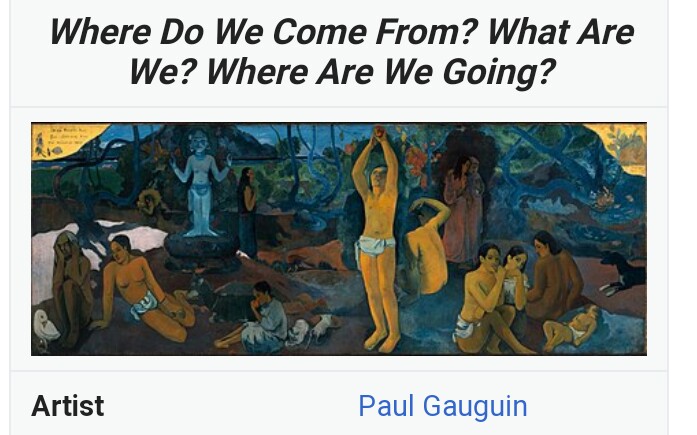
    Where have come from? where are we now?
    and where are we going?
    This is the title of a painting by Paul Gauguin when he was feeling depressed and suicidal. Which when he completed it he felt better illustrating the power of creativity in moments of despair?
    In the midst of the pandemic Covid 19 it seems relevant.
    We cannot go back to the ‘old normal’!

    The question is where are we going in the futures because it seems we cannot go back to ‘normal’ because the normal it no answer to challenges that lie ahead, most of all Global Warming, which requires a real change in values, behaviors and creative action.

    We can learn from the past, where we have come from, because there are obviously lessons to be learnt. Mark Twain was said to have said that ‘history doesn’t repeat itself but it sure rhymes’.
    The Black Death
    If we go back to the Black Plague, which killed a third of Europe’s population, this plague created a change of attitude towards authority and led to new ideas, and with the invention of printing now called the Reformation.

    Covid 19 provides such an opportunity for new ideas.

    I am aware that Twain also said that ‘prediction if difficult now even if we have no real idea of what will unfold; if direction is important –means will be found

    The world goes to big epochs of change each one requiring different behaviors, values and most important of actions

     First we were hunters and gatherers, then humans developed a more settled Agricultural Age, followed by an Industrial Age marked by mass production – now, it seems, we are moving into an Information Age (based on the disruptive power of modern information technology) or even a Creative Age – a Second Renaissance.
    Cycles of change in recent history
    Franklin Delano Roosevelt

    The above are rather big changes but recent times political thinking seems to go in smaller cycles lasting three or four decades.

    The ‘Roaring Twenties’ – ‘free market’ capitalism
    In the 1920s, often called the ‘roaring twenties’, free market politics was the thing until in 1929 when it came to a sudden end – the Great Depression A depression leading to unheard of unemployment and extreme poverty. Maybe this is the’ rhyming’ Twain talked about.
    The rise of the New Deal
    The world struggled along until new thinking evolved (not really new but up until then largely ignored) resulting in the election in America of Democrat Franklin Delano Roosevelt. Roosevelt developed an unheard of programme of government assistance called the New Deal. Sounds familiar?
    The Welfare State of Michael Joseph Savage

    In New Zealand the Great Depression equally caused great dislocation and as a result voters elected the First Labour Government led by Michael Joseph Savage. Savage introduced extensive life saving welfare provisions.  In the UK Clement Atlee was elected to replace war leader Winston Churchill and introduced similar reforms.

    The importance of the State to protect all citizens
    The importance of the state, or central government, worldwide was made more pertinent by World War Two by returning troops who, along with their families, felt the need to develop a better fairer world.
    Years of rebuilding and prosperity
    The years following the War lead to decades of prosperity, led by the state, that all provided social security for all.

    Up until the 1970s all went well but with the expensive oils shocks, and with an economy felt by many to be dictated by union power, and added to this, the increasing costs of the welfare state, new ideas were in the air (ideas not seen since the twenties).
    The rise of Neo Liberal politics
    Reagan and Thatcher

    There were those who believed ‘big’ government was limiting enterprise and creativity. This was best expressed by Republican President Ronald Reagan whose stated ‘the government is no longer the solution, it is the problem’. Social welfare politics worldwide were demonized as being a ‘nanny state’ and worse still ‘socialism’ – one step, for many, away from communism.

    The rise of the self-interested individual
    In the UK Conservative Margaret Thatcher was elected saying, ‘there is no such thing as community only self-interned individuals and their families’. Ironically, in New Zealand, it was a Labour Government, under Prime Minister David Lange and Finance Minister Roger Douglas, who introduced privatization politics known as ‘Rogernomics’
    And so began the introduction in Western countries of ‘market knows best ‘politics and that brings us up to present day
    •        State assets were sold off, often at low prices, to private enterprise to be made more         efficient and profitable.
    •    The power of unions limited and the idea of personal contracted workers introduced.
    •    The cult of privatization was introduced and loosening up on regulations
    •     And the ‘big sell’, wealth created by privatization would ‘trickle down ‘and benefit all.
    •      All of this was based on a disdain for the public sector and a reduced role for the state

    The promise of ‘trickle down ‘economics

    The key phrase of ‘trickle down’ used by the supports of ‘market force’s,’ has resulted today’s troubling list of social problems along with housing problems and growth in personal debt
    Beyond Covid 19 – Climate Change
    The focus on economic growth at all costs has contributed to the biggest issue facing us today – beyond the challenge of Virod 19 – –  that of global warming and sustainability of the environment and human civilization as we know it.

    Apposing politician views

    The National Party is still wedded to Market Force ‘free market’ politics (sometimes called neo –liberal politics) if somewhat watered down over the years.

     As yet the Labour Coalition Government has not made a dramatic shift from neo liberal politics, no doubt because to voting public still support the previous conservative government. Up until now there has been no real anger about the inequality – it has become ‘normal’.
    This brings up to ‘where we are now’ – and the challenge of the current pandemic or more to the point, ‘where to from here’.
    Returning to the old ‘normal’ no longer seems an alternative except for hard line neo conservatives. Private enterprise word wide has had to be supported by central governments – this is a return to social welfare on a large scale. Some might call this state assistance socialism!


    Beyond Covid 19
    The Covid 19 Crisis provides an opportunity to face up to the challenge of climate change and to develop push new ideas to encourage new ideas of responsible regenerative systems of production and consumption. Ideas that bring together the ‘well-being’ of people and our planet as we face a bigger challenge of climate warming.
    Where to from here? What sort of country do we want to become?
    To ensure transformation requires anger to be expressed at the inequality and environmental despoliation that has been created by the past three decades of growth at all costs – the basis of the market forces and privatization policies implemented, with the false promise of wealth ‘trickling down’ since the 1980s
    There is now an alternative.


    Those who implemented market policies convinced all that ‘there was no alternative (TINA) and demonized the ‘nanny state’, believing in less government, and to achieve privatization they demonized the union movement.
    A reason for anger and need for change.
    Up until this day all governments have implemented ‘market force’s policies including Helen Clark, Bill Clinton and Tony Blair. In New Zealand Helen Clark’s Labour Governments did their best ameliorate the worst aspects by introducing policies like ‘working for families’ to assist those most affected. Never the less inequality and despoliation of the environment has been the result; the rich have got richer and the poor poorer.

    For thirty-five years the corporate world has ruled supreme. Particularly in the USA, but now ironically they are being rescued by the state that they have seen as ineffective.  Neo liberalism was all about individuals deciding for themselves, based on self-interest, and by competing with each other. Such an approach did not tap the power of community energy, communal collaboration and cooperation and this is where we now need to turn.

    The need for change in a few dramatic weeks

    Who would’ve thought in a few short weeks, as a result of Covoid 19, the world would change so dramatically providing challenges well beyond self-interested private enterprises – all a sudden only the state can assist in such dire situations. Greater social welfare and assistance is now essential.

    So time to demonize and discredit the ‘trickle down’ market forces politics to change the consciousness of people to be able to envisage a better world. In times of crisis impossible ideas become possible. We cannot go back to the ‘normal’ destructive road of market forces politics.
    The Challenge for the Coalition Government.
    The challenge for the Labour Coalition Government, as we move out of the Covid 19 crisis and under the leadership of Jacinda Ardern, is develop a new vision or direction for our future based on the ideas of ‘well-being’ of all citizens and the sustainability of the environment.
    Labour is well placed to articulate such a people centred community and environmentally sustainable vision. A government led by Jacinda Ardern could see New Zealand being a world leader, something we could all be proud of.
    Need to rebalance state and private enterprise
    What is required is to rebalance the influences of state direction and private enterprise; to focus and reward private enterprises who focus on developing a sustainable New Zealand.’ Let the market decide’ is now a failed dogma.
    There are a number of ideas to consider, none original:

    ·         To introduce a ‘Green New Deal; for state agencies to implement and for private enterprises to be rewarded for positive actions. To encourage investment in productive areas of the economy and not just for individual reward This relates to the ideas introduced by Franklyn Delano Roosevelt following the Great Depression as well as the policies of the First Labour Government in New Zealand.
    ·       

      t      To  build on the ‘well-being’ philosophy underpinning the Coalition Government and to move away from a narrow misleading emphasis on GDP. A focus on GDP emphasizes the idea of infinite growth serving, first and foremost, the richest 10% and says little about non material well-being such as mental health and capturing the fullness of human flourishing.

    ·         To upgrade infrastructure needs – the ‘shovel ready ‘projects. Consider the possibility of the government buying into firms currently struggling and to develop a Ministry of Works to coordinate projects.
    ·       To continue developing a range of state innovative low cost housing and accommodation including communal concepts.
    ·         To build on the regional development being led by Minister Shane Jones.

    ·          It might be time to consider rebalancing the central and local Government.  There is a need to provide greater finance and flexibility for local government making local government more attractive for voters to be involved.  This could also more power sharing with local organizations and identifying steps to be taken to build community and strengthen the local community.
    ·         As part of the Green New Deal to encourage and assist land owners to develop regenerative agricultural approaches.
    ·         To come to terms with the possibility that unemployment (and under employment) will become endemic with the continued application of automation and to introduce a Universal Basic

    Income. Not only would this simplify the plethora of welfare benefits but it would remove any stigma that people currently feel as well as providing a much needed sense of security.  There are numerous article outlining benefits and problematic issues to be taken into consideration. I believe a UBI would encourage innovative creative activities for many creative individuals. An extra payment could be given to people working as teacher aides or similar worthwhile occupation such as working in rest homes or working with adults with special needs

    ·         Even with a UBI progressive tax required rising to a higher percentage of income earned over a generous certain amount.
    ·         A reconsideration of a Capital Gains Tax (needing cross party agreement) as a lack of a Capital Gains Tax is a major factor in driving up house prices Wealth Tax is another option although I’m not sure what this involves. Plus, raising taxes on fossil fuel fertilizer to encourage regenerative agriculture.

    ·         Encouraging renewable clean energy projects   and to reduce extractive industries to move New Zealand to a post carbon economy. Further subsidizing house insulation and including solar panels.
    ·         A greater focus on protecting New Zealand’s natural environment – investment in preserving the environment would provide much needed jobs. A New Green Deal workforce. There is a need to encourage ‘degrowth’ – a deliberate downscaling of segments of the economy harmful to the ecosystem such as the fossil industry while at the same time valuing people such as those working in the care industry.
    ·         Providing greater Research and Development finance to encourage an environment of innovation and to share and upscale successful projects.
    ·      

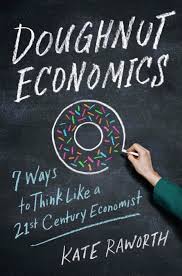
       Consider the circular regenerative economy outlined by economist Kate Raworth in her book The Doughnut Economy. The book sets out the minimum we need to lead a good life and sustain the environment. It highlights boundaries across which human kind should not go in contrast to current greed based economics.

    With Covid 19 and the Climate Change challenge provides motivation for transformational change.
    The free market promised to liberate the individual from the supposedly restrictions of the ‘nanny state’ but instead it has weakened safety nets, increased insecurity for far too many and put the entire planet at risk
    Covid 19 and the Climate Warming crisis has given us an opportunity and the resolve to move away from self-interested capitalism to a kinder, fairer and more creative world – one we have a chance to hand on to future generations.
     It is possible to imagine a new world and a different type of society with new values and behaviours. – where human values of fairness, mutual aid and compassion are paramount.  It Hs happened before after the Great Depression and we can do it.
     It must have looked equally challenging in the days after WW2 when social democratic governments, including our own led by Michael Joseph Savage and Peter Fraser developed socially secure states leading to an era of unparalleled prosperity.


    Keep your soul diligently

    We’ve all seen those memes on Facebook and other places where the letters of each word are scrambled, but the first and last letters are kept unchanged. Sometimes these memes are accompanied by statements such as, “Only intelligent people are able to understand this message.” Actually, most adept readers are able to read them; as we learned to read, our brains developed shortcuts that recognize words even when the internal parts of the words have been changed.

    But, by the same token, sometimes we mistake one word for another. The slip-up can be amusing, such as confusing “immorality” and “immortality.” Usually a second glance fixes the misreading. But this morning in my Bible reading, I faced a misreading that indicates just how overwhelming our current virus crisis has become.

    I was reading Deuteronomy chapter four. I got to verse nine, which says, “Only take care, and keep your soul diligently, lest you forget the things that your eyes have seen, and lest they depart from your hearts all the days of your life. Make them known to your children and to your children’s children.” This is a trustworthy saying. But when my eyes first scanned the verse, my brain changed the beginning to, “Only take care, and keep your social distancing.”

    Of course a second glance fixed the misreading. I suppose the words “take care” only added to the tendency to expect s…l d……..y to be “social distancing.” But my mildly amusing experience only shows how overwhelming this virus crisis has become, that I even expect the holy Word of God to command social distancing.

    My experiences with the virus crisis are like those of most people. As an introvert, I don’t mind keeping my distance from other people. Three times a week I take a two-mile walk through the neighborhood. I do what I was taught as a child: I walk on the left-hand side of the road, facing the traffic. But now, with social distancing, if someone is coming toward me on the same side of the road, I cross to the other side to avoid that person. I’ve always wanted to do that. Now, not is it not rude to cross the road to avoid people—it’s recommended.

    I’m very much blessed to have three jobs that all paid me my regular salary while I worked from home. Every week I write a sermon, and every Saturday I email it to the members of the congregation. Our church musician presents a concert of church music on Facebook every Sunday. We mail in our offerings, and my check comes in the mail. My history class was changed from classroom to online. Some students dropped out, and a couple have fallen behind on the work, but several are faithfully taking their quizzes (open book, since we don’t have the classroom discussion before the quiz) and—I expect—writing their essays that are due next week. But my full time job at the library raised the biggest concerns. How can a library function when the doors are locked and the workers are told to stay home?

    The first week the library was closed, we were told that it was like snow days—we would stay home and be paid. The second week, they began encouraging us to do tasks at home that were somehow job related. Since I am an archivist, I began sorting and arranging the family pictures I brought from my father’s house several years ago. After they were arranged, I even started putting them on Facebook and tagging family members. I also explored the family genealogy. More than half the people who visit our research room in the library are doing genealogy—some in great depth, others just getting started. I’ve always been able to guide people to resources, but now I have much more experience in genealogical research and will be more helpful.

    By the third week, we had a process of reporting how we were spending our time “on the clock.” But after that, the library decided that 75% of our hours had to be of direct benefit to the library system; the other 25% could be for learning and wellness activities. Some library branches began experimenting with curb-side services. Four branches are providing free meals to neighborhood children who usually get fed at school. My department remains locked up; but we are taking turns being in the building to answer the phone and help patrons.

    Last week, with the phone-answering system in place, I was invited to return to my desk and continue processing archival materials. I must wear a mask everywhere in the building except at my desk; I must wash my hands frequently and wipe down surfaces often. This procedure might last for the rest of the summer.

    Since it is losing some money—parking and meeting room fees, and overdue fines—the library director decided that he would reduce or eliminate some positions temporarily to save the library money. All positions will be restored when the crisis is over. People in eliminated positions retain their health insurance and other benefits but must apply for unemployment. Those who are reduced will—if the state government allows—work only part-time and receive unemployment money for the hours lost. I have been placed in the second category.

    I do not feel comfortable with the likelihood that I will be receiving unemployment compensation for ten weeks or so. It’s not that I don’t need the money. It’s that every person thrown into the unemployment system is added to the financial burden that taxpayers like me and my children will be reimbursing for years to come. I disagree with the library’s decision to lower its costs by putting its workers temporarily into unemployment. In fact, I cannot help but view this as a cynical political ploy to deepen the crisis (and the feeling of crisis) at the expense of the current administration.

    We will all get through this together. Stress and anxiety are high right now. (I spend little time on social media precisely because I rapidly tire of all the talk of virus and quarantine. It makes me shaky and queasy.) Meanwhile it’s important for each of us to take care, and keep our social distancing… I mean, keep our souls diligently. J.