LinkedIn Jobs: It’s Not What You Know, It’s Who You Know

Guest Blog by the LinkedIn Careers Team – Article 1/5
LinkedIn Jobs: It’s Not What You Know, It’s Who You Know
Your soon-to-be awarded degree is likely a requirement for your dream job. But what is going to set you apart from everyone else who just graduated college with the same qualification? Your network! 

Harness the power of your network, providing you an edge in your job search
Do I even have a network?
LinkedIn is helping soon-to-be grads from around the country tap into their professional community—whether they realize they have one already or not.  LinkedIn has the power to uncover 1st and 2nd degree connections that will boost your chances of getting hired for highly sought-after jobs in a competitive market.  We found that 70% of people were hired at a company where they had a connection.
One of the easiest ways for students to make connections is through the LinkedIn Alumni tool. It’s a simple way to explore and create alumni connections from your school.  You can lean in on where they work now and in what cities. Simply search for your school and select “see alumni” to get started. You can access career paths for more than 23,000 colleges and universities worldwide.
Your First Job is a First Step!
Even if you land your dream job right out of college, the most successful professionals will warn you about complacency and how it may negatively affect your earning potential over time.  Searching for jobs can seem like a daunting task, especially right after you’ve just landed one. It’s ideal to continue interviewing and keep an open mind for your next career move.  LinkedIn has made it easier than ever to keep your options open even when you’re not actively seeking alternative employment.  It’s called Open Candidates and it’s as easy as updating your LinkedIn career interest preferences.  By flipping the switch, you privately signal to recruiters that you’re interested in new opportunities.
What Now?
Create or update your LinkedIn profile today.  There is no other place where you can access such a wide range of knowledge, skills and resources to help you reach your goals!

III semester & I semester – Elements of teaching poetry


Dear students,

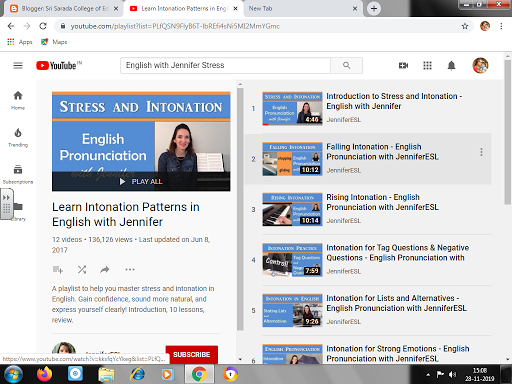
Do visit the site in the following link and post me your comments which may reflect your understanding of the content….

Video 1  (https://youtu.be/b8q3xX0qyDA)

Video 2  (https://youtu.be/C1t2daf5_LE)

Video 3  (https://youtu.be/YylGOdLCc8c)


After watching the videos, visit the site in the following link

https://drive.google.com/open?id=1Lk4as86T2aJZAxabRc93KOcQnW6XML59


Expecting both I and II year students’ reply….

I Sem – Special English – Teaching Language through Literature


Dear Students,

I found it extremely useful and interesting, the material which I studied recently prepared by ARPIT course… This is highly relevant for our study also. Do read it and Pass your comment to me…

https://drive.google.com/file/d/1l_T60ktssP-dT6fFlhb2vNGSD0ogrU4Y/view?usp=sharing


Hope a fruitful discussion in the classroom…

Sorry, the above link doesn’t open it seems….
Try this one

https://drive.google.com/open?id=1z1NZxGLOy0-VysSSL7Jcw-6mKsay6s1W

I sem – General English – Audio lingual method


Dear learners,

Yet another interesting method of teaching a second language is Audio lingual method.

The Audio-lingual methodArmy Method  is a style of teaching used in teaching foreign languages. It is based on behaviourist  theory, which postulates that certain traits of living things, and in this case humans, could be trained through a system of reinforcement. An important belief of structural linguistics is that a language is primarily what it is spoken and only secondarily what is written. Speech is language. We learn to speak before we learn to read and write. So the structural linguistics pays emphasis on the spoken skills of a language (Brooks, 1964)

THE AUDIO LINGUAL METHOD
The teaching of English as a second language in the United States between the two world wars used either a modified Direct Method Approach. The Audio lingual Method (ALM) gained attention in the 1950s, largely in the USA where it was rooted in the military’s need during World
recite the basic sentence patterns and grammatical structures. The students were given only “enough War II to train large volumes of personnel in disparate languages.
    Charles C. Fries, the director of the English Language Institute at the University of Michigan, the first of its kind in the United States, believed that learning structure, or grammar was the starting point for the student. In other words, it was the students’ job to vocabulary to make such drills possible.” (Richards, J.C. et-al. 1986). Fries later included principles for behavioural psychology, as developed by B.F.Skinner, into this method.
THE PRINCIPLES OF THE AUDIO LINGUAL METHOD
Ø  Language learning works best with a context.
Ø  Try not to mix the L1 and L2 so interference does not occur.
Ø  Teachers are used as role models for the language. 
Ø  Students will mimic the correct form.
Ø  Language learning is habit. Repeat and drill often.
Ø  Correct errors immediately. Do not allow bad habits to develop.
Ø  Language is for communication.
Ø  Substitution drills help students understand how language works.
Ø  Positive reinforcement is good for changing habits.
Ø  Verbal, and non verbal (flashcards, pictures) stimuli are used in class.
Ø  Students learn to answer automatically, without thinking first.
Ø  Grammar structures come first, vocabulary will follow.
Ø  Rules will be induced from using examples.
Ø  Follow the natural order that children do when language learning; listening, speaking, reading then writing.
Ø  The teacher has a responsibility to teach the culture of the target language users.

LEARNERS ROLES 
Learners play a reactive role by responding to stimuli, and thus have little control over the content, pace or style of learning. They are not encouraged to initiate interaction, because this may lead to mistakes.
The fact that in the early stages earners do not always understand  the meaning of what they are repeating is not perceived as a draw back, for by listening to the teacher, imitating accurately, and responding to and performing controlled tasks they are learning a new form of verbal behavior. 
TEACHERS ROLE
In Audio Lingualism, as in Situational Language teaching, the teachers role is Central and Active, it is a teacher Dominated method.
The teacher must keep the learners attentive by varying drills and tasks and choosing relevant situations to practice structures.
  Language learning is seen to result from active verbal interaction between the teachers and the learners.
PROCEDURE
Brooks lists the following procedures the teacher should adopt in using  the Audio Visual Method:
       a.The modeling of all learning’s by the teacher.
       b.The Subordination of the Mother tongue to the second language.
       c.The early and continuous training of the ear and tongue without recourse to graphic symbols.
       d.The minimizing of vocabulary until all common structures have been learned. 
       e. The study of vocabulary only in context.                      
              MERITS
   Ø Listening and speaking skills are emphasized and, especially the former, rigorously developed.
       Ø The use of visual aids is effective in vocabulary teaching.
       Ø The method is just as functional and easy to execute for larger groups.
       Ø Correct pronunciation and structure are emphasized and acquired.
       Ø It is a teacher-dominated method.
       Ø It is a mechanical method since it demands pattern practice, drilling, and memorization.
      Ø The learner is in a directed role; the learner has little control over the material studied or the method of study.
          DEMERITS
ØThe behaviourist approach to learning is now discredited. Many scholars have proved its weakness.
ØIt does not pay sufficient attention to communicative competence.
ØOnly language form is considered while meaning is neglected.
ØEqual importance is not given to all four skills.
ØIt is a teacher-dominated method.
ØThe learner is in a passive role; the learner has little control over their learning.


Do compare and contrast the Audio lingual method with that of the Direct method and let me know it…


I Sem – General English – Word & Sentence Stress

Word Stress
« The word is a linguistic entity composed of one or more syllables
« The syllable that is pronounced more prominently than the other(s) in the same word is said to be accented or to receive the stress
« In English there are several polysyllabic words in which more than one syllable may be prominent – one of the syllables is said to receive the primary stress; the other syllable that is secondly prominent is said to receive the secondary stress
« Primary Stress is marked with a vertical bar above & in front of the syllable to which it refers
« Secondary Stress is marked with a vertical bar below & in front of the syllable to which it refers
RULE 1:
There are some disyllabic words in which word accent depends upon whether the words are used as nouns/adjectives or as verbs.
For nouns the stress is on the first syllable
For verbs the stress is on the second syllable
Word
Noun / Adjective
Verb
conduct
object
product
direct
export
Rule : 2   Accent in Compound Words
The most common type in English is the first of the two elements receiving the primary stress.
Air – raid                                 Cardboard
Bookshelf                               Footprint
Rule 3:
Words ending with –ever  & -self  take the stress in the second element
Her self                          what ever
My self                          when ever
Rule 4 :
Words with weak prefixes always take the accent on the root.
A board
A broad
Be come
Rule 5:
Words having weak vowel followed by a strong vowel syllables have the accent in the second syllable
Recom mend
Com pose
Ad vance
Rule 6:
Words ending in  -ion take the primary stress on the penultimate syllable
admi ration
appli cation
combi nation
Rule 7:
Words ending in –ic, -ical, -ically, -ious, -ial & -ially take the stress on the previous syllable
-ic               pathetic                        terrific
-ical            optical                           biological
-ically         chemically          psychologically
-ious           notorious                      atrocious
-ially           commercially               dramatically
-ial              commercial                  memorial
Rule 8:
Words ending in –ity take the accent on the ante – penultimate syllable (third from the last syllable)
a bility                           fu tility
ca pacity                       oppor tunity
Sentence Stress
In a sentence, some words have been stressed rather than other words.  This depends on the intention of the speaker.  Mostly the content words receive the stress rather than the structural words.
‘He is my uncle   ( not any other person, only he )
He is ‘my uncle   ( not any other’s )
He is my ‘uncle   ( not any other relation)

I Sem – Special English


Dear Students,

I had the opportunity of reading a research paper on the role of literature in language learning... You may also find it useful.. Here is the link.

https://drive.google.com/open?id=1–lBvr75AsbKleSXZCkqx4c8FaF4LquH


You can find the materials for the concept “Language and Power” in the below link

https://drive.google.com/open?id=1q9q68ZGknPQ03mgeov4vvqwGKkNHVjPZ


Place of English in Indian Constitution
https://drive.google.com/open?id=1q9q68ZGknPQ03mgeov4vvqwGKkNHVjPZ

Characteristics of language
https://drive.google.com/open?id=1UqnhGdrx7H29-gT9XlgXxR6lnvwUQFMS

Role and Nature of Language
https://drive.google.com/open?id=1OwtUHA8uU7gM7lyL_5Osn35EBTQ-pGNJ

I sem – Gen. English – Word stress

Word Stress
« The word is a linguistic entity composed of one or more syllables
« The syllable that is pronounced more prominently than the other(s) in the same word is said to be accented or to receive the stress
« In English there are several polysyllabic words in which more than one syllable may be prominent – one of the syllables is said to receive the primary stress; the other syllable that is secondly prominent is said to receive the secondary stress
« Primary Stress is marked with a vertical bar above & in front of the syllable to which it refers
« Secondary Stress is marked with a vertical bar below & in front of the syllable to which it refers
RULE 1:
There are some disyllabic words in which word accent depends upon whether the words are used as nouns/adjectives or as verbs.
For nouns the stress is on the first syllable
For verbs the stress is on the second syllable
Word
Noun / Adjective
Verb
conduct
object
product
direct
export
Rule : 2   Accent in Compound Words
The most common type in English is the first of the two elements receiving the primary stress.
Air – raid                                 Cardboard
Bookshelf                               Footprint
Rule 3:
Words ending with –ever  & -self  take the stress in the second element
Her self                          what ever
My self                          when ever
Rule 4 :
Words with weak prefixes always take the accent on the root.
A board
A broad
Be come
Rule 5:
Words having weak vowel followed by a strong vowel syllables have the accent in the second syllable
Recom mend
Com pose
Ad vance
Rule 6:
Words ending in  -ion take the primary stress on the penultimate syllable
admi ration
appli cation
combi nation
Rule 7:
Words ending in –ic, -ical, -ically, -ious, -ial & -ially take the stress on the previous syllable
-ic               pathetic                        terrific
-ical            optical                           biological
-ically         chemically          psychologically
-ious           notorious                      atrocious
-ially           commercially               dramatically
-ial              commercial                  memorial
Rule 8:
Words ending in –ity take the accent on the ante – penultimate syllable (third from the last syllable)
a bility                           fu tility
ca pacity                       oppor tunity
Sentence Stress
In a sentence, some words have been stressed rather than other words.  This depends on the intention of the speaker.  Mostly the content words receive the stress rather than the structural words.
‘He is my uncle   ( not any other person, only he )
He is ‘my uncle   ( not any other’s )
He is my ‘uncle   ( not any other relation)

I Sem – General English – Communicative Approach

Communicative Approach
Introduction
            The Communicative approach is a learner centred approach. It gives the learner not only grammatical competency but also a sort of skill as to what to say, how to say, when to say, and where to say in order to satisfy his/her daily needs or larger aims.
            In the communicative approach apart from fluency of saying something, accuracy and appropriateness are equally important. Of course an efficient user of language needs to produce grammatically well – formed sentences. The teacher has to develope in the pupils both rules of use (what to say & how to say) and rules of usage (grammatically correct sentence).
Meaning
            This approach pays attention to functional as well as structural aspects of language and combines these into a more fully communicative view. It emphasizes that the goal of foreign language teaching is to develop “communicative ability” among the learners.
            This approach considers language not only in terms of its structures (grammar & vocabulary) but also in terms of communicative functions that it performs.
Aims of Communicative Approach
@ To develop both accuracy and fluency from the very beginning of language learning.
@ To tolerate the mistakes or errors as stepping stones to correct learning .
Importance
X  The learner is helped to acquire language forms to their potential functions and /or social meaning
X  The learner is placed in situations and he must use language as an instrument for satisfying communicative needs. Here the criterion for success is functional effectiveness rather than structural accuracy.
X  The learner can be helped to use language as an instrument for social interaction. Ex: Role play
Purpose
            Communicative ability can be achieved through communicative activities in the class. They are learner – directed activities. They can;
W Provide structural ‘whole task practice’
W Improve motivation
W Allow natural learning
W Create a content which supports learning
Types of communicative activities
            There are two main categories;
Functional communicative Activities
            The teacher creates a situation in which learners must solve a problem with whatever language they have at their disposal. It may not even matter whether the language is grammatically incorrect. The main purpose of his activity is that learners should use the language they know.
            For example a small talk on a particular topic for just three minutes is an activity for functional communication. Success is measured primarily according to the immediate situation.
Social Interaction Activities
            The learners chooses language which is not only functionally effective, but also appropriate to the social situations he is in. Learners pay greater attention to the social content in which their interaction takes place. Simulation and role play are important techniques for creating a wider variety of social situations.
Teacher’s role in Communicative Approach
            The teacher must;       
 Be a perfect model in speech
 Stress on oral communication not bothering about systematic grammar rules
 Create situations in which pupils express their ideas and suggestions
 Insist on meaning in speech activity more than any thing else
 Mediawares like TV, video and audio cassette player can be used often
 Give language exercises which will bring out the originality and creativity of pupil’s ideas
 Let the pupils observe lexis and structure unconsciously
 Create where the pupils speak more on his own
 At a later stage, make pupils describe things and explain functions of certain organs, machines, etc.
Merits
C  By interacting in pairs and small groups, pupils feel confident and do better.
C  Learning will be self- generating exercise
C  They get more language practice because nobody feels inhibited by grammatical rules and definitions
C  They acquire fluency and accuracy and appropriateness of English use
C  Co-operation in language learning is a great motivating factor and helps each individual to shed his shyness and show his individuality in using English.
Demerits
D  Our overcrowded class rooms and unwidely benches make group work and face to face discussion very difficult to organize.
D  An average teacher with limited language skills cannot make a success of their approach
D  When the students can well communicative in their mother tongue, there is no genuine desire in them to talk in English and take part in elaborate discussions in English.
D  Detailed classroom techniques integrating the textual lesson and communicative tasks have yet to be evolved for the benefit of the teachers of English
Conclusion
         In the present global village, English is a growing and living language. This has created awareness among the people to learn the language in its time form and manner. It is in this respect that the language skills are to be developed, nurtured, cultured and harnessed.

Role of English language in India

Role of English in India
English has been playing an important role in our educational system as well as in our national life. It is through English that we have shared the wisdom of the West and that the West has shared with us our intellectual and spiritual heritage.
Views of Dr. S. Radhakrishnan: “English is the only means of preventing our isolation from the world. If we give up English because of sentimental urges, we would cut ourselves from the living stream of ever growing knowledge”
Views of Nehru: “one hundred and fifty years of intimate contact has made English an integral part of our educational system and this cannot be removed without injury to the cause of Indian education”
The official Language:
            English has been the official language of the country for more than 200 years. It has been declared as the associate Official Language of the union for an indefinite period by an Act of Parliament in 1963. as such it dominates the administrative work throughout the country.
World Language:
            Emphasizing the importance of the knowledge of English, the Radhakrishnan University Education Commission observed, “English is a language which is rich in literature- humanistic, scientific and technical”. Over 50% of world’s newspapers, over 50% of world’s scientific and technical periodicals and more than 60 % of world’s radio stations use English as medium of communication.
Language of International Trade and Commerce:
            Business and Trade across the country are carried on through English. Even semi literates on travel and trade promoted to use English for conversing people of other states and to exchange ideas and views. For bringing about revolutionary changes in various fields such as agriculture, medicine, industry, transport, telecommunication, etc., we have to be in touch with the outside world. It is possible only with the knowledge of English.
Scientific and Technical language:
English is a rich store house of knowledge. Discarding English will amount to closing a window on the world of technology. If English is not given due consideration, we will fall back hundreds years and never will be able to catch up economically with the developed countries.
In Social Life:
            English plays an important role in the social life of the country. The highly educated and sophisticated sections of our society find it prestigious to talk in English, they write letters in English. Ceremonials like marriages and other parties’ invitations are mostly in English. Most of the educated people put their signatures in English.
Window on the Modern World:
            Jawaharlal Nehru has rightly said, “English is our major window through which we can see the scientific, technological, agricultural and commercial development taking place in the world. English si the only language through which we have distilled essence of modern knowledge in all fields of human activity.
Link language :
            English is our national link language, as India is a multilingual country. It is the only language which is understood in all states. In the other states, without the knowledge of English, one will become an Alien in our own country. It is only through English that we have established the social, economic, cultural and political relations with other countries of the world.
Library Language:
            Largest numbers of reference books on subjects like science, technology, language, medicine, engineering, agriculture etc. are available in English language. Kothari Commission said, “English should be the most useful library language in higher education.
Court Language:
            English still continues to be the language of the courts. So far there is no other suitable language for legal business, not only at the Supreme Court but also at the High courts and District courts. Cases are presented and judgements given are in English.
Being in Education:
            English plays an important role in the field of education. It is taught compulsorily in most of the states in the country. It is the medium of instruction in  the public schools, technical, medical, law and other institutions.
Conclusion:
Keeping in view the role of English, we cannot dispense with the study of English. Indians can neglect its study at their own risk.

I Sem – General English – Study Materials – Skill subject

Teaching English as a Skill Subject
Introduction:
Language is skill subject as it involves the various skills like listening, speaking, reading and writing. It has to be developed by oneself by constant effort and with proper training of senses. In a skill there is a co ordination of muscular activities along with the intellectual activity.
Differences between skill and content subjects:
Skills cannot be taught but rather caught. Language is skill subject and not a content or knowledge subject as history or science is. While learning history what the student learns is the subject matter or facts. One learns certain facts about history. But in language work one does not gather information about the language, but learns the language itself. Knowing a language is different from knowing how to use the language.
Emphasis on Repeated Practice:
As Thompson Wyatt say, “The power of expression in a language is a matter of skill rather than of knowledge; it is a power that grows by exercise, not by knowing merely meanings or rules”. Language is a skill subject like painting or dancing. The basis of learning a skill is practice. So language has to be learnt through constant and sustained practice.
The rules of grammar and the meanings of words are taught as another abstract subject. Knowing them is not sufficient to acquire mastery over the language. Students have to be provided ample opportunities to use the language. Each of the four skills, viz. listening, speaking, reading and writing has to be mastered.
Co-ordination of muscles & Intellect:
            Though a skill does not need only the intellectual activity, it is more a matter of doing than of knowing. In case of listening, enough practice has to be given to the hearing nerves so as to be familiarized with the speech sounds of the language. Apart from the intellectual competency of comprehending the new words and grammar, the ears must also be trained so to accustom with the new speech sounds of English as it is a foreign language.
            In case of speaking, the speech organs like tongue, lips, palates, nostrils are to be trained by constant efforts to produce the speech sounds fluently. Some may know how to pronounce the words / sounds, but they cannot do so because of the lack of co ordination of speech organs. In case of reading also the nerves have to be trained to recognize the new symbols (English alphabets) and know how to read them. One has to develop eye span also.
            In case of writing also, without the co-operation of the finger muscles one cannot write the letters in their appropriate forms. There comes the need of training.
Division of skills:
            In any language, the skills can be divided into two major divisions;
1.      Productive or Expressive skills
2.      Receptive or Comprehensive skills


RECEPTIVE / COMPREHENSIVE SKILLS
Listening & Reading


PRODUCTIVE / EXPRESSIVE SKILLS
Speaking & Writing


Receptive or Passive Skills:
Listening and reading skills are comparatively passive and require less exertion on the part of the person. They are receptive because when listening and reading, the person is at the receiving end of the communication channel.
Productive or Active Skills:
Speaking and writing are active skill since the person being at the transmitting end of the channel has to take the initiative. So that only they are called productive skills.
Audio – lingual / aural oral skills:
Listening and speaking which demand the exercise of te auditory and speech organs may be called audio –lingual or oral – oral skills.
Graphic Motor skill:
Reading and writing involve the psycho motor organs. Hence they are called graphic motor skills.
Conclusion:
The language is not just a conglomeration of diverse skills, but one of the integrated skills. Hence we have to use more than one skill simultaneously in many situations. For instance, when one engaged in a conversation, he/she has to listen and speak at the same time. So is the case of reading and writing

Communicative Approach – Video lesson

Dear learners,

Happy to share a link of a video of CLT, which is by an Associate Professor from Morocco.

Do watch the video, and take notes of his explanation apart from the matter in the slides…

We shall discuss the approach in the classroom along with a short quiz on it using Kahoot…

Image result for emoji images

“If you are proactive, communicate clearly, network with others effectively, negotiate with others successfully, and work smart, you can succeed in the real estate business.” —Professor M.S. Rao

“If you are proactive, communicate clearly, network with others effectively, negotiate with others successfully, and work smart, you can succeed in the real estate business.” —Professor M.S. Rao
Vision 2030: One Million Global Leaders