Forgiveness

“For if you forgive others their trespasses, your heavenly Father will also forgive you, but if you do not forgive others their trespasses, neither will your Father forgive your trespasses” (Matthew 6:14-15).

In his model prayer, Jesus had us promise to forgive those who sin against us. Now he reinforces that message with a strong warning. These verses frighten some Christians. Can we really lose the forgiveness of God by refusing to forgive another person?

These verses are spoken within the context of the higher expectations Jesus has for us. He says, “When you give… when you pray… when you fast….” He expects us to do these things; he does not make them optional. In the same way, Jesus assumes that because we are forgiven, we will forgive. His blessings have changed our lives; they are making us more like Jesus.

When we refuse to be like Jesus, forgiving the trespasses of those who sin against us, we block the flow of forgiveness through our lives. When a river is dammed, the water behind the dam often stagnates. Jesus warns us of a similar thing that happens in our spiritual lives. When we are unable to forgive as Jesus forgives, we can cause our own spiritual lives to become stagnant and to die.

However, holding a grudge is not the unforgivable sin. Jesus died to rescue us from that sin as well as from all our other sins. We do not earn forgiveness from Jesus by forgiving others. His forgiveness is a blessing; it is a gift. It is not earned. Yes, we can lose that forgiveness by continuing to sin without wanting to change. When we prefer our sins to our Savior, we lose that Savior; he becomes, instead, a Judge. But saying we can lose his forgiveness does not imply that we can earn his forgiveness. In the matter of God’s forgiveness and our obedience to his commands, God always makes the first move. God always goes first.

In the prayer, Jesus employs this order: “Forgive us our trespasses, as we forgive those who trespass against us.” God forgives first, and then we imitate him. God does not limit himself to our level, our ability to forgive. He forgives first, setting the standard, and then he invites us to be like him, offering us the strength to follow his lead.

Let’s imagine that someone has done something dreadful that hurt you. How can you forgive? Not from the goodness of your own heart, but only from the power of God’s gift. Jesus suffered and died on the cross to pay for all sins, including sins that hurt you. When you forgive the sinner who hurt you, you are sharing the promise of Jesus. When you refuse to forgive, you are keeping secret the life-changing promise from Jesus, a promise that every sinner needs to hear.

We cannot make ourselves more forgiving by trying harder to forgive. That road leads nowhere but to despair. We become more forgiving by drawing closer to Jesus, by remembering what he has done, and by believing his promises. When we remember that we are forgiven even for our failures to forgive—since forgiveness is a gift and not something we earn—then we become able to forgive those who sin against us. J.

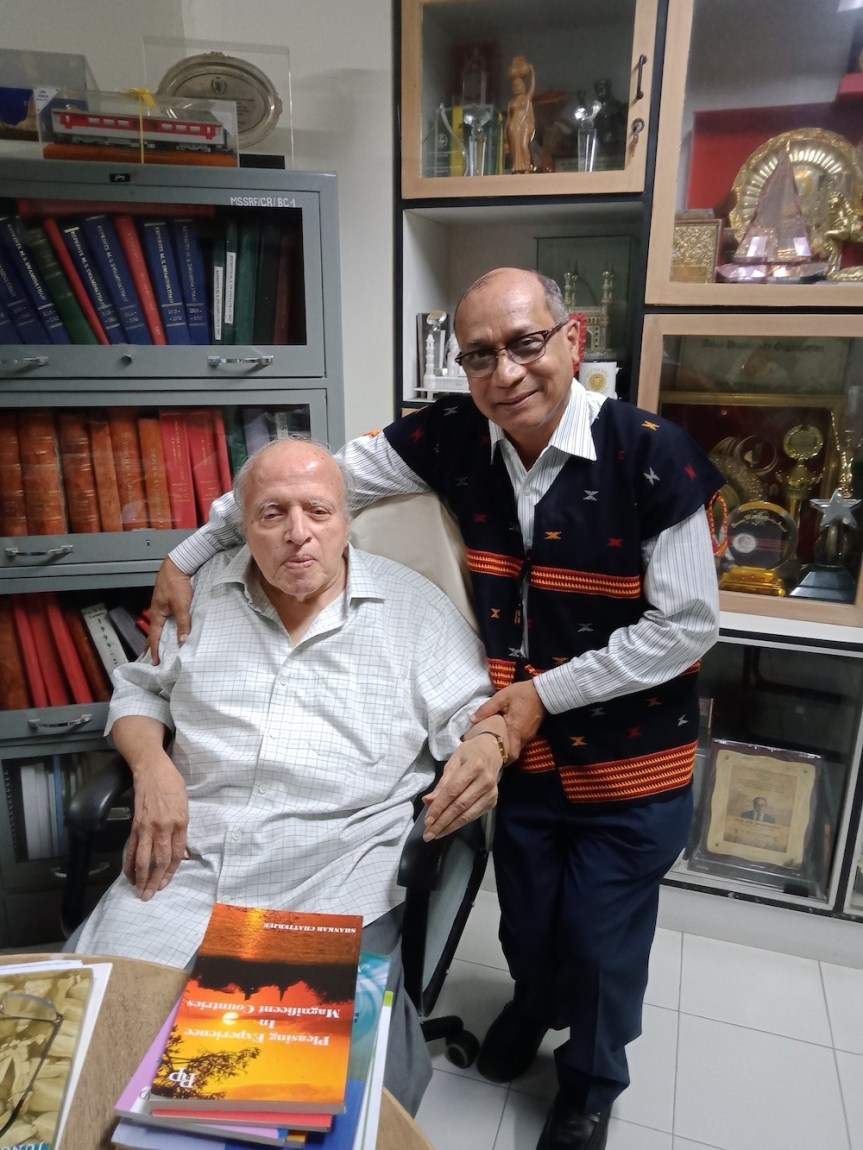
Wonderful Experience to meet Father of Green Revolution: Prof M S Swaminathan Sir

Prof. Mankombu Sambasivan Swaminathan, popularly known as M.S. Swaminathan, (born 7 August 1925) is a great personality not only in India but across the world as he has shown the path how a country can be self-sufficient in food-grains after experiencing severe food shortage because of drought. And for his enormous contributions in the field of agriculture, he was awarded with many national and international awards. The recent one is the first World Agriculture Prize in 2017. There is not an iota of doubt that because of Prof M.S. Swaminathan sir’s contribution today India is self-sufficient in food grains and 130 crores people are getting food. In the backdrop, we all know severity of the food problem in 1943, the Bengal famine and later on in 1965 because of monsoon failure India seriously suffered from food crisis. Now all are in history as Swaminathan sir has shown the path to both Indian Government and our farmers, how one can be self-sufficient which all know as ‘Green Revolution’. His vision is to get rid of the world from hunger and poverty and he is great believer of sustainable development, especially using environmentally sustainable agriculture and preservation of biodiversity, which he calls an “evergreen revolution.” He successfully completed various coveted positions and inter alia of which are – Director General of Indian Council of Agricultural Research from 1972 to 1979, after that Principal Secretary, Ministry of Agriculture, Government of India from 1979 to 1980. He served as prestigious post of Director General of the International Rice Research Institute (1982–88) and selected as the President of the International Union for the Conservation of Nature and Natural Resources. For his excellent contributions, in 1999 the prestigious Time Magazine placed him in the ‘Time 200’ list of most influential Asian people of the 20th century.

Another praiseworthy contribution of Swaminathan Sir to the world in general and India in particular is setting up of the MS Swaminathan Research Foundation, popularly known as MSSRF in Chennai, Tamil Nadu. MSSRF (established in 1988) is a non-profit organisation.

The MSSRF aims to accelerate use of modern science for sustainable agricultural and rural development. It focuses specifically on tribal and rural communities with a pro-poor, pro-women and pro-nature approach. The Foundation applies appropriate science and technology options to address practical problems faced by rural populations in agriculture, food and nutrition.

MSSRF is carrying out research and development in the following major areas:

I had the opportunity to meet Prof Swaminathan sir on 18 December 2019 at MSSRF in Chennai and took his blessing as I feel he is ‘Annadata’ (food provider) to all of us. Interaction was although few minutes but I was greatly enlightened.  I was charmed to see such a simple and wonderful human being although endowed with ‘ocean of knowledge’, awards etc.; he is ‘down to earth’ person. Immediately the Sanskrit proverb, which I read in school days, came to my mind ‘Vidya Dadati Vinayam’ (simple meaning Knowledge makes a man perfect).


Dr. Shankar Chatterjee

Former Professor& Head (CPME)

NIRD &PR (Govt. of India), 

Hyderabad-500 030

Telangana, India 

Email <shankarjagu@gmail.com>


Your Father knows

“And when you pray, do not heap up empty phrases as the Gentiles do, for they think that they will be heard for their many words. Do not be like them, for your Father knows what you need before you ask him” (Matthew 6:7-8).

People speak about “the power of prayer.” But prayer by itself does not have any power. The One to whom we pray has unlimited power. No magic words can be sprinkled into our prayers to force him to do what we want. God wants us to pray, but he does not want us to trust in the power of our payers. He prefers that we put all our trust in him.

The Gentile approach to prayer treats the words of prayers as if they have magical powers. Repetition is important for such prayers and incantations to work. In the Gentile world, special times are set aside for prayer and meditation, because those activities are seen as a source of power for the faithful Gentile.

Jesus denies to us these forms of babbling. He gives us no special words to use and no special times to pray. He places no value in the repetition of prayers. Rather, Jesus wants us to treat prayer as conversation with God. Talk to God in a way you would speak to anyone you respect. Have your mind on him as you pray, not on the mechanics of your prayer. Treat God as a Father who can be trusted to love you, to understand you, and to want what is best for you.

Failing to pray is a sin. The person who refuses to pray reveals that God does not matter to him or her. Misusing prayer is also a sin. Prayer itself can become an idol, something worshiped in the place of the true God.

Jesus makes genuine prayer possible for us. Our sins had come between us and God—including our sins of neglecting God and our sins of replacing God. Jesus cancels our sins by his sacrifice. His forgiveness opens channels of communication between us and God. Because the only Son of God sacrificed himself for our adoption, we now are children of God and are invited to call him “Father.”

Genuine natural prayer requires some effort on our part. Such prayer includes struggle, and often our prayers fall short of the ideal. The more we think about prayer, the more likely we are to change prayer into something God never intended it to be. Instead of thinking about prayer when we pray, we think about Jesus. We lift our prayers to the Father “in Jesus’ name,” but not because that name is a magic formula which guarantees that we will be heard and answered. We pray “in Jesus’ name” because the life of Jesus, his death on the cross, and his resurrection have made prayer possible for us. We pray because of Jesus. We pray with our minds and hearts set upon him. J.

What We Learn Cannot Be Burnt – ‘An Afghan Neo-Literate Woman

As we work in education, it often tends to get too ‘sanitized’ – as if it is not about real people in real situations, where education has a meaning that’s almost impossible to comprehend. Here’s a story from Afghanistan, from a programme called Learning for Life that sought to provide initial literacy and health awareness to enable women to become CHWs (community health workers, sorely needed in the country). This story was documented in June 2005, by Judie Schiffbauer, and shared by Katy Anis.


Each morning, six days a week, 40 year old Zeba Gul wraps a light gray shawl around her head and shoulders and leaves her family’s mud-walled compound in the Afghan village of BegToot.  She follows a path that winds through dusty alleyways and then along green fields to arrive at a two-story building constructed of unbaked brick made from mud and straw.  Inside, a set of narrow stairs leads to the Learning for Life classroom, where other women are already gathered.  Removing her shoes at the doorway, she enters and lowers herself to the mat-covered floor, tucking her long legs beneath her.  
In December 2004, when the LfL health-based literacy program began in BegToot, wind whipped snow against the classroom windows, but on this fine summer day, the windows are open to admit a pleasant breeze.  The room looks out over groves of mulberry trees, for which the village is named.  Tall, creviced mountains rise high in the distance, still bearing traces of winter snow.
But the 26 women in the class are not admiring the view.  Instead, each attends to Qotsia, their 21-year-old teacher, who stands beside a small blackboard at the front of the room.  One of millions of Afghans who fled the war-torn country, Qotsia grew up as a refugee in Iran, where she received 12 years of formal education.  Now she has returned to BegToot, and the women are grateful.
 Dressed and coifed in black, Qotsia begins to write with a piece of chalk.  Carefully demonstrating each stroke, she writes a word in Dari composed of several letters from the alphabet displayed on a poster on the wall.  The dark black letters on the poster are easy to see, but six months ago, no woman in the class could have named or written a single one.  Today, hands shoot up when Qotsea asks someone to spell out and then read what she has written.  One woman rises and comes forward:  k a r u m (worm).  “Very good, Pashtoon Jan!” says Qotsia.  Pashtoon Jan smiles as her fellow learners sound out the word, repeat it in unison, and write it in their notebooks:   k a r u m.  Worms are the topic of today’s lesson.  
To the left of the blackboard, a series of drawings depicts women busy with women’s chores:  one is cleaning vegetables; one is boiling water to be stored in an earthenware jar; another is feeding a sick baby; and one is washing a child’s dirty hands.  Now the women in this Level One literacy class are going to learn how worms and a child’s dirty hands are related. 
As one of six Community Health Workers enrolled in the class, Zeba Gul already knows a lot about worms.  Their life cycle and method of transmission were explained to her when BRAC, a REACH NGO-grantee, trained her as a CHW.  But until now, Zeba Gul has never known how to spell, read or write the names of the parasites– roundworm, tapeworm, and pinworm—that sicken so many children and adults in the village. 
As Qotsia begins the lesson, Zeba Gul leans forward and points to a young woman sitting nearby: “That’s my daughter,” she whispers. “Because of this class, she is learning to read and write before her hair turns gray.”
Later, the class at an end and women lingering to talk, Zeba Gul told her story.  She was born in Paghman, but she has not always lived there.  When she was sixteen, she married and moved to Kabul with her husband to live with his family. Her daughter and several other children were born in the city.
“It was good,” says Zeba Gul.  “My husband had a small shop.  He worked hard.  In the morning, he opened the shop.  In the afternoon, he had a second job in a government building.”
Even during the dark days of war, the family chose not to leave Afghanistan for sanctuary in Pakistan or Iran.  “We stayed,” she says, remembering their struggles with a hint of pride in her voice.  “We were hard workers, and we stayed.” 
For a time after the Russians left, Zeba Gul thought the worst was behind them.  But peace did not last long.  “After that,” she said, “I wasn’t sure what the fighting was about; I know only that it did not stop.  So much fighting.”
When Zeba Gul explains that both the family’s shop and home were near Damazang in Karte Seh, the room grows very quiet.  Everyone knows that Karte Seh was virtually destroyed during the civil war.  “Ay, Khoda!” the women whisper, as Zeba Gul continues her story:
“One night, our shop was ablaze. How it burned!  And our house burned too.  Everything we had was swallowed in fire.  Oh, God.  What could we do?  We had nothing left!  So we returned to Paghman.  It was more than ten years ago.  Here, my husband is a farmer.  Thanks to Allah, he is alive.” 
Many of her listeners have been less fortunate, and the widows nod in agreement as Zeba Gul utters her prayer of gratitude.  The women in the room have known great sorrows, but it is resilience that binds them. 
“Now,” continues Zeba Gul, “I am a CHW.  And I am learning to read and write in this class.  See there: my daughter is also here! Faz l’Khoda–Give thanks to God.  What we learn cannot be burned.”  

The Case for Children’s News Programmes

Imagine regular news programmes for children
While advertising and entertainment programmes have begun to cater to children’s needs, for some reason news channels have ignored children altogether! Imagine a regular children’s news programme, at a fixed time, presented in a lively way, as something for children to look forward to daily. It could be on radio and better still, on TV.

What such programmes could contain
While national and international events would figure in it, children’s news would focus on the world as seen by children. Background information would make the news more accessible, along with activities that can be done at home or school. There might even be discussions and debates on issues that children have views and opinions on, along with scope to engage with the channel through phone calls / sms / email.

Newspapers too
And perhaps newspapers would follow with some space for children’s news, based on what came on TV the previous night. This would not only enable greater understanding of the news itself, it would greatly boost higher order literacy (apart from newspaper circulation). This would also provide teachers with more current material for use in different classes across a range of subjects!

Many benefits
The immediate benefits for the channels themselves would be in terms of developing loyal viewers for the future (and perhaps an expanded revenue source through increased advertising range).

However, the longer term implications for children themselves, for society and the country would be enormous.

  • Children who have had the opportunity to engage with a world beyond their immediate environment would develop cognitively and socially (well exceeding the abysmal levels attained at present!) 
  • Focusing the programming at special groups (e.g. girls, or children with disabilities or the rural poor or those who need help to learn the state language – such as tribal children – or English) would dramatically increase learning opportunities for the marginalized and the disadvantaged.
  • Wide spread use of such programmes would also help harness the demographic dividend India has at the present.

If handled sensitively, this could help create a nation where plurality is cherished and the narrow confines of identity are not allowed to become a source of conflict.

Are teachers villains or victims?

At some point or the other in their lives, almost everyone has held the view: ‘If only teachers did their work better, so many problems would be solved…’  Schools would be so much better off, isn’t it? Education would be great and our lives very different as a result; in fact, society itself would change, if only teachers did their work better.

People who think thus are, of course, only being ‘nice’. Because there are any number of others who have less ‘nice’ ways of putting it. ‘Bloody teachers, curse them, they don’t work at all. They’re never there in school, and when they’re there they don’t teach. And if they teach, they don’t teach properly, beat children, and don’t even know themselves what they’re supposed to teach. All they’re interested in is their salaries, and making money from the grants that flow to the school.’

In fact, this is unfortunately a very widely held view, especially among officials, supervisors, trainers and others who are in any way responsible for and towards teachers. Condemn them, point out all their flaws (exaggerate where it helps) and hold them accountable for all the ills of the education system. Teacher condemnation remains the starting point of many discussions related to improving education.

Anyone who spends time in school trying to implement what teachers are asked do on a daily basis soon finds that motivation has a way of evaporating rather rapidly. You’re supposed to teach children of one class, but you find yourself teaching more than one class, of children at different ages, with huge variations among them.  Often, you don’t know their language, and whatever you do, so many of them seem not to be getting it at all (partly also because they cannot attend regularly). Far from support, you get indifference (often derision) from those who are supposed to support you (head teachers, community representatives, supervisors, officials). Soon, if you happen to be from another area than your posting, you start trying to get yourself transferred.

Those ‘above’ them are not immune to exploiting teachers either – using their services to support their own administrative tasks, or even asking them to pay bribes for getting their travel allowance or even school grants (I came across a state where teachers used to be paid only Rs.400 as the TLM grant, with someone siphoning off Rs.100!).

But this doesn’t mean teachers should absent themselves from school or beat children up, you would say. It’s true, they shouldn’t. It’s just that it’s so hard (and rare) to experience success as a teacher that it’s not so surprising. Perhaps our system is victimizing teachers such that they’re becoming villains? Or do you think they’re only victims? Or are they really villains?

The Qualities of a Change-Maker

Improving educational quality ends up being about change rather than tinkering with some elements. 

What then are the qualities of those involved in bringing about this change? 

Here are my guesses. As can be expected, this is a long wish-list! I need your help to identify which ones are really important. And suggestions, too, about how to generate these qualities in the people we work with.
A change-maker:
  1. is sharp, can quickly see what needs to be changed, and has effective ways of helping others see this too, but without getting into a conflict!
  2. can spot opportunities for introducing change
  3. does not have a sense of hierarchy; does not discriminate
  4. has a sense of humour, which gives her/him the ability to live with the difficulties and slow pace of change
  5. at the same time, s/he can take quick decisions and act fast if needed
  6. is aware that he may himself by a victim of the old ways of thinking and living; so is constantly examining himself and trying to improve himself
  7. can help a person see what is wrong without feeling bad or without that person feeling he is being disliked.
  8. has a sense of strategy – that is, of actions that will slowly, perhaps indirectly, bring about the change desired, in stages
  9. is honest and has the greatest accountability to herself, on behalf of those she works for
  10. is aware that there will be some conflicts, and has a plan and ability to deal with this; if necessary, generates conflict, though in a calibrated manner
  11. is aware that his role is that of enabling others to deliver rather than deliver on their behalf
  12. knows how long change takes, and does not give up
  13. Can work as a team member, and also get others to work as a team – for which, helps by:
  • Sharing goals

  • Sharing information

  • Recognizing, utilizing and balancing the strengths and weaknesses of the group

  • Ensuring recognition as a team


What kind of process would help develop these qualities? 
What kind of reflection, debate and conversation do you think is needed? 
And can it be done in the kind of time-frames we usually have?

Pseudo Solutions for Real Educational Problems

Ask an intelligent question and get a ________ reply!
Here’s an experiment. It seems to work well with functionaries from educational systems in India, Bangladesh and several other countries in South Asia and beyond.
Bring together a group of educational personnel such as academic supervisors, district and state / provincial educational officials. Pose a critical educational problem before them. Of the kind that they probably deal with on a daily basis, such as:
  • How to improve learning among children? Or
  • What action to take so that classroom processes become more interactive than they are at present? Or
  • How to enable children to enjoy learning mathematics (rather than being afraid of it)? Or
  • How to ensure and increase teacher attendance?

 Now, monitor the responses you get. They will usually include answers such as:
Teachers must be dedicated / devoted to the profession.
  • We must ensure that the system functions well.
  • We must increase monitoring and do it properly.
  • Teachers must be made aware of their responsibilities.

That didn’t surprise you, did it? These are the typical answers one hears (you can probably increase the list greatly). But why should these answers worry us?
Because these answers are positively dangerous!
Either they reveal that our education system is in the hands of people who don’t know what to do. Or, what is worse, it is in the hands of those who know what to do but are trying to hide behind these kinds of answers.
You can decide for yourself – after taking a look at the explanation below.
THE RICH VARIETY OF PSEUDO SOLUTIONS
The key issue is that instead of actions and concrete steps, those responsible come up with other things instead. From an educational planning point of view, a step or an action is something that you have to do, that you can set in a clear time-frame, that can be budgeted, broken down into clear parts to be implemented. It is not a vague statement of good intent.
And by coming up with statements that are not actions or steps, those making these statements are actually preventing solutions from really coming about. Here’s how.
Give a quality instead of an action
A commonly offered ‘solution’ – ‘teacher must be dedicated to his profession’ – is not an action but a quality, the outcome of many other steps that we would have to take. Since those talking are often even responsible for recruiting teachers (and they did not take into account whether the potential teacher had a sense of ‘dedication’ or not), they need to discuss exactly how this dedication will now be ensured. E.g. by conveying to teacher that they matter, are valued, by visiting them, developing and disseminating performance standards (and using them to identify good performance, in an objective manner), or by setting role models in the form of the seniors themselves following a code of conduct, or a thousand other activities…. But instead of concrete action, we are presented sermons. Basically, offering a quality instead of a step merely looks like a ploy to avoid the necessary!
Defer the solution through ‘action’ that keeps on requiring further action
Do you remember those little ‘Russian’ dolls we used to get long ago – you lifted one and found another doll inside it, and another one inside, and so on. This variety of ‘pseudo-solution’ is just like those dolls. Here, the proposed solution is nothing but a guise to postpone committing oneself to actual action. For instance, you commonly hear suggestions such as ‘Teachers must be trained properly’, which begs the question: ‘What should we do to ensure that teachers are trained properly?’ Answer: ‘We must have proper trainers.’ But: ‘How will we get proper trainers?’ Answer: ‘By recruiting them properly.’ And so on. The solution is never really in your grasp; it keeps on evading you because it contains in itself yet another question, the answer to which contains another one…. Even Socrates with his Socratic Method would have had a tough time pinning down the actual action required. Lesser mortals like us just go mad and give up!
Show resolve, not necessarily solve!
Here, the answer to the critical problem is in the form of some very resolute-sounding statement. It gives the feeling that people are ‘very serious’ about doing something (never mind if scratching the surface shows that it can’t really be converted into action). Pseudo-solutions of this category sound like this: ‘We must ensure discipline.’ Or ‘We have to cover every single school.’ Or ‘The inputs must be made regularly.’
Nothing wrong with these statements, except that they are only resolutions and not clear steps or concrete action. They don’t take into account that the present action, which is so strongly being proposed to be improved, may itself not be the right action to start with. Or may not even have anything wrong to begin with. For instance, before concluding that inputs must be made regularly, we need to take into account that perhaps the inputs may be inappropriate, and making them regular will not help. Also, the feeling is that having said that they will be regular, what are the steps to make them regular? (E.g. use of scheduling software and training everyone it its use, or interactions to discuss the needs of the different components of our programme in terms of regularity as well as the nature of inputs needed, and exploring whether more than just regularity it is how well they are implemented that needs to be improved…)
Once again, the feeling is that having declared something solemnly, it will now happen. Unfortunately, it doesn’t.
Everyone except us!
This is encapsulated in statements that exhort everyone to pull up their socks (or equivalent), except the people making these statements. Hence in a discussion on the kind of improvements required to increase the effectiveness of an educational system or a programme, it will be said that teachers must be devoted / dedicated, that supervisory staff must be capable, that managers must be professional and administrators sensitive and flexible apart from being committed. Such statements will be made about categories other than that of the solution givers, of course! And of course it is still not clear as to how the suggested change will be brought about.
The monitoring myth
For some reason as yet not very clear, a lot of proposed solutions have to do with monitoring – it is pointed out that monitoring is very poor, ineffective, irregular, and several other words that I’m sure you can reel off. Well, excuse me, but monitoring is extremely limited as a solution. A commonly used example: I’m monitoring the weight of a child regularly and it keeps on decreasing – all this regular monitoring does not help me if I don’t know what to do – the kind of nutrition to ensure, how to obtain / procure and prepare the required nutrients and enable the child to ingest these in an appropriate manner over the required period… I can keep monitoring without necessarily bringing about any improvement.
The dangerous part is the feeling that programmes and systems work only if they are monitored. Not necessarily – in order to work well, those involved need to feel that they are doing something worthwhile, that someone cares that they are there, that the task is challenging yet doable and enjoyable, that they are equipped to do it, enjoy doing it and are supported in their actions. Under these circumstances monitoring can indeed play a role to enhance effectiveness, but it is no substitute for the basics that need to be in place. It’s a little bit like a car that has a very good speedometer and odometer (monitoring devices), but no engine (implementation requirement)! Good monitoring is not necessarily equal to good implementation.
An accompanying myth is that better planning is the solution. In fact, if you look at the kind of technical professionals brought in by donor agencies, multilaterals, development partners and even governments, there seems to a far greater concentration on the planning and the monitoring/evaluation parts, but very little on the stuff that comes in between the two – i.e., implementation! And that is why, when educational functionaries are asked to come up with solutions or steps that will lead to specific outcomes, they tend to suggest action related to better planning and monitoring, rather than improved implementation.
The thesis, and a question
So that’s the thesis – that when asked to identify actions / steps / solutions to address critical educational issues, those responsible come up with things that might look like them but are not the real thing. And it is this that has kept us back, preventing the huge amounts of money and effort being invested from translating into reality.
But if this is actually the case, is it due to sheer incompetence, or is it a deliberate ploy to ensure that real change does not happen (because behind it all, people are very uncomfortable with an education system that actually works). If you’re a conspiracy theorist too, let me know!


When you pray

“And when you pray, you must not be like the hypocrites. For they love to stand and pray in the synagogues and at the street corners, that they may be seen by others. Truly, I say to you, they have received their reward. But when you pray, go into your room and shut the door and pray to your Father who is in secret. And your Father who sees in secret will reward you” (Matthew 6:5-6).

The help we give to others is a matter between ourselves and God. How much more, then, are the words we speak to God a matter between ourselves and God. When we talk to him, our reason is not to try to impress anyone else. Imagine a man who spoke to his wife in public to send a message to others rather than to communicate with her! If he was only showing off, if he did not really think of her while he spoke to her, what sad things that would tell us about their marriage!

For that reason, I am a little uncomfortable when people ask me to pray at an event. Jesus does not forbid us ever to pray in front of other people—he prayed aloud in the presence of others on several occasions—but he reminds us that every prayer is communication with God, not having the purpose of impressing other people. Prayers said in church services are said to God. Prayers said before a Bible class or a church meeting are said to God. Prayers said at any public occasion, such as a high school graduation or a session of Congress, are said to God. The person asked to pray at these occasions should remember that he or she is talking to God, even though that conversation is happening aloud in the presence of other people. A prayer must not be turned into a sermon, an effort to persuade people about something while they are forced to listen in silence. When a prayer is spoken as an attempt to preach or to persuade, God does not regard those words as prayer at all.

We have a wonderful privilege. We are invited to speak with our Maker, with the One in control of the universe, with the One who loves us so much that he came into this world to live for us and to die for us. How dare we take this opportunity to speak with God and use it instead for worldly purposes? Such manipulation is sinful. Like all sins, this sin is forgiven through the suffering and death of Jesus on the cross. His forgiveness is one more reason for us to talk with him in prayer. Whether we say our prayers hidden in our rooms or aloud in front of other people, we remember that we are speaking to a God who loves us and who cares—more than anyone else in our lives—about what we have to say. J.

When you give

“Thus, when you give to the needy, sound no trumpet before you, as the hypocrites do in the synagogues and in the streets, that they may be praised by others. Truly, I say to you, they have received their reward. But when you give to the needy, do not let your left hand know what your right hand is doing, so that your giving may be in secret. And your Father who sees in secret will reward you” (Matthew 6:2-4).

Although giving to the needy necessarily involves another person, the act of giving still is largely between ourselves and God. In Jesus’ day, giving to the needy did not involve charitable organizations, income tax deductions, and other technicalities. Today the government allocates money to help the needy. As a result, some people lobby the government for more help or for different kinds of help. Hundreds of other organizations also help the needy; they are funded by contributions, which they seek to raise in a variety of ways. Not all the needy get the help they need from the government and from charities. Some beg on the roadsides for money, and others travel from church to church asking for money. Some are truly poor and needy. Others have chosen poverty and begging as a way of life. Many are under the control of addictions or other mental disorders. All the same, in the United States today, more ways of helping the needy exist than ever before in any time or any place.

Because there are so many ways to offer help to the needy—and because we all receive frequent reminders of the help that is needed—we easily forget that the help we give to others is a secret part of our relationship with God. The Lord has given most of us more than we need so we have the privilege of sharing what we have with others. We begin by helping the members of our family and those nearest to us. We continue by seeing what we can do to assist the needy person who crosses our paths. Merely handing out money does not meet the needs of all the needy. Instead, we can provide food for the hungry, shelter for the homeless, clothing for those who lack clothing, and time to visit those who are sick or in prison or lonely. We have different opportunities to serve our Lord by helping the least of our neighbors. When we choose to give to charities, we take time to think—maybe even do some research—to make sure that our money, our time, and our resources are accomplishing the greatest good possible.

If we try to keep for ourselves everything the Lord has provided us, we sin against God and against our neighbors. When we waste our resources—even when we carelessly give to liars and con artists—we sin against God and against our neighbors who have real needs. (Yes, Jesus did say, “Give to everyone who asks.” At the same time, Jesus wants us to be wise stewards of the property he has entrusted to us. He wants each of us to do the most good possible with what we have.) Jesus stresses that, when we give to the needy to call attention to ourselves, we sin. Being self-centered about the help we give to others taints our giving, keeping it from being recognized by God as a good work.

We sin every day. We need God’s forgiveness every day. God forgives us every day. He sends us forgiveness as surely as he sends us daily bread, more than we need, so we can share what we have with others. Jesus sets an example for us to follow. When he healed the sick, he told them not to talk about it. He told them to keep the healing secret. Even today, as Jesus meets our needs for daily bread and daily forgiveness, he does it in a way that other people do not notice. Often, his gifts even escape our attention!

Because our sins are forgiven each day, we are free to be like Jesus. We are free to use what we have to help others. After all, God gave us more than we need so that our help given to others is part of our relationship with God. As we help, we are free to help quietly, so the matter remains secret between ourselves and God. J.

Practicing righteousness

“Beware of practicing your righteousness before other people in order to be seen by them, for then you will have no reward from your Father who is in heaven” (Matthew 6:1).

To this point, Jesus has discussed prohibitions found in God’s Law: do not murder, or even surrender to anger; do not commit adultery, or even surrender to lust; do not resist an evil person. Even the positive commandment, love your enemies, is largely a prohibition against treating people in response to what they have done in the past or what they might do in the future. Each of these commandments relates to our neighbors, the people we encounter in this world.

Jesus now speaks of positive things and of things pertaining to our relationship with God. He describes three things God expects us to do: giving to the needy, praying, and fasting. Jesus does not question whether we will do these things—he firmly says, “When you give… when you pray… when you fast….” These are positive actions, but Jesus adds one prohibition: we are not to do these things in a way that calls attention to ourselves from other people.

In this tightly-knit set of teachings, Jesus repeats a refrain. He says that what we do to impress people here on earth will be ignored by our Father in heaven. Only the things we do secretly, thinking about God and not about other people, are seen and rewarded by God. Our relationship with him is an inner relationship, a matter of the heart. When we start trying to impress people—when we want to be recognized on earth as holy, religious, spiritual, or good-hearted—we omit God from our spiritual life.

Other religions know this as well. What matters most in many religions is a relationship with the divine. Things done for attention here on earth are ignored in heaven. God is our first priority; everything else is forgotten as we draw near to God.

Many teachers would frown even at Jesus’ mention of a reward from our Father in heaven. If we do holy things to earn a reward, we are not really doing them for God. What sounds like a paradox is actually sensible: Whatever we do on earth to earn a reward earns no reward; whatever we do to serve God without seeking a reward will be rewarded.

Jesus plainly says that God rewards those who seek him. His reward is not measured in worldly ways—in money or influence or even good feelings. We are not invited to tell God what reward he should give us. God chooses the rewards he gives. He has already given us gifts and blessings, including the forgiveness of our sins and eternal life in the new creation. We have the kingdom of heaven. We will be comforted. We will inherit the earth. We will be satisfied. We will be shown mercy. We will see God. We will be called sons of God. What reward do we need or want beyond these gifts? God chooses fitting rewards for those who seek him. He has selected rewards for all those who set aside the things of this world because their hearts already are in the kingdom of heaven. J.

Constitution Day (National Law Day): A Glimpse

Indians celebrate many days and dates of national and international importance but few of us celebrate or even talk about 26 November, which is an important date for all as on 26 November 1949 the Constitution of India was passed and adopted by the Constituent Assembly. The Government of India declared 26 November as Constitution Day on 19 November 2015 through gazette notification. This Day is also known as National Law Day/ Samvidhan Divas. The logic is that in 2015 with full gaiety, 125 birth anniversary of Dr B.R. Ambedkar saheb was celebrated and in commemoration of his contribution towards the framing of our Constitution (as he had chaired the drafting committee of the Constituent Assembly and played a pivotal role in the drafting the Constitution), the Day (26 November) is celebrated as Constitution day.

In this context, few lines from the Press Information Bureau, Ministry of Social Justice & Empowerment, and Government of India’s notification dated 23 November 2015 may be quoted “The Government has decided to observe 26th November as ‘Constitution Day’. On the day in 1949, the constitution was adopted which came into force on January 26, 1950 marking the beginning of a new era in the history of India.  This year, the country is celebrating 125th birth Anniversary of Dr. B. R. Ambedkar. The ‘Constitution Day’ will be a part of these year-long nationwide celebrations. This will be a tribute to Dr. Ambedkar, who played a seminal role in the framing of the Indian Constitution as the Chairman of the Drafting Committee of Constituent Assembly Ministry of Social Justice and Empowerment is the Nodal Ministry for celebration of Constitution Day. A number of activities will be taken up by other Ministries/Departments which include:-

  • Department of School Education and Literacy, Ministry of Human Resource Development has informed that following activities are proposed to be undertaken by all schools under the CBSE, Kendriya Vidyalaya Sangathan, Navodaya Vidyalaya Samiti (NVS), Central Tibetan School Administration (CTSA), and Council for the Indian School Certificate Examination (CISCE) and those under the State Governments and UTs on the occasion of the first ‘Constitution Day’-
  1. Preamble to the Constitution (as it exists on date) to be read out in

school assembly on 26th November 2015 by all students.

  1. One period to be devoted on 26th November, 2015 for a talk on the salient features of the Constitution of India and its making, by a guest speaker or one of the teachers.

iii. Essay competitions and quizzes to be organized on the theme of the Constitution.

  1. An online Essay competition to be also organized on the theme of the Constitution by all CBSE affiliated schools”.

The judiciary is the final intermediary of the Constitution. Its duty is to act as a watchdog, preventing any legislative or executive act from overstepping constitutional limits.  The judiciary protects the fundamental rights of the people.

Mr. Granville Seward Austin (1927 –2014) an American historian who thoroughly studied  Indian Constitution was awarded Padma Shri award as he is the author of two seminal political histories of the Constitution of India, “The Indian Constitution: Cornerstone of a Nation” and “Working a Democratic Constitution: The Indian Experience”. According to him, “The Indian constitution is first and foremost a social document, and is aided by its Parts III & IV (Fundamental Rights & Directive Principles of State Policy, respectively) acting together, as its chief instruments and its conscience, in realising the goals set by it for all the people.” It has to be admitted that we have got an ideal Constitution.

Before winding up, few points from Kesavananda Bharati vs. State of Kerala, case may be referred. The Supreme Court ruled that an amendment cannot destroy what it seeks to modify; it cannot tamper with the Constitution’s basic structure or framework, which are unchallengeable. The Kesavananda Bharati v. State of Kerala decision laid down the Constitution’s basic structure:

  • Supremacy of the constitution
  • Republican, democratic form of government
  • Its secular nature
  • Separation of powers
  • Its federal character

It is evident that Parliament can only amend the Constitution to the limit of its basic structure. The Supreme Court or a high court may declare the amendment null and void if this is violated, after a judicial review.

Dr Shankar Chatterjee
Former Professor & Head (CPME),NIRD & PR ( Govt. of India), Hyderabad,  India
Former Associate Professor, Eritrea

Former Assistant Prof, Govt. Degree College, Tripura, India
Former Senior Planning Officer, Govt of Assam, India 

Learn from history – Steel tariffs don’t help

The US has been there before many times. And yet they do it again and again. Granted that logic and thoughtful action is not a feature of the current US administration. But still, you would have thought they would have read up what happened when they tried it last time.
I am referring to the announcement today that the US plans to impose a tariff of 25% on steel imports.
George W Bush tried the same tactics in 2002, with an eye on the same political prize – voters in Pennsylvania and West Virginia.  He imposed 8-30% tariffs on imported steel . At that time the target was European steel. Europe promptly took the US to the WTO and won sanctions of  some $2 billion. More tellingly, the politically astute European Union threatened retaliatory tariffs on oranges (goodbye Florida votes) and cars (ta ta Michigan votes).  Meanwhile steel prices in the US surged, screwing industries that buy steel. A later study concluded that 200,000 jobs were lost in the US as a result.  Bush retreated and called off the tariffs in 2003.
His father George HW Bush , and his predecessor Ronald Reagan tried various forms of it too. Reagan famously tried quotas on cars (at that time the target was Japan). The end result of that was that car prices went up by $1000 between 1982 and 1984 and the auto industry actually lost 60,000 jobs as a result of the quotas.
Obama indulged in steel tariffs too. His target was China. But that administration did it selectively – huge tariffs, selectively on products and against companies from China that were dumping.
It is not clear what the current administration is trying to achieve. Presumably their target is China , the current bogeyman and indisputably the cause of depressed world steel prices because of overcapacity. But China exports not much steel to the US possibly as a result of the Obama era actions. It is the 11th largest exporter to the US occupying a small portion of US imports – even India is above it in the rankings. The biggest exporter of steel to the US is Canada, followed by Brazil. Is the US trying to screw Canada ?
Why pick a trade war with Canada of all the countries. The US has a  deficit of $ 12 bn in goods and a surplus of $24 bn in services on a $ 700 bn two way trade. Overall the US has a surplus with Canada. And you want to provoke a war with them ? Yes, the current administration has launched a war on NAFTA, but even by that perverted logic, the target must be Mexico and not Canada.  Canadians are not fools . Selected tariffs from Canada  on Vehicles (bye Michigan) and Agricultural Produce ( adieu Ohio) and we are back to reliving the George Bush experience.
Albert Einstein is famously quoted to have said ” The definition of insanity is doing the same thing over and over again, but expecting different results.” But to avoid that, you have to read history to determine what has been done before. Well, in the current administration, reading history is too much to ask. They would make a “yuuge” improvement if they could just begin with reading !

The economics of Classical Music in India

 (carnaticdurbar.com)
This blogger is  a recently turned fan of Indian classical music. Being the weirdo he is, it is only to be expected that he would turn his attention to the economic side of this . Yes, I know it’s weird with a capital W that instead of humming a tune, a blog post on economics is what comes out.
Classical music in India is economically a basket case. Every piece in the carnatic music supply chain is in doldrums moneywise.
Take the fan. A listener will only go to a concert if it is free. Will not buy a ticket even if it is just Rs 50. It is perfectly acceptable behaviour to go to a concert, find that there is a ticket and return back without going in ! The fan is a complete hypocrite. Music must be free. Musicians don’t deserve money. But their own salaries (pensions) must be doubled.
Artistes, unless they are at the top of the profession earn an absolute pittance. I am  certain that what most upcoming musicians earn will not even be up to the minimum wage levels in India for casual labour. It is not unknown for lesser musicians to pay to perform rather than the other way around.
The musicians at the very top do earn for their concerts and the popular perception amongst the fans is that they demand too much money. This is nonsense. They may earn Rs 100,000 for a concert; something they have to share with the accompanying artistes. They can probably do 4 or 5 concerts a month on an average. That level of earnings is equivalent to what a middle manager in a company doing an irrelevant pedestrian job will make. And these are the top musicians in the land.
The organisations that hold these concerts are called sabhas – they are the equivalent of music clubs. Given the facts above, every one of them makes a loss and are barely solvent. How they survive is a mystery.
With these economics, it is hardly surprising that there are zero facilities for concerts. None of the cities have anything like the equivalent of an opera house. There is just one good concert hall in the cities of Chennai, Mumbai and Bangalore and they were all built at least 25 years ago. Not a single new concert hall of any size or quality has come up in decades – and just witness the number of malls, cinema multiplexes, resturants and the like that have sprung up. Concerts are held in ramshackle places where the word acoustics is foreign and as for facilities, what are they ?
There are two lifelines that has so far kept this genre going.
One is sponsorship from businesses. Sabha organisers harry, beg, plead, grovel for grants for businesses. You can always find a music fan in a company and they sometimes contribute for a concert. This can hardly be justified in any company for business reasons – this must just be written off as a handout with no benefit for the business.
For the artistes themselves, their main source of income is teaching music to Indian Americans on Skype. You see, the Indian parents in the US feel very guilty for disassociating their children from Indian culture. They are partial to therefore teaching them Indian classical music. Skype offers a perfect medium. Its a nice ego boost to be taught by the finest musician in the genre. This is how artistes put food on the table. The dollar goes a long way as you know.
Another option for artistes is to perform in  the US.  The huge Indian American community in the US wants to “keep in touch” with Indian music, even if they are pretty ignorant about it. For some strange reason Cleveland (of the “bum state” fame) is the headquarters of carnatic music.
All this makes for depressing reading. Musicians world over, in most genres, are millionaires. Classical music in  India is however economically gasping for breath. It is in decent health in terms of listener interest. But it can only thrive if a sensible economic model starts to emerge. For a start, listeners should start paying for a concert instead of demanding it for free. I’ll buy a ticket for every concert I go to , or if its a free concert, at least drop the notional ticket price into the donation box.

Send them back

This blogger knows a thing or two about procuring visas , having had to endure this torture hundreds of times for nearly 30 years now. Indians, as is generally well known, are not welcome anywhere. The visa regimes of every country is designed to make it as difficult as possible for an Indian to visit. Note – the word is “visit” and not “stay”.
You sign all sorts of declarations and produce all sorts of proofs before you will even be considered for a visa. You have to produce a ton of documents (my favourite is the Australian visa for which I once had to produce 723 pages). You have to make all sorts of declarations (my favourite is a US declaration that says you have not kidnapped somebody below 18 years of age – there is no requirement to declare that you have not kidnapped somebody above 18 years of age). You solemnly swear to everything under the sun in the fine print.  My favourite is the UK requirement in the past (thankfully no longer there)  that if you are a lady going to get married to somebody in the UK, you swear that you are a virgin, which will subsequently be tested by somebody inserting her hand in to test whether your hymen is intact (I am not kidding). After all this you are subjected to the ignominy of a visa interview where you stand in a long and winding queue outside the embassy starting from 4.00 AM in the morning, then wind your way inside a virtual jail till you come into a prison like counter where you face a visa officer. He or she can , and does, reject your visa application simply because he/she/it does not like the look of your face . Period. That’s it. No chance of even appealing.
All this is a long and elaborate preamble to illustrate how the very same countries completely flip 180 degrees if you are an economic offender who has fled your country.  You are now welcomed with open arms. Suddenly human rights of the alleged offender take precedence over everything else.  The very same United Kingdom of Great Britain and Northern Ireland (of the virginity test fame) will shield the alleged economic offender until its very last breath and allow him to stay indefinitely in the country. 
There is a long and illustrious list of alleged crooks who have fled India – Lalit Modi, Vijay Mallya, Jatin Mehta, Nirav Modi, Mehul Choksi et al. If you are interested, the exact number of such luminaries is 184. The modus operandi is usually the same. As soon as the heat starts to be felt and you feel that you are likely to get caught, flee the country. And then claim that you are being harassed , fear for your life, etc etc and stay put. Uncle Sam, Old Blighty and all the rest will freely protect you.
Sure, this lot has obtained permanent residency in these countries sometime in the past. So ? You  sign all the honest to god statements that you have to do for a mere visa to visit. Probably you swear to a few more things before you get permanent residency. This is not citizenship; just permanent residency. You still remain an Indian citizen , bound by the laws of India. If you have then violated them, why isn’t permanent residency revoked ?
I can understand protecting those undergoing political persecution, those who are fleeing from war, and those who might be killed if returned. But these are economic offenders. If they are returned to India, they will be put through due legal process in a court of law. The Indian justice system may not be perfect, but it isn’t arbitrary and without merit. Even with the greatest of ingenuity, the argument cannot be made that India is a lawless country. So what is the logic in not sending them straight back.
The long list of luminaries referred to earlier are Indian citizens. They are subject to the laws of India. The government of India has revoked their passports. Any foreign government, in whose jurisdiction they are staying,  are hypocrites in not returning them to India forthwith. 
I am not welcome to even transit through Heathrow, let alone visit the UK (the same visa process applies even if you are transiting and not entering the country). Mr Vijay Mallya is free to stay for as long as he wishes to and will be protected by Her Majesty. Shame on you, and every other country harbouring these 184 worthies.