UGC Proposes Initiative for Inter-varsity Degrees

The University Grants Commission (UGC) is proposing a ‘National
Academic Credit Bank’ in higher education and if the proposal comes
through, inter-university degrees can be a reality soon, a senior UGC
official said Thursday.
UGC vice-chairman professor BhushanPatwardhan, speaking on
the sidelines of the ongoing three-day Training of Teachers (ToT) for Student
Induction Programme (SIP)here, said the proposal was similar to that existing
in some foreign universities. The initiative proposed in the place of the
current ystem of CBCS (credit-based choice system) would allow students to join
in one university, pursue it in another university and earn a degree from a
different university, a press release quoted Patwardhan as saying.
This would give a lot of flexibility to the students, the
release further quoted him as saying.
The UGC has appointed a committee which met a couple of
times to study the proposal, the release said.
The proposal was made recently in Pune and was still in
deliberation stage, he said adding with the National Academic Credit Bank,
inter-university degrees can be a reality in the near future in India.

UGC Notification For Mid-Career Award, BSR Faculty Fellowship

Check out the notification for the UGC Notification For Mid-Career
Award, BSR Faculty Fellowship & Start-Up Research Grant, that is
open and available for this year. Interested and eligible candidates
check out all of the details on the same below, this scheme is available
throughout the year:
Introduction
Creation
of knowledge through research, and dissemination of a better
understanding through teaching, are the primary objectives of a
University. While both teaching and research are central to the
realization of the objectives of these places of higher learning,
research is often neglected in the University, particularly in India.
Taking
note of steep decline in the research environment in Indian
Universities, the Government of India, through the University Grants
Commission, has taken several initiatives to arrest this trend and
strengthen Basic Scientific Research in Indian Universities.
The
Faculty Research Promotion Programme is one such innovative program,
under which research support is provided at three levels to the
faculties of the science departments (including medical and engineering
sciences) at Indian Universities, which are eligible to receive
developmental grants from the UGC.
Schemes
The Programme comprises 3 different Schemes. Entry-level faculty is supported by a Start-Up Research Grant; active, research-oriented mid-career faculty by a Mid-Career Award; and active, talented senior faculty nearing superannuation by a BSR Faculty Fellowship.
While the Start-Up Research Grant provides seed money for research to
new faculty members at the time of commencement of their career, and
benefits the fresh faculty members of a University; the Mid-Career Award
aims to augment the research efforts of active mid-career faculty
members and support them with this research incentive;The BSR Faculty
Fellowship is meant for successful (with proven track record) and active
senior faculty nearing superannuation. It enables continuance of their
productive research career and mentorship role in Universities for a
longer period.
he
Empowered Committee selects the candidates after scrutiny and
evaluation of the applications by the National Coordinator of this
Programme.
Eligible Categories of Research
This
support is available only to faculty members in the Basic Sciences,
including Medical and Engineering Sciences. The following disciplines
are eligible:
  • Physical Sciences
  • Chemical Sciences
  • Mathematical Sciences
  • Biological Sciences
  • Engineering Sciences
  • Earth Sciences
  • Medical Sciences
Nature of Assistance
Start-Up Grant
A grant of Rs. 10.00 lakhs is provided, which can be utilised for items like minor equipment, consumables, contingencies (maximum Rs. 50,000/-pa), fieldwork (maximum Rs. 50,000/- pa), travel, etc.
The quantum of funds under each head can be decided by the PI depending
on his/her need maintaining the maximum limit prescribed above for
contingencies & fieldwork.
No Research Fellow, Project
Assistant etc. can be appointed using this grant, as it is expected that
the Assistant Professor, as a young researcher, will initially conduct
the bench work by himself/herself. The grant cannot be utilized for
foreign travel.
The grant will be released in 2 installments.
Initially, 80% of the grant will be released. The remaining grant will
be released after the receipt of the UC of first installment. The grant
is to be utilized within two years from the date of issue of sanction
letter of the first installment.

Apply here for Start-Up Grant

Mid-Career Award
A grant of of Rs. 10.00 lakhs
is provided, which can be utilized towards minor equipment,
consumables, chemicals, glasswares, contingencies, fieldwork, travel,
etc.
The grant cannot be used for international travel, purchasing
furniture items and appointing project assistant or research fellow.
The quantum of funds under these heads is flexible and the same can be decided by the recipient depending on his/her needs.
The
grant will be released in 2 installments. Initially, 80% of the grant
will be released. The remaining grant will be released after the receipt
of the UC of first installment. However, the entire grant must be
utilized within 2 years from the date of issue of sanction letter of the
first installment.

Apply here for Mid-Career Award

BSR Faculty Fellowship
Under this Scheme, a Research Grant of Rs. 5.00 lakhs per annum, and a Fellowship of Rs. 50,000 per month (exclusive of the pension and/or other retirement benefits), is provided for a maximum duration of 3 years.
The
Research grant can be utilized for purchase of equipment,
computer/laptop, printer, chemicals, glasswares, consumables,
contingency, hiring project/technical assistant, field work, travel
(within India), etc.
The grant cannot be utilized for International travel and purchase of furniture.
The recipient can decide the quantum of funds under these heads depending on his/her needs.

Autonomy to Educational Institutions in India – National Education Policy 2019

The draft national education policy of 2019 (DNEP-2019) is a
comprehensive initiative aimed at revamping the Indian higher education sector,
create world class multidisciplinary institutions, and increase the gross enrollment ratio to at least 50% by 2035 to match with China and Brazil. It is
presently in public domain for views, opinion and suggestions.
In this write-up, I shall deal only with the policy
initiative of DNEP-2019 for creating autonomous colleges removing the concept
of an affiliated college from the Indian universities. Removing the burden of
affiliation from the universities will set them free to concentrate on teaching
and research for their on-campus students rather than as affiliating and
examination conducting bodies for the college sector country wide. Therefore,
the concept of affiliating universities and affiliated colleges will go from
Indian higher education system. Every HEI will be either a full-fledged
research or academic university or an independent degree awarding autonomous college.
Therefore, there will be no college to be called as affiliated college. All
previously affiliated colleges will function as autonomous colleges by 2032 and
will be empowered with degree awarding authorities in their own names. There is
also the provision that if any college can’t sustain itself as an autonomous
college, then it has to merge completely with the current affiliating
university and become part of it. However, this will prove quite challenging
for the universities to broaden their campus beyond boundary limits
particularly for the colleges who lack on multiple fronts.

The policy basically plans for whole institutional
restructuring and consolidation of existing 800 universities and 4000 colleges
into three types of higher education institutions labelled as type 1 (research
universities), type 2 (teaching universities), type 3 (autonomous colleges)
with equitable roles in multidisciplinary teaching, research and service.
However, what is more surprising is that these type 1 and type 2 universities
will also be required to run undergraduate courses across all subjects. It will
create confusions among the minds of student community regarding relevance of
type 3 institutes. Under this plan the centrally funded HEI’s will
automatically transform as type 1 institutions, however, this is also a major
drawback as all centrally funded universities are not having quality mandate of
excellence in research. Some state institutions have done remarkable
progression in teaching and research, therefore, there must be lateral entry
for good and quality state institutions to type 1 category also.
In DNEP-2019, the thrust is on faculty autonomy also which
is a welcome and laudable initiative, however full of challenges for teaching
community. Providing autonomy to faculty will in real sense help and motivate
the teachers to use their own and innovative ideas and ways to enrich the
curriculum in tune with societal needs, improve teaching methods and pedagogy,
developing a healthy and liberal relationship with student community and
motivate them towards quality learning. Overall, this initiative will provide
teachers scope for continuous improvement of teaching-learning in HEI’s.
Providing academic and administrative autonomy including
financial autonomy to HEI’s is a remarkable initiative of DNEP-2019. This will
fulfil a long pending demand of granting autonomy to academic institutions to
put themselves in the path of imminence or excellence without undue
interference in administrative and academic matters from outside and will also
prove quite healthy for the efficient work culture, faculty promotions, timely
updating of curriculum, introduction of new courses and programmes in tune with
institutional vision and mission. The autonomous colleges are expected to emerge
as centres of excellence to contribute to the overall development of the Indian
higher education sector.

Under a UGC scheme hundreds of colleges are already
functioning as an autonomous institutions in India. Pertinently, Islamia
College of Science and Commerce, Srinagar also functions as the only UGC
autonomous institution in the valley since 2015. Therefore, the functioning of
existing autonomous colleges is also expected to get changed and have the every
opportunity to get converted as type 2 universities. Similarly, the existing
top ranked universities and centrally funded universities will be eligible to
move into type 1 universities. However, for that purpose they will have to
approach national research foundation (NRF) for funding under the Mission
Nalanda and Mission Takshashila.
State governments will have to prepare plans for creation of
new institutional architecture and consideration for framing the different
types of institutions: one each of type 1, 2, and 3 for 50 lakhs, 5 lakhs, and
2 lakhs of population, respectively with due consideration for geographic
boundaries. At least one type of institution will be established for every
district the policy reads and that is a healthy initiative to eliminate the
concept of parity vis-à-vis imparting quality education with no rural city
divide. The matter of concern is however, that whole higher educational system
in the state will get revamped and consolidation of existing HEI’s into a fewer
number of type 1, 2 & 3 HEI’s will prove an uphill task for policy makers
and administrators. States will be required to prepare ten year educational
plans and emphasize on using the college campuses effectively for the
development of school complexes and extension centres for vocational education,
however, this again seems to prove as a messy situation for the states.
The challenging aspect for the state governments is that
colleges that fail to develop as type 3 (autonomous colleges) by 2032 will have
to be closed by the respective governments and instead will be used as adult
education centres, public libraries, vocational educational facilities, etc. by
the concerned states. This will definitely put state governments under
tremendous pressure to see them converting as autonomous colleges in absence of
quality infrastructure, deficit teaching-learning initiatives, incompetent
leadership, etc. Therefore, focus of our policy makers must be on strengthening
the existing colleges, develop research oriented infrastructure, initiate
faculty development and enrichment initiatives, create more physical
infrastructure, establish adequate laboratory and library facilities, and
enrichment of teaching faculty, adequate funding and state-of-the-art
technologies for innovative teaching learning processes to enable them to qualify
for type 3 category institutions (autonomous colleges) and sustain as an
autonomous institutions.
To conclude, formulating and implementing a policy or a plan
is the core of the institutional progress and relies finally on the leadership.
Therefore, colleges should get able and competent leadership to enlighten them
with the goals of autonomy and prosperity in the coming years to grow as type 3
institutions.

National Education Commission Of NEP 2019


After decades, now the newly and second time elected BJP led
NDA government has brought a New Education Policy 2019 just after their
swearing ceremony. There have been two National Education Policies, in 1968,
during the respective regimes of Indira Gandhi and Rajiv Gandhi. The NEP of
1986 was revised in 1992 when P V Narasimha Rao was the Prime Minister. Now it
has been proved that the NEP of 1986 had opened the flood gate of privatization
and commercialization of education and had converted the entire education
system into the market commodity. The Bharatiya Jana Sangh, or the BJP in its
original form, was part of the 1977-79 Janata Party Government, which attempted
to draw up a policy in 1979, but it was not approved by the Central Advisory
Board for Education. In a way this is the BJP’s second attempt of drafting the
education policy.
And now after getting full majority in the General Election
of 2019, BJP has taken up the education first. The draft of NEP 2019 has 23
chapters with 478 pages. The government wants to change the entire education
system but the time provided for submitting suggestions is very less. Just in a
one month, how the grass root level discussions among all the section of common
people and all stakeholders is possible? It shows the real intension of the
government! New Education Policy – 2019 submitted by the nine-membered K
Kasturinangan Committee to HRD ministry will create a disastrous effect on
Indian education and social system, if implemented. Why so much hurry if the
government really wants to provide quality education to all?

All the provisions of the draft will lead to the
commercialization and privatization of education. Here I just want to discuss
the core point of NEP 2019. And it is about the Chapter 23 titled ‘Rashtriya
Shiksha Ayog’. It aims synergistic functioning of India’s education system, to
deliver equity and excellence at all levels, from vision to implementation, led
by a new Rashtriya Shiksha Aayog. The Rashtriya Shiksha Ayog or National
Education Commission will be an apex body and it will be headed by the Prime
Minister. And this is the most dangerous and objectionable thing. It clearly
means that the entire education system will come under the total government
control. The NEP has suggested that the Ministry of Human Resources and
Development will be converted into the Ministry Education. But by formation of
National Education Commission, there will be no independent role of the
Education Department as our all educational institutions starting from school
education to higher education will come under the PMO as PM is heading the
chair of National Education Commission. The Vice Chairperson of the NEC will be
the Union Minister of Education. It means that our ministers but not teachers, educationists,
students, parents will decide our education.
Structure of NEC
•             20-30
members includes Union Ministers, in rotation, whose ministries impact
education directly (e.g. health, woman and child development, finance), as well
as a few Chief Ministers of states, in rotation, the Principal Secretary to the
PM, the Cabinet Secretary, Vice Chairperson of the Niti Ayog, the senior most
secretary in the Ministry of education and other such senior
bureaucrats/administrators as the government may deem appropriate.
•             At least
50% of the members will be eminent educationists, researchers and leading
professionals from various fields such as arts, business, health, agriculture
and social work. Well, there is no mention of science’s field in above
mentioned list!
•             There
will be National Education Commission Appointment Committee consisting of the
PM, The Chief Justice of India, the Speaker of the LS, the leader of the
opposition in the parliament and the UME.
There are so many different provisions and sub committees
under the NEC. Same provisions under the name of Higher Education Council have
been already introduced in different states where the Education Ministers are
heading the chair and controlling education in their respective states.
As per the draft, the NEC will be responsible for
developing, articulating, implementing, evaluating and revising the vision of
education in the country. If this draft will be finalized, then our educational
institutions and our syllabus will be full of irrationality, intolerance
towards other communities and unscientific thoughts. It will push our future
generation towards darkness. Already the BJP government has introduced
books  in primary education which has so
many myths about scientific inventions in ancient India like plastic surgery,
test tube babies, aero planes and what not! 
We have witnessed the Prime Minister propagating publicly unscientific
ideas, even in the forum of Indian Science Congress which had formed to fight
out unscientific thoughts prevailing in common people. Eventually this will
lead to a fascistic centralisation of the education.
The educationists from entire world have dreamt for
democratic, secular and scientific education. “The University must be free from
external control over the range of subjects of study and methods of teaching
and research. We have to keep it equally free from trammels in other directions
So there may be many golden words in NEP 2019 which can
attract us. But it can never be tolerated that our universities and education
system will be caged by reactionary forces. Our education system must be
decided by educationists, professors, teachers, students, parents and neither
by any Prime Minister nor by any bureaucrats!
In that situation we are affected into different ways.
Firstly, it is our duty to put historical truths in front of the people and
secondly criticize the history made up with political ideological intensions.”
So let us come forward before our schools and colleges get converted into the
place of spreading political agenda of hatred and thus save our society and
future generations. It is the prime need of the hour.
-Editorial Team, Eduindex News

UGC Issues Important Guidelines for Recruitment of Faculty

New Delhi:
The University Grants Commission (UGC) has issued guidelines for
recruitment of faculty members in institutes of higher education to
address the issue of shortage of quality teaching staff in such
institutions.

The UGC (Minimum Qualifications for Appointment of
Teachers and other Academic Staff in Universities and Colleges and other
measures for the maintenance of standards in Higher Education)
Regulations, 2018 provides for minimum qualifications for appointment
and other service conditions of University and College teachers and
cadres of Librarians, Directors of Physical Education and Sports for
maintenance of standards in higher education and revision of pay-scales.
The
Commission has the mandate to take steps for the promotion and
co-ordination of university education and for determination and
maintenance of standards of teaching, examination and research in
Universities, Colleges and Institutions deemed to be Universities (i.e.
in Higher Educational Institutions or HEIs).
Shortage of quality
teaching faculty in HEIs is one amongst the many issues presently
confronting the higher education system in the country. This is also
affecting the quality of higher education.Therefore, these guidelines
should be followed by HEIs to ensure timely filling up of vacant faculty
posts with appropriately eligible and competent candidates.


Selection Procedure:
HEIs
should follow the selection process as per their Acts, Statutes or
constituent documents and in accordance with the University Grants
Commission (Minimum Qualifications for Appointment of Teachers and other
Academic Staff in Universities and Colleges and other Measures for the
Maintenance of Standards in Higher Education) Regulations, 2018.
HEIs
should, however, ensure that all the vacant posts, along with the
reservations details, are uploaded on the online portal at https://nherc.in. The monitoring of the filling up of the
vacancies would be done by the MHRD and UGC through this portal.
HEIs should initiate and complete the selection process within a period of 6 months.
Click here to read the complete guidelines

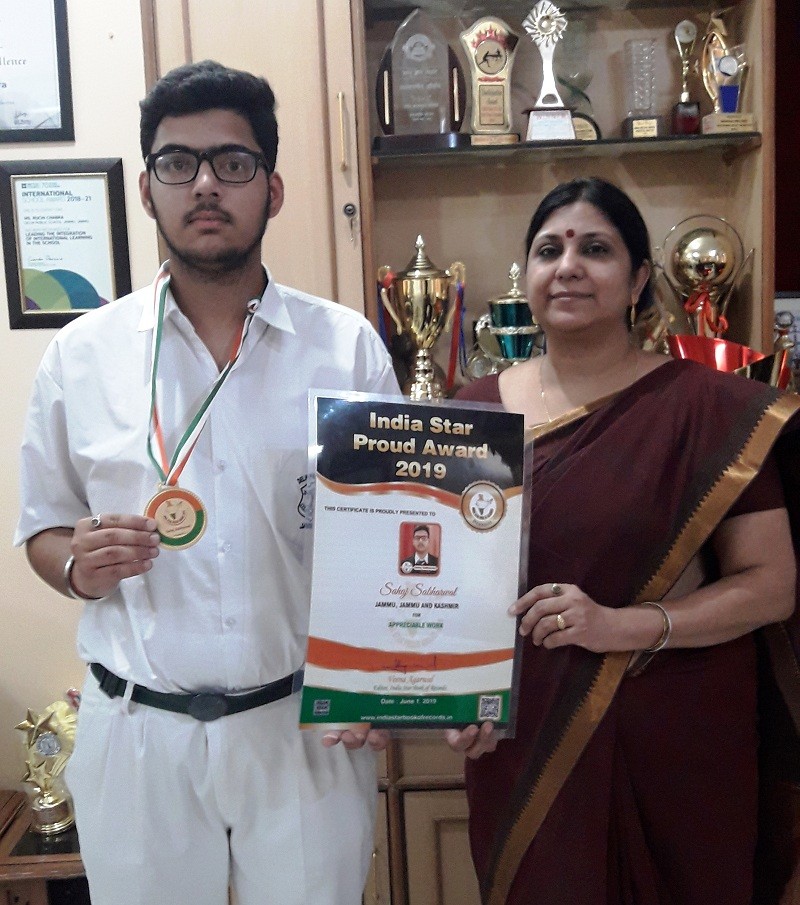
SAHAJ SABHARWAL OF DPS JAMMU WINS STAR PROUD AWARD-2019

Sahaj Sabharwal (XII-B), a budding poet from Delhi Public School, Jammu
brought laurels to the school and his parents by winning ‘Star Proud
Award-2019 for his appreciable work in Poetry and Literature. The
competition was held online on 1st June, 2019 where millions of people
across the country took part. Further, 100 people were selected for the
final event in which Sahaj was awarded ‘Star Proud Award-2019’. 
He was
also facilitated with an appreciation certificate and a medal.  He was
also selected to be invited for the International Writers Meeting to be
held in Tarija, Bolivia and Hungary. He was awarded with the
International Diploma in writing and International Merit Certificate in
writing and was published by the Young Writers Association in UK and
received Certificate of Publication from UK. Principal, DPS Jammu, Ms.
Ruchi Chabra congratulated Sahaj and his parents for the achievement.
She also blessed him for the future events. Hon’ble President, RCT, Sh.
Sh. M.K Ajatshatru Singh Ji, Hon’ble PVC, Kunwrani Ritu Singh Ji and
Hon’ble Director, Sh. S.S Sodhi Ji extended their best wishes to Sahaj
and his parents.

Top 25 University of Arts And Humanities in world – EduINDEX Ranking 2019

List of Top 25 University of Arts And Humanities in world – EduINDEX Ranking 2019

1. University of Oxford
2. Harvard University
3. University of Cambridge
4. University of California, Berkeley (UCB)
5. Stanford University
6. Yale University
7. Princeton University
8. Columbia University
9. University of California, Los Angeles (UCLA)
10. New York University (NYU)
11. University of Chicago
12. The University of Tokyo
13. The University of Edinburgh
14. National University of Singapore (NUS)
15. UCL (University College London)
16. The Australian National University
17. Massachusetts Institute of Technology (MIT)
18. The University of Hong Kong
19. University of Toronto
20. The University of Melbourne
21. Humboldt-Universität zu Berlin
22. London School of Economics and Political Science (LSE)
23. The University of Sydney
24. Freie Universitaet Berlin
25. University of British Columbia

Jammu and Kashmir HC Upholds PM’s Employment Package (2009) ForKashmiri Pandits Living In The Valley

There can be no two views that in a landmark, latest and laudable judgment delivered by the Jammu and Kashmir High Court in Kashmiri Sikh Community and others v. State of J&K and others in OWP no. 2048/2017 just recently on February 14, 2019, it has very rightly upheld PM’s Employment Package (2009) for Kashmiri Pandits living in the Valley.  Every Indian must salute the heroic determination of all those Kashmiri Pandits who did not flee the Valley despite all round pressure on them and terrorists breathing down their neck since such a long time from 1990s onwards! No doubt, the Jammu and Kashmir High Court has very rightly turned down the plea challenging special dispensation in the matter of employment given in favour of Kashmiri Pandits living in Kashmir Valley for which it must be applauded and appreciated in no uncertain terms.
Jammu and Kashmir HC Upholds PM’s Employment Package (2009) For Kashmiri Pandits Living In The Valley
                            First and foremost, this commendable and noteworthy judgment delivered by Justice Sanjeev Kumar of Jammu and Kashmir High Court sets the ball rolling in para 1 by bringing out that, “The petitioner no. 1 claims to be a body of Kashmiri Sikhs, represented by one Shri Santpal Singh, resident of Aloochi Bagh, Srinagar. The petitioners 2 & 3 claim to be the unemployed Kashmiri Sikh youth. The petitioners are aggrieved of special dispensation in the matter of employment given in favour of Kashmiri Pandits, living in Kashmir Valley, by amending J&K Migrants (Special Drive) Recruitment Rules 2009 (for short “Rules of 2009”) in terms of SRO 425 dated 10th October 2017. They are also aggrieved by the subsequent Government Order, issued by respondent no. 1, bearing no. 96-DMRR&R of 2017 dated 13th November 2017. It is asserted that SRO425 dated 10th October 2017, whereby the Rules of 2009 have been amended violates the equality clause, bedrock of Articles 14 and 16 of the Constitution, by treating the Sikh Community staying in Kashmir Valley differently than the similarly placed Kashmiri Pandits, for the purposes of extending the Prime Minister’s Employment Package. In essence, the petitioners seek mandamus to respondents to treat them at par with Kashmiri Pandits, staying in Valley, for the purposes of providing the employment pursuant to the Prime Minister’s Package of Return and Rehabilitation.”
                                        Of course, it is then pointed out in para 2 that, “Before adverting to the grounds of challenge urged in support of the claim made in the writ petition, it would be pertinent to briefly narrate the factual background leading to issuance of the impugned SRO.”
                  In hindsight, it is then brought out in para 3 that, “It is a historical known fact that during the year 1990, there was a sudden spurt of militancy and terrorism in Kashmir Valley. There were stray instances of target killings of minority community (Kashmiri Pandits) and political workers. This led to scare in the minds of such people who feared for their life and honour in the wake of happenings which were taking place at the relevant point of time. The happenings created a sort of fear of psychosis and instilled strong sense of insecurity in the mind of aforesaid community. In the result, the Nation witnessed large scale exodus of Kashmiri Pandits along with the political workers from Kashmir Valley. This was unprecedented situation witnessed by the Nation. The condition in the Valley at the relevant point was such that no authority of the State could prevent such mass exodus. There are different versions on the reasons for such mass exodus of a particular community. Different political parties hold different views. The Court may not be concerned as to what were actual reasons of the mass exodus of Kashmiri Pandits from Kashmir Valley but at the same time is not oblivious to the plight and miseries that befell on these migrants. They had to leave their home and hearth and settle in camps in Jammu, New Delhi and various other places of the country, where they felt sense of security.”
                                 It cannot be lost on us that it is then further noted in para 4 that, “There can be no dispute that sufferings of all these Kashmiri Migrants, who had to leave their home and hearth in peculiar law and order situation in the State, were of high magnitude. The Government of India as also the Governments of various States came up with different measures of rehabilitation and provided relief and succor to these families by all possible means. Despite all efforts made by the Government of India at its level, there was no discernible improvement in the living standard of this migrant community. This led the Government of India to come up with a comprehensive package and policy of relief and rehabilitation in the year 2008. This package/policy was first announced by the then Prime Minister during his visit to the State on April 25-26, 2008. The package was meant to ameliorate the lot of Kashmiri Pandit Community, who had been forced to migrate from Kashmir Valley and to facilitate their return and rehabilitation. Apart from other incentives contained in the package formally announced in June 2008, it was also decided to provide the jobs to the educated among migrant youth in the State Government services and financial assistance (grant of loans to unemployed to help them engage in self-employment through vocational training. Accordingly, 3000 supernumerary posts were created in various Departments for providing employment to migrant youth who were willing to return and serve in Kashmir Valley. With a view to filling up these posts and providing employment exclusively to the unemployed youth from amongst the migrants, the Government came up with the Rules of 2009, which were notified by the Government vide SRO 412 dated 30th December 2009. These Rules, as is apparent from their recital, are statutory rules framed by the Governor under proviso to Section 124 of the Constitution of J&K. The supernumerary posts created under the Prime Minister’s package were, accordingly, filled up under the aforesaid Rules and the employment to several migrant youth, came to be provided.”         
                                   Going ahead, it is then elaborated in detail in para 5 stating that, “It appears that despite all efforts made by the Central Government and issuance of the employment package under the name of the Prime Minister’s package for relief and rehabilitation of Kashmiri Migrants, the things did not improve at the desired pace. This led the Government of India to do rethinking on the matter. With a view to going deep into the living conditions of the Kashmiri Migrants and to suggest better means and ways to improve upon their living standards, a Joint Parliamentary Committee was constituted, which submitted its 137th report on the rehabilitation of J&K Migrants. Apart from the general suggestions, various measures for improving the pitiable condition of migrants were suggested. The Committee, in its observations/conclusions/recommendations at serial no. 4.2, expressed its deep concern over the pathetic condition of about 4000 Kashmiri Pandits, living in Kashmir Valley. The Committee felt that there should be special budgetary provision for Kashmiri Pandits left behind in the Valley for fulfilling their genuine needs of the housing, employment/self-employment, for improving their living conditions. Subsequently, the Parliamentary Standing Committee of Home Affairs submitted its 179th report on the action taken by the Government on the recommendations/observations contained in 137th Report on rehabilitation of the J&K Migrants. The report elaborately deals with the action on different aspects but with regard to the condition of Kashmiri Pandits living in the Valley. The Parliamentary Committee in paragraph 2.1.21 observed that a large number of Kashmiri Pandit families were living in Kashmir Valley in a pathetic condition. A  number of such families living in the Valley, was pegged at 600. The Committee, thus, recommended that courage of such Kashmiri Pandit families, who continued to reside in the Valley despite the adverse conditions, needed to be appreciated and they should be provided appropriate security and other facilities as may be required. It appears that in light of the report of the Parliamentary Standing Committee on the rehabilitation of Kashmiri Migrants and also taking note of pathetic condition of Kashmir Pandit community, which had decided not to migrate because of many reasons as also to extend the Prime Minister’s Package of Return and Rehabilitation, the Government of India sanctioned additional 3000 government jobs for Kashmir Migrants vide its communication dated 4th December 2015. This package of employment was meant for all Kashmiri Migrants and the category of Kashmiri Pandits, who had not migrated from the Kashmir Valley during the terrorist violence, was first time included for the benefit of the aforesaid employment package. As is apparent from the aforesaid communication, the Government of India desired that while providing the jobs to the Kashmiri Pandit families under the package, preferably the formula of one job per family be adopted. This sanction of the additional package of employment prompted the Kashmiri Pandits residing in the Valley to approach this Court by way of OWP no. 1986/2013 titled Kashmiri Pandit Sangarsh Samiti and others v. Union of India and others. The petition was essentially filed to implement the package of incentive particularly in part pertaining to the benefit of jobs to be given to the Kashmiri Pandit families on the formula of one job per family. The petition was disposed of by this Court on 31st May 2016, with a direction to the respondents to consider the claim of the petitioners therein in accordance with the rules. The decision was directed to be taken within a period of six weeks from the date of receipt of copy of the order. It appears that the State Government did not move in the matter, which made the petitioners in the aforesaid petition to file a contempt petition, seeking implementation of the directions passed on 31st May 2016. The notice in the contempt appears to have waken the State from its slumber, which immediately came up with Government Order no. 58-DMRR&R of 2017 dated 29th July 2017, and created 3000 supernumerary posts in different departments. Since in the revised package of the employment and rehabilitation issued by the Government of India, the Kashmiri Pandit families residing in the Valley who had not migrated in the wake of onslaught of militancy in 1990, had also been included for the benefits, it was necessary for the Government to amend the Rules of 2009. It may be noted that under the Rules of 2009, as they then stood, the employment package was meant for all migrants, who had fled from the Valley leaving their home and hearth for settlement in safer places irrespective of their caste, community or religion. These migrants include the internally displaced persons as well, but this package of employment under Rules of 2009 was not available to the Kashmiri Pandit community, which had decided to stay back in the Valley despite the prevailing adverse security scenario and despite the fact that there was large scale exodus of their community from the Valley in the year 1990. The State Government, after going through the formal procedure, ultimately amended the rules of 2009 vide SRO 425 of 2017 dated 10th October 2017 and included such Kashmiri Pandit families also for the benefit under the Rules of 2009. Since the Government of India, while sanctioning the additional 3000 supernumerary posts, had indicated that for the purposes of providing the employment to Kashmiri Pandit families, preferably the formula of one job per family, should be adopted, as such, the State Government decided to set apart 500 posts for Kashmiri Pandit families to be filled up by a different committee, constituted vide Government Order no. 96-DMRR&R of 2017 dated 13th November 2017. A separate committee was necessitated as these posts could not have been filled up through J&K Services Selection Board, which is enjoined to make the selection on the basis of merit. It is worthwhile to notice that the State Government, instead of effecting appropriate amendment in the Rules of 2009, did so by executive fiat.”     
                                        In essence, it is then aptly stated in para 6 that, “From the sequence of events given hereinabove, it is clear that the amendment impugned has enured to the benefit of a particular community, i.e. Kashmiri Pandit community, which stayed back in the Valley despite adverse conditions. It does not make any provision for the petitioners’ community, which claims to have suffered in the similar manner and which like the Kashmiri Pandit families also decided to stay back and did not migrate from the Valley. This deprivation appears to have led to heartburning in the petitioners’ community. The petitioners feel that the State has ventured into class legislation and has treated persons in the same class differently. They claim that the similar benefit needs to be extended to them and the Rules of 2009 as amended vide SRO impugned are ultra vires the Constitution. It is in this background that the instant petition has been filed by the members of the Sikh community living in the Valley.”  
                      As a consequence, it is then pointed out in para 7 that, “The respondents have filed their reply and have explained the reasons for coming up with the special package of employment in favour of Kashmiri Pandit families staying in the Valley. Referring to some empirical data which respondents claim was analysed before grant of the package of employment to Kashmiri Pandit families, it is pleaded that the two communities, i.e. Kashmiri Pandits and Sikhs living in the Valley do not form the same class and, therefore, classification made by the respondents for providing the benefit of employment to one person per family to the Kashmiri Pandits living in the Valley is a valid classification and meets the requirement of Article 14 and 16 of the Constitution.”
                             More importantly, it is then pointed out in para 8 that, “Kashmiri Pandits living in the Valley too have intervened in the matter and have filed a separate set of objections raising several issues with regard to maintainability of the petition. In short, they too have sought to justify the classification made by the respondents for the purposes of employment on the formula of one job per family to the Kashmiri Pandit families living in the Valley. In their objections they have relied upon the Parliamentary Standing Committee reports and other material to demonstrate that Kashmiri Pandit community which decided against migration and stayed back due to various reasons viz. economical, security or the assurances by the community in the neighbourhood etc, have suffered more than those who migrated from the Valley. The Parliamentary Standing Committee, which went deep into the matter has clearly highlighted the pitiable and pathetic condition of the Kashmiri Pandit community living in the Valley. It is, thus, pleaded that the decision to extend the special benefit of employment to the Kashmiri Pandit community was on the basis of the empirical data collected by the Government with regard to the living conditions of the Kashmiri Pandit community living in the Valley. It is, thus, pleaded that looking to the empirical data, it cannot be said that the Sikh Community, which stayed in the Valley and did not migrate, suffered in the same manner.”
                                        Having said this, let us now turn to para 23. It states that, “From reading of Rules of 2009, in their entirety, it is abundantly clear that the posts specially created from time to time in the Valley under the Prime Minister’s Special Package are meant to be filled up from ‘Migrants’ as defined in Rule 2(d). From the definition of migrant given in the Rules, it is evident that the benefit envisaged under the Rules is available to all migrants fulfilling the three conditions enumerated herein above irrespective of their caste, community or religion. The Rules of 2009 treats all migrants as a class and do not make any discrimination on any ground whatsoever.”
                                 Be it noted, what cannot be missed out here is that it is then added in para 24 stipulating that, “However, the amendment incorporated in the Rules of 2009, vide SRO 425 dated 10th October 2017, introduces a class of Kashmiri Pandits, who have not migrated from Kashmir Valley after 1st of November 1989, and are presently residing in Kashmir Valley. The Rules of 2009, which prior to amendment were called J&K Kashmiri Migrants (Special Drive) Recruitment Rules, 2009, now after amendment would be known as J&K Kashmiri Migrants or Kashmiri Pandits (Special Drive) Recruitment Rules 2009. The expression “Kashmiri Pandits” has been defined by inserting Clause (ca) after Clause © of Rule 2. Similarly, other necessary amendments have been made to give effect to the intendment of the amendment, which is to confer the similar benefit of the package of employment on Kashmiri Pandit community, who did not migrate during turmoil of 1989-90 and decided to stay back in the Valley. Interestingly, SRO 425 of 2017 does not make any amendment to the definition of post given in Rule 2 (c), which when read with Rule 3 would mean that amended Rules would apply to the posts which are sanctioned from time to time in the Valley under the Special Package for return and rehabilitation of Kashmiri Migrants to the Valley, issued by the Prime Minister. It would also mean that the posts becoming available on account of supernumerary creation under the Prime Minister’s Special Package cannot be filled up otherwise than in accordance with the Rules of 2009 as amended vide SRO 425 of 2017.”    
                                Enumerating on the various reasons why Kashmiri Pandits who did not migrate from Kashmir were given reservation, para 25 then goes on to elaborate stating rightly that, “From careful reading of the Rules of 2009 and amendments carried thereto vide SRO impugned in this petition, it is abundantly clear that a class different from the migrants has been created for conferring the benefit of the Prime Minister’s Package for return and rehabilitation of Kashmiri Migrants. The class identified under the impugned SRO is a community of Kashmiri Pandits, who did not migrate in the wake of turmoil in the Valley and stayed back despite adverse conditions perceivably prevailing for their community. This classification has been necessitated pursuant to the several representations received for and on behalf of this community, which was living in a very pitiable and pathetic condition in the Valley. The Government of India also took note of the fact that these handful families had not migrated due to reasons of their poverty, economic conditions, a sense of security instilled in them by their supporting neighbourhood, etcetera, etcetera. They stayed back and braved the adverse conditions in the Valley, which seriously impacted growth of their families educationally and economically. Taking note of their plight and the persistent pitiable conditions, a policy decision was taken to confer the benefit of the Prime Minister’s Package of return and rehabilitation on this community as well. As noted above, this was not a hollow exercise by the Government of India. Not only it collected the relevant empirical data but also appointed a Standing Parliamentary Committee to go into all these aspects and make their recommendations. As is averred by the respondents in their affidavit that as per the records available with the Relief and Rehabilitation Commissioner (Migrant), Jammu, there are 15700 Hindu Relief families and 22062 Hindu Non-Relief families, consisting of 49859 souls and 82740 souls respectively. Besides there are 1336 Relief Sikh families and 353 Non-Relief Sikh families consisting of 5043 souls and 1502 souls respectively registered with the Relief Organisation. In the light of the aforesaid data placed on record, the respondents have pleaded that the effect of migration in the wake of turmoil in the Valley was more on the Kashmiri Pandit community than other communities. It is though conceded that handful of Sikh families too migrated from the Valley but majority decided to stay back and has been residing peacefully. It is on the basis of this empirical data and the recommendations of the Parliamentary Standing Committee constituted for the purpose that the Government appears to have taken a policy decision to extend some helping hand to this distressed Kashmiri Pandit community.”  
                                    Needless to say, para 25 makes it abundantly clear why Kashmiri Pandits who did not migrate from Kashmir Valley were given reservations. It also specifies why Sikhs were not given reservation. This was because majority of them did not migrate from Kashmir as opposed to majority of Kashmiri Pandits who had migrated from the Kashmir Valley! The stand taken by the Government was a well thought out decision which has to be appreciated and applauded! No wonder that Jammu and Kashmir High Court too endorsed it!
                                        Viewed from this perspective, there can be no gainsaying that para 26 then further goes on to explain stating that, “From the aforesaid discussion and in view of the stand taken by the respondents, it cannot be said that the Sikh Community is similarly placed with the Kashmiri Pandits. There appears to be intelligible differentia, which distinguishes Kashmiri Pandits, who have stayed back in the Valley and did not migrate when lakhs of their community members left their home and hearth in view of the then prevailing security scenario in the Valley. The classification clearly distinguishes Kashmiri Pandit community from Sikh Community living in the Valley, which has been left out of group. The classification based on intelligible differentia has a definite nexus with the object sought to be achieved by the Rules of 2009 as amended vide impugned SRO, and is meant to ameliorate the lot of Kashmiri Pandits who preferred to stay back and did not flee despite unsavoury security conditions in the Valley in the year 1989-90. The target killings of members of their community instilled sense of fear and insecurity in their minds, which made their living in the Valley possible only at the cost of their lives. This sense of insecurity was all pervasive. In the milieu, there were certain families who decided not to migrate either because they were poverty ridden or did not have resources to move out or that they were assured by the community in their neighbourhood not to be afraid of. Whatever be the reasons, they decided to stay back but suffered due to unsavoury and not too good conditions in the Valley for the community. As per 137th report of the Standing Parliamentary Committee, their condition continued to worsen. They lacked behind in education and fared very bad on the economic front. Taking into account all these factors and the historical background responsible for en masse exodus of the community, the Central Government decided to provide some relief and succor to these families of Kashmiri Pandits. It is in this background that a policy decision was taken by the Government to treat these families of Kashmiri Pandits, staying in the Valley, at par with the migrants for the purposes of providing the employment package. This necessitated the amendment in the Rules of 2009, so as to include Kashmiri Pandits, staying in the Valley, also as beneficiary of the Prime Minister’s Package for return and rehabilitation of Kashmiri Migrants, issued from time to time.”
                        It is then underscored in this same para 26 that, “Viewed thus, it cannot be said, by any stretch of imagination or reasoning, that the classification made by the impugned SRO is not based on intelligible differentia or that differentia has no nexus with the object sought to be achieved. If the object of the Rules of 2009 is return and rehabilitation of migrants, it would make no sense if the same does not provide for rehabilitation of those who have not fled from the Valley despite adverse conditions and have stayed back.”
                                  Not stopping here, it is then held in para 27 that, “In view of the foregoing discussion, I find that the impugned SRO does not amount to class legislation but makes a valid classification which is permissible under Article 14 and 16 of the Constitution.” 
                                      It would be imperative to mention here that para 33 then envisages that, “Going by the aforesaid considerations, the respondents have carved out the classification on the parameters of data as well as the recommendation of Parliamentary Standing Committee. Such a decision is based on policy considerations. It cannot be said that this decision is manifestly arbitrary or unreasonable. It is settled law that policy decisions of the Executive are best left to it and a court cannot be propelled into the unchartered ocean of Government policy. [See: Bennett Coleman & Co. v. Union of India, 1972 (2) SCC 788]. Public authorities must have liberty and freedom in framing the policies. It is well accepted principle that in complex social, economic and commercial matters, decisions have to be taken by governmental authorities keeping in view the several factors and it is not possible for the Courts to consider the competing claims and to conclude which way the balance tilts. The Courts are ill-equipped to substitute their decisions. It is not within the realm of the Courts to go into the issue as to whether there could have been a better policy and on that parameters direct the Executive to formulate, change, vary and/or modify the policy which appears better to the Court. Such an exercise is impermissible in policy matters. The scope of judicial review is very limited in such matters. It is only when a particular policy decision is found to be against a Statute or it offends any of the provisions of the Constitution or it is manifestly arbitrary, capricious or mala fide, the Court would interfere with such policy decisions. No such case is made out. On the contrary, views of the petitioners have not only been considered but accommodated to the extent possible and permissible.”
                                      What’s more, it is then clarified in para 34 that, “The Court cannot sit in judgment over the wisdom of the policy evolved by the Legislature and the subordinate regulation-making body. It may be a wise policy which will fully effectuate the purpose of the enactment or it may be lacking in effectiveness and hence calling for revision and improvement. But any drawbacks in the policy incorporated in a rule or regulation will not render it ultra vires and the Court cannot strike it down on the ground that in its opinion, it is not a wise or prudent policy, but is even a foolish one, and that it will not really serve to effectuate the purposes of the Act. The Legislature and its delegate are the sole repositories of the power to decide what policy should be pursued in relation to matters covered by the Act and there is no scope for interference by the Court unless the particular provision impugned before it can be said to suffer from any legal infirmity, in the sense of its being wholly beyond the scope of the regulation-making power or its being inconsistent with any of the provisions of the parent enactment or in violation of any of the limitation imposed by this Constitution. Reference in this regard may be made to Maharashtra State Board of Writ Secondary Education v. Paritosh Bhupeshkumar Sheth, 1984 (4) SCC 27; and Federation Haj PTOs of India v. Union of India, 2019 SCC Online SC 119.”     
                                  To be sure, it is then reiterated in para 35 that, “I have already elaborately discussed all the aspects in detail herein above and reaffirm that the impugned SRO only makes a valid classification which falls within the scope and purview of Articles 14 and 16 of the Constitution of India. The impugned SRO is affirmative action and a policy decision on the part of the State to bring a particular community, staying in the Valley under peculiar circumstances, at par with their counterparts, so that they could compete and avail of the employment opportunities after they are brought in a position to compete with them. Having said that, I hold the amendment to the Rules of 2009 intra vires the Constitution.”
                                 Continuing in the same vein, it is then brought out in detail in para 36 that, “This brings me to the second question, which pertains to the competence of the Government to set apart 500 posts out of 3000 supernumerary posts created by the Government under the Prime Minister’s Package for return and rehabilitation of Kashmiri Migrants. Although the issue was not well articulated and debated by the parties before this Court, yet while going through the records and appreciating their contentions, I have reached a conclusion that filling up of the posts as defined in Rule 2 (e) of the Rules of 2009 as amended vide impugned SRO, which are sanctioned by the State from time to time under the Prime Minister’s package for return and rehabilitation of Kashmiri Migrants, is regulated by the Rules of 2009, which are statutory in character, having been issued by the Governor in exercise of the powers conferred by proviso to Section 124 of the Constitution of J&K. The SRO, as amended, makes a provision for Kashmiri Pandit community by treating them at par with the migrants and, therefore, takes care of their rehabilitation. It is equally true that the implementation of the Rules of 2009 as amended would pose some difficulty in allocating one job per family for this community of Kashmiri Pandits, staying in the Valley. In this background, perhaps, it was advisable on the part of the Government to take out 500 posts out of the Package to be appropriated for achieving the aforesaid end but that could have been done by adopting proper process countenanced by law. Needless to say, that the Government Order can supplement, but cannot supplant the Statutory Rules and, therefore, without effecting appropriate amendment in the Rules and providing for a separate allocation of posts for Kashmiri Pandits, the respondents could not have set apart 500 posts to be filled up in the manner provided in the impugned Government order. If the Government Order impugned is allowed to stand, it would mean that not only Kashmiri Pandit community would be entitled to one job per family to be provided by the Government from out of 500 posts created under the Prime Minister’s Package and set apart for the purpose, but it would also entitle them to compete with other migrants for rest of 2500 posts under the Rules of 2009. I am sure this is not intended by the Government.”     
                                    Needless to add, it is then stated in para 37 that, “In view of the aforesaid, I do not find the impugned Government Order no. 96-DMRR&R of 2017 dated 13th November 2017 sustainable in law, for the same has the effect of modifying the Statutory Rules which is impermissible. All the posts created in pursuance to the Prime Minister’s Package for Return and Rehabilitation are required to be filled up as per the Rules of 2009 and in no other manner.”
                         Finally, it is then held in para 38 that, “In view of the aforesaid analysis, I find no merit in the petition so far as challenge to the vires of SRO 425 dated 10th October 2017 is concerned and the same is accordingly, rejected. However, the impugned Government Order no. 96-DMRR&R of 2017 dated 13th November 2017 is held unsustainable in law and is accordingly quashed. The respondents may proceed in the matter in accordance with law.”
                                   All said and done, it is a comforting, commendable and courageous decision which clearly takes into account the unpardonable trauma and innumerable sufferings faced by those Kashmiri Pandits who inspite of being subjected to repeated harassment still refused to shun their homes and courageously face the situation! This alone explains why it upheld PM’s Employment Package (2009) for Kashmiri Pandits living in the Valley! Very rightly so! A majority of Sikhs preferred to stay back in Kashmir Valley in 1989-90 and therefore the Jammu and Kashmir High Court very rightly refused to accord them the same position which was accorded to those hapless Kashmiri Pandits who decided not to leave the Kashmir Valley even though a majority of them decided to shift to other places!   
Sanjeev Sirohi, Advocate,
s/o Col BPS Sirohi,
A 82, Defence Enclave,
Sardhana Road, Kankerkhera,
Meerut – 250001, Uttar Pradesh. 

INDIA’S BEST ARCHITECTURE COLLEGES 2019 EduINDEX Ranking

1. Department of Architecture and Planning, Indian Institute of Technology Roorkee
2. Sir J J College of Architecture
3. Department of Architecture, Birla Institute of Technology Mesra
4. Faculty of Architecture, Manipal Institute of Technology
5. Faculty of Architecture & Ekistics, Jamia Millia Islamia
6. School of Planning and Architecture, Bhopal
7. School of Planning And Architecture, University of Mysore
8. Sushant School of Art and Architecture
9. School of Planning & Architecture Jawaharlal Nehru Architecture and Fine Arts University
10. BMS College of Architecture
11. R V College of Architecture
12. Amity Institute of Planning and Architecture
13. Aayojan School of Architecture
14. School of Architecture IPS Academy Indore
15. The Department of Architecture, Town and Regional Planning, Indian Institute of Engineering Science and Technology Shibpur
16. AAERT & SSB Faculty of Architecture, Sarvajanik College of Engineering & Technology
17. Faculty of Architecture & Planning, Integral University
18. Department of Architecture, Sathyabama Institute of Science & Technology (Deemed To Be University)
19. Rizvi College of Architecture
20. Amity School of Architecture and Planning
21. Axis Institute of Architecture
22. Guwahati College of Architecture
23. Priyadarshini Institute of Architecture & Design Studies
24. MBS School of Planning and Architecture
25. Institute of Design Education & Architectural Studies

Top 30 Medical Colleges in India 2019 EduINDEX Ranking

INDIA\’S BEST MEDICAL COLLEGES 2019 EduINDEX Ranking
1. All India Institute of Medical Sciences
2. Christian Medical College
3. Armed Forces Medical College
4. Maulana Azad Medical College
5. JIPMER
6. King George\’s Medical University
7. Institute of Medical Sciences, BHU
8. University College of Medical Sciences & GTB Hospital
9. Lady Hardinge Medical College
10. KEM Hospital and Seth GS Medical College
11. Grant Medical College
12. Kasturba Medical College
13. Vardhman Mahavir Medical College & Safdarjung Hospital
14. St John\’s Medical College
15. Sri Ramachandra Medical College and Research Institute (SRMC)
16. Government Medical College and Hospital
17. Lokmanya Tilak Municipal Medical College
18. Faculty of Medicine, Aligarh Muslim University
19. R.G. Kar Medical College & Hospital
20. Gandhi Medical College
21. Medical College and Hospital
22. MS Ramaiah Medical College
23. Dayanand Medical College & Hospital
24. Amrita Institute of Medical Science and Research Centre
25. Army College of Medical Sciences
26. Kasturba Medical College
27. Christian Medical College
28. K.S. Hegde Medical Academy
29. ERA\’s Lucknow Medical College
30. Sikkim Manipal Institute of Medical Sciences (SMIMS)

Top 30 LAW COLLEGES 2019 EduINDEX Ranking

INDIA\’S BEST LAW COLLEGES 2019
1. National Law School of India University
2. The WB National University of Juridical Sciences
3. Symbiosis Society\’s Law College
4. ILS Law College
5. Faculty of Law, Banaras Hindu University
6. Amity Law School
7. Faculty of Law, Aligarh Muslim University
8. Bharati Vidyapeeth\’s New Law College
9. Faculty of Law, Jamia Millia Islamia
10. Christ College of Law
11. Faculty of Law, University of Lucknow
12. Army Institute of Law
13. MS Ramaiah College of Law
14. Dr. B.R. Ambedkar College of Law
15. ICFAI Law School
16. Lloyd Law College
17. Institute of Law, Kurukshetra University
18. CMR Law School
19. KIIT School of Law
20. Indore Institute of Law
21. SDM Law College
22. V.M. Salgaocar College of Law
23. Faculty of Law , the ICFAI University (ICFAI Law School)
24. Bangalore Institute of Legal Studies
25. K.L.E. Society\’s Law College
26. School of Law, IMS Unison University
27. Manikchand Pahade Law College
28. ICFAI Law School
29. Law College Dehradun, Uttaranchal University
30. Bengal Law College

Top 30 Colleges for BBA in India 2019 EduINDEX Ranking

College of BBA in India 2019, EduINDEX Ranking

1. Anil Surendra Modi School of Commerce (ASMSOC), Narsee Monjee Institute of Management Studies University

2. Christ University

3. Presidency College

4. Loyola College

5. Mount Carmel College

6. KJ Somaiya College of Arts and Commerce

7. Amity School of Business

8. Symbiosis Institute of Computer Studies & Research (SICSR)

9. JD Birla Institute

10. S.R.M. Engineering College

 
11. Ethiraj College for Women 
12. Ness Wadia College
13. Maharaja Surajmal Institute Of Technology
14. Jagannath International Management School, Kalkaji
15. Kristu Jayanti College
16. Center for Management Studies, Jain University
17. Prestige Institute of Management Dewas
18. Goswami Ganesh Dutta Sanatan Dharma (GGDSD) College, Sector 32
19. M.S. Ramaiah College of Arts, Science and Commerce
20. Maris Stella College (Autonomous)
21. St. Xavier\’s College
22. ITS Mohan Nagar
23. DAV College
24. Doon Business School
25. Manav Rachna International Institute of Research and Studies
26. Sri Dharmasthala Manjunatheshwara College(Autonomous)
27. Chandigarh Business School of Administration
28. Institute of Business and Management, GLA University
29. St Aloysius College (Autonomous)
30. DAV Centenary College

Top 30 College for BCA in India 2019 EduINDEX Ranking

Top Colleges of BCA

1. Symbiosis Institute of Computer Studies & Research (SICSR)
2. Department of Computer Science, Christ University
3. Loyola College
4. Amity Institute of Information Technology
5. Kristu Jayanti College
6. Women\’s Christian College
7. St. Joseph\’s College
8. Stella Maris College
9. Presidency College
10. DAV College
11. Department of Computer Science, St. Xavier\’s College
12. The Oxford College of Science
13. Goswami Ganesh Dutta S.D. College
14. Maharaja Surajmal Institute Of Technology
15. ITS UG Institute, Mohan Nagar
16. Sri Ramakrishna College of Arts and Science
17. Faculty of Computer Applications & Information Technology, GLS University
18. MIT Arts, Commerce & Science College
19. Sri Dharmasthala Manjunatheshwara College(Autonomous)
20. St Aloysius College (Autonomous)
21. Ness Wadia College
22. School of Computer Science & IT, Jain University
23. Ethiraj College for Women
24. St Joseph\’s College (Autonomous)
25. Dev Samaj College For Women
26. St. Mira\’s College for Girls
27. Mehr Chand Mahajan DAV College for Women
28. Amity Institute of Information Technology
29. Sri Ramakrishna College of Arts and Science for Women
30. Maharani Laxmi Ammanni (MLA) College For Women

To 30 Hotel Management Colleges of India 2019 EduINDEX Ranking

INDIA\’S BEST HOTEL MANAGEMENT COLLEGES 2019
1. Institute of Hotel Management, Catering & Nutrition (IHM), Pusa
2. Welcomgroup Graduate School of Hotel Administration
3. Institute of Hotel Management, Catering Technology and Applied Nutrition (IHM)
4. Institute of Hotel Management, Catering Technology and Applied Nutrition (IHM)
5. Institute of Hotel Management, Catering Technology and Applied Nutrition (IHM)
6. Banarsidas Chandiwala Institute of Hotel Management & Catering Technology
7. Institute of Hotel Management, Catering Technology and Applied Nutrition (IHM)
8. Department of Hotel Management – Christ University
9. Army Institute of Hotel Management & Catering Technology (AIHMCT)
10. Institute of Hotel Management, Catering Technology and Applied Nutrition (IHM)
11. Institute of Hotel Management, Catering Technology and Applied Nutrition
12. Institute of Hotel Management Catering Technology & Applied Nutrition (IHM Gwalior)
13. Faculty of Hospitality Management And Catering Technology, M S Ramaiah University of Applied Sciences
14. School of Hospitality & Tourism Studies, D Y Patil University
15. Amity School of Hospitality
16. Institute of Hotel Management (IHM Gurdaspur)
17. AIMS Institutes
18. Amity School of Hospitality
19. Chitkara School of Hospitality
20. SRM Institute Of Hotel Management And Catering Technology
21. Chandigarh Institute of Hotel Management
22. School of Hotel Management & Catering Technology
23. Guru Nanak Institute of Hotel Management
24. Department of Hotel Management, T John College
25. MMICT & BM (Hotel Management)
26. The ICFAI University Sikkim
27. Oriental School of Hotel Management
28. All India Shri Shivaji Memorial Society\’s College of Hotel Management & Catering Technology
29. International Institute of Hotel Management
30. Sri Krishna Arts and Science College

Top 30 COMMERCE COLLEGES of India 2019 EduINDEX Ranking

INDIA’S BEST COMMERCE COLLEGES 2019
1. Shri Ram College of Commerce
2. Hindu College
3. Lady Shri Ram College for Women
4. Hansraj College
5. Department of Commerce, Christ (Deemed to be University)
6. Loyola College
7. Kirori Mal College
8. Madras Christian College
9. St. Joseph’s College of Commerce
10. Mithibai College of Arts
11. Atma Ram Sanatan Dharma College
12. KJ Somaiya College of Arts and Commerce
13. Daulat Ram College
14. Stella Maris College
15. Gargi College
16. Kristu Jayanti College
17. Deen Dayal Upadhyaya College
18. Goswami Ganesh Dutta Sanatan Dharma (GGDSD) College, Sector 32
19. Goenka College of Commerce and Business Administration
20. Sri Guru Gobind Singh College of Commerce
21. Presidency College
22. Mount Carmel College
23. Shivaji College
24. Maharaja Agrasen College (MAC)
25. Women’s Christian College
26. Sacred Heart College
27. Kishinchand Chellaram (KC) College of Arts, Science and Commerce
28. Symbiosis College Of Arts and Commerce
29. JD Birla Institute
30. Seshadripuram College