Art and Science of Teaching

Abstract

Teachers are the flag bearers of humanity. They spend their entire
lives making next-generation wiser and more productive to society. Demands from
the roles of teachers have been increasing with the growing vastness of the
subjects. Mere knowledge is not sufficient to be a good teacher. It is an art
to make the subjects lucid and interesting enough to get through the restless
younger generations; it is a science to keep the learning process more
objective and accurate. Teaching is perhaps the most perfect example of the
amalgamation of science and art into one.


Introduction

Our ability to think and process
information is what sets us apart from the monkeys. Humans are the only species
who have benefited from the number of years of their existence because they
accumulate knowledge and pass on to fellow human beings. We do not need to take
pain of learning to light fire or make wheels, because our forefathers did it
for us thousands of years back! And some of them took the responsibility of
teaching this skill to their next generation and the same has been being passed
on ever since. Unless there were responsible teachers in each generation, this
power of humanity would vanish.

Role of a Teacher

A teacher is the most important person
in our lives after our parents who kindles the life of others with his
knowledge and make them humane and productive. One cannot really learn things
without having a teacher in his life- formal or informal, but a teacher is must
to learn anything. Scriptures across the world sing of the praises of teachers.
In fact one Hindi proverb even goes to say that the teacher is even more
respectable than God himself.
Of course, the subjects to learn
have gotten more and more complicated over time. Early teachers like Aristotle and
Chanakya could have afforded to teach all the subjects ranging from political
science to philosophy to mathematics to science to economics. But now the
subjects have become much more complex. One person may really need to spend his
entire life to understand probably just one concept of one subject! Therefore,
the job and qualifications demanded of a teacher has become more complex.
A good teacher needs to have
sufficient professional or specialized knowledge in a particular subject. As Brad
Henry once said “A good teacher can inspire hope, ignite the imagination, and
instill a love of learning.

T
eachers need to accumulate knowledge and invest this in their students to
pave path of a good future to them with widen up thinking and absorbing ability
giving sense about the truth of life, and thus making them a more productive
member of society.
The teacher has to act as a
mediator between books and students and try to make ease their way of
understanding subjects.  He has to
encourage and build a friendly environment to facilitate learning, encourage
Q&A. He builds up a student confident enough to face the society, confident
enough to put their knowledge to test in the real world.
Therefore, behavioral training is
also a part of teaching that grows reciprocity and cooperation among students. The
teacher has to teach moral and ethical values to students.

Is teaching a science or an art?

Good teaching has
to blend emotions and feelings with objectivity of observations, measurements
and the precision of language. To make learning effective, the process has
to be interactive and objective. Without the use of the scientific method, the
learning may not have necessary impact. Therefore, it is essential to
scientifically proven processes like- discussions, active learning, distance
learning, and case studies, to facilitate learning.
But identifying
the correct set of tools to facilitate learning and perfect delivery of the
tool is actually an art. Creating a healthy environment is important for having
the desired impact of these techniques.
 Therefore good teaching is the perfect blend
for art and science.

Should I pay for additional Google One storage?

Best answer: If you use Google Drive for a home-based or small business, are a student, or have a hobby, such as photography, that requires a lot of online storage, then it’s best to bump up your storage space a bit. But the amount of free space you get with a basic account may be tapped out even if you use Google Drive for personal use, too, so go ahead and invest in some storage space and give yourself a safe buffer. Price vary depending on your country.

What you get with a basic account

A free Google Drive account gives you 15GB of online storage space. This is shared among all Google’s programs including Gmail, Docs and Photos. This means all the messages in your Gmail inbox, plus the files saved in Drive folders, chip away from that 15GB of space. For a lot of people, this is plenty of space to keep a few personal documents, photos, and email messages saved for later, but there are times when more space is definitely warranted, and even necessary.

Do you need more space?

One situation where more online space is needed is when using Google Drive to save a substantial number of digital images. If you sync your Google Drive to your phone’s camera, you can upload pictures taken with your camera to your Google Photo files, which is a great way to keep your images in one place and free up space on your devices.
However, because images are much larger than a document or email message files, they will gobble up 15GB pretty quickly. If you’re a photography junkie than you’ll definitely need some extra space. If you use photography for work, it’s probably even mandatory.
Google Drive storage
For students, especially college students, Google Drive is invaluable. It’s a great place to keep all your research notes, essays and projects together. This lets you reference old assignments, notes, and ideas throughout your college career. From Drive, you can also share editing access to teachers and study groups or submit finished homework from right within Drive. With four, or more, years of college, students need a good amount of space. Google offers several packages that fit within a student’s budget.
If you run a home-based business, whether you have an Etsy store or freelance, having more than 15GB of online storage is needed. With purchase orders, contracts, shipping tracking, price sheets, and invoices, plus all the messages coming through Gmail, a paid Drive account would be helpful. Google has several packages that make it easy to step up as your need and budget grows, so you don’t have to feel trapped with an expense that’s hard to pay while working on your bottom line.

Additional storage packages and pricing

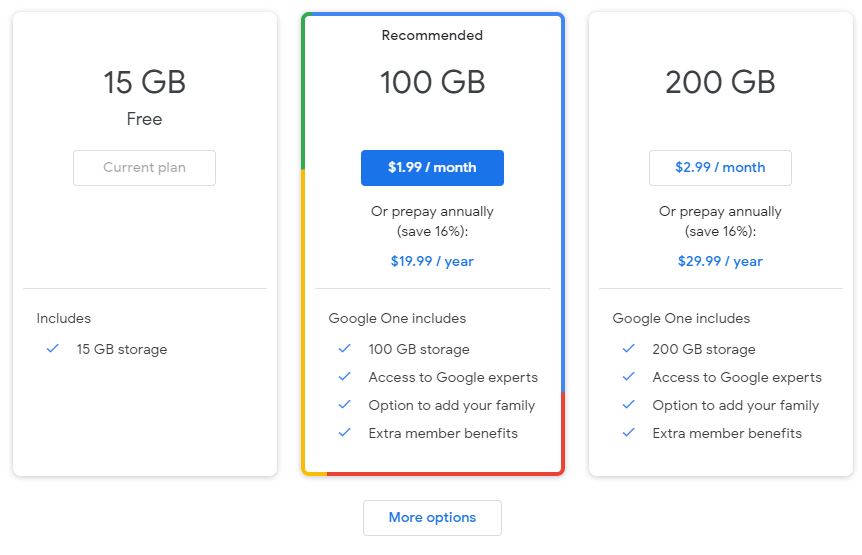
Google Drive has six different storage upgrade packages available ranging from 100GB to 30TB of space. Each one is paid through a monthly or yearly subscription, meaning you need to continue to pay the subscription so you don’t lose files saved beyond the 15GB of the basic, free plan.
Google recommends its 100GB tier for most people. Prices vary via country, but this costs $2 per month, or $20 a year, which is very reasonable for nearly 600% more storage. All Google’s paid plans let you add family members to your account so they, too, can use the storage space, and access Google Experts, specialty tech support personnel that will help you set up and maneuver through all that Google Drive has to offer. Paid Google Drive accounts also tap you into a few extra perks including Google Play and special hotel and travel rates.
Other packages available include 200GB for $3 per month and 2TB for $10 per month. For between $100 and $300 per month, you can pay for between 10TB and 30TB of space, although most people won’t need that much.

Jio Fiber Prepaid Plans starts from 699 – Know more here

Jio Fiber Prepaid Plans starts from 699 – Know more here

Jio Fiber broadband plans start at as low as Rs 699 for 100Mbps speed offering 100GB with additional 50GB data for 30 days period. To get the Jio Fiber broadband service, interested users will have to pay a one-time payment of Rs 2,500 which is the security deposit of Rs 2,500 and non-refundable installation of Rs 1,000.
Making the deal sweeter, Reliance Jio is offering Norton device security with all its broadband plans that cover up to 5 devices. For those unaware, the Norton security plan costs Rs 999 per year if purchased separately.
As part of Jio Fiber Welcome offer, Reliance Jio is bundling some offers on long term plans which is being marketed as Jio Forever annual plan. Under long term plans, customers opting for Rs 699 yearly plan will end up paying Rs 8,388 annually and will get 6W Bluetooth speaker worth Rs 2,999 for free. Similarly, Jio Fiber Gold annual plan worth Rs 31,176 will offer users a free HD TV with a 24-inch display worth Rs 12,990 for free.
Jio Fiber monthly prepaid tariffs:
Bronze pack starts at Rs 699 and offers 150GB data in total where 100GB is regular data quota that comes with the pack while 50GB is additional data. The Jio Fiber Bronze pack comes with other freebies as free voice calls anywhere in India via Jio landline, TV video calling or conferencing. As showcased at the Reliance AGM last month, the features will be rolled out soon to Jio Fiber users.
Silver broadband pack is priced at Rs 849 and offers 100Mbps speed. It provides 200GB data for 30 days; however, as welcome offer Jio is offering addition 200GB data for 30 days. It will also offer free voice calls across India. The Jio Fiber Silver pack users will have to pay Rs 1,200 per year for TV video calling and gaming experience as currently listed by Reliance Jio. We will update the story as and when we receive more details.
Gold pack worth Rs 1,299 offering 250Mbps speed and provides 500GB data alongside 250GB additional data for a month. It also comes with all the benefits that Silver pack users are getting.
Diamond pack is worth Rs 2,499 and offers 500Mbps speed with FUP of 1250GB for a month. Under the welcome offer, Jio is offering an additional 250GB every month for 30 days. It also comes with all the benefits.
Platinum pack comes at Rs 3,999 and offers 1Gbps speed. It comes with 2500GB data for a month.
Platinum pack comes at Rs 3,999 and offers 1Gbps speed. It comes with 2500GB data for a month. 

Titanium pack priced at Rs 8,499 for a month that offers 1Gbps speed with FUP of 5000GB data. 

Jio Welcome Offer

Reliance Jio has confirmed that every Jio Fiber user will get additional benefits on subscribing to Jio Forever annual plans. User can get Jio Home Gateway, Jio 4K set-top box, a Television (in Gold plan and above), and subscription to OTT apps. There are unlimited voice and data available with all  JioForever annual plans. Jio Fiber long-term plans will come with 3, 6 and 12-month plans that will offer higher value. “Through bank tie-ups, Jio will provide attractive EMI schemes, so customers get the benefits of annual plans by paying only monthly EMI,” the company says in a statement.

ISRO and Chandrayaan-2: Proud Moment of India

In 1962, India achieved a great place in the space-history of world when Indian Space Research Organisation, popularly known as (ISRO) was established with its headquarters at Bengaluru. It was established with the vision to “harness space technology for national development while pursuing space science research and planetary exploration”. ISRO was set up under the leadership of Dr. Vikram Sarabhai who is considered as the Father of the Space Programme. The principal objective of ISRO is to use space technology for the development of the country. He once told, “There are some who question the relevance of space activities in a developing nation. To us, there is no ambiguity of purpose. We do not have the fantasy of competing with the economically advanced nations in the exploration of the Moon or the planets or manned space-flight. But we are convinced that if we are to play a meaningful role nationally, and in the community of nations, we must be second to none in the application of advanced technologies to the real problems of man and society, which we find in our country. And we should note that the application of sophisticated technologies and methods of analysis to our problems is not to be confused with embarking on grandiose schemes, whose primary impact is for show rather than for progress measured in hard economic and social terms”. 

ISRO and Chandrayaan-2: Proud Moment of India
The former President of India, A. P. J. Abdul Kalam who was also associated with the ISRO, said, “Very many individuals with myopic vision questioned the relevance of space activities in a newly independent nation which was finding it difficult to feed its population. But neither Prime Minister Nehru nor Prof. Sarabhai had any ambiguity of purpose. Their vision was very clear: if Indians were to play meaningful role in the community of nations, they must be second to none in the application of advanced technologies to their real-life problems. They had no intention of using it merely as a means of displaying our might”.
From the quotations of above two eminent persons, it is evident that few persons in those days were not in favour of India’s space programme. Anyhow today India is a great name in the space programme. Dr. Sarabhai started a project for the fabrication and launch of an Indian satellite as a result, the first Indian satellite Aryabhata, was put in orbit in 1975 from a Russian cosmodrome. In 2008, India launched as many as eleven satellites, including nine foreign and went on to become the first nation to launch ten satellites on one rocket. 
One of the greatest achievements in present days is Chandrayaan-2 which is the second lunar exploration mission developed by the Indian Space Research Organisation (ISRO) after Chandrayaan-1. Chandrayaan-2 comprises of a lunar orbiter, the Vikram lander, and the Pragyan lunar rover, all of which have been developed in India. The main scientific objective is to map the location and abundance of lunar water via Pragyan, and on-going analysis from the orbiter circling at a lunar polar orbit of 100 × 100 kilometres. However, regarding the landing of Chandrayaan-2, Indians are aware about the issue but the recent news items reveal that the health of lander Vikram of Chandrayaan-2 is yet not fully ascertained (up to 10 September 2019), although it has been accurately located. 
All Indians are proud of Dr K. Sivan, the Chairperson of the Indian Space Research Organization (ISRO) and his team members for their excellent endeavour to take Chandrayaan-2 at the pinnacle.
Dr. Shankar Chatterjee
Former Professor& Head (CPME)
NIRD &PR, 
Hyderabad-500 030
Telangana, India 
Email <shankarjagu@gmail.com>

Government Notifies Strict Provisions Of Motor Vehicle (Amendment) Act 2019

It is most heartening to learn that as per an official release, the Government has notified 63 provisions of the Motor Vehicles Amendment Act 2019 including the ones dealing with enhanced penalties for various traffic offences. The new clauses would come into effect from September 1, 2019. The Ministry of Road Transport and Highways said in a statement that these are provisions which require no further amendments in the Central Motor Vehicles Rules 1989. The 63 clauses deal with various provisions like penalties, licences, registration and National Transport Policy among others. 
Needless to say, we earlier saw how Parliament passed the Motor Vehicles (Amendment) Bill. This Bill was introduced in Lok Sabha on July 15, 2019 by the Minister for Road Transport and Highways – Nitin Gadkari. The Lok Sabha had passed the Bill on July 23, 2019. The Rajya Sabha had passed the Bill on July 31, 2019. Earlier we saw how the legislation on this which was previously introduced in 2017 could not be passed in Rajya Sabha and lapsed with the dissolution of the 16th Lok Sabha 
As it turned out, the Bill was passed in Rajya Sabha with three key amendments and so it had to be sent back to the Lok Sabha for approval. The President gave his assent to the Bill on August 9, 2019. The Bill contains all such provisions that will ensure Indian roads are made more safer. Presently, we all know that India records maximum road accidents in the world and maximum people die in India from such accidents! Union Road Transport and Highways Minister Nitin Gadkari was candid enough to concede in Lok Sabha that more than 1.50 lakh people die and 5 lakh people injured annually in road accidents. 
Let us now briefly discuss some of the salient provisions of this Motor Vehicles (Amendment) Bill which has now become an Act after being passed by both Houses of Parliament. It will help us in understanding better what exactly the new law postulates to check road accidents. Some of the important salient provisions of this new law are as follows:- 
1. It makes Aadhaar mandatory for getting a driving licence and vehicle registration.
2. For deaths in hit-and-run cases, the government will provide an enhanced compensation under Section 161 of Rs 2 lakh or more to the victim’s family out of the scheme fund and Rs 50,000 in case of bodily injury. Presently, we see that the amount is just Rs 25,000 in case of death and Rs 12,500 in case of bodily injury. 
3. In traffic violations by juveniles, the guardians or owner of the vehicle would be held responsible unless they prove that the offence was committed without their knowledge or they tried to prevent it. A penalty of Rs 25,000 with 3 years imprisonment can be imposed under Section 199. The registration of the motor vehicle in question will be cancelled. The juvenile will be tried under the Juvenile Justice Act. The newly proposed Section 199A imposes liability on guardian or the owner of the vehicle responsible for an accident caused by the juvenile. 
4. It incorporates provisions for protection of good Samaritans. Those who come forward to help accident victims will be protected from civil or criminal liability. It will be optional to them to disclose their identity to the police or medical personnel. 
5. The minimum fine for drunk driving under Section 185 has been increased from Rs 2000 to Rs 10,000.
6. The fine for dangerous driving under Section 184 has been increased from Rs 1000 to Rs 5000.
7. Now driving without a licence under Section 181 will attract a minimum fine of Rs 5000 as against Rs 500 at present.
8. The fine for over-speeding under Section 183 will go up from Rs 400 at present to Rs1000 for LMV and Rs 2000 for Medium passenger vehicle.
9. Not wearing seatbelt would under Section 194B attract a fine of Rs 1000 as against Rs 100 at present.
10. Talking on mobile phone while driving would now attract a fine of Rs 5000 up from Rs 1000 at present.
11. A Motor Vehicle Accident Fund will provide compulsory insurance cover to all road users in India for certain types of accidents. This has been introduced under Section 164B which is to be augmented by a special tax or cess. The Fund is to be utilized for giving immediate relief to victims of motor accidents and also hit and run cases. The compensation paid out of this Fund shall be deductible from the compensation which the victim may get in future from the Tribunal.
12. It will be mandatory to alter vehicles to make them suitable for specially abled people.
13. Contractors, consultants and civic agencies will be accountable for faulty design, construction or poor maintenance of roads leading to accidents.
14. A time limit of six months has been specified for an application of compensation to the Claims Tribunal with regard to road accidents.
15. Now the cap on liability for third-party insurance has been removed. The 2016 Bill had capped the maximum liability at Rs 10 lakh in case of death and Rs 5 lakh in case of grievous injury.
16. The time limit for renewal of driving licence is increased from one month to one year before and after the expiry date.
17. The government can recall vehicles whose components or engine do not meet the required standards. Manufacturers can be fined up to Rs 500 crore in case of sub-standard components or engine.
18. The penalty for motor vehicles is proposed to be increased by 10 percent every year.
19. The new law now mandates the recall of defective motor vehicles if the defect may cause a threat to the environment, or the driver or other people on the road. In such a case, the recalled vehicle’s manufacturer will have to :
(i) Reimburse the vehicle owner the full cost of the vehicle.
(ii) Replace the defective vehicle with another vehicle of similar make. 
20. The new law now very rightly and commendably provides for the setting up of a National Road Safety Board by the Central Government as per Section 215D for advising on matters related to road safety. The National Road Safety Board will be now required to advise the Central and State Governments on all aspects of road safety and traffic management including registration and licensing of vehicles, standards of motor vehicles, standards for road safety and promotion of new vehicle technology.
21. Now the condition to undergo “driver refresher training course” for reviving license after suspension/revocation under Section 19, and also for compounding of traffic offences under Section 200 has been introduced. 
22. A provision has been suggested to regulate the licensing of cab aggregators, by amending Section 93 of the Act, and also by introducing definition of “aggregator” under Section 2(1A).
23. Through amendment to Section 200, punishment in the form of ‘Community Service’ can be imposed for traffic violations. The newly proposed Section 2(4A) defines ‘Community Service’ as unpaid work which a person is required to perform as a punishment for an offence committed under this Act. 
24. The newly proposed Section 198A imposes liability on contractor, concessionaire or designated authority when their failure to follow prescribed design and standards results in death or injury.
25. The amendment makes non-receipt of premium one of the specified conditions, which would enable the insurer to seek exoneration from the liability by virtue of new section proposed as Section 150 2(c). 
26. The newly proposed Section 88A empowers the Central Government to frame schemes for inter-state permits and make schemes for national, multi-nodal and inter-state transportation of goods or passengers. 
27. As per the present law we find that a claim for personal injury would abate on the death of the claimant, and would not survive to his estate, due to the operation of Section 306 of the Indian Succession Act. The claim would survive to the estate only if death had nexus with the injuries, and only in such cases the legal heirs would be entitled to come on record and continue with the prosecution of the claim. But the amendment cures that loophole by incorporation of a new sub-section, Section 166(5), with a non-obstante clause which stipulates that the right of a person to claim compensation for injury in an accident shall, upon the death of the person injured, survive to his legal representatives, irrespective of whether the cause of death is relatable to or had any nexus with the injury or not. 
28. The newly introduced Section 66A empowers the Central Government to develop a “National Transportation Policy”, for establishing a framework for grant of transport permits. The Section directs the Central Government to consult the State Governments before formulation of policy.
29. The penalty for violation under Section 177 was Rs 100 but now it has been raised to Rs 500.
30. The penalty for violation under new Section 177A pertaining to rules of road regulation has also been enhanced from Rs 100 to Rs 500.
31. The penalty for travelling without ticket under Section 178 has been raised from Rs 200 to Rs 500.
32. The penalty for disobedience of orders of authorities under Section 179 has been raised from Rs 500 to Rs 2000.
33. The penalty for unauthorized use of vehicles without licence under Section 180 has been raised from Rs 1000 to Rs 5000.
34. The penalty for driving despite disqualification under Section 182 has been increased from Rs 500 to Rs 10,000.
35. The penalty for oversize vehicles under Section 182B is Rs 5000.
36. Now for offences committed by enforcing authorities under Section 210B twice the penalty can be imposed under the relevant Section.
37. The power of officers to impound documents as stipulated in Section 206 provides for suspension of driving licenses under Sections 183, 184, 185, 189, 190, 194C, 194D and 194E.
38. Now the fine for driving without insurance under Section 196 has been increased from Rs 1000 to Rs 2000.
39. Now not providing way for emergency vehicles will be punished with fine of Rs 10,000 under Section 194E.
40. Now penalty for not wearing helmet has been increased from Rs 100 to Rs 1000 along with disqualification for 3 months for licence under Section 194D.
41. Now penalty for overloading of two wheelers has been raised from Rs 100 to Rs 2000 along with disqualification for 3 months for licence under Section 194C.
42. Now overloading which earlier under Section 194 was punishable with Rs 2000 and Rs 1000 per extra tonne will now be punishable with Rs 20,000 and Rs 2000 per extra tonne. 
43. Now overloading of passengers under Section 194A will be punished with Rs 1000 per extra passenger.
44. The penalty for vehicles without permit which earlier was upto Rs 5000 under Section 192A has now been enhanced upto Rs 10,000. 
45. The penalty for aggregators (violation of licencing conditions) under Section 193 will be ranging from Rs 25,000 to Rs 1,00,000.
To conclude, it is most heartening and most refreshing to learn that many new amendments have been made in the Motor Vehicles Act which was first enacted in 1988. They were necessary also as more than 31 years have flown under the bridge. We have discussed by and large all the important provisions under the new law. More stricter laws and more stricter penalties for violations of rules was the crying need of the hour. But enacting strict laws alone is just not enough. Implementing them with equal vigour is the real solution to increasing road accidents and this alone can help in containing this deadly malaise which is responsible for the maximum deaths in the whole world in our country alone! The violators must be taken to task and should not be let off lightly so that a loud and clear message goes to one and all that, “Be you ever so high, the law is above you. If you dare to violate the law, the long arms of law will catch you and you will not be able to smirk it by wielding your money power or muscle power or political power under any circumstances”! It goes without saying that only then will the people start respecting law truly in the real sense! 
Sanjeev Sirohi, Advocate,
s/o Col BPS Sirohi,
A 82, Defence Enclave,
Sardhana Road, Kankerkhera,
Meerut – 250001, Uttar Pradesh.

NDPS: Reverse Burden Of Proof Does Not Absolve Prosecution From Establishing Prima Facie Case Against Accused: SC

It must be mentioned right at the outset that in a significant development, the Supreme Court in a latest, landmark and extremely laudable judgment titled Hanif Khan @ Annu Khan Vs Central Bureau Of Narcotics Through Inspector L.P. Ojha in Criminal Appeal No(s). 1206 of 2013 delivered on August 20, 2019 has observed clearly and convincingly in no uncertain terms that, though Narcotics Drugs and Psychotropic Substances Act carries reverse burden of proof, it does not absolve the prosecution from establishing a prima facie case against the accused. The Bench of Apex Court comprising of Justice Navin Sinha and Justice Indira Banerjee was considering an appeal challenging conviction of an accused under Sections 8 and 18(b) of the NDPS Act sentencing him to 10 years rigorous imprisonment, along with fine of Rs. 1 lakh, with a default stipulation. The accused was ultimately acquitted as he was entitled to get the benefit of doubt.

NDPS: Reverse Burden Of Proof Does Not Absolve Prosecution From Establishing Prima Facie Case Against Accused: SC

To start with, it is first and foremost pointed out in the opening para of this notable judgment that, “The appellant is aggrieved by his conviction under Sections 8 and 18(b) of the Narcotics Drugs and Psychotropic Substances Act, 1985 (“the NDPS Act”) sentencing him to 10 years rigorous imprisonment along with fine of Rs. 1 lakh with a default stipulation.”

What follows next as described in next para of this noteworthy judgment is this: “Learned counsel for the appellant submits that the allegations were with regard to illegal sale/purchase between the appellant and the acquitted co-accused. No appeal has been filed against the acquittal. If the sale/purchase was not established, the conviction of the appellant alone is improper. It is next submitted that PW-1 and PW-2, the independent witnesses to the search and seizure have turned hostile and have denied their presence during such search and seizure.”

Moving on, it is then pointed out that, “Learned counsel further submits that the search and seizure memo itself is suspicious in view of the large gap in space between the signature of the appellant and that of the independent witnesses.”

What’s more, it is then pointed out in the next para that, “Relying on Narcotics Control Bureau vs. Sukh Dev Raj Sodhi (2011) 6 SCC 392, it is submitted that there has been non-compliance with Section 50 of the NDPS Act as the appellant was not informed of his legal right to be searched before a Magistrate. The entire allegations of recovery against the appellant are suspicious as even his father’s name has been recorded incorrectly.”

Going forward, it is then stated in the next para that, “The last submission was that there was an inordinately long delay of one year in production of the seized sample before the Court. PW-6 has not furnished any satisfactory explanation with regard to the same. The Trial Court has itself recorded its satisfaction with regard to the signatures on the seizure memo having become illegible. It creates a serious doubt as to whether the sample produced in court was the same as alleged to have been recovered from the appellant. The appellant has been seriously prejudiced in the trial for that singular reason apart from the other grounds urged. Reliance is placed on Vijay Pandey vs. State of Uttar Pradesh 2019 (10) SCALE.”

On the contrary, it is then pointed out in the next para that, “Learned counsel for the respondent submitted from the seizure memo, that Section 50 of the NDPS Act stands complied. The appellant was informed of his legal right to be searched in presence of a Magistrate if he so desired. He voluntarily consented to be searched by PW-5, the Sub-Inspector. The fact that there may be any gap between the signature of the appellant on the seizure memo, and the signature of the attesting witnesses, is not very relevant in view of the search and seizure conducted in accordance with the law and the consequent recovery. The acquittal of the co-accused was premised on the only material against him being the confession of the appellant.”

While continuing in the same vein, it is then pointed out in the next para that, “The sample taken from the seized material was sent the very next day to the Forensic Science Laboratory (“FSL”). There are no allegations of the seal on the sample being tampered. The laboratory test has confirmed the seized material to be Opium. Our attention was also invited to the original Malkhana Register, to demonstrate that the seized sample was deposited on the very same day. In the circumstances, it was submitted that no prejudice has been caused to the appellant even if the signatures on the seized sample had become illegible.”

To put things in perspective, the Apex Court Bench then holds in the next para that, “We have considered the submissions on behalf of the parties. The prosecution under the NDPS Act carries a reverse burden of proof with a culpable mental state of the accused. He is presumed to be guilty consequent to recovery of contraband from him, and it is for the accused to establish the normal rule of criminal jurisprudence that an accused is presumed to be innocent unless proved guilty. But that does not absolve the prosecution from establishing a prima facie case only whereafter the burden shifts to the accused. In Noor Aga v. State of Punjab, (2008) 16 SCC 417 it was observed as follows:

58. Sections 35 and 54 of the Act, no doubt raise presumptions with regard to the culpable mental state on the part of the accused as also place the burden of proof in this behalf on the accused; but a bare perusal of the said provision would clearly show that presumption would operate in the trial of the accused only in the event the circumstances contained therein are fully satisfied. An initial burden exists upon the prosecution and only when it stands satisfied, would the legal burden shift. Even then, the standard of proof required for the accused to prove his innocence is not as high as that of the prosecution. Whereas the standard of proof required to prove the guilt of the accused on the prosecution is “beyond all reasonable doubt” but it is “preponderance of probability” on the accused. If the prosecution fails to prove the foundational facts so as to attract the rigours of Section 35 of the Act, the actus reus which is possession of contraband by the accused cannot be said to have been established.”

Needless to say, it is then clarified in the next para that, “Because there is a reverse burden of proof, the prosecution shall be put to a stricter test for compliance with statutory provisions. If at any stage, the accused is able to create a reasonable doubt, as a part of his defence, to rebut the presumption of his guilt, the benefit will naturally have to go to him.”

As it turned out, the next para states that, “The contraband is stated to have been seized from the appellant on 28 December 2001. The Malkhana Register undoubtedly shows that the seized sample was deposited the same day. There is also no dispute with regard to the sample extracted and sent to the FSL for examination confirming that the contraband was Opium and that the seal had not been tampered with in any manner.”

Be it noted, it is then observed in the next para that, “The fact that the independent witnesses may have turned hostile is also not very relevant so long as they have admitted their signatures on the seizure memo. The seizure memo is also signed by the accused. There has been compliance with section 50 of the NDPS Act also, as the appellant was duly informed of his legal rights. But, considering the nature of the present prosecution under the NDPS Act, we are satisfied that the ground urged on behalf of the appellant with regard to the large vacant place below his signature and that of the independent witnesses, is clearly abnormal and cannot be lightly wished away especially when the independent witnesses have deposed that they were not present at the time of such search and seizure. It certainly creates a doubt with regard to the veracity of the allegation made by the prosecution.”

It would be imperative to mention here that it is then pointed out in the next para that, “The delay in the production of the seized sample coupled with the signature on the seal being illegible, to our mind creates a serious doubt with regard to the prosecution case. There is no credible evidence that the FSL sample produced related to the very same contraband stated to have been seized from the appellant. PW-6 in his cross examination, did not offer any reasonable explanation why the sample seized from the appellant and deposited in the Malkhana could not be produced in the Court except after a long gap of one year. His explanation that he had several important works can hardly be considered sufficient, if not, any justification for the same.”

As things stand, it is then envisaged in the next para that, “We have also examined the Malkhana Register from the Trial Court records. While there is an entry with regard to the deposit, Column 11 dealing with the exit from the Malkhana for taking it to the Court is blank. It may not be unreasonable to presume that the delay in production of the seized sample before the Court was occasioned due to lack of identification consequent to the signatures on the seized sample being illegible. Therefore what may have been produced in court cannot be held to be conclusively the same sample as seized from the appellant.”

Furthermore, the Bench then holds in the next para that, “Learned counsel for the respondent did make an effort to convince us that there will be a difference where the sample is never produced in Court as compared to a case where a sample is produced and an argument is made that it may not be the same sample especially when an FSL report has been made available in time, which causes no prejudice to the accused. We are unable to accept the submission.”

Suffice it to say, the Bench then observes in the next para that, “There can hardly be any difference between a case of non-production of a sample and the production of a sample doubtful in its identity in being co-related to what was seized from the accused. In both the cases, it will become doubtful if the FSL Report is with regard to the very sample seized from an accused.”

While rapping the High Court on its knuckles, the Bench of Apex Court then minced no words in pointing out that, “Unfortunately, the High Court did not advert to the evidence of PW-6 or consider the prejudice that may have been or may not been caused to the appellant by the doubtful identity of the sample stated to have been seized from him.”

It cannot be lost on us that it is then stated in the next para that, “In view of the law laid down by this Court in Vijay Jain vs. State of Madhya Pradesh (2013) 14 SCC 527 and Ashok alias Dangra Jaiswal vs. State of Madhya Pradesh (2011) 5 SCC 123, on the single premise of a doubtful identity with regard to the sample seized from the appellant and that produced in Court, the FSL Report loses much of its significance and the appellant is held entitled to the benefit of doubt.”

Finally, in the concluding paras, it is then held that, “The appeal deserves to be allowed. It is ordered accordingly. The appellant is stated to be on bail. His bail bonds shall stand discharged. Pending application(s), if any, shall stand disposed of.”

In conclusion, it must be said that this noteworthy judgment leaves no room of doubt in anyone’s mind that though Narcotics and Psychotropic Substances Act carries a reverse burden of proof, it does not absolve the prosecution from establishing a prima facie case against the accused. The Bench made it clear that if there arises a reasonable doubt at any stage and the accused is able to rebut the presumption of his guilt, the benefit will naturally have to go to him! Very rightly so! There can be no denying it also!

Sanjeev Sirohi, Advocate,

s/o Col BPS Sirohi,

A 82, Defence Enclave,

Sardhana Road, Kankerkhera,

Meerut – 250001, Uttar Pradesh.

Biodiversity and its Conservation

Introduction
Our
civilization has witnessed many evolution happening around the world. Many
things that have developed with passing time have helped man growing even
better. One of such development is communication through roadways, waterways
and airways. Among them the very common and chief source of communication is
roadways.  Roadways are the strip of the
lands where road passes or specifically intersects with each other.  And it main purpose is to connect human of
one places to another place.  But ever
since the development and commercialization of all natural sources has taken a
toll to the environment and its surroundings.
 In recent years, as part of a move to empower the communities
many resources has either vanished or are about to extinction. There is a need
to have serious efforts to delegate resource management and that can only be
the way to conserve the society and natural things around.

Impact of
industrialization
Soon after
World War 2, many of the western countries witnessed industrialization and
economic boom.  Henceforth, new product
merchandise is all we saw all around buy soon after that these companies
started witnessing economic stagnation in the late1970s. This is due to the
fact that product manufacturing is much greater than product consumption and
that leads to unemployment with inflammation in market and around.  In emerging republics, there was a weakening
in financial growth in the 1970s and 1980s partially as a consequence of a mix
of state-led economy, patriotism, dishonesty, politics, and populism. The inflation
enforced numerous states to look for novel financial systems. The neoliberalism
and other associated frugally liberal policies arose as a answer to the problematic
and brushed all over the world.
Chronic
exposure to air pollution and loud traffic has created a chaotic condition to
loud traffic and ill effect of noise pollution in many countries are second
only to those from dull air. According to World Health Organization (WHO) that
the ill-effects of noise pollution in such countries are second only to those
from dirty air and Long-term exposure can cause hormonal imbalances as well as
mental-health problems.
Need of
Biodiversity Conservation
The main
components that are responsible for production and altercation of the
environment are mainly carbon flora and fauna, countryside aesthetics and genetic
possessions and related information, and ecosystem services.
There have
been main policy leaflets secondary this method. The economics of ecosystems
and biodiversity and towards a green economy and the main commodities for
production and exchange there which have been major policy documents supporting
this approach. These documents among others, includes the economics of
ecosystems and biodiversity and towards a green economy.
Much
ecological impairment has been produced by the people behave selfishly. And
there is greater way of changing our financial replicas from being part of
these biodiversity endanger components.
Need to
protect bio diversity
Bio
diversity is inimitable but the loss and degradation of its quality has
fast-tracked to an exceptional level in much part of the worldwide. It has been
projected that the existing international extermination rate is numerous times
higher than the ordinary rate. In some parts of the world almost 40% mammals
are endangered and together 20% of birds and 45% of butterflies and reptiles
are on verge of extinction. There are many of the species and birds that have
either lost their lives or are about to die.  The Arctic fox and the red squirrel are all
under serious threat. Dealing with biodiversity loss makes economic sense and
Nature and biodiversity are important for our health and well-being.
How can people help in protecting bio
diversity conservation?
Need to
identify locations of critical wildlife habitat that are on risk and their life
is under threat. Need to maintain cleanliness and hygiene for better and
healthy environment. Save the air quality by keeping vehicles stop while not in
use. This will help to avoid air pollution and sound pollution. Leave native
plants undisturbed, and landscape using native trees and vegetation. Say no to
plastic as much as possible. Stop using packaged water drinking and many
aerated packing. Provide Wildlife Corridors and Connections Between Green
Spaces. Use organic material that can cut urea and use of excess chemical based
fertilizers that has its adverse effect on health and environment birth. Try
planting more herbs and eco-friendly shrubs in home and kitchen garden.

What Are The Latest Advancement In Gaming Technology?

The gaming industry has seen a magnificent
development in technology over the decade. There have been some technologies in
3D and AI from the beginning and then there are others which have been
introduced in the past few years. These recent years have been really great for
the gaming industry. 
 

The video games industry has been with us from
the 1980s and some amazing advances have made the future of gaming even better.
The more you think about it, the more the people are getting crazier outside.
40 years ago, the people were playing pong but now is the time of virtual and
augmented reality. This jump is enormous for a very small amount of time. This
advancement explains how many users are interested in playing games all around
the world. 
Addicting games has led to this sudden
and fast advancement in the world of gaming. It used to be a kid thing when the
idea of gaming was introduced. But now, even the adults are showing their
interest in playing games. The difference between the graphics of the games on
the 80s and the games of today is just phenomenal. Nowadays, games are made in
a way that they feel so real and close to the real world. 
This has all been possible due to various latest
advancements in gaming technology.
Here are some of the latest advancement in
gaming technology:
Virtual reality:
If you are a dedicated gamer and looking for a
fully immersive experience, then you must allow yourself to enjoy the VR (Virtual
Reality). This technology has made gamers to experience something which was not
at all possible before. Although Virtual reality has been with us for many
years, recently it has been more collaborative. It is not one of those
experiences now as it used to be when players had no idea about it. 
It is no longer an experience of isolation. This
technology has added more fun to the actual gaming experience. You become a
part of the game and this way you experience something which had never been
experienced by you. 
Augmented Reality:
Well, what take things one step further than the
Virtual reality? The answer is Augmented reality. It allows gamers to interact
with their environment in real-time. AR makes it possible that you can play the
game in your physical environment. For example, there are car games which
allows you to play the game on roads in the real environment while overcoming
the obstacles and people in it. There are shooting games as well which allows
you to shoot the target with your smartphone. The latest example of such a game
is Wizards unite, which allows the users to throw magic spells on the wizards
using the smartphones. 
The latest advancement in this technology is the
wearable UI that can need to eliminate the need to point the objects using a
device.  
Amazing graphics:
The world of gaming has come a long way as
compared to the days of basic 8-bit graphics. The cutting-edge advancements
have made it possible for the new gamers to experience the games in the
completely restored worlds with realistic textures. This makes you feel like
you are inside the game and experience something mind-blowing. 
You are going to feel what the character is
feeling at that point of time or might even become the character itself. All
this has been possible due to amazing and real-time graphics.

High- definition displays:
The graphics of the game indeed needs to be good,
but you need to have some genuine way to show them off. Nowadays, there are
TV’s with 4K capabilities which means that it supports at 4000 pixels. The
price of this technology has dropped eventually as more and more people have
been using it. 
These televisions are providing the unbeatable
crispness and colors that there else which can come close. 8K Television sets
have also captured the markets and are changing the world of image
quality. 
Mobile gaming:
Smartphones are now what has become a necessity.
With the advent of smartphone technology, the gaming experience has been out of
the living room and arcade and has been into your hands. People commuting
through trains and buses in the morning are seen playing games in the morning
on their smartphone devices. 
People are no-more sitting in their living room
and playing console games or online games but are enjoying the digital gaming
in their hands. 
Gesture control:
Do you want to play the first-person shooter
games with real experience? Well, with the advancement in gaming technology,
this is now even possible. Just with a wave of a hand, you can play the games.
The
two
player games
of tennis and other racing games can be played with this
technology. 
The gesture control allows you to control the
natural movements being made in the game so that you can actually feel like the
part of the game and experience it closely. 
Conclusion:
The gaming is an industry which will evolve with
time and will continue to evolve in the future as well. The gaming industry is
taking big steps towards an unconquered territory, exploring and pushing the
limits. Let’s just sit back and take pleasure in experiencing the advancement
in the gaming industry. 

Why are there stones on railway tracks?

The train journey can be a very soothing and wonderful travel experience. However, most of us must have wondered at least once in our lives why there are stones on railway tracks. These crushed stones are called track ballast and they help keep the train tracks in place.

What is track ballast?

Track ballast is the collective term for the crushed stones on railway tracks. They form the trackbed and are packed around railway tracks. They form the ground for the railway sleepers which are used to keep the railway tracks upright and properly spaced.
Railway sleepers are the rectangular support piece kept perpendicular to the tracks. A railway sleeper is also called a railroad tie or a crosstie.
Sleepers used to be made of wood earlier but now they are mainly created with pre-stressed concrete.

Why is only a certain type of stone used on railway tracks?

Track ballast cannot be made with any kind of stone. If smooth, round pebbles like the ones on river beds or used for decoration were used on railway tracks, they might roll over or slide against one another when a train passed on the railway lines.
Thus, the wrong type of stone wouldn’t fulfil the main function of track ballast to provide support to the railway tracks. Only stones which wouldn’t move around much would suit the job.
That is why sharp edges stones are used on railway tracks for track ballast.

Other functions of track ballast

Apart from holding the railway lines in place and providing support for heavy trains to pass on, here are the other functions of the stones called track ballast:
1. The stones don’t allow vegetation to grow on railway tracks which could weaken the ground on which the railway lines run.
2. Track ballast also keeps water from reaching the track on a regular basis and softening the ground. It doesn’t completely seal off water from the railway tracks but it facilitates proper drainage beneath or around the tracks to ensure that the water doesn’t stay on it.

Technique used to minimise railway vibrations

The immense vibration of a passing train is a threat to nearby buildings apart from the loud noise which is a problem too.
Railways use a clamping technique to minimise vibrations consisting of EPDM or Ethylene Propylene Diene Monomer rubber which is highly resistance to heat, water and other mechanical strains. This helps noise and vibration to be reduced to a great extent.
Now that you know the crucial function of track ballast and why there are stones on railway tracks, make sure you don’t keep picking stones from the tracks to chuck them outside!

‘India’s participation at WorldSkills International Competition must be seen as big as the Olympics’

The 48-member Indian Team representing the country at WorldSkills Kazan 2019 was given a grand send-off at a ceremony in the capital today, organized by National Skill Development Corporation (NSDC) under the aegis of Ministry of Skill Development and Entrepreneurship (MSDE), to motivate the participants as they gear up to pit their skills against the best in the world. India is the sixth largest team that will take part in the competition.

Nearly 1,500 competitors from 60 countries will compete in 56 skill competitions at this mega event in Kazan, Russia on August 22-27. The 48-member Indian team will participate in 44 skills, including mobile robotics, prototype modelling, hairdressing, baking, confectionary & patisserie, welding, brick laying, car painting, floristry, etc. Forty-four experts and 14 interpreters are also accompanying the participants to Kazan. In 2017, a 28-strong contingent took part in the WorldSkills International at Abu Dhabi, winning one silver, one bronze and nine Medallions of Excellence.
Addressing the candidates Dr. Mahendra Nath Pandey, Minister for Skill Development and Entrepreneurship, said, “My heartiest congratulations to the 48 of you who have proven your mark at the national level. You all will now represent the country at the world’s biggest skill competition in Russia. My advice to you is to compete in the true spirit of participation and make India proud on the global platform and at the same time learn from your international peers competing with you. You are the brand ambassadors of India and your victory will be an inspiration for every Indian youth who aspires to make it big in their life. Participating at events of such scale adds to the larger cause of skill development which is integral to Prime Minister, Shri Narendra Modi’s vision of a Skilled India.”
“I am happy to learn that we have six young girls also bearing the flag of the country at Kazan. I am positive you will inspire many more and we will see increased female participation in the years to come. I also hope with Team India’s participation at WorldSkills, the event will gain the same level of popularity in the country, as the Olympics and the Asian Games,” he added.
The desire to excel in the trades of their choice has played a crucial part in the candidates realising their dream of performing at a global stage. Mohammed Rabith from Malappuram, Kerala is one such example of grit and determination. The 22-year-old whose father works as a coolie and mother is a homemaker, aims to make his parents and his country proud by winning the gold medal in Wall & Floor Tiling Skill at the WorldSkills. Stories like Rabith are abound in the Indian team, where the spirit of youth is motivated by aspiration and the desire to excel.
Himanshu Vohra, a final-year civil engineering student from Chitkara University in Punjab, is representing India in Plumbing and Heating Trade. Himanshu’s passion and interest in plumbing has taken him to multiple competitions, including Global Skills Competition in Australia, before he found himself as a contender for the WorldSkills in Russia.
About 75% participants come from tier II and tier III cities, with 25% from rural areas. Most belong to humble backgrounds, parents work as farmers, coolie, daily wage laborers and security guards. Among states/UTs, Maharashtra tops the chart with seven contestants participating in the competition, followed by five from Karnataka and four from Uttar Pradesh. Over 50,000 youth had registered for the IndiaSkills Competitions that was organized across several legs last year.
Participants spoke about their experiences at the send-off. Present among the audience were proud parents who greeted them with loud cheers as the Minister felicitated all 48 contestants.
The 48 contestants have been shortlisted through a series of contests conducted at district, state, regional and national levels over the past year. These candidates were provided extensive training in skills ranging from Wall and Floor Tiling, Brick Laying, Cabinet Making, Car Painting, CNC Turning, Hair Dressing, Welding, Restaurant Service, Beauty Therapy, Auto-body Repair to Mobile Robotics, Mechatronics, Prototype Modelling, Visual Merchandising, etc, by leading corporate entities with NSDC acting as a facilitator and have been gained extensive support from Sector Skill Councils, Industry and Corporates.
Candidates have been exposed to international training with industry support from over 100 companies. More than 100 companies have Renowned experts such as Vinesh Johny – Chef/Trainer, winner of Forbes 30-under-30; Samantha Kochhar, renowned beauty expert and director of Aroma Magic; JP Shroff, Chairman of Kushal Credai; Seema Jhaveri, Director of IFD and Vaishali Shah, Principal of LTA Beauty School came together to prepare the contestants for the mega-event. Leading organisations such as Maruti, Mahindra, Toyota, Daikin, Saint Gobain, Tata Motors are among the 100+ partners which have extended support via infrastructure, equipment, expert trainers, facilities, training and more.
Aimed at promoting world-class standards in technical education and vocational training, NSDC, under the aegis for MSDE, is working to make skills aspirational and create a pathway for a career in vocational trades. 

Google Domains Review: Pros & Cons of Google As Domain Registrar

Google Domains is a domain name registrar owned and operated by
Google. Google rolled out the product in 2014, and is still in “beta” as
of 2019.
Google Domains is not my primary domain registrar (which is NameCheap). As a Googlephile and SEO consultant, I pretty much had to register a domain with Google Domains the day they started.
Here’s my experience so far and my full Google Domains review with pros & cons…

Disclosure
– I receive referral fees from companies mentioned on this website. All
data and opinion is based on my experience as a paying customer or
consultant to a paying customer.
Before we look at the pros & cons, there are a couple items to mention.
First, Google Domains is strictly a domain registrar.
They allow you to claim, register & manage domain names. They do
not offer complementary services such as hosting**. Google separately
offers email and business services through Google Apps. Google Apps does require a custom domain name to get started.
**except for Google Sites, which is a website builder that provides storage (but not hosting) via Google Drive.
We’ll explore this point more in the pros & cons, but it’s important to understand Google’s goal with Google Domains.
They want “getting online” simpler & less daunting for very small
and/or less tech-savvy businesses – that means getting these businesses a
domain name.
And even further, it means making the process of getting a domain as simple & transparent as possible.
Second,
it’s important to remember that a domain is not a website. It’s not
email – or any other service. It’s analogous to your address in the
offline world – it helps people locate where your property is. A domain
simply tells browsers/email/etc where to go to get whatever it wants
(website files, emails, images, data, etc).
If you want to setup a website, you’ll still need to get hosting or a website builder / eCommerce provider that provides hosting.
All that said – let’s look at the pros & cons of using Google Domains as your domain registrar.

Pros of Google Domains

Interface / Backend

Google Domains promises to be simple and transparent. And you’ll notice it right off with their homepage and backend design.
It’s so minimalist that it’s nearly blank.
Google Domains Interface
It
has Google’s trademark design ethos (aka – the nearly blank Google
Search page). Google Domains focuses on doing one thing and one thing
only – domains.
The design has no upsells, no cross-sells and no visual clutter. It’s
honestly refreshing contrasted to the typical direct response offers
from most domain & hosting companies.
Once you leave the site, you won’t even see striking retargeting ads.
On Facebook, you’ll see just classy reminder ads. No offers – just a
promise of simplicity and transparency.
When you need to point your domain to a host or website builder, it’s
all there in a single place. There’s literally just 3 options on the
backend sidebar.
Google Domains’ interface is a refreshing pro in an industry where
most small business owners have to put up with pop-ups, upsells and
confusing backends.

Integrations

Although Google Domains does not offer built-in complementary
products, it does integrate very well with the most common web apps.
It syncs simply with Google Apps (for email, storage, records, etc). And Google runs one of the best DNS servers (the system that tells a browser to go to a specific server to get files) on the Internet.
Google Domains Integration
In
fact, many webmasters will use Google’s DNS in place of their domain
registrar’s or hosting companies, which is a plus because it’s
integrated well with Google Domains.
A menu of (sponsored) common website builders is integrated directly in the “add website” drop down. It includes Shopify, Weebly, Wix, Blogger & Squarespace.
Google Domains Website Integrations
All this leads to the next pro of overall simplicity.

Simplicity

If you are setting up your own website with a hosting provider, pointing your nameservers is directly in the domain menu. It’s one click.
But it’s more than just one click on a clean interface – even advanced functions are simple to find and operate.
If you want to leave Google Domains – unlocking your domain is simple (something that other domain name registrars make quite difficult). Updating addresses are simple.
Google Domains Billing
Discovering
your billing history is simple. Since Google Domains uses your Google
Account, it’s easy to pay and maintain (it pulls from your email and
Google Wallet information).
Simplicity is the one thing Google Domains promises and they live up to it.

Transparent Value Pricing

Google Domains maintains a single price for each top level domain (TLD). .Coms are $12/year.
Google Domains Pricing
Their
pricing across the board is not the cheapest long or short term. They
are a couple dollars more expensive per year than NameCheap. And they
don’t do short-term discounting like GoDaddy.
However, Google Domains does bundle Privacy Protection with all their domains. NameCheap and GoDaddy both have this option as an upsell.
So although Google Domains isn’t the cheapest, they do offer a solid
total value pricing – and they are very transparent for what you’re
getting.
Google Domains Features

Selection of New TLDs

In 2014, ICANN, the internet’s governing body, allowed for a lot more top level domains
(TLDs). This introduced wide new selection into the domain name market,
which use to be limited to .com, .net, a few other generics plus
country-designated TLDs.
Now more businesses are looking for unique TLDs like .kitchen or
.academy among hundreds of others. The issue now is making sure your
domain registrar has all the ones you want to register.
Google Domains TLDs
There
is one catch – Google Domains does not have country designated TLDs.
It’s a US-only service and has only “generic” TLDs (plus the .us country TLD). If you want a .co.uk or .ie domain – you’ll be out of luck.
TLD Availability
But
as long as you’re US-only looking for a generic TLD, you’ll find solid
selection with Google Domains. Google Domains has almost all of them
that I’ve seen.

Cons of Google Domains

Pricing

Like I mentioned in the pros section, Google Domain’s pricing focuses
on simplicity and transparency. They include privacy in their pricing –
and are cheaper than most hosting companies that offer domain
registration.
However, when Google Domain’s pricing goes up against NameCheap or GoDaddy, they lose out. NameCheap’s pricing is transparent and consistently cheaper.
NameCheap also includes the first year of WHOIS Guard (privacy) for the first year free with this link.
GoDaddy is more expensive year to year than Google Domains. However, they also deeply discount domains in the first year.
If you are just trying to secure domains quickly & cheaply, then GoDaddy will be a better bet on price. NameCheap will still be the better long-term option.

Support

Google Domain’s interface & product is focused on eliminating any
possible need for customer support. That said – stuff happens. And when
stuff happens, you need support.
I’ve never had to use Google Domain’s support, however, their support
options are not best in the industry. Their contact forms are buried
and their phone support options are limited to US business hours. They
do offer off-hours chat/email.
Google Domains Support
Support isn’t necessarily a con – but it’s not really a reason to choose Google Domains.

Complementary Products

Google Domain’s focus on only domains is a pro – but it’s also a con.
And that’s because there are several products that almost always go with a domain. If you want to make your site secure with SSL, you’ll need an SSL certificate associated with the domain.
You can buy it separately from a third party, but from my experience, managing it with your domain is simpler.
I like to separate my domains and hosting, but many owners prefer
that their hosting and domains get bundled into one (even if it’s not
ideal from a performance perspective).
NameCheap has competitive hosting; GoDaddy offers alright basic hosting with domains. And most hosting companies offer domain registration (or even free domains) with hosting purchase (such as InMotion or Bluehost).
Those kind of products simply aren’t available with Google Domains.
So if you want that kind of convenience, then you’re out of luck.

Selection of Country TLDs

Although Google Domains has a wide selection of generic domains, they do not support country-level domains.
Google Domains Country TLDs
At first, I didn’t think this would be too much of an issue since it’s only available to US customer anyway.
However, if you are a US company with a country specific website, it
might be convenient to manage those domains together. You can do that
with companies like NameCheap, but not Google Domains.

Google Promise / Beta Status

The last con of using Google Domains as your domain provider is
Google itself. Right now at the end of 2018, the product is in “beta” –
or testing. And it’s been in Beta for almost 5+ years now.
And
while Google says that it’s a long-term project and a natural fit with
their other business products like Google Apps and Google App Engine –
Google also has a long history of shutting down well-known projects.
They killed Google Reader, iGoogle, Google Apps for Teams and Google
Glass. Google has gone through countless changes with their local
business product (aka Google Places, Google+ Local, Google MyBusiness,
etc) and even Google+ – their highest profile side project ever.
In other words, even though Google Domains has a lot of benefits with Google, domain names is not and never will be Google’s priority.
Google Domains will always be under threat of shutting down – even if
it’s doing well. If they did shut down – you wouldn’t lose your domain
name, but would have to transition companies on Google’s timeline.
NameCheap, GoDaddy, Hover
or other domain name registration companies only do domain name
registration. They might go out of business, but as long as they are
making money, they will never be unceremoniously shuttered.

The Google SEO Advantage / Disadvantage

Before looking at next steps, I have to touch on one bit of SEO
(search engine optimization) mythology. In the SEO world, there are 3
camps on Google products.
The first camp says that Google is inherently untrustworthy. They say
you should never use their products because they just spy on you and
are out to punish you. It’s all about tricking and outsmarting Google.
The second camp says that Google is SEO. They say you should use all
their products and do everything they say. Google will always prefer
their own products and will reward everyone that uses them. It’s all
about cooperating and sucking up to Google.
The third camp says that neither of the first two camps rely on
evidence or testing. The answer to all things SEO is “it depends.” Use
Google products that suit your business; don’t use Google products that
don’t work for you. Either way, focus on testing and doing the right
things for your customers.
I’m in the third camp. I have never seen any evidence that Google
Domains will “cleanse” or “un-blacklist” a domain. I’ve never seen any
evidence that domains registered with Google get an advantage in the
search results. I also have no idea why Google would even make that a
factor.
Don’t buy into SEO snake oil when you are looking for a domain name registrar.
The only tested SEO truth is that the internet is made up of domain
names. And you do need a custom domain (not a .weebly.com or
.wordpress.com or .blogspot.com subdomain) to build a long-term project
around.
The registrar you choose should be based on pricing, convenience, usability and support.

Next Steps

If you –
  • are just looking to register a few generic domains for your business
  • value simplicity and transparency
  • don’t need a wide product selection
  • don’t need a super-competitive price point
  • trust Google as a company

Google Domains FAQs from Readers

What Is Google Domains?

Google
Domains is a domain registration product from Google. You can register a
domain and “point” it to wherever your website lives.
How Does Google Domains Work?

Google
Domains works similarly to many other domain registrars, but with a
stripped down Dashboard and limited management features. You search for a
domain of your choice. If it is available, you
can register it for a period of time. During that time, you can point it
to a website of your choice with Google Domains’ dashboard.
Is Google Domains Free?

No,
Google Domains is a registrar that charges an annual domain
registration fee like other competing registrars. Your actual account is
integrated with your Google account for free, though.
Is Google Domains a Host?

No,
Google Domains is not a host. Registering a domain with them will not
give you a website. It will only reserve that domain name that you can
then point to wherever your website lives. You can browse this site to
find a website builder or host that works for you & works with
Google Domains.
Is Google Domains Good?

That
depends on what you want from a domain registrar. They have a
minimalist interface, but limited complementary products (ie, SSLs).
Their pricing is fair but a bit on the expensive side. It has Google’s
brand and is super-convenient, but also comes with Google’s “shut down
under-performing products notoriety”. Read the main review above for all
the tradeoffs – and explore other domain registrars that I’ve looked at
elsewhere on the site.

Vikram lander will land on Moon as a tribute to Vikram Sarabhai from crores of Indians

The
centenary celebration of the birth anniversary of the founding father
of ISRO – Dr. Vikram Sarabhai kicked off in Ahmedabad today in the
presence of dignitaries from ISRO, Department of Space, Department of
Atomic Energy and members of Sarabhai Family. Prime Minister of India
Shri Narendra Modi addressed the gathering through a video message.

In
his Video message, Shri Narendra Modi said that it will be a tribute to
Dr. Sarabhai from crore of Indians in true sense when ‘Vikram’ lander
will land on Moon. He also said that Vikram Sarabhai’s ideology leads
India to become a powerful country in the field of science and
technology. Shri Modi said Dr. Homi Bhabha’s demise had created a vacuum
in the world of Indian science. At that time, Vikram Sarabhai gave a
new dimension to science with his skills and leadership ability.
Describing Dr. Vikram Sarabhai as a dedicated soldier of Science,
Shri Modi said that he encouraged science as well as India’s culture
and Sanskrit language. He always gave time for the students. Shri Modi
said that Dr. Vikram Sarabhai has left a legacy for us and it is our
responsibility to take this legacy to the people. He also encouraged
school children to participate in the online space quiz launched by
ISRO.
Dr.
K Sivan, Chairman of ISRO, described Dr. Vikram Sarabhai as a great
institution builder. He said that Vikram Sarabhai has made a huge
contribution in the construction of Modern India by establishing
institutions in the fields of Modern Science, Physical Research and
Atomic Energy etc. He said that institutions set up by Vikram Sarabhai
have become the Center of Excellence today. He said that in this sense,
Dr. Vikram Sarabhai is the true Son of India.
During
the inaugural programme, an album on the life story of Dr. Vikram
Sarabhai, a coffee table book on ISRO and commemorative coin from
Department of Atomic Energy were released. ‘Space on Wheels’ an
exhibition inside a bus was also inaugurated on the occasion.
The
yearlong Dr. Vikram Sarabhai Centenary Programme includes exhibitions,
competitions to school children, journalism awards and speeches by
eminent personalities.  The programme will be conducted across 100
selected cities all over India commencing today and ending on August 12,
2020 with the valedictory function at Thiruvananthapuram.
Former
Director of Vikram Sarabhai Space Center Dr. B N Suresh, Former
Director of Space Application Center and a close associate of Dr.
Sarabhai Shri Pramod Kale, Former Chairman of ISRO Dr. Kasturirangan,
Chairman of Atomic Energy Commission Shri K N Vyas, former chairman of
Department of Atomic Energy Shri M R Shrinivasan and Son of Dr. Vikram
Sarabhai Dr. Karthikeya Sarabhai were also present on the occasion.

Structural Reforms in the Agricultural sector to make Agriculture profitable and Sustainable

The
Vice President of India, Shri M. Venkaiah Naidu has called for
introducing structural reforms in the agricultural sector along with
financial assistance schemes like Direct Benefit Transfer to make
agriculture profitable and sustainable.
He
was addressing the gathering after inaugurating the Mukhya Mantri
Krishi Ashirwad Yojna of the Jharkhand Government, in Ranchi, Jharkhand
today. Lauding the Jharkhand government for coming up with the scheme,
he expressed hope that it would go a long way in addressing agricultural
distress in the state.

Under
the scheme, all the small and marginal farmers of the state, who have
arable land up to a maximum of 5 acres, will be given a grant-in-aid at
the rate of Rs. 5000 / – per acre per year, which will also reduce their
dependence on loans. This amount would be given in two installments
through Direct Benefit Transfer to the beneficiary’s bank account. This
is in addition to PM Kisan Nidhi Yojana under which each small &
marginal farmer’s family having combined landholding/ ownership of up to
two hectares is paid Rs. 6, 000 per year, said the Vice President.
Shri.
Naidu opined that Direct Benefit Transfer would eliminate middlemen and
ensure that every penny of the financial assistance given by the
government reaches the beneficiaries.
The
Vice President said that the Government of India had taken a firm
resolve to double the income of farmers by 2022. He added that the
government was continuously increasing the minimum support price of food
grains to achieve this objective.
He
asserted that our development would be meaningless until the benefits
of progress reached the rural areas and made the lives of our farmers
better.
The
Vice President also stressed the need for water conservation and said
that “Conservation of natural resources like water is essential. For
this, a massive campaign of rainwater conservation should be carried
out, which will replenish our ground water”.
He
cautioned that groundwater levels are continuously falling due to
uncontrolled exploitation of groundwater. Due to which the cost of
irrigation is increasing. The Vice President also urged the farmers to
adopt traditional techniques to support groundwater conservation.
The
Governor of Jharkhand, Smt. Draupadi Murmu, the Chief Minister of
Jharkhand, Shri Raghuvar Das, the Deputy Chairman of Rajya Sabha, Shri
Harivansh Narayan Singh, the Minister of Agriculture, Animal Husbandry
and Co-operative Department, Government of Jharkhand, Shri Randhir Kumar
Singh and others were present on the occasion.

2-day exhibition on DAE Technologies: Empowering India through Technology

The
Department of Atomic Energy (DAE), Government of India, is organizing a
two-day exhibition on DAE spin-off technologies for non-power
applications at New Moti Bagh recreation club, New Delhi. The exhibition
was inaugurated by the
Secretary,
Union Public Service Commission (UPSC) Shri Rakesh Gupta here today. The
exhibition is open to public for two days (Aug 11-12, 2019).

The
exhibition is coveringtechnologies developed by the Bhabha Atomic
Research Centre (BARC), Raja Ramanna Centre for Advance Technology,
Indore and other Units of Department of Atomic Energy (DAE), which are
useful for the common man in day-to-day life e.g. in the field of
health, agriculture, water, food security and environment.

The details of the exhibits are as follows:

Health:
In health sector there are three segments  i) Development of Radio
Pharmaceuticals ii) Production & Distribution iii) its
implementation for diagnosis and therapeutic  application. The treatment
of Cancer is managed by Tata Memorial Hospital (TMH), a fully
autonomous aided institution of DAE, provides comprehensive treatment to
cancer patients.  Medical devices for Tele-ECG, Bhabhatron- A Radiation
tele-therapy machine, screening of TB and Cancer are on display.
Agriculture:
DAE has developed 44 high yielding seed varieties by inducing
mutationto suitlocal weather conditionsacross the country. DAEhas also
developed technologies of fertilizer production frombio-sludge and
encourages organic farming. The disease resistant, low maturity period
and high yielding crops have been well accepted by the farmers. Rural
technologies are also being made available to rural youth through
‘AKRUTI’ programme.
Water:
DAE has developed technologies for clean waterto fulfill departmental
requirements and as spin-off developed many techniques which finds
applications in ultra-filtration membrane, RO membrane, multistage flash
evaporation and water hydrology based on radiotracers. Low cost water
filters for removal of all contamination from drinking water have been
displayed.
Environment:
DAE technologies are findinga lot of applications for Swatch Bharat
Mission where bio-methanization& Urban Sludge Hygienization
technologies are being deployed across the country.  “Nisargruna” plant
is a bio- Methanization plant
for digesting kitchen food waste and green vegetable wastes from
agriculture markets to Methane gas which can be used for
cooking/generating electricity or even for running biogas vehicles. 
This plant can digest animal waste from slaughter house also.
While
inaugurating the exhibition, Shri Rakesh Gupta expressed his happiness
that such exhibition is being organized in New Delhi. He said that these
technologies are helpful in day to day life for common people. He added
that Government officials act as opinion leaders, so they should visit
the exhibition and understand these technologies. Shri Gupta emphasized
that these technologies should be adopted in the whole country at a
large scale.
The
Secretary, DAE, Dr K. N. Vyas reviewed the preparations for exhibition
yesterday. The former Secretaries of DAE, Dr Anil Kakodkar, Dr M R
Srinivasan were present. The former Secretary DST and member of Atomic
Energy Commission,
Prof. P. Rama Rao, also visited exhibits, along with CMD, NPCIL, Shri S. K. Sharma.

‘One Nation One Ration Card’, Inter-State portability in two clusters of adjoining States of Andhra Pradesh & Telangana and Gujarat & Maharashtra

In a major step towards achieving the objective of ‘One Nation One Ration Card’, the Union Minister for Consumer Affairs, Food and Public Distribution Shri Ram Vilas Paswan today inaugurated the inter-State portability in two clusters of adjoining States of Andhra Pradesh & Telangana and Gujarat & Maharashtra. This will enable beneficiaries from either States’ cluster to avail the benefits accruing to them under the National Food Security Act from any of the two States.

Addressing the media after inaugurating the inter-State portability Shri Ram Vilas Paswan said that today marks the beginning of National level portability of Ration Cards which has begun with the two States’ clusters.Shri Paswan further stated that after leveraging the progress under Computerization scheme, 11 States/UT of Andhra Pradesh, Gujarat, Haryana, Jharkhand, Karnataka, Kerala, Maharashtra, Punjab, Rajasthan, Telangana and Tripura have implemented the intra-State portability of ration card holders to lift the entitled foodgrains from any Fair Price Shop within their State.Further, it is envisaged that the inter-State portability shall be introduced in the 11 States having already implemented intra-State portability by 1stJanuary 2020. 
Shri Paswan further added that all other States/UTs having attained requisite readiness for inter-State portability, shall be integrated in a phased manner. Thereby, enabling nation-wide portability of ration card holders to receive subsidized foodgrains under NFSA from anywhere in the country by 1st June 2020. The Union Minister said that this initiative shall be very helpful for the large migratory population of the country who migrate from one part of the country to other in search of job/employment, marriage, or any other reason and find difficulty in accessing subsidized foodgrains in the present system.
To sustain the reforms brought in by the ongoing scheme of ‘End-to-End Computerization of TPDS Operations’ and to introduce new reforms, the Department of Food & Public Distribution, is targeting implementation of nation-wide portability in distribution of subsidised foodgrains to the beneficiaries without the need of obtaining a new ration card under ‘One Nation One Ration Card’ System.
Installation of electronic Point of Sale (ePoS) devices at Fair Price Shops (FPSs) is the main enabler of portability of ration card holders, supported by the biometric/Aadhaar authentication.More than 4.1 lakh (77%) ePoS devices are already operational across the country. 25 States/UTs have either completed the installation in all FPSs or having significant progress in this area. Further, more than 85% ration cards (at least one member) in the country have been seeded with the Aadhaar numbers of the beneficiaries.