

THE BEGINNING OF A NEW AGE: VIRTUAL COURT HEARINGS: THE INDIAN CONTEXT

INTRODUCTION

The Covid-19 pandemic has hit all the countries hard but as far as the legal system is concerned, it has shown us how the coming times and the future shall be and also how things in the ‘new normal’ would be.

But there is always a Silver lining in these tough times which is the Virtual Court Hearings which has ensured that Justice isn’t delayed for the one’s who seek it inspite of these tough times as Justice delayed is Justice denied.

The lockdown has affected the functioning of courts across the globe, but the Hon’ble Supreme Court of India has done much better than the top courts in countries like the UK, the US, Singapore and Canada.

The Apex Court began the hearing of urgent matters virtually till May 1st and heard them for 22 days via video conferencing in March after the imposition of lockdown in order to curb the spread of COVID-19.

ABOUT VIRTUAL HEARINGS
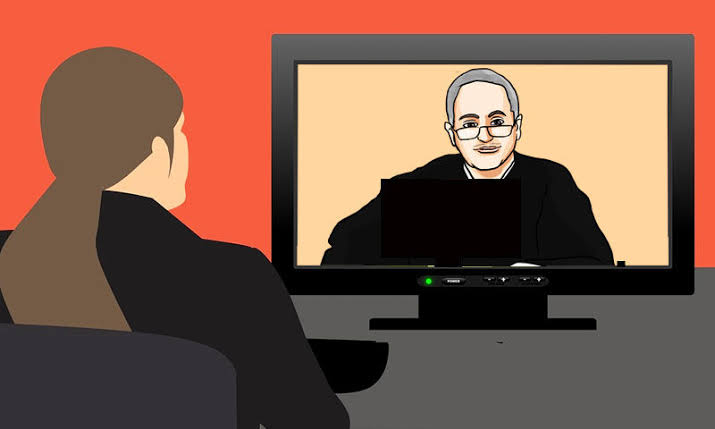
Virtual hearings are court hearings conducted by audio-visual means, where cases are progressed without the need for participants to attend the Court in person. It also shows how the distance becomes immaterial when one has to appear before the court to argue the case.

FOR THE FIRST TIME
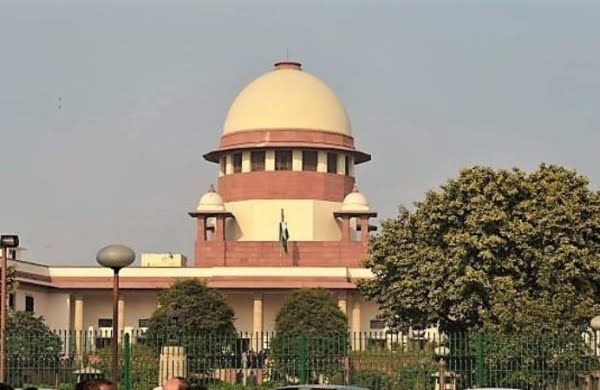
The Hon’ble Supreme Court of India held its first Constitutional bench sitting and this is the first time since March 5 that five judges sat together in a single court hall ever since the lockdown forced the apex court to stop physical court hearings and begin hearing cases through videoconferencing from March 25 this year.

It was for the first time on Tuesday, the 14th July, 2020 that a Constitutional Bench (comprising five judges) held a virtual hearing. A bench of justices Arun Mishra, Indira Banerjee, Vineet Saran, MR Shah and Aniruddha Bose appeared wearing masks and maintaining nearly two-feet distance between them on the bench.

The first case that was heard by the five-judge bench was a legal tussle on whether Centre or States have the power to provide reservation to in-service candidates in post-graduate medical degree courses. The plea was brought up by Tamil Nadu Medical Officers Association.

Opening the argument, Senior Advocate Arvind Datar exchanged the extensive compilation of his arguments including cases to be referred through Google drive with all Lawyers. One of the Lawyers, Senior Advocate Vikas Singh appearing for Medical Council of India (MCI) complained about being unable to access Google Drive.

He objected to Datar referring to the same, the first hiccup encountered by the Court in the virtual proceeding. The problem was sorted as Hon’ble court asked Senior Advocate Arvind Datar to give case law citations.

As the virtual hearing proceeded the Senior Advocate Arvind Datar was inaudible to the Hon’ble Court. Hon’ble Justice MR Shah commented in a lighter vein that, “Don’t keep social distancing with your mike.” Datar heard ‘mike’ as “wife”, leaving the bench in splits.

SUCCESS STORY: DATA THAT MATTERS

The Hon’ble Supreme Court of India shared the ‘success story’ of virtual court proceedings. At the beginning of June as many as 2,893 lawyers appeared in the hearings via video-conferencing, it said in the data release.

According to the data, 538 matters were taken up by the SC during the lockdown period, besides 297 connected cases. Judgment was delivered in 57 matters. Besides, 49 special leave petitions, 92 writ petitions, 138 review petitions and 58 pleas for interim relief were also taken up.

HOW THE COURTS FARED AND PERFORMED?
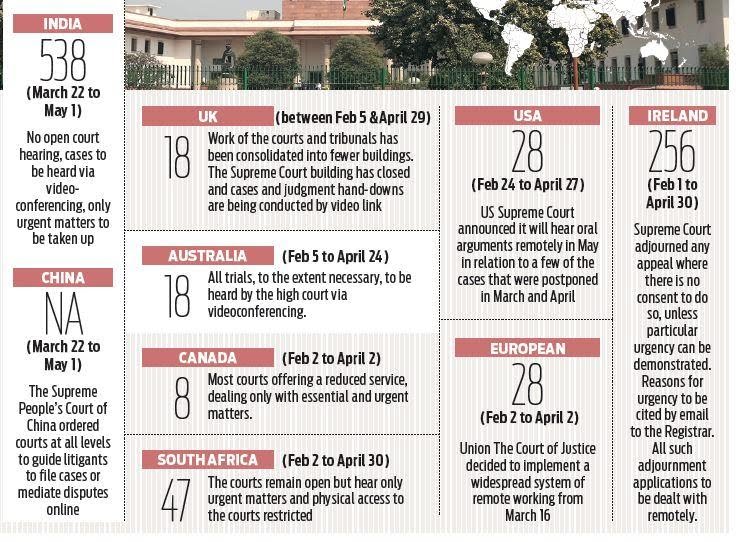
India has fared the best as per the above data as many other countries have been using the virtual system but their top courts that have lagged way behind in the hearing or disposal of cases.

It conducted proceedings via video-conferencing from March 25 as it has suspended the entry of lawyers and other staff into its premises and also the apex court decided to explore the feasibility of ‘physical appearance’ of advocates in real courtroom hearings after strictly adhering to the guidelines of the COVID-19 triggered lockdown and resorting to virtual hearings since March 25.

Data available on other judicial websites indicate that in the nations hit hard by the pandemic like the US, the UK, France, Italy, Germany, China, Canada, Australia etc., The organs of that state which carried out the administration of justice are mostly relying on the virtual court methodologies and online case management.

CONCLUSION

Hence after going through the above facts and circumstances it’s certainly a grand success yet there is always room and scope for improvement.

WEBSITES REFERRED:-

1)https://www.supremecourt.vic.gov.au/law-and-practice/virtual-hearings/virtual-hearings-glossary

2)https://www.google.com/amp/s/www.newindianexpress.com/nation/2020/may/04/virtual-hearing-indias-apex-court-way-ahead-than-many-counterparts-2138843.amp

3)https://scholarlykitchen.sspnet.org/2020/03/30/marketing-amidst-a-pandemic/
4)https://www.google.com/amp/s/m.hindustantimes.com/india-news/supreme-court-holds-first-virtual-constitution-bench-hearing/story-6OIJDbbzpliujLFjz1z3mI_amp.html

Intoxication Not A Mitigating Factor

It has been most rightly remarked by the Supreme Court most recently on December 13, 2019 in a latest, landmark and extremely laudable judgment titled Suraj Jagannath Jadhav vs State of Maharashtra in Criminal Appeal No. 1885 of 2019 that, “Mere intoxication is not a mitigating factor factor when accused was not in a highly inebriated condition”. This was held so while clearly rejecting the contention of the accused that he was under the influence of liquor and threw matchstick on his deceased wife and set her ablaze  and therefore his condition was such that he could not understand what he was doing! There can be no reason to justify an unlawful act and that too of such a horrifying nature as burning one’s own wife!

Apex Court Bench
Apex Court Bench

To start with, this noteworthy judgment authored by Justice MR Shah for himself and Justice Ashok Bhushan set the ball rolling in para 1 wherein it was observed that, “Feeling aggrieved and dissatisfied with the impugned judgment and order dated 09.10.2018 passed by the High Court of Judicature at Bombay in Criminal Appeal No. 723 of 2013, by which the High Court has dismissed the said appeal preferred by the appellant herein-original accused and has confirmed the judgment and order of conviction passed by the learned Trial Court convicting the accused for the offence punishable under Section 302 of the IPC, the original accused has preferred the present appeal.

As it turned out, para 2 then states that, “At the outset, it is required to be noted that the only submission made by the learned counsel appearing on behalf of the appellant-original accused is that the death of the deceased can be said to be a culpable homicide not amounting to murder and the case would fall under Exception 4 to Section 300 IPC and therefore the case would be under Section 304 Part II IPC. Even this Court has issued the notice in the present appeal limited to the nature of offence.”

While elaborating further on this pale defence, para 3 then states that, “Shri Sushil Karanjkar, learned counsel appearing on behalf of the appellant-original accused has vehemently submitted that, as such, there was no intention on the part of the accused to kill his wife. It is submitted that at the time when the unfortunate incident had taken place, the accused was under the influence of liquor and therefore his condition was such that he could not understand what he was doing. It is further submitted by the learned counsel appearing on behalf of the appellant-original accused that even thereafter the appellant tried to save the deceased and poured water to save her and, while doing so, even the appellant-original accused also sustained the injuries. Therefore, relying upon the decision of this Court in the case of Kalu Ram v. State of Rajasthan (2000) 10 SCC 324, it is prayed to alter the conviction from Section 302 IPC to Section 304 Part II IPC.”

For the sake of brevity, let us now have a glimpse of the key findings of the Apex Court Bench. To start with, it is observed in para 5 that, “Heard the learned counsel appearing on behalf of the respective parties at length. As observed hereinabove, in the present appeal, the sole question which is posed for consideration of this Court is, whether, in the facts and circumstances of the case, the case would fall under Exception 4 to Section 300 IPC or Section 300 fourthly and, therefore, whether Section 302 IPC shall be attracted or the case may fall under Section 304 Part II IPC?”

More significantly, it is then disclosed in para 5.1 that, “It is the case on behalf of the appellant-original accused that as at the time when the incident took place, the accused was drunk and under the influence of liquor and he had no intention to cause death of the deceased-wife and that even subsequently the accused tried to save the deceased and poured the water on her and therefore the case would fall under Exception 4 to Section 300 IPC and, therefore the conviction is to be altered from Section 302 of the IPC to Section 304 Part II IPC, having relied upon the decision of this Court in the case of Kalu Ram (supra). However, it is required to be noted that, in the present case, the appellant-accused poured the kerosene on the deceased when she was trying to run out of the house to save herself and was trying to open the latch of the door of the house, the accused threw the match stick on her person and set her ablaze. Nothing is on record that the accused was in a highly inebriated stage. Even looking to the conversation which took place between the deceased and the accused, so stated in the dying declaration given by the deceased, it can safely be said that the accused was in very much conscious condition when the incident took place. He was very much in the senses and was conscious about what he was doing. Therefore, the accused was fully conscious of the fact that if kerosene is poured and matchstick is lit and put on the body, a person might die due to burns. Therefore, the case would fall under Section 300 fourthly and Exception 4 to Section 300 IPC shall not be applicable.”

Finally and most importantly, it is then held in para 7 that, “Applying the law laid down by this Court in the cases of Bhagwan (supra) and Santosh (supra) to the facts of the case on hand and the manner in which the accused poured the kerosene on the deceased and thereafter when she was trying to run away from the room to save her, the accused came from behind and threw a match-stick and set her ablaze, we are of the opinion that the death of the deceased was a culpable homicide amounting to murder and Section 300 fourthly shall be applicable and not Exception 4 to Section 300 IPC as submitted on behalf of the accused. We are in complete agreement with the view taken by the learned Trial Court as well as the High Court convicting the accused for the offence punishable under Section 302 of the IPC.” Lastly, it is then held in the last para 8 that, “In view of the above and for the reasons stated above, the present appeal fails and the same deserves to be dismissed and is accordingly dismissed.” Very rightly so!

In conclusion, the Apex Court Bench has very rightly convicted the accused as he was fully conscious of what he was doing while he threw a  match-stick and set her wife ablaze. The intoxication was not so much that he could not understand what he was doing. So he was not given the benefit of doubt. Very rightly so!

Sanjeev Sirohi, Advocate,

s/o Col BPS Sirohi,

A 82, Defence Enclave,

Sardhana Road, Kankerkhera, UP