



By Shashikant Nishant Sharma
Abstract:
The ASEAN-India and Thailand trade relations have witnessed significant growth over the years, leading to positive impacts on the economies of the participating countries. This paper highlights the benefits and opportunities arising from the flourishing trade relations between India, Thailand, and ASEAN countries, including enhanced market access, increased trade volume, and strengthened economic ties. The study also sheds light on the challenges faced by the ASEAN-India and Thailand trade relations, such as non-tariff barriers and limited infrastructure. The paper concludes that the ASEAN-India and Thailand trade relations have the potential to be a driving force for economic growth and regional integration, and recommends measures to further enhance the trade and investment ties between the regions.
Keywords:
ASEAN, India, Thailand, Trade Relations, India and Thialand
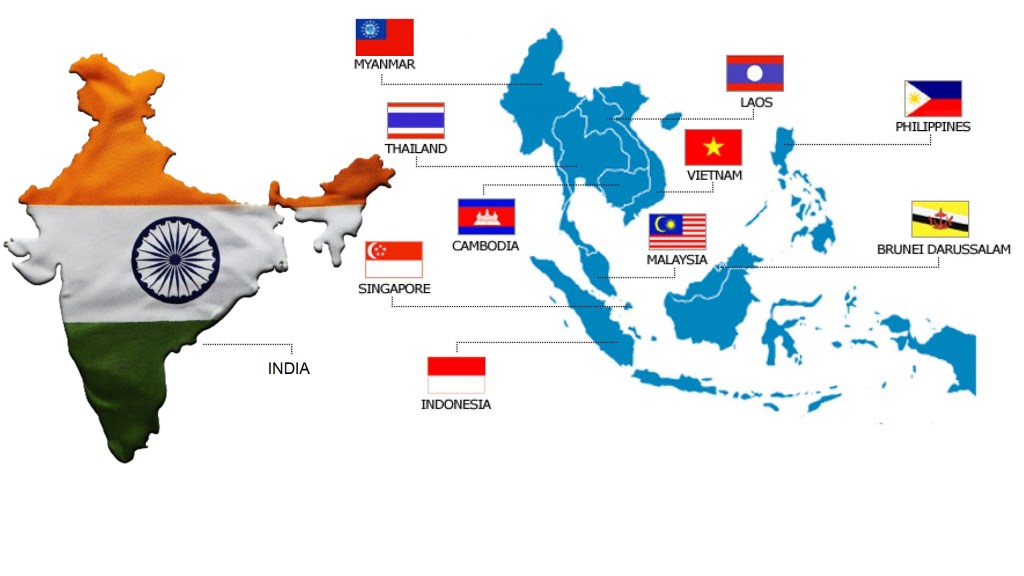
The aim of the Association of Southeast Asian Nations (ASEAN) is to promote economic, political, and security cooperation among its member countries in Southeast Asia. ASEAN was established on August 8, 1967, with the signing of the ASEAN Declaration, also known as the Bangkok Declaration. The founding members of ASEAN were Indonesia, Malaysia, the Philippines, Singapore, and Thailand. Brunei Darussalam joined in 1984, Vietnam in 1995, Laos and Myanmar in 1997, and Cambodia in 1999.
ASEAN’s role in Asia is significant. It is a regional organization that fosters economic integration and cooperation, political stability, and social progress among its member states. ASEAN plays an important role in promoting peace, security, and stability in the region, as well as in enhancing regional economic growth and development. ASEAN also serves as a platform for dialogue and cooperation between the member states and with other countries in the region and beyond. It has established several partnerships with countries such as China, Japan, South Korea, India, and the United States, among others.
In recent years, ASEAN has become increasingly important in the evolving regional security architecture of Asia, particularly with the rise of China and its growing influence in the region. ASEAN-led forums such as the East Asia Summit (EAS) have become key platforms for discussing security issues in the region, including the South China Sea disputes.
India and Thailand share a long-standing historical and cultural relationship that dates back several centuries. India and Thailand have been trading partners for over two thousand years, with cultural and economic exchanges flourishing during the ancient times along the land and sea routes. In recent times, India and Thailand have developed a strong strategic partnership based on shared values and interests. The two countries have close economic ties, with Thailand being one of India’s important trading partners in the ASEAN region. The total trade between India and Thailand stood at USD 13.76 billion in 2020-21.
India’s main exports to Thailand include gems and jewelry, machinery, iron and steel, organic chemicals, and vehicles. Thailand’s main exports to India include pearls, precious stones, electrical machinery, boilers, machinery, and parts. India and Thailand also cooperate in areas such as defense, security, tourism, and cultural exchanges. In the defense sector, the two countries have been conducting joint military exercises, and Thailand has purchased military hardware from India.
Tourism is another area of cooperation, with over a million tourists from each country visiting the other annually before the COVID-19 pandemic. Cultural exchanges between the two countries are also vibrant, with several cultural festivals and events being held in each other’s countries. India and Thailand also collaborate in regional forums such as ASEAN, BIMSTEC, and the Mekong-Ganga Cooperation. The two countries share a commitment to promoting regional integration and connectivity in the region.
The 13th Meeting of the India Thailand Joint Trade Committee (JTC) took place in New Delhi today. Ms. Auramon Supthaweethum, the Director General of Department of Trade Negotiations, Ministry of Commerce of Thailand, and Ms. Indu C. Nair, the Joint Secretary, Department of Commerce, Ministry of Commerce & Industry, India, co-chaired the meeting. This was the first in-person meeting of the JTC since its revival in 2020, after a 17-year hiatus.
Thailand is an important trading partner for India in the ASEAN region, with a total trade of USD 16.89 Billion in 2022-23, accounting for 13.6% of India’s total trade with ASEAN. India exports gems and jewelry, mechanical machinery, auto and auto components, and agricultural products, especially marine products, to Thailand.
During the meeting, the chairs reviewed the current status of bilateral trade and discussed the need to identify new potential products and priority sectors to expand bilateral trade. They also discussed market access issues and technical barriers faced by exporters and agreed to resolve them through regular and sustained bilateral discussions. India raised concerns about the restrictions it faces in exporting marine, poultry, and meat products.
Both sides identified several potential commodities and sectors for a stronger partnership, such as value-added marine products, smartphones, electric vehicles, food processing, and pharmaceuticals. They also agreed that there is a vast scope for collaboration in the service sector and decided to explore establishing mutual recognition/cooperation arrangements in nursing, accounting, audio-visual, and medical tourism. The meeting also reviewed the progress of the ongoing efforts to connect India’s Unified Payment Interface (UPI) with Thailand’s Prompt Pay Service and the settlement of trade transactions in local currency.
Some recommendations for enhancing the India and Thailand trade relations are:-
- Strengthen bilateral economic engagement through the establishment of joint ventures, investment, and technology transfer.
- Enhance connectivity between the two countries by improving transport links, including air and sea connectivity.
- Promote cooperation between small and medium enterprises (SMEs) in both countries to enhance trade and investment.
- Work towards establishing mutual recognition/cooperation arrangements in various sectors, including nursing, accounting, audio-visual, and medical tourism.
- Address trade barriers and technical issues faced by exporters through regular and sustained bilateral discussions.
- Explore the possibility of signing a Free Trade Agreement (FTA) to further enhance economic engagement between the two countries.
- Overall, there is significant potential for India and Thailand to deepen their trade and economic partnership. By addressing trade barriers, promoting cooperation in key sectors, and enhancing connectivity between the two countries, India and Thailand can further strengthen their relationship and realize the untapped potential of their trade and economic ties.
References
Sivadasan, S. K., Susheel, M. A., & Bindu, C. (2012). India-Thailand Bilateral Trade A Review against the Backdrop of the Framework Trade Agreement. ABAC Journal, 32(3).
Asher, M. G., & Sen, R. (2005). India-East Asia integration: A win-win for Asia. Economic and Political Weekly, 3932-3940.
Chenoy, A. M. (2023). The Multipolar Global Political Economy. Economic & Political Weekly, 58(2), 31.
Francis, S. (2011). A sectoral impact analysis of the ASEAN-India free trade agreement. Economic and Political Weekly, 46-55.
Marwah, R. (2020). Reimagining India–Thailand Relations: A Multilateral and Bilateral Perspective.
Nataraj, G., & Sekhani, R. (2015). China’s One Belt One Road: An Indian Perspective. Economic and Political Weekly, 67-71.
Sen, R., Asher, M. G., & Rajan, R. S. (2004). ASEAN-India economic relations: current status and future prospects. Economic and Political Weekly, 3297-3308.
 Eduindex
You must be logged in to post a comment.