Alpha Centauri, Star System Closest To Our Sun

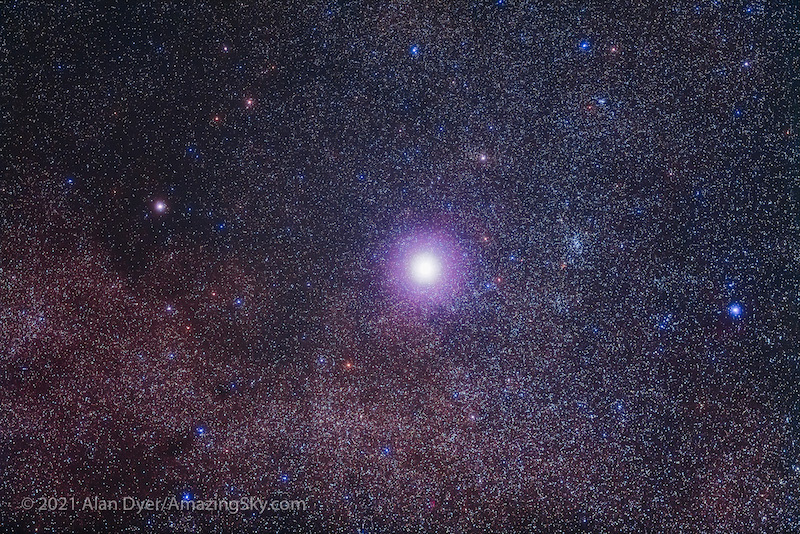
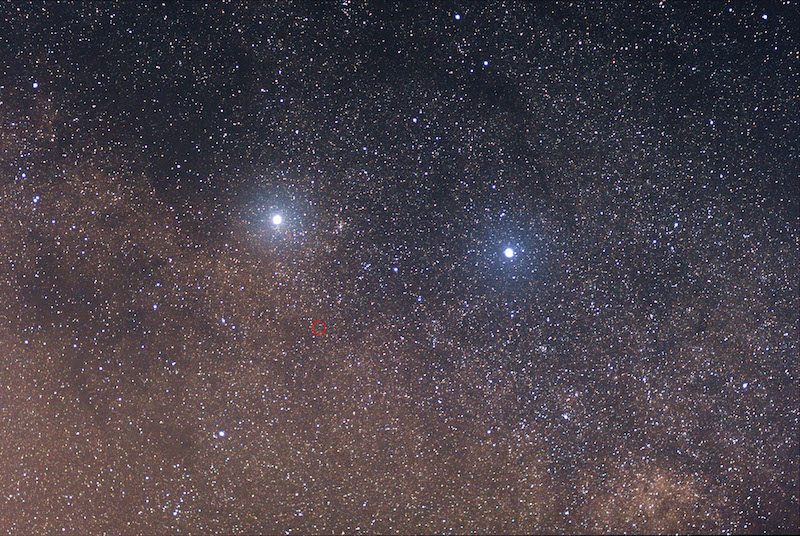
Star Alpha Centauri very bright against a backdrop of extremely dense field of fainter stars and dust clouds.
Alpha Centauri is the third-brightest star in our night sky – a famous southern star – and the nearest star system to our sun. Through a small telescope, the single star we see as Alpha Centauri resolves into a double star. This pair is just 4.37 light-years away from us. In orbit around them is Proxima Centauri, too faint to be visible to the unaided eye. At a distance of 4.25 light years, Proxima is the closest-known star to our solar system.
Science of the Alpha Centauri system. The two stars that make up Alpha Centauri, Rigil Kentaurus and Toliman, are quite similar to our sun. Rigil Kentaurus, also known as Alpha Centauri A, is a yellowish star, slightly more massive than the sun and about 1.5 times brighter. Toliman, or Alpha Centauri B, has an orangish hue; it’s a bit less massive and half as bright as the sun. Studies of their mass and spectroscopic features indicate that both these stars are about 5 to 6 billion years old, slightly older than our sun.

Alpha Centauri A and B are gravitationally bound together, orbiting about a common center of mass every 79.9 years at a relatively close proximity, between 40 to 47 astronomical units (that is, 40 to 47 times the distance between the Earth and our sun).Must Watch Sky Events in 2021

In comparison, Proxima Centauri is a bit of an outlier. This dim reddish star, weighing in at just 12 percent of the sun’s mass, is currently about 13,000 astronomical units from Alpha Centauri A and B. Recent analysis of ground- and space-based data, published in 2017, has shown that Proxima is gravitationally bound to its bright companions, with a 550,000-year-long orbital period.

Proxima Centauri belongs to a class of low mass stars with cooler surface temperatures, known as red dwarfs. It’s also what’s know as a flare star, where it randomly displays sudden bursts of brightness due to strong magnetic activity.

In the past decade, astronomers have been searching for planets around the Alpha Centauri stars; they are, after all, the closest stars to us so the odds of detecting planets, if any existed, would be higher. So far, two planets have been found orbiting Proxima Centauri, one in 2016 and another in 2019. A paper published in February 2021 reported tantalizing evidence of a Neptune-sized planet around Alpha Centauri A, but so far, it has not been definitively confirmed.

Large-appearing bright star with 4 lens-effect bright spikes coming out from it.
Extremely dense star field with 2 brights stars and a small red circle around a much smaller one.

How to see Alpha Centauri. Unluckily for many of us in the Northern Hemisphere, Alpha Centauri is located too far to the south on the sky’s dome. Most North Americans never see it; the cut-off latitude is about 29° north, and anyone north of that is out of luck. In the U.S. that latitudinal line passes near Houston and Orlando, but even from the Florida Keys, the star never rises more than a few degrees above the southern horizon. Things are a little better in Hawaii and Puerto Rico, where it can get 10° or 11° high.

But for observers located far enough south in the Northern Hemisphere, Alpha Centauri may be visible at roughly 1 a.m. (local daylight saving time) in early May. That is when the star is highest above the southern horizon. By early July, it reaches its highest point to the south at nightfall. Even so, from these vantage points, there are no good pointer stars to Alpha Centauri. For those south of 29° N. latitude, when the bright star Arcturus is high overhead, look to the extreme south for a glimpse of Alpha Centauri.
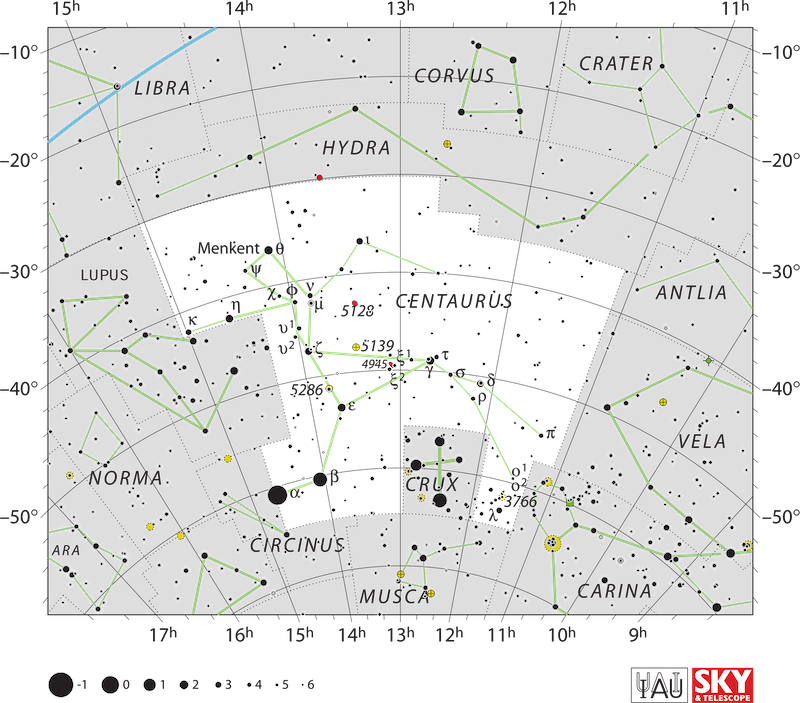
Star chart with stars in black on white, of Centaurus with Southern Cross constellation.
The southern constellation Centaurus. Image via Wikimedia/ International Astronomical Union/ SkyandTelescope.com.

Observers in the tropical and subtropical regions of the Northern Hemisphere can find Alpha Centauri by first identifying the distinctive Southern Cross. A short line drawn through the crossbar (Delta and Beta Crucis) eastward first comes to Hadar (Beta Centauri), then Alpha Centauri. Meanwhile, in Australia and much of the Southern Hemisphere, Alpha Centauri is circumpolar, meaning that it never sets.

A telescope dome at in the foreground with Milky Way and bright stars in the sky.
In this image taken at the European Southern Observatory’s La Silla Observatory in Chile, the Southern Cross is clearly visible, with the yellowish star, closest to the dome, marking the top of the cross. Drawing a line downward through the crossbar stars takes you to the bluish star, Beta Centauri, and then to the yellowish Alpha Centauri. Image via ESO / Wikimedia Commons.

Alpha Centauri in mythology. Alpha Centauri has played a prominent role in the mythology of cultures across the Southern Hemisphere. For the Ngarrindjeri indigenous people of South Australia, Alpha and Beta Centauri were two sharks pursuing a sting ray represented by stars of the Southern Cross. Some Australian aboriginal cultures also associated stars with family relationships and marriage traditions; for instance, two stars of the Southern Cross were through to be the parents of Alpha Centauri.

Astronomy and navigation were deeply intertwined in the lives of ancient seafaring Polynesians as they sailed between islands in the vast expanse of the South Pacific. These ancient mariners navigated using the stars, with cues from nature such as bird movements, waves, and wind direction. Alpha Centauri and nearby Beta Centauri, known as Kamailehope and Kamailemua, respectively, were important signposts used for orientation in the open ocean.

For ancient Incas, a llama graced the sky, traced out by stars and dark dust lanes in the Milky Way from Scorpius to the Southern Cross, with Alpha Centauri and Beta Centauri representing its eyes.

Dark-on-light shepherd, mother llama with baby, partridge, toad, and snake.
A plaque at the Coricancha museum showing Inca constellations. Coricancha, located in Cusco, Peru, was perhaps the most important temple of the Inca empire. Image via Pi3.124 / Wikimedia Commons.

Ancient Egyptians revered Alpha Centauri, and may have built temples aligned to its rising point. In southern China, it was part of a star group known as the South Gate.

Alpha Centauri is the brightest star in the constellation Centaurus, named after the mythical half human, half horse creature. It was thought to represent an uncharacteristically wise centaur that figured in the mythology of Heracles and Jason. The centaur was accidentally wounded by Heracles, and placed into the sky after death by Zeus. Alpha Centauri marked the right front hoof of the centaur, although little is known of its mythological significance, if any.

Antique etching of half-man-half-horse in field of stars in black on white.
A depiction of the Centaur by Polish astronomer Johannes Hevelius in his atlas of constellations, Firmamentum Sobiescianum, sive Uranographia. Image via Wikimedia Commons.

Alpha Centauri’s position is RA: 14h 39m 36s, Dec: -60° 50′ 02″

Bottom line: Alpha Centauri is actually two binary stars that are quite similar to our sun. A third star that’s gravitationally bound to them is Proxima Centauri, the closest star to our sun.

SPACE RASPBERRIES AND RUM !

For the past few years, scientists have been studying a dust cloud near the centre of our Milky Way Galaxy. If there is a God out there, it seems that he decided to get creative – this dust cloud , named Sagittarius B2, smells of rum and tastes like raspberries… This gas cloud consists largely of ethyl formate. This large cloud is said to contain a billion , billion, billion liters of the stuff, which would be great , if it wasn’t rendered undrinkable by pesky particles like propyl cyanide. The creation and distribution of these more complex molecules is still a mystery to scientists. 

What is Astrophysics?

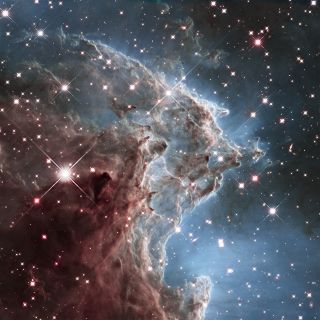
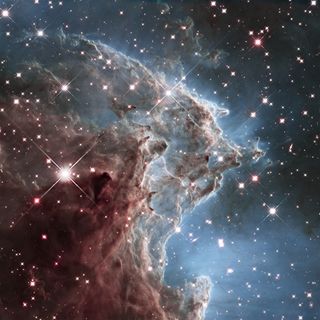
Hubble Snaps 'Monkey Head' Nebula
Astrophysics is a branch of space science that applies the laws of physics and chemistry to explain the birth, life and death of stars, planets, galaxies, nebulae and other objects in the universe. It has two sibling sciences, astronomy and cosmology, and the lines between them blur. 

In the most rigid sense:
Astronomy measures positions, luminosities, motions and other characteristics
Astrophysics creates physical theories of small to medium-size structures in the universe
Cosmology does this for the largest structures, and the universe as a whole. 

In practice, the three professions form a tight-knit family. Ask for the position of a nebula or what kind of light it emits, and the astronomer might answer first. Ask what the nebula is made of and how it formed and the astrophysicist will pipe up. Ask how the data fit with the formation of the universe, and the cosmologist would probably jump in. But watch out — for any of these questions, two or three may start talking at once!
Goals of astrophysics
Astrophysicists seek to understand the universe and our place in it. At NASA, the goals of astrophysics are “to discover how the universe works, explore how it began and evolved, and search for life on planets around other stars,” according NASA’s website.

NASA states that those goals produce three broad questions:

  • How does the universe work?
  • How did we get here?
  • Are we alone?

It began with Newton

While astronomy is one of the oldest sciences, theoretical astrophysics began with Isaac Newton. Prior to Newton, astronomers described the motions of heavenly bodies using complex mathematical models without a physical basis. Newton showed that a single theory simultaneously explains the orbits of moons and planets in space and the trajectory of a cannonball on Earth. This added to the body of evidence for the (then) startling conclusion that the heavens and Earth are subject to the same physical laws.

Perhaps what most completely separated Newton’s model from previous ones is that it is predictive as well as descriptive. Based on aberrations in the orbit of Uranus, astronomers predicted the position of a new planet, which was then observed and named Neptune. Being predictive as well as descriptive is the sign of a mature science, and astrophysics is in this category.

Milestones in astrophysics

Because the only way we interact with distant objects is by observing the radiation they emit, much of astrophysics has to do with deducing theories that explain the mechanisms that produce this radiation, and provide ideas for how to extract the most information from it. The first ideas about the nature of stars emerged in the mid-19th century from the blossoming science of spectral analysis, which means observing the specific frequencies of light that particular substances absorb and emit when heated. Spectral analysis remains essential to the triumvirate of space sciences, both guiding and testing new theories.

Early spectroscopy provided the first evidence that stars contain substances also present on Earth. Spectroscopy revealed that some nebulae are purely gaseous, while some contain stars. This later helped cement the idea that some nebulae were not nebulae at all — they were other galaxies! 

In the early 1920s, Cecilia Payne discovered, using spectroscopy, that stars are predominantly hydrogen (at least until their old age). The spectra of stars also allowed astrophysicists to determine the speed at which they move toward or away from Earth. Just like the sound a vehicle emits is different moving toward us or away from us, because of the Doppler shift, the spectra of stars will change in the same way. In the 1930s, by combining the Doppler shift and Einstein’s theory of general relativity, Edwin Hubble provided solid evidence that the universe is expanding. This is also predicted by Einstein’s theory, and together form the basis of the Big Bang Theory.

Also in the mid-19th century, the physicists Lord Kelvin (William Thomson) and Gustav Von Helmholtz speculated that gravitational collapse could power the sun, but eventually realized that energy produced this way would only last 100,000 years. Fifty years later, Einstein’s famous E=mc2 equation gave astrophysicists the first clue to what the true source of energy might be (although it turns out that gravitational collapse does play an important role). As nuclear physics, quantum mechanics and particle physics grew in the first half of the 20th century, it became possible to formulate theories for how nuclear fusion could power stars. These theories describe how stars form, live and die, and successfully explain the observed distribution of types of stars, their spectra, luminosities, ages and other features.

Astrophysics is the physics of stars and other distant bodies in the universe, but it also hits close to home. According to the Big Bang Theory, the first stars were almost entirely hydrogen. The nuclear fusion process that energizes them smashes together hydrogen atoms to form the heavier element helium. In 1957, the husband-and-wife astronomer team of Geoffrey and Margaret Burbidge, along with physicists William Alfred Fowler and Fred Hoyle, showed how, as stars age, they produce heavier and heavier elements, which they pass on to later generations of stars in ever-greater quantities. It is only in the final stages of the lives of more recent stars that the elements making up the Earth, such as iron (32.1 percent), oxygen (30.1 percent), silicon (15.1 percent), are produced. Another of these elements is carbon, which together with oxygen, make up the bulk of the mass of all living things, including us. Thus, astrophysics tells us that, while we are not all stars, we are all stardust.

Astrophysics as a career

Advertisement

Becoming an astrophysicist requires years of observation, training and work. But you can start becoming involved in a small way even in elementary and high school, by joining astronomy clubs, attending local astronomy events, taking free online courses in astronomy and astrophysics, and keeping up with news in the field on a website such as Space.com. 

In college, students should aim to (eventually) complete a doctorate in astrophysics, and then take on a post-doctoral position in astrophysics. Astrophysicists can work for the government, university labs and, occasionally, private organizations.

Study.com further recommends the following steps to put you on the path to being an astrophysicist:

Take math and science classes all through high school. Make sure to take a wide variety of science classes. Astronomy and astrophysics often blend elements of biology, chemistry and other sciences to better understand phenomena in the universe. Also keep an eye out for any summer jobs or internships in math or science. Even volunteer work can help bolster your resume.

Pursue a math- or science-related bachelor’s degree. While a bachelor in astrophysics is the ideal, there are many other paths to that field. You can do undergraduate study in computer science, for example, which is important to help you analyze data. It’s best to speak to your high school guidance counselor or local university to find out what degree programs will help you.

Take on research opportunities. Many universities have labs in which students participate in discoveries — and sometimes even get published. Agencies such as NASA also offer internships from time to time. 

Finish a doctorate in astrophysics. A Ph.D. is a long haul, but the U.S. Bureau of Labor Statistics points out that most astrophysicists do have a doctoral degree. Make sure to include courses in astronomy, computer science, mathematics, physics and statistics to have a wide base of knowledge.

Natalie Hinkel, a planetary astrophysicist who was then at Arizona State University, gave a lengthy interview with Lifehacker in 2015 that provided a glimpse into the rewards and challenges of being a junior astrophysics researcher. She described the long number of years she has put into doing her research, the frequent job switches, her work hours and what it’s like to be a woman in a competitive field. She also had an interesting insight about what she actually did day to day. Very little of her time is spent at the telescope.

“I spend the vast majority of my time programming. Most people assume that astronomers spend all of their time at telescopes, but that’s only a very small fraction of the job, if at all. I do some observations, but in the past few years I’ve only been observing twice for a total of about two weeks,” Hinkel told Lifehacker. 

“Once you get the data, you have to reduce it (i.e. take out the bad parts and process it for real information), usually combine it with other data in order to see the whole picture, and then write a paper about your findings. Since each observation run typically yields data from multiple stars, you don’t need to spend all of your time at the telescope to have enough work.”