
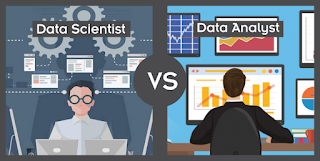
Data Scientist Vs Data Analyst

What is the contrast between a Data Scientist and a Data Analyst? Are these two the equivalent? Such inquiries have been a wellspring of extraordinary disarray among youths, who wish to make an effective career in data science. I’m here to settle these inquiries and explain the whole matter for you.

How about we initially comprehend the center distinction between two occupation jobs, Data Scientists are master experts, outfitted with a blend of Coding, Mathematical, Statistical, Analytical and ML abilities. 

Data Analysts are principally associated with the everyday information assortment and investigation undertakings. They should filter through information to distinguish significant experiences from information.

Data Scientist and Data Analyst Comparison

1. Responsibilities

Data Scientist

! Create & define programs for data collection. modelling, analysis, and reporting.

! Perform information cleansing and preparing tasks to mine important bits of knowledge from information. 

! Foster custom information models and ML algorithms to suit organization/client needs.

! To mine and analyse data from company databases to foster optimisation and improvement of business operations. 

! To use the right data visualization and predictive modelling tools to boost revenue generation, marketing strategies, enhance customer experiences, etc.

! To foster new ML techniques and scientific models. 

! To associate diverse datasets, decide the legitimacy of new information sources and information assortment techniques. 

! To facilitate and speak with both IT and business supervisory crews to execute information models and screen the results. 

! To distinguish new business openings and decide how the discoveries can be utilized to upgrade business systems and results.

Data Analyst

! To analyse and mine business data to identify correlations and discover valuable patterns from disparate data points

! To work with customer-centric algorithm models and personalize them to fit individual customer requirements.

! To make and send custom models to reveal answers to business matters, for example, advertising techniques and their presentation client taste, and inclination designs, and so forth.

! To guide and follow information from various frameworks to tackle explicit business issues. 

! To compose SQL inquiries to remove information from the information stockroom and to recognize the responses to complex business issues. 

! To apply statistical analysis to lead purchaser information research and examination.

! To coordinate with Data Scientists and Data Engineers to gather new data from multiple sources.

! To design and develop data visualization, reports, dashboards, to help the business management team to make better business decisions.

! To perform routine analysis tasks as well as quantitative analysis as and when required to support day-to-day business functioning and decision making.

2. Skills

Data Scientist

The role of a Data Scientist is highly specialized and versatile. Henceforth, Data Scientists generally have Advanced Degrees like a Masters or PhD. 

! A least of a Master’s certification in Statistics/Mathematics/Computer Science. 

! Proficiency in programming languages like R, Python, Java, SQL

! In-depth knowledge of ML techniques, including clustering, decision trees, artificial neural networks.

! In-depth knowledge of advanced statistical techniques and concepts.

! Experience in working with statistical and data mining techniques (linear regression, random forest. trees, text mining, social network analysis) 

! Experience in working with as well as creating data architectures.

! Experience in manipulating data sets and developing statistical models.

! Experience in using web services such as $3. Spark, Redshift, Digital Ocean.

Data Analyst

For the work job of a Data Analyst, the base prerequisite is to have an undergraduate stamp. Science, Technology, Engineering or Math Degree, having advanced Degrees is excellent, but it is not a necessity. 

3. Salary

As indicated by a PWC study report, by 2020, there will be around 2.7 million employment opportunities for Data Scientists and Data Analysts. Glassdoor keeps up with that the normal yearly compensation of Data Scientist is Rs.10 lakh, while that of a Data Analyst is Rs.4,82,041. 

With everything taken into account, both the alternatives are arising and exceptionally rewarding profession decisions. So you have a promising profession in Data Science, regardless you pick.
Top Trending Technologies in 2021

Technology is persistently refreshing at such a quick speed that it may appear to be quicker than light. A technology or a programming language making the rounds this week maybe obsolete in the next few days. As an ever increasing number of assets are put resources into innovative work, computer scientists and experts are ceaselessly tweaking and working on existing advances to take advantage of them. Here are probably the most recent moving advances that make certain to overwhelm the IT business in the forthcoming years.

1. Artificial Intelligence

Artificial intelligence or AI is a technology used to match computer systems with human decision-making capabilities. Being one of the trending technologies, when Al programs are fed to systems, the aim is to mimic human intelligence for performing complex tasks, such as pattern recognition, speech recognition, weather forecast, and medical diagnosis. So, learning Al will help you secure job roles. such as machine learning engineer, data scientist, computer vision engineer, business intelligence developer, data analyst.

2. Data Science

Data science is the technology that helps to make sense of complex data. Everyday tons of data are produced by companies across the globe. This includes Business data, Sales data, Customer Profile Information, Server Data, Financial Figures. The future scope of data science looks promising, in turn creating opportunities for the following career roles, Data scientist, data architect, business intelligence manager, data engineer, data analyst, business analyst. 

3. Internet of Things

IoT, is a network of devices that are connected to each other. The devices can interact and share data. These gadgets might be associated by means of Wi-Fi, and they share information about their environment and how they are being utilized. The devices have a computer chip that facilitates this exchange. It is predicted that more than 41 billion devices powered by IoT will be used by 2025. IoT chips embedded on machines help businesses assess those machines performance and assist in their maintenance. Learning this most recent technology will assist you with securing positions, for example, IoT software developer, system design engineer, IoT product manager, IoT research developer, IoT solution architect. 

4. Blockchain

Blockchain is the foundational technology that powers electronic currencies such as cryptocurrencies. In simple terms, a blockchain is an electronic ledger that can be shared among different users. This helps in creating a record of transactions that cannot be altered, making the technology verifiable and secure. There is a rise in a career in blockchain. Here are some opportunities that are on the rise. Blockchain developers, blockchain quality engineer, blockchain legal consultant or attorney, blockchain engineer.

5. Robotic Process Automation (RPA)

Robotic process automation, RPA is a technology used to automate daily tasks.  Like artificial intelligence, software is used here to automate a series of tasks such as handling and responding to emails, processing transactions and manipulating business data.  Companies like Accenture, Deloitte and Capgemini use RPA tools to automate their daily operations.  Therefore, the greatest need for skilled professionals in RPA is to follow the various RPA working rules.  RPA Developer, RPA Business Analyst, RPA Consultant, RPA Solution Architect, RPA Project Manager.

6. Virtual Reality

VR is simply the technology by which you can submerge yourself in an environment that appears to be amazingly realistic. It is the utilization of computer technology for establishing a simulated environment. It is prominently utilized for playing computer games. Unlike traditional games where you experienced the gaming environment by viewing it on the screen, you are directly placed in the environment. The VR business is relied upon to arrive at near $40 billion by 2021. Here are some VR work positions you can pay special mind to. Content Writer, AR and VR Content Writers, Product Management, Software Engineer, UI and UX Design, Quality Assurance.

7. Edge Computing

Edge computing is the latest technology trend that is gaining popularity day by day. The technology is based on the philosophy of bringing computer power as close to the data source. This helps in reducing bandwidth and latency. Edge computing is used to handle time sensitive data stored in remote locations with limited connectivity to the central location. The technology will make cloud computing and IoT devices faster. By 2022, the Edge computing market is estimated to be $ 7 billion.  The technology will be mainstream in sectors like healthcare, retail and manufacturing.

8. Intelligent Apps

Intelligent apps are software applications that use Al components, such as machine learning, deep learning, data analytics, robotics, and natural language processing. They assist you in making decisions based on real-time data or historical data. Examples of intelligent apps are voice assistants, such as Siri, Google assistant, and Alexa. As companies like Google, Apple, and Oracle keep putting investments into these applications, it will undoubtedly make many jobs later on. Intelligent application developers are sure to bring home generous income packages. In this fiercely competitive IT industry, getting a job is becoming challenging. But if you keep up-skilling and continue learning new tools, you will surely grab your dream job.

History of Python Programming Language

Python

In this article we’ll see about the most popular and commonly used programming language, Python. So, let’s begin and learn about the development of Python and gain insights about the current IT trends.

Introduction of Python

Python is very famous for its simple programming syntax. code readability and English-like commands that make coding and English-like commands that make coding a lot easier and efficient. Due to this, it is the most popular and preferred language. Python is an interpreted, high-level, general-purpose programming language developed by Guido van Rossum at National Research Institute for Mathematics and Computer Science, Netherlands.

In contrast to popular belief that Python was named after the snake, Python was actually named after the show “Monty Python’s flying circus”. Guido van Rossum formulated Python in the late 1980’s as a successor to the ABC language.

Versions of Python

In 1994, Python version 1.0 was released with features like exception handling, Lambda, Map, Filter and Reduce. Python 2.0, released in 2000, introduced features like list comprehensions and garbage collection system capable of collecting reference cycle. Python 3.0 was released on the 3rd of December 2008. Undoubtedly, Python 2.x and 3.x have proven to be the most used versions. As of today, Python 3.9.5 is the latest stable version released in the summer of May 2021.

Applications of Python

Python is popularly used for development, scripting, and software testing. Top IT companies like Google, Facebook, Instagram, Spotify and Netflix, among others, use Python. Some major applications of Python can be seen in the fields of Machine Learning, Artificial Intelligence, Data Science and IoT.

Python Also Offers Many Libraries like

👉 Numpy

👉Scipy

👉 Keras

👉Tensor Flow

👉Django 

👉 Flask

Pep-8 is the official style guide that defines the styling conventions for Python code. A few popular open source Python projects include PipENV, Chatistics, solving the travelling salesman problem using self-organizing maps and Python to BPF converter. Popular websites on the internet, like Reddit and Quora, are built using Python. 

Some Popular Games Developed Using Python

👉EVE Online Freedom Force

👉Pirates of the Caribbean Online

👉 Civilization IV, Battlefield 2

👉Sims 4

👉World of Tanks  

According to Indeed, the average salary of a Python developer in India is about Rs.5,00,000 per annum and that in the US is around $124,000.

Users and admirers of Python, especially those considered knowledgeable, are referred to as Pythonists, Pythonistas, and Pythoneers. Since its inception, Python has come a long way to become the most popular coding language and continues to revolutionize the IT industry. This is the best course for all beginners who want to learn the new course.

What is Java Programming? Java Introduction for Beginners

JAVA

Introduction

In today’s era, the internet and smartphones have become an integral part of our lives. We use our phones for almost all of our day to day tasks. Earlier, we used to shop at mails, queue up in front of banks and make our travel bookings at travel agencies. But now, we can do this comfortably in our homes using smartphones. All of this is made possible by the high-level programming language Java. In this article we will discuss everything we need to know about the class based, object oriented programming language, Java.

What is Java?

Java is an Object Oriented Programming language that is used in a distributed environment on the internet. It is a high level language that is easy to read and understand. It is popularly used in console, GUIs, web, and mobile applications, game development and embedded systems. Apart from these, Java is also used to create software for devices. It is used not only in computers and mobiles but even in electronic devices like televisions, washing machines, air conditioners, and so on. Online forms, banking, and shopping are possible because of Java.

The Invention of Java

Java is a computer based programming language invented by James Gosling and Sun microsystems in 1991. He had a single motto while creating the language, it was “Write Once, Run Anywhere.” This meant that the code would have to be written only once, but it could be used anywhere. They named this language “Oak” because of the Oaktree outside Gosling’s office. Later, it was named to “Green”, then to “Java Coffee” which was named after the coffee from Indonesia, and finally to ” Java” in 1995.

Editions of Java

There are three editions of Java. Each programmer can learn any of these editions based on the application they need to create.

❤ Firstly, we have Java Standard Edition, this edition contains core libraries like java.lang, java.util, etc.

❤Secondly, we have Java Enterprise Edition, this edition has APIs like JMS, EJB, JSPs, Servelets, etc.

❤ And lastly, we have Java Micro Edition which is used to program Java in cell phones, set-top boxes, handhelds, and so on.

Java is an object oriented programming language based on C and C++. However, it is improved and simplified to solve the errors in programming. Java files are converted to bit code format using a compiler and then executed by the Java interpreter. The whole Java code is run on the Java Virtual Machine which provides a runtime environment.

Major Concepts of Java

Now, the major concepts in Java are its methods and classes. A method is a block of code that performs a task only when it is called. Consider this example, while watching television, you use the TV remote to change channels. Each button on the remote performs a different task. Methods in Java are the same. We can have methods to add two members or email a person or to convert kilometers to meters.

A group of methods make a class. Classes are used to organize code just like how fruits, vegetables, and clinical products are divided into different sections in a super market. There are a lot of features in Java. Let’s start by looking at them one by one.

It has a simple syntax and is very easy to understand and learn. Java language is robust. It eliminates errors that occur in the C and C++ languages. Java also has characteristics like garbage collectors and exception handling. This makes Java very unique. The most popular feature of Java is that it is platform independent. Compilation happens in bytecode, and because of this, Java can run on any machine. It is very secure language as it contains no virus. Java has a feature of multi-threading. The feature of multi-threading helps Java to do multitasking. Java is a portable language as it can run on any platforms and data type sizes are set permanently. So, Java program has a fixed size of the code. Last of all, Java is not as fast as C and C++, but provides higher performance than any other language.

OOPS Concepts in Java

Now, let’s see OOPS concepts in Java. Java has four concepts. They are,

👉  Abstraction

👉Encapsulation

👉Inheritance

👉 Polymorphism

In Java we use objects and classes identified with this present reality that makes the code simpler to make and comprehend.

Abstraction means showing the relevant information that is needed for a task.

Encapsulation makes the Java code secure data is stored within the classes, and it is not easy to access the data.

Inheritance as the name suggests, the attributes and characteristics of one class can be inherited by another class. Because of this, coders take less time to create the code.

Polymorphism means using the same method for different tasks. In Java, we can utilize the similar object or variable in two different places where their tasks will vary.

Conclusion

In this article we learnt all kinds of things about Java. So you can take the Java programming language and read and benefit.