
5th Joint Group of Customs (JGC) meeting between India and Bhutan

 The 5th Joint Group of Customs (JGC) meeting between India and Bhutan was held on 6th-7th May, 2024 in Leh, Ladakh. The meeting was co-chaired by Mr. Surjit Bhujabal, Special Secretary and Member (Customs), Central Board of Indirect Taxes and Customs, Government of India, and Mr. Sonam Jamtsho, Director General, Department of Revenue and Customs, Ministry of Finance, Royal Government of Bhutan.
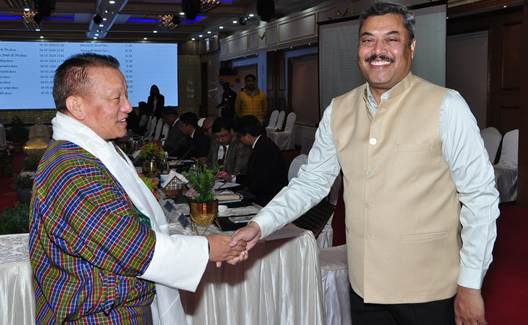
The 5th JGC meeting discussed a host of bilateral issues such as opening of new Land Customs Stations and notifying new trade routes, development of infrastructure, automation and digitisation of transit processes, prevention of smuggling, coordinated cross-border management, pre-arrival exchange of Customs data, bilateral agreement on Customs cooperation and movement of transit cargo under electronic cargo system among others.

Bhutan thanked the Government of India and particularly the Central Board of Indirect Taxes and Customs for the continued support in providing capacity building, training and skill development through workshops, seminars and various training programmes, including the IRS programme to the Bhutan customs administration. Also, Bhutan expressed sincere appreciation to the Indian Government for initiating and promoting the cross-border trade and economic activities with Bhutan through the various bilateral agreements.
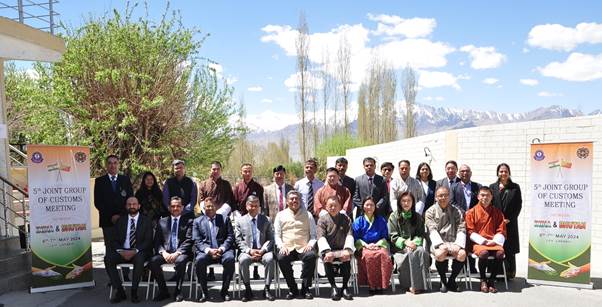
 

The India-Bhutan Joint Group of Customs meetings are held annually to discuss issues relating to re-defining and re-engineering of Customs procedures, promote Customs cooperation and cross-border trade facilitation with alignment to global best practices. These meetings play a vital role in enhancing connectivity and developing trade infrastructure for smooth customs clearance at land borders. There are 10 Land Customs Stations along the India-Bhuan Border in the States of West Bengal (6) and Assam (4).

India is Bhutan’s top trade partner both as an import source and as an export destination. Since 2014, India’s trade with Bhutan has more than tripled from $484 million in 2014-15 to $1,615 million in 2022-23, accounting for about 80% of Bhutan’s overall trade. Trade with Bhutan through the land Customs Stations is significant as Bhutan is a land-locked country.  Enhancing connectivity with Bhutan is pivotal to India’s ‘Neighbourhood First’ and the ‘Act East’ Policy.

The meeting concluded on an optimistic note. Both the countries agreed on discovering new strands of complementarities between India and Bhutan that can be maximised for mutual benefit, respond to the expectations and aspirations of the youth and adapt to the rapid changes related to new technologies and social innovations. Both sides also agreed to consider new developments for facilitating customs and trade cooperation for mutual prosperity. 

****
Creating miracles while fighting air pollution- The inspiring story of Bhutan

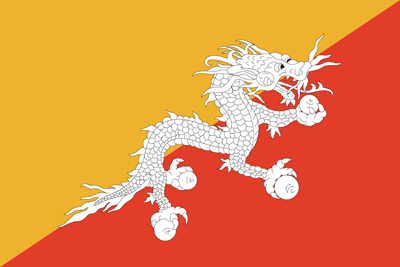
Flag Of Bhutan

The amount of carbon dioxide emission is increasing day by day causing a rise in overall temperature and global warming. Main reason behind the increase is that most of the energy producing sources emit carbon dioxide (for e.g. in thermal plants), burning of combustible substances and even our vehicles and transports emit carbon dioxide.

Usually, the plants and trees are able to absorb most of the carbon dioxide that is emitted but due to increase in deforestation it has become hard to maintain that balance.

While most of the countries are struggling to become carbon neutral that is trying to find a balance between carbon dioxide emission and absorption, Bhutan has already achieved that milestone.

Bhutan may be a small country but it is the only country in this world that is carbon negative.

Carbon negative can be explained by the comparison between total amount of carbon dioxide released to total amount carbon dioxide absorbed in the atmosphere as total amount of carbon dioxide released is lower than the amount of carbon dioxide absorbed.

Bhutan produces around two million tonnes of Carbon Dioxide and absorbs around 7 million tonnes of carbon dioxide.

This milestone was achieved because the 4th king of Bhutan-King Jigme Singye Wangchuck’s belief that Gross National Happiness of the population of Bhutan was more important that Gross National Product. And further development was done by keeping this ideology in mind.

Few steps that were taken to achieve this are as follows-

-By maintaining 60+% of forest cover at all the times and not letting it go below that number played a huge role.

-By building Biological Corridors- People of Bhutan believe in co-existence that is why they have built biological corridors between forests to enable the free movement of wildlife throughout the forests

-By using Hydro-Power plants to generate electricity without causing pollution, and they highly promote the use of sustainable resources.

-By planting more trees, in 2016 on the birthday of the last prince they planted over 1 lakh trees, they even have the Guinness World record for planting the highest no. of trees in one day in the year 2015.

But despite its great efforts to maintain the balance, Bhutan is still suffering from the global warming without any of its own fault. China and India, two of those countries which contribute the most to the world’s pollution, surround Bhutan from two sides and is causing it to suffer from global warming, melting glaciers resulting in flash floods. Some states in India and China have the highest pollution index in the world. Unless some strict actions are taken, it is not possible reduce the pollution. We should learn from Bhutan, even though is has a smaller economy than most of the developed and developing countries but it is still better at controlling the air pollution than most of them.