
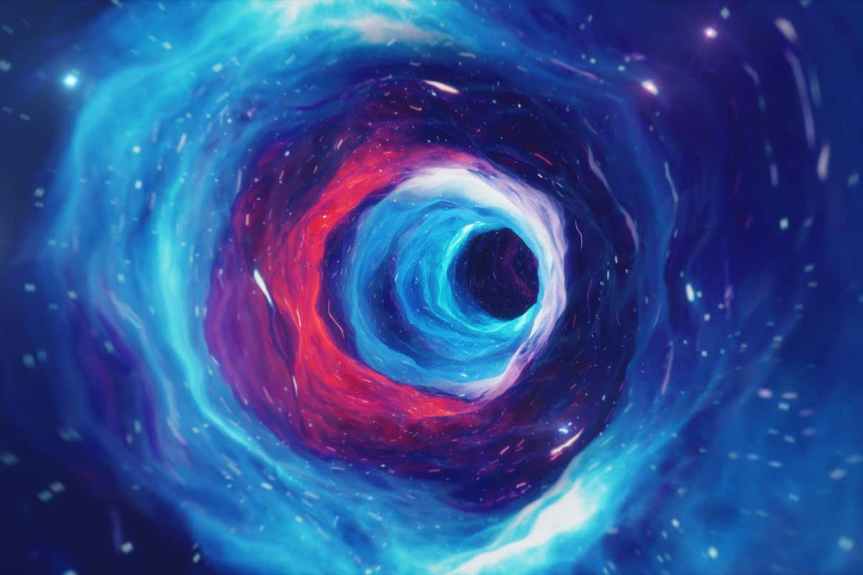
Wormhole

The wormhole theory postulates that a theoretical passage through space-time could create shortcuts for long journeys across the universe. Wormholes are predicted by the theory of general relativity. But be wary: wormholes bring with them the dangers of sudden collapse, high radiation and dangerous contact with exotic matter.

Wormhole theory

Wormholes were first theorized in 1916, though that wasn’t what they were called at the time. While reviewing another physicist’s solution to the equations in Albert Einstein’s theory of general relativity, Austrian physicist Ludwig Flamm realized another solution was possible. He described a “white hole,” a theoretical time reversal of a black hole. Entrances to both black and white holes could be connected by a space-time conduit.

In 1935, Einstein and physicist Nathan Rosen used the theory of general relativity to elaborate on the idea, proposing the existence of “bridges” through space-time. These bridges connect two different points in space-time, theoretically creating a shortcut that could reduce travel time and distance. The shortcuts came to be called Einstein-Rosen bridges, or wormholes.

PLAY SOUND

“The whole thing is very hypothetical at this point,” said Stephen Hsu, a professor of theoretical physics at the University of Oregon, told our sister site, LiveScience. “No one thinks we’re going to find a wormhole anytime soon.”

Wormholes contain two mouths, with a throat connecting the two. The mouths would most likely be spheroidal. The throat might be a straight stretch, but it could also wind around, taking a longer path than a more conventional route might require.

Einstein’s theory of general relativity mathematically predicts the existence of wormholes, but none have been discovered to date. A negative mass wormhole might be spotted by the way its gravity affects light that passes by.

Certain solutions of general relativity allow for the existence of wormholes where the mouth of each is a black hole. However, a naturally occurring black hole, formed by the collapse of a dying star, does not by itself create a wormhole.

Through the wormhole

Science fiction is filled with tales of traveling through wormholes. But the reality of such travel is more complicated, and not just because we’ve yet to spot one.

The first problem is size. Primordial wormholes are predicted to exist on microscopic levels, about 10–33 centimeters. However, as the universe expands, it is possible that some may have been stretched to larger sizes.

Another problem comes from stability. The predicted Einstein-Rosen wormholes would be useless for travel because they collapse quickly. 

“You would need some very exotic type of matter in order to stabilize a wormhole,” said Hsu, “and it’s not clear whether such matter exists in the universe.”

But more recent research found that a wormhole containing “exotic” matter could stay open and unchanging for longer periods of time.

Exotic matter, which should not be confused with dark matter or antimatter, contains negative energy density and a large negative pressure. Such matter has only been seen in the behavior of certain vacuum states as part of quantum field theory.

“A wormhole is not really a means of going back in time, it’s a short cut, so that something that was far away is much closer,” NASA’s Eric Christian wrote.

Although adding exotic matter to a wormhole might stabilize it to the point that human passengers could travel safely through it, there is still the possibility that the addition of “regular” matter would be sufficient to destabilize the portal.

Today’s technology is insufficient to enlarge or stabilize wormholes, even if they could be found. However, scientists continue to explore the concept as a method of space travel with the hope that technology will eventually be able to utilize them.

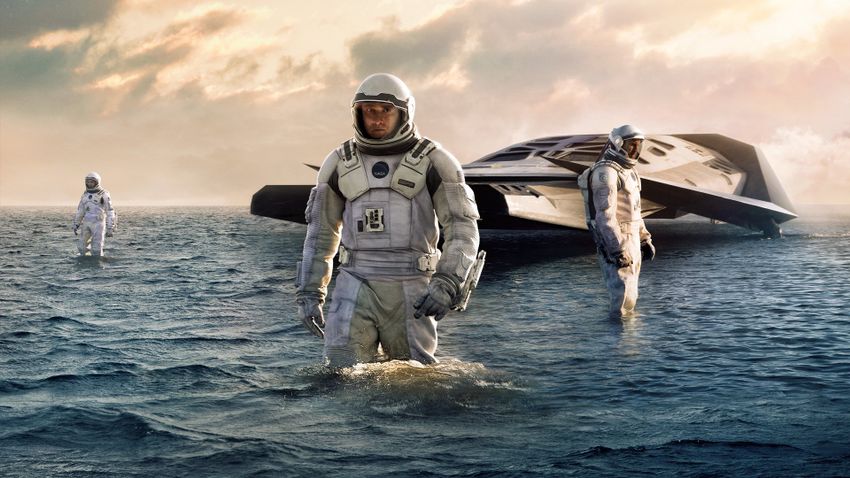
Movie Review: Interstellar

In Interstellar, the final frontier is not outer space but the fifth dimension, which exists beyond the three dimensions of space and the time dimension of relativity. This is not surprising: director Christopher Nolan conducted ambitious experiments with space and time in his prior films Memento and Inception. Here he returns to the set with a hypothesis that rests somewhat uneasily on both the hardheaded persistence of science and the earnest vulnerability of the human condition. For instance, it is noteworthy that Kip Thorne, a theoretical physicist who specializes in gravitational physics, served as a consultant and executive producer. Yet, Interstellar is a movie where “love” is uttered in the same breath as explanations for Einstein’s theory of relativity, and the formula to break the space-time continuum can be found in a child’s bedroom. What Nolan conveys is that the problem, the drive that pushes mankind to explore space is connected—inseparable, even—to the spaces of interiority we inhabit as individuals, and the solution lies beyond the perceptions cast in three dimensions.

What distinguishes Interstellar from his prior work is the way that Nolan tackles the consequences of the very same pleasure found in the technological offerings in his other films like The Dark Knight trilogy and The Prestige. Accordingly, his latest movie builds off these premises: that humans have exhausted all resources within 3D Earth, technology has accelerated its obliteration, and time is pushing the planet forward to ruin. The Atlantic’s Noah Gittell writes that when it comes to addressing the effects that technological fallout may have on the environment, “Hollywood has yet to adequately address [it]… When faced with unpleasant [End Page 92] realities, we all prefer a fantasy.”1 This is a movie that explores ways to escape Earth, and the protagonist Cooper (Matthew McConaughey), is charged with carrying out an undercover NASA mission to find a suitable planetary replacement. Cooper agrees to the mission after discovering NASA’s underground headquarters and meeting its de facto head Brand (Michael Caine), who spells dire consequences for Earth. This imperative pushes mankind out of the dust and out into the stars.

In the world of Interstellar, if man is contesting his place under the sun, then where does technology fall? Computers no longer serve as totemic objects; rather, they appear in a home-worn ubiquitous way, much in the same vein as Her, Gravity, and other recent sci-fi films. In Interstellar, technology is no longer representational—it does not appear as glitzy gadgetry that typically serve as plot gimmicks nor as the focus of cyborgian suspicion like with Ridley Scott’s David in Prometheus or Spike Jonze’s Samantha in Her. The film’s droids come in the form of TARS and CASE, and the former, voiced with deadpan humor by Bill Irwin, portrays none of the tension that arises from artificial sentience the way that his predecessors do. In fact, most of the technology looks worn: the ship is called the Endurance and the images of the team’s take-off look like they were pulled from footage of Cold War era space missions. Man’s greatest endeavors are meant to look fragile. At a moment of grave miscalculation, Cooper rages at Brand, the professor’s daughter and a scientist of her own right (Anne Hathaway): “We’re not prepared for this.” Movie critic A.O. Scott observes, “The Nolans cleverly conflate scientific denialism with technophobia, imagining a fatalistic society that has traded large ambition for small-scale problem solving and ultimate resignation.”2 The movie occupies half of its screen time in dust-baked American farmland. By juxtaposing scenery evocative of the 1930s Dustbowl with televised memorials of elderly Americans recounting the blight with an innocuous black laptop on a kitchen table collecting dust, the film subtly jolts viewers back to the movie’s futuristic premise.