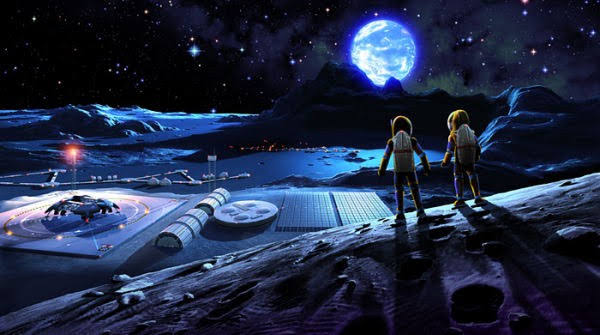
Yesterday when I lay asleep, a magical force lifted me from my bed and I found myself floating towards the skies rapidly. I saw the pale blue sphere that I was leaving behind. Earth never looked so magical before. I took a spin around the moon and marveled at the craters. I passed through the rings of Saturn and played hopscotch on the red soil of Mars. I made a snowman on the icy surface of Neptune. I saw the Milky Way from afar and was awestruck by the vast expanse of our Universe. I rode on the meteors that went whooshing by and saw pulsars and quasars. I almost got sucked into a black hole but pull myself away in time.I danced on the glowing surface of Venus and visited mercury.I took a spin around the sun without a single hair singed.After witnessing all the beautiful sight,I started feeling homesick. I slowly drifted back to the pale blue planet that we call home.Full of memories from the visit,I hoped to take another trip soon.Soon I was laid back on my bed and I drifted back into sleep.
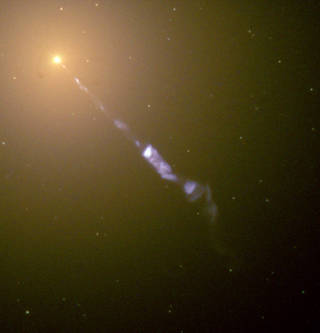
The elliptical galaxy M87 is the home of several trillion stars, a supermassive black hole and a family of roughly 15,000 globular star clusters. For comparison, our Milky Way galaxy contains only a few hundred billion stars and about 150 globular clusters. The monstrous M87 is the dominant member of the neighboring Virgo cluster of galaxies, which contains some 2,000 galaxies. Discovered in 1781 by Charles Messier, this galaxy is located 54 million light-years away from Earth in the constellation Virgo. It has an apparent magnitude of 9.6 and can be observed using a small telescope most easily in May. This Hubble image of M87 is a composite of individual observations in visible and infrared light. Its most striking features are the blue jet near the center and the myriad of star-like globular clusters scattered throughout the image. The jet is a black-hole-powered stream of material that is being ejected from M87’s core. As gaseous material from the center of the galaxy accretes onto the black hole, the energy released produces a stream of subatomic particles that are accelerated to velocities near the speed of light. At the center of the Virgo cluster, M87 may have accumulated some of its many globular clusters by gravitationally pulling them from nearby dwarf galaxies that seem to be devoid of such clusters today. For more information about Hubble’s observations of M87, see: http://hubblesite.org/news_release/news/2008-30 http://hubblesite.org/news_release/news/2000-20 http://hubblesite.org/news_release/news/2013-32
“Black Hole” almost everyone has heard this term but, what exactly it is? How it is formed? Is a black hole is danger? what if we pass near to black hole?
The idea of a body so massive that even light cannot escape was given by astronomical pioneer John Michell in a letter published by him in november 1784. And since after this an excitement was filled between astronomers and physicists about a body which is invisible. And in December 1967 in a lecture of John Wheeler one of his student reportedly suggested phrase ‘Black Hole’, which Wheeler adopted for his brevity.
Black hole was first spotted in 1971. But after 235 when it was first mentioned by John Michell in 2019, the Event Horizon Telescope(EHT) saw and captured an image of black hole in center of Galaxy M87 53.49 million light years away from earth. The images before this are just art work based imagination and properties of black hole done by astronomers and physicists to define black hole.
Image of black hole captured by Event Horizon Telescope in 2019
How Black Hole is formed? Let us first understand how a star is made. From cloud from Nebula(made of hydrogen and 25% helium) due to density compresses together and forms a shape some what circular, and this object after many million years becomes star one of like sun. The core of star burns hydrogen to be active, when after million years the fuel of star burns out then due to its own gravity and density it starts to compress itself. And if that star is bigger than our sun than it may form a neutron star or the star makes a negative gravity and starts to pull every mass near it. If we compress a massive body bigger than our sun into a size of a city say Mumbai, then it will become black hole. The gravity of this black hole so much increases that even light cannot escape from its horizon making it invisible.
A black can also be size of our sun but its gravity is 1 crore times more than sun. Albert Einstein in his theory of special relativity said that near the black hole the time will run slow. When a star becomes black hole it makes changes in fabric of space-time. And the movement will happen in only linear direction for a person inside it.
What if s person goes inside Black Hole? If a person goes near black hole than time will run slow for him compared to a person on earth. And as a person goes inside the black hole than he will feel so much gravity i.e. gravity 1 crore time more than our sun, that he can die. When a matter goes inside a black hole than due to gravity the atoms are separated and slowly it is vanished. But let say somehow a person survives than for the person it is like having a boon of immortality. If we put a black hole same as the size of sun and replace it with sun then probably nothing change will be happen, it cannot affect us. But due to lack of sunlight our earth will freeze and will only be a giant snowball.
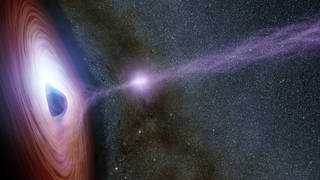
How to find a Black Hole? When a black hole tries to swallow a massive body than its own then it belch just like animals and it gives some portion of light. Black hole has gravity much higher that light like x-rays cannot escape, but when there is a material very close to horizon of black hole, matter is heated at millions of degrees as it is pulled towards black hole and glows in x-rays. Black hole can also be found by coronas. Black holes don’t give any light themselves, but they are often encircled by glowing materials and making it to shine with different types of light.
Corona coming out of a black hole
Types of Black Holes: There are four types four black holes. 1) Stellar-mass black holes As star reaches to the end of their lives, most will inflate, lose mass, and then will cool down to be a white dwarfs. But those with 10 to 20 times as massive as our sun, destined to either become a super-dense neutron star or stellar-mass black holes. Thousands of these stellar-mass black holes may lurk within our own galaxy. 2) Super massive black holes Super massive black hole are the ones predicted by Einstein’s general theory of relativity, can have masses equal to billion of suns; these cosmic giant creatures hide in the center of galaxies. The milky way hosts its own black hole called Sagittarius A* as is more than four million times massive than our own sun. 3) Intermediate Black holes Astronomers also suspect that there is class of so-called intermediate black holes exists in the universe, although evidence for them is so far debatable. 4) Miniature black holes The tiniest member of the black hole family, so far theoretical. These black holes may have swirled to life soon after the universe formed by big bang, some 13.7 billion years ago and quickly evaporated.
Answer to some questions about black holesIs it possible for a black hole eat entire galaxy? No. There is no chance that a black hole whatever is in size can eat a whole galaxy, because the gravitational reach of black holes(even super massive black holes) is not large enough to eat entire galaxy. What if sun turned it a black hole? The sun will never turn into a black hole as it is not massive to explode into a black hole. Instead sun will become a white dwarf. Have black holes have any influence on our planet? No. Even if we put a black hole in place of our sun then also it will not make a difference, earth will continue its rotation, but due to no sunlight it will we disastrous event on earth. Which is farthest black hole we found? The most distant black hole is located 13.1 million light years away from earth called “Quasar”. This black hole is made 690 million years after big bang.
We have found many black hole and learnt many things about them, yet many discoveries are to be made. And black holes will always amaze us.







 Eduindex
You must be logged in to post a comment.