

Hello everyone , Space Tourism will be possible. Like you go to other counties for a vacation from next year, you can go to space on a vacation. And most importantly, you wouldn’t need to undergo any training No need to become an astronaut to make this happen. Actually, friends, three people are making it possible.
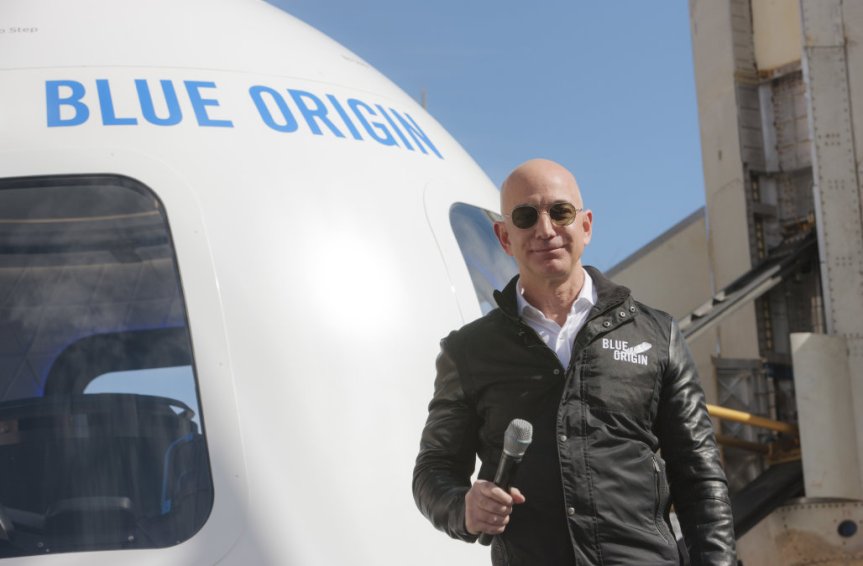
First, billionaire Richard Branson. The owner of the Virgin Group. His space tourism company is named Virgin Galactic. Second, Jeff Bezos. The owner of Amazon. His space tourism company is named Blue Origin. And third, Elon Musk. The owner of Tesla. His space company is named SpaceX.
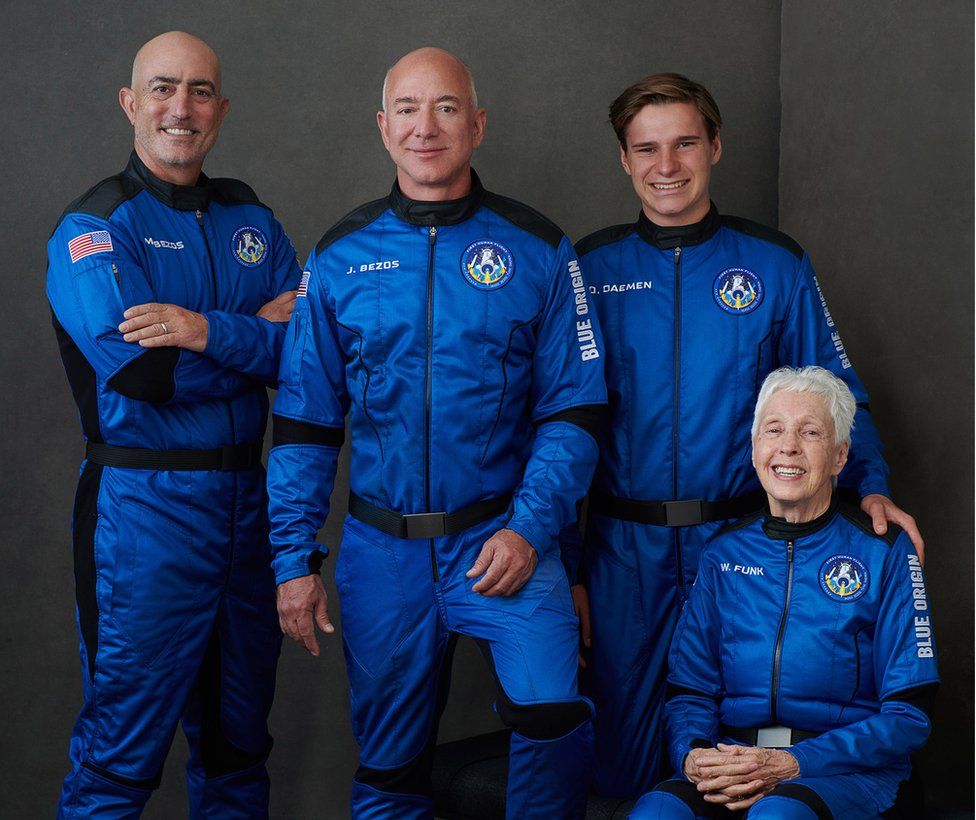
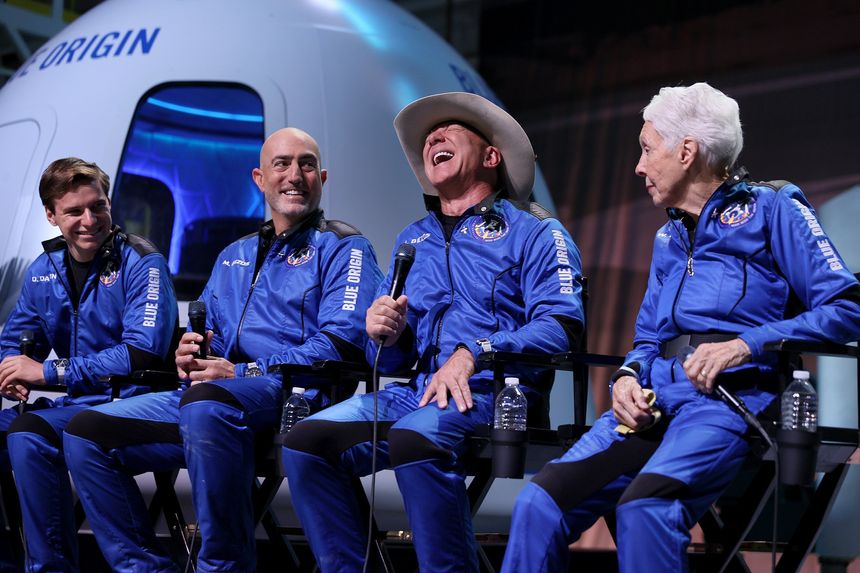
There was a neck-to-neck competition between the first two people to see who would be the first man in the world to go to space in their own rocket. Jeff Bezos had announced that he would do this on 20th July. After that, Richard Branson, who had originally planned to attempt this a few months later, preponed his plan.
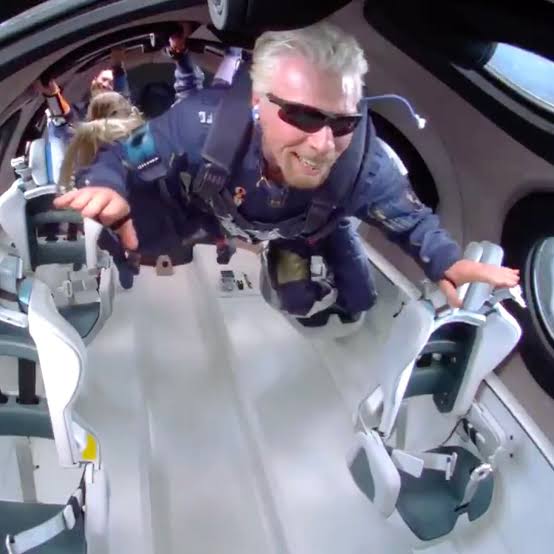
Richard Branson attempted this a few days ago, on 11th July. With two pilots and three other crew members he got into his Unity Spacecraft.
This Spacecraft flew into the sky. And this mission was successful. Leaving Jeff Bezos behind, he became the world’s first man to go to space in his own spaceship.
It’s very interesting to get to know the technical details of this feat. Because he wasn’t in a rocket that’s launched from a launchpad. Like you normally see in films or like astronauts usually travel, in a rocket. Instead, it was a kind of an aeroplane.
You can call this aeroplane a ‘Space Plane’ because it went into space. What happened was, there is a big plane on the runway, you can call it the ‘Mother Aircraft’ this smaller Space Plane is attached to it. It’s named Unity. Initially, both planes take off from the runway together because they’re attached. And when they reach around 50,000 feet altitude, this Unity Space Plane detaches from the Mother Aircraft. And then at supersonic speed, faster than the speed of sound, it goes towards space. And when we talk about going to space here,
What it exactly means is that it was 88 km above the earth’s surface. If you look out of the window at that height, you’d get to see the curvature of the Earth. This was the view from this flight. And most interestingly, at this height, the passengers of the plane can experience weightlessness.
Like the astronauts experience it. But the unfortunate thing is that, this plane doesn’t remain at that height for long. This weightlessness can be experienced for only 4 minutes on this Virgin Galactic flight. After that, this plane starts its descend. And lands on the runway like a normal aeroplane. It takes only an hour to complete this journey. And the part from the detaching of the Space Plane, reaching the top to landing back takes only 15 minutes.
So it’s not a very long journey. We could see all the photos and videos because Richard Branson live-streamed his test flight on the internet. Another interesting thing, Among the 6 crew members, one was an Indian-born woman. This incident is historic for many reasons.
Even though, Richard Branson wasn’t the first private civilian to go to space. Dennis Tito, an American entrepreneur, had paid $20 Million to be able to sit with the astronauts in the rocket to fly to the International Space Station and stay for 8 days. But that was different. Because he was going with the astronauts in an actual rocket.
But you can think of this as a private aeroplane. For this reason, you may think that Richard Branson didn’t actually go to space. If you do, then you wouldn’t be the first person to think that. Jeff Bezos’ space company, Blue Origin, they mocked this on Twitter. They said that there will be an asterisk (*) next to Richard Branson’s name because he went up to the height of 88 km only.
When globally, most scientists believe that space actually begins at the height of 100 km. This 100 km line is known as the Karman Line. Internationally, the astronauts’ organization in European countries they believe that this line at 100 km is the official boundary between our atmosphere and space.
But in the USA, the US government and NASA believe that the boundary between the atmosphere and space starts at the height of 80 km. So in the defense of Richard Branson, it can be said that according to the US standards, he has gone into space.
But not according to the International standards. That’s why Jeff Bezos’ company mocked him. And now when Jeff Bezos will attempt to go to space on 20th July, he will try to cross this line at 100 km. The difference is very critical here. When Jeff Bezos will attempt it, it will be in the spacecraft built by his company that’s like a rocket. So he’ll go up in a rocket.
His company claims that not only will they reach beyond 100 km but also that the windows on this spacecraft will be huge. So that you can enjoy watching the Earth. But the windows on the Virgin Galactic’s spaceplane, were of the size of an aeroplane’s window and so quite small. Second, Blue Origin claim that their spacecraft will have an escape system that was missing in the Virgin Galactic’s spacecraft.
Third, they claim that their rocket will not have an environmental impact because they’ll use environment-friendly fuel. The exhaust will be only water. But in the case of Virgin Galactic, Nitrous Oxide, which is very harmful, is being released. It is very damaging to the environment. If you find stories about space to be interesting,
I’ll talk about the environmental impact at the end of the video. First, let’s talk about how expensive it will be if you want to go too. What will be the cost? The price of one ticket of the Virgin Galactic’s flight will be $250,000. In Indian currency, it’ll cost around ₹20 million – ₹25 million. (₹2 crore – ₹2.5 crores) It’s up to you whether you can afford it or not.
Our politicians can definitely afford this. 600 people have already reserved tickets for next year. There are many famous names among them. Like Justin Bieber and the actor Leonardo DiCaprio. They are expecting full commercial service by 2022.
And Richard Branson says that eventually, the price will be lowered when more people will start using it. He says that eventually, the price of the ticket may be as low as $40,000. Around ₹3 million – ₹3.5 million. (₹30 lakh – ₹35 lakh) Definitely, today it is not something that a common man can afford.
But once it starts, maybe 10 or 15 or 20 years down the line, I think that normal people will also be able to afford it. On the other hand, we don’t know the exact price of the ticket for Jeff Bezos’s spacecraft. But one ticket was auctioned in June, that was sold for $28 million.
Same with Elon Musk’s SpaceX, one ticket was auctioned that sold for $55 million. But that’s a bit different because they’re proper rockets. And it’s possible that Elon Musk’s flight may take you to the International Space Station to travel.
And the ticket cost obviously includes the training and on-flight accommodation. In the beginning when I had said that no training is required, I meant that one wouldn’t need astronaut-level training to do this.
But you’d still be given some basic training. About how you should behave in zero gravity. And what you should do in case of any emergencies. You’d obviously be told all this. Some people may be scared after knowing all this Because they’d be undertaking a new thing and going to space they may lose their lives if there is any technical problem.
So how realistic is it to be scared of it? It is very realistic. Because you’re going to space. So it hasn’t been tried out enough. If you do this next year, you’d be one of the first people to do so. So there are many risks. Even Richard Branson acknowledges this. He had revealed his intention of building a spaceplane in 2004.
He thought space tourism would be possible by 2007. But after so many problems and hurdles, one of his test flights crashed in 2014. In which some people were even killed. Now, this is finally ready in 2021. His test flight has been successful. But there are many risk factors apart from the flight crashing.
Because generally when Astronauts go into space, they are given severe training to do so. But when space tourists will go to space, they will not undergo any health checkup or fitness checkup. So we don’t know what problems they may have to face. Additionally, the impact of zero gravity on the human body, has never been studied in the long term. Because space travel is a very recent phenomenon.
Additionally, the G-force that you’d have to face, and the radiation at that level maybe quite high. These are also some factors. Though, the Federal Aviation Administration of the USA has said that the radiation that you might experience at that height will be insignificant and not a cause for worry. But looking at the other risk factors, when you’d go to do this, obviously, they will get a form signed by you like shown in the film Zindagi Na Milegi Dobara. Before skydiving, you need to sign a liability waiver form. If there’s any harm to you, then it is your responsibility.
The company will not bear any responsibility. Now, let’s talk about the environmental impact. Many people have criticised all three billionaires on this point. That space tourism will be something that only the rich can afford. Only the top 0.1% of people. But it will lead to so much pollution and the environmental impact of this will be so large, that it is very disproportionate.
The other people will not get the opportunity to do this but the environmental impact on the Earth will have to be borne by the others as well. Talking about Virgin Galactic, the CO2 emissions in a normal flight per passenger per mile is at 0.2kg here you’d get 12 kg of CO2 emissions.
A difference of 60 times. Apart from this, Nitrous Oxide, when it’ll be released into our atmosphere, it will lead to ozone depletion. You’ve learnt in school how important the ozone layer is in our atmosphere. It protects us from the ultraviolet rays of the sun.
The second problem is that when these rockets take off from the land so much heat is generated, that the ozone levels increase at ground level. Ozone near the surface is useless. Higher in the atmosphere, it is beneficial. An increase in ozone at the ground level will be harmful to us. Losing ozone from the ozone layer will be harmful to us. And this will be the result of space tourism.
Ozone will increase near the surface and decrease from the atmosphere. In the case of Jeff Bezos too, even if no harmful gasses are emitted from his rocket, when it takes off from the ground, it will lead to a lot of heat being generated. This again leads to a threat to the ozone levels. These are some points that we’d have to remember in the near future. When space tourism will become more common. And these billionaires will have to come up with their solution.

 Eduindex