Issues due to Caste System in India

Daily writing prompt
What is the greatest gift someone could give you?

By Shashikant Nishant Sharma

The caste system in India has been a defining feature of its society for centuries. Rooted in ancient traditions, the caste system categorizes individuals into distinct social groups based on their birth, determining their occupation, social status, and even personal relationships. While some proponents argue that it provides a sense of identity and order, a critical examination of the caste system reveals its inherent flaws, perpetuation of discrimination, and hindrance to social progress.
Social Inequality and Discrimination:

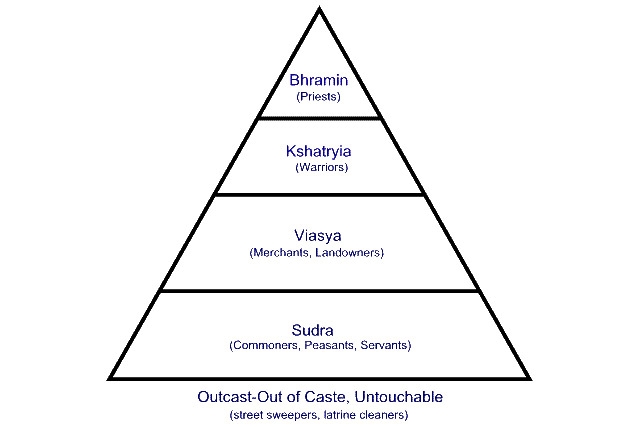
The caste system reinforces a rigid social hierarchy that categorizes individuals into four main varnas (castes) – Brahmins (priests), Kshatriyas (warriors and rulers), Vaishyas (merchants and farmers), and Shudras (laborers). Additionally, there are numerous subcastes and Dalits (formerly known as untouchables) who are marginalized and subjected to severe discrimination. This system institutionalizes inequality and denies equal opportunities, social mobility, and basic human rights to those born into lower castes.

Occupational Limitations:

One of the key features of the caste system is the hereditary nature of occupations. Individuals are expected to follow the occupation associated with their caste, regardless of their interests, skills, or aspirations. This restricts social and economic progress, preventing individuals from pursuing professions of their choice and contributing to a lack of innovation and entrepreneurship within society.

Discrimination against Dalits:

The Dalits, historically regarded as the lowest caste, face extreme social exclusion, violence, and economic marginalization. They are subjected to inhumane treatment, denied access to public spaces, and suffer from limited opportunities for education and employment. Despite legal protections and affirmative action policies, discrimination against Dalits continues to persist, perpetuating a cycle of oppression and injustice.

Inter-caste Marriages and Social Stigma:

The caste system maintains a strong influence on personal relationships, particularly marriage. Inter-caste marriages are often met with opposition, leading to social stigma, ostracization, and sometimes even violence. This rigid enforcement of caste boundaries hampers the development of a cohesive and inclusive society and curtails the freedom of individuals to choose their life partners based on love and compatibility.

Impediment to National Unity and Progress:

The caste system fragments Indian society along caste lines, leading to division and social unrest. The caste-based politics that emerge from this system further exacerbate these divisions, hindering collective progress. Instead of focusing on issues such as poverty, education, and healthcare, political leaders often exploit caste-based identities for electoral gains, impeding the nation’s overall development.

The caste system in India, while deeply ingrained in the country’s social fabric, poses significant challenges to equality, justice, and progress. Its perpetuation leads to social inequality, discrimination, and the denial of basic human rights. Addressing the caste system’s deep-rooted issues requires concerted efforts from society, policymakers, and educational institutions to promote inclusivity, eradicate discrimination, and create a more equitable and just society for all. Only by challenging and dismantling the caste system can India realize its full potential as a diverse and united nation.

References

Bidner, C., & Eswaran, M. (2015). A gender-based theory of the origin of the caste system of India. Journal of Development Economics114, 142-158.

Dehalwar, K., & Sharma, S. N. (2024). Politics in the Name of Women’s Reservation. Contemporary Voice of Dalit, 2455328X241262562.

Dehalwar, K., & Sharma, S. N. (2024). Social Injustice Inflicted by Spatial Changes in Vernacular Settings: An Analysis of Published Literature.

Ogbu, J. U. (2020). The consequences of the American caste system. The school achievement of minority children, 19-56.

Olcott, M. (1944). The caste system of India. American Sociological Review, 648-657.

Srinivas, M. N. (2017). Mobility in the caste system. In Structure and change in Indian society (pp. 189-200). Routledge.

Stevenson, H. N. C. (1954). Status evaluation in the Hindu caste system. The Journal of the Royal Anthropological Institute of Great Britain and Ireland84(1/2), 45-65.

Caste in the Modern Age

Caste system is an extreme form of stratification peculiar to India and is hereditary in nature. The above stated system of stratification offers no vertical mobility. One is ascribed his caste from his/her birth and does not have the liberty to choose his/her caste.

Characteristics of Caste System:

  1. Caste: As a hierarchical division of society: The Hindu society is a gradational one. It is divided into several castes and subcastes. A sense of ‘highness’ and ‘lowness’ or ‘superiority’ and ‘inferiority’ is associated with this gradation.
  2. Restrictions on food habits: The restrictions on food habits of the members differ from caste to caste. “Who should accept what kind of food from whom?” is often decided by the caste.
  3. Restrictions on social relations: The idea of ‘pollution’ makes this point clear. It means a touch of a lower caste man would pollute or defile a man of higher caste. Even his shadow is considered enough to pollute a higher caste man.
  4. Social and religious disabilities of certain castes: In the traditional caste society, some lower caste people [particularly, the Harijans] suffered from certain civil or social and religious disabilities. Generally, the impure castes are made to live on the outskirts of the city or the village. Educational facilities, legal rights and political representation were denied to them for a long time.
  5. The civil and religious privileges of certain castes: If the lower caste people suffer from certain disabilities, some higher caste people enjoy certain privileges.
  6. Restrictions on occupational choice: In a caste ridden society, there is a gradation of occupations also. Each caste has its own specific occupation and these were almost hereditary.
  7. Restrictions on marriage: Caste is an endogamous group. Endogamy is a rule of marriage wherein a person has to marry within his or her own caste group.

Changes in the caste system:

The caste system which is an integral part of the Indian system, prior to the coming of the British, had grown into a powerful social institution, with the dominance of Brahmins at the top of the hierarchy. The modern period saw some major developments taking place in the caste system during the two stages:

  1. Caste during the British rule
  2. Caste in Independent India

Caste during the British rule:

  1. Declining hold of Caste Panchayats: The British introduced throughout India uniform legal, legislative and judicial systems. They transferred the judicial powers of the caste councils to the civil and criminal courts which affected the authority which the caste panchayats held on its members.
  2. Influence of social legislation: Some legislations which the British introduced shook the integrity of the caste system. A few of the legislations are as follows:
    1. The Caste Disabilities Removal Act of 1850.
    2. The Special Marriage Act of 1872
    3. The Hindu Widows Remarriage Act of 1856
  3. Impact of social reform movements: The social reforms launched by social reformers during the British rule attacked the caste system and its inequalities. The Brahma Samaj, The Prarthana Samaj, The Arya Samaj, etc focused on condemning and iradicating some stern beliefs related to the Caste system.
  4. Spread of english education and influence of western Ideas: With the establishment of British rule in India came the inflow of many western ideologies such as equality, liberty, democracy, etc.
  5. Influence Of Industrialization: The growth of industries destroyed the old crafts and household industries and provided for countless ways of earning livelihood. People of all castes started making use of new economic opportunities.
  6. Impact of urbanization: In order to reap the benefits of the new opportunities, people started moving towards towns and cities in large numbers.
  7. Influence of freedom struggle and Gandhiji: The freedom struggle organized by the Indian National Congress brought together people of different castes, classes and religions under one banner.

Caste in Independent India:

The political independence of the country brought in a series of changes in the caste system.

  1. The religious beliefs of the caste has been attacked. Caste is no more believed to be divinely ordained.
  2. The restrictions on food habits have been relaxed.
  3. Caste is not very much associated with hereditary occupations.
  4. Endogamy, although still prevails, is not seen as an obligation to all.
  5. The special civil and religious privileges which the Brahmins enjoyed are no more being enjoyed by them.

Although caste still continues to be a segmental division of Hindu society, it is not as much strict as it was before th modern era. There have been certain changes in the role of caste as well in the independent India. Caste has now become an inseparable part of politics. The caste- consciousness of the members has been increasing making every caste wanting to safeguard its interests. The constitution of India has made enough provisions to protect the interests of the Scheduled Castes and the Scheduled Tribes. Caste has its roots embedded deep within the social structure of India and it is next to impossible to completely eradicate it from the social structure of India.

Impact of caste dynamics in contemporary India

The association between various caste groups has now become more flexible and is now at ease. One of the significant impacts in the contemporary age is personal job preference. In the past, men believed in pursuing occupation under its caste like mainly they were engaged in pottery, blacksmithing etc. However, the current scenario is very much different, people have started pursuing jobs of their own choices irrespective of their caste such as in railways, teaching, government jobs, marketing and business. The food habits of the people have been modified, sharing of food is now common between both the sections of society and nowadays people of both upper and lower caste enjoy their food in restaurants in the local together. Power and wealth are almost in least association with the caste. The belief that the lower castes are responsible for pollution and freshness has now somewhat become extinct. However, in petto, rituals of purification with regard to one’s caste ranking, such practice still prevails. The custom of marrying only within the limits of a caste is still in practice, though not as severely as in the past. Lower sections of the society still faces difficulty in pursuing of caste related occupation and access to essential resources in extreme remote rural areas, however in urban areas, caste has almost nil significance in the society. The growth or ranking of women is still based on man’s positioning in the society. But today awareness of equal rights of women, education, employment are eventually advancing the modern society. The Indian Constitution made and implemented various special provisions, due to which competition among the caste groups in order to access the power and necessities like better life enhancement, educational benefits, government oriented jobs, etc. have gained force.

Implementation of such provisions and policies have always been the talk of the town and ground to numerous controversies, although political parties support these policies seemingly for their political benefits, but keeping it aside, it has been of great significant to the people belonging to the lower caste especially the Scheduled Castes (SCs), Scheduled Tribes (STs) and backward classes (OBCs). These groups have grabbed every opportunity provided to them and excelled in it. In the elected offices, these groups have greater representation. They have proved to be an essential part of the Indian political election system. They have also successfully mend their paths in each and every institution, be it political, legal or educational, and also secured high posts in government jobs. In a number of regions, these caste groups have succeeded in forming powerful parties in politics.

However, regrettably, a small portion of people belonging to the lower caste have gained profit from the policies and provisions made by the Indian Constitution. When observed from far, other sections of society seem to have willingly accepted the individuals of the lower castes, but the reality is quite contrary, in numerous parts of India, the upper castes still treat the lower caste’s individuals as outsiders and deny them access to resources. Such an incident came into light in parts of Bihar, India in 1994, the landowners of the upper caste formed a special army known as Ranvir Sena in order to defend themselves from lower caste’s individuals. Though fortunately by 1999, this was disbarred, the Ranvir Sena had already slaughtered 20 Dalits. The upper caste’s individuals who are against the special polices made for the lower castes and also those who are at any sort of economic disadvantage by the implementation of such policies, often are responsible for the mistreatments against lower sections.

The caste system has played a vital role in molding the ethics, principles as well as habitation of the society in India. The rituals  and customs of Hindu philosophy greatly influence the faith and lives of the Indians. Post independence, Indians are still in the clutch of beliefs regarding one’s social rank and their caste status. In the ancient days, people of a common society were divided on the basis of caste, sex and birth. Since birth they had their lifestyles organized according to their specific caste rule and had no choice preference as such. However, with the course of time the linkage between one’s occupation and caste has become almost insignificant. In urban areas, interaction among various castes is without restriction. The current Indian society is progressing eventually from the closed caste system to interactive functioning of the society irrespective of any caste. The various provisions and policies implemented by the government have encouraged the lower sections to come forward and represent themselves in the society. Such provisions have also encouraged the people of other caste groups to be secular towards one another. Therefore, it is essential to look after how caste discrimination has affected the standard of life and mobility of society in contemporary India.

Did Caste Reservations Is Good Or Bad … ?

Hello everybody, In order to end caste discrimination from the country, the government introduced the policy of caste reservation after independence. And this has been quite a controversial issue. People debate on this issue a lot but very few have sought answers as to whether caste reservations have actually been effective in changing and improving the lives of SCs and STs and in decreasing caste discrimination. Specifically, we will look at the impact of reservation in three different areas; public education institutes, government jobs and political representation. Outputs vs Outcomes Before talking about the impact of caste reservation, I would like to explain this basic difference to you. What is the difference between output and outcome? It is important for you to understand this so that you can understand the content of this video going forward. These two words sound similar but there is a big difference between the two. 

Let’s take the example of Swacch Bharat Abhiyan. What was the target outcome of Swachh Bharat Abhiyan? What did the scheme actually intended to achieve? Make India Open Defecation free! Make it clean, increase sanitation in the country and decrease the number of diseases that occur due to lack of cleanliness. But how will Swachh Bharat Abhiyan achieve its outcome? It will be through outputs. The output of Swachh Bharat Abhiyan was to construct toilets. Outputs tell us how effectively a policy has been implemented and on the other hand outcomes tell us the impact of implementing the policy. It is easy for governments to ask for votes in the name of outputs. 

This is the reason governments want to focus more on outputs. with claims like- Look how many toilets we have constructed…look how many free cycles we have distributed to girls. But in reality if we really want to develop our nation then we should focus on the outcomes. Did building more toilets result in the nation becoming cleaner? Did dirtiness in the county actually lessen? Did distributing cycles to girls result in them being more educated? Similarly, when we talk about the impact of caste reservation in this video, we will first look at the output -whether caste reservation has resulted in larger representation of lower caste in colleges (which is an output) Thereafter we will look at the outcome whether lower caste people got better job opportunities? Have their lives improved? Have their incomes risen? And has caste discrimination decreased in society? Let’s talk about outputs in higher education first. Has reservation resulted in increased representation of the marginal groups in higher educational institutes or not? Article 15 and 16 of the Constitution has given powers to our government to reserve seats in educational institutes and in matters of public employment.
 According to population shares, about 22% seats have been reserved for SCs and STs. So the first question is has reservation resulted in increased representation of the SCs and STs? Yes, it has increased. From 1970 to 1990s, this representation has increased for both the groups and according to the latest higher education survey; this representation has increased further as well. But can we say with utmost guarantee that reservation is the reason behind the increase in representation? It is possible that due to good economic growth in India, SCs and STs have been uplifted more and this is the reason behind the increase in their representation and not reservation. If we want, we can speak of it in probabilities but as told by a researcher, we cannot say with guarantee that reservation only is responsible for it. Despite the increase, we must focus on the fact that the representation share of STs is still lower than their seat reservation number. One of the most common criticisms of reservation is of the creamy layer. According to this theory, the SCs and STs that do get reservations do not belong to some poor family but are in fact from a rich family and because of their reservation, the people belonging to the poorer section from the general category do not get seats.
 Researchers have looked into this as well. They found out that the SCs and STs that do get reservations are better off in their own group but their situation is not better than general category people. The second argument given against reservation in education is that the reserved students have lesser score requirements. This might help them get a seat but after getting into the college, they would struggle and this seat would be wasted. In a research conducted in 215 engineering colleges, it was found that there isn’t any evidence that suggests that reserved students are not able to cope up with the syllabus. Now, let’s talk about public employment. Let’s get to know whether reservation has resulted in the increase in representation of SCs, STs and other marginal groups in Indian bureaucracy or not.

 According to government data, there has been an increase in representation of SCs and STs in government administration. But when we look at this data in detail and divide the government positions in different levels, we see that SCs, STs do have representation but it is mostly in lower positions. For example, their representation is near their representation quota only in group C and group D category. SCs have higher representation in group D positions because many of these people are “Safai Karamcharis” (sanitation workers) In fact, almost 40% Safai Karamcharis belong to the scheduled castes. A common criticism against reservation in government jobs as well is of the creamy layer. A researcher investigated the same but found no evidence to support this creamy layer theory. One more argument that is quoted against reservation in government jobs is that if people from the marginal groups enter governance then the effectiveness of governance will be compromised. 
But researchers did not find any evidence regarding this as well. Two researchers conducted a very interesting study to investigate this. They considered the data of Indian railways from 1980 to 2002 and studied 15 lakh railway employees. They wanted to see if reservation affected the productivity of the Indian railways in a negative manner. After analyzing, they found no such evidence suggesting that the efficiency of the railways were decreasing due to reserved employees. In fact, in some cases, they found out that the efficiency increased due to the reserved employees. Reservation has resulted in increased representation of disadvantaged groups in public administration and higher education institutes but what has been its impact in their lives? Let’s get to know about that.
 According to research, overall it has had a positive impact in their lives but there is a lot of room for improvement even now. For example, a research highlighted that post reservation in government jobs, the representation of SCs and STs in salaried jobs increased by 5%. Another study highlighted that reservation in government jobs has resulted in boosting the morale of OBC students and they started studying more. Due to reservation, on an average, a student started studying for 0.8 years more. If we talk about reservation in political seats then we see a mixed impact. According to one study, reservation in gram panchayat has resulted in decrease in poverty amongst the STs but a similar impact was not seen in SCs Another paper showed that reservation in politics has not only resulted in more jobs for SCs and STs but government schemes have also started targeting them more. Another study tried investigating the impact of quotas in panchayat elections. 
They found out that because of these quotas the people from the disadvantaged groups get more aid from the MNREGA scheme and there is improvement in their roads, water and education as well. Another study that was conducted in Rajasthan found that when a SC sarpanch is elected then the entire community benefits in many ways. If you look at all these studies then you feel like that reservation is quite a good policy tool resulting in so many positive changes. But we should also remember that reservation cannot change everything. The same researchers also said that despite a SC Sarpanch, the relationship between different castes did not change much within the village. And we have seen many such examples that reservation wouldn’t necessarily result in changing the undercurrent of the society. Recently, we saw a report where a SC panchayat President had to sit on the floor because of her caste in Tamil Nadu. 
“The woman panchayat leader there has not been allowed to sit on a chair. She was sitting on the floor and she also alleged that she was also not allowed to hoist the flag.” Many researchers have even talked about the same as well that including quotas in political representations do not guarantee benefit to marginal communities. A researcher said that to win any panchayat election, a leader needs support from different social groups and this is the reason that many times they would not take such a decision that will only help their group. Despite these benefits of reservations, there is a huge gap between lower caste and upper caste people today. Data from 2011 shows that a Brahman adult on an average acquires 5.6 years of more education over the course of his lifetime as compared to a scheduled tribe adult. This map is from 1954. This shows how people reside on the basis of caste in the country. 
Even after 6 decades, there isn’t a huge change in it. This table shows you a comparison of average income, assets and education level across different caste groups. You can easily see that forward caste members compared to the rest of population are quite ahead in every aspect. All these data proves that only caste reservation is not enough to solve the problem of caste discrimination in our country. And this is not just my opinion. DR. B R Ambedkar opined the same in his book Annihilation of Caste. Greater social integration simply means that people from different castes live together in every aspect of life. Not just lie in the same societies but also participate in similar activities and inter caste marriages also rise. We gave a great example of the same in the last video that how researchers conducted an experiment where they organised a cricket tournament. 
They observed that the teams which had members from different caste had greater sense of friendship which does not happen when all the players in a cricket team belong to similar caste. Actually schools are one of the best social settings to enhance this integration. According to another research experiment conducted in Delhi schools found out that the classes where poor and rich kids mingle, the rich kids discriminate lesser and they interact more with poor kids. And if such interactions happen more is school and colleges then inter-caste marriages will automatically rise in the country consequently resulting in decrease in discrimination. Another research found out that if women in the country are given the independence to choose their husbands while marrying, 20% of such cases are inter-caste marriage. But in reality, in the entire country only 6% marriages are inter-caste marriages. 
So an interesting connection can be seen here that how giving the right to choose to women i.e women empowerment increases inter caste marriage and also results in reduction in caste discrimination. This is the reason that some governments have tried promoting the same. Recently, Odisha government has announced a scheme to incentivise social harmony They launched a Sumangal portal to increase inter-caste marriages in the state. But this is not just the job of the government alone. Here, the Police and judiciary too need to take swift action in cases of discrimination. Prevention of Atrocities Act, 1955 tries to protect SCs and STs from discrimination. But the evidence that has come to the front suggests the provisions of act have been barely utilised. The conviction rate is quite low and the backlogs are quite high in such cases. There was a study conducted of 100 such cases in Andhra Pradesh in 2002-03. The study found out that the Police usually does not register such cases or pressurise lower caste individuals to compromise and the accused doesn’t get arrested here. 
Another good example of improving the system is to not only provide reservation for seats but also offer free coaching to marginalized groups. One such scheme was launched by the Ministry of Social Justice in 2016 where SCs and OBCs were offered free coaching for UPSC, NEET and JEE exam. It was reported that more than 10 percent of students who availed the benefits of this scheme cracked these exams. So these are some solutions/suggestions to improve the reservation system in order to further reduce the caste discrimination in our country and equality flourishes. Some people would argue that reservation is actually against equality because the hard work put in by us in order to secure a seat, our options shrink and an undeserved candidate takes our seat away. In my opinion, it is quite a narrow perspective to look at the entire situation here. Imagine, you are competing with one lakh people and you write an exam to get selected on one of the 100 seats. 
Amongst these 100 seats, say 50 seats are reserved. But think about that if you are competing with one lakh people just for 100 sets then how difficult it is in the first place itself. And if the seats are reduced from 100 to 50 then does that make any difference to the difficulty level? But imagine if there were 1000 seats instead of 100 for which one lakh people were competing. 
If 50% were reserved then you would write the exam for 500 seats but otherwise you were writing for 50 seats. It is not right to blame reservation for this problem. If the exam is so competitive and seats are so less then this problem is of our education system. 
Ask the government to build more universities, schools and colleges so that seats can be increased. Or the education system should be overhauled such that people go to other fields and more jobs are available. 

Caste Discrimination

Caste discrimination is one of the most exceedingly awful denials of basic freedoms on the planet today. It is minimal perceived and infrequently recognized, and influences in excess of 260 million individuals around the world. Through a hierarchical situation, the task of essential rights among different castes is profoundly inconsistent, with those at the top getting a charge out of most rights combined with least obligations and those at the base performing most obligations combined with no rights. The situation is kept up with through the inflexible implementation of social segregation (an arrangement of social and financial punishments).

Caste discrimination includes enormous infringement of common, political, financial, social and social rights. It is normal banned in nations influenced by it, yet an absence of execution of enactment and caste-inclination inside the equity frameworks to a great extent leave casualties without security.

The rejection of supposed ‘lower caste networks’ by different gatherings in the public eye and the intrinsic underlying disparity in these social connections lead to significant degrees of neediness among influenced populace gatherings. There is little admittance to advantages and improvement measures, and their position by and large blocks contribution in dynamic and significant investment openly and common life.India’s caste framework is maybe the world’s longest enduring social progressive system. A characterizing highlight of Hinduism, caste includes an unpredictable requesting of gatherings of people based on custom immaculateness. An individual is viewed as an individual from the caste into which the person in question is conceived and stays inside that caste til’ the very end, albeit the specific positioning of that caste might differ among areas and over the long run. Contrasts in status are generally advocated by the strict regulation of karma, a conviction that one’s place in life is controlled by one’s deeds in past lifetimes.

Conventional grant has portrayed this over 2,000-year-old framework inside the setting of the four head varnas, or enormous caste classes. Arranged by priority these are the Brahmins (ministers and educators), the Ksyatriyas (rulers and officers), the Vaisyas (dealers and merchants), and the Shudras (workers and craftsmans). A fifth classification falls outside the varna framework and comprises of those known as “untouchables” or Dalits; they are regularly appointed undertakings also customarily dirtying to justify incorporation inside the customary varna system.7 Almost indistinguishable designs are likewise noticeable in Nepal.

Regardless of its established abrogation in 1950, the act of “distance”- the inconvenience of social incapacities on people by reason of birth into a specific caste-stays a lot of a piece of rustic India. Addressing more than one-6th of India’s populace or exactly 160 million individuals Dalits suffer close to finish social segregation. “Untouchables” may not go too far isolating their piece of the town from that involved by higher castes. They may not utilize similar wells, visit similar sanctuaries, or drink from similar cups in tea slows down. Dalit youngsters are regularly made to sit at the rear of study halls. In what has been called India’s “covered up politically-sanctioned racial segregation,” whole towns in numerous Indian states remain totally isolated by caste.

“Distance” is supported by state portion of assets and offices; separate offices are accommodated separate caste-based areas. Dalits frequently get the less fortunate of the two, in the event that they get any whatsoever. In numerous towns, the state organization introduces power, disinfection offices, and water siphons in the upper-caste segment, however fails to do likewise in the adjoining, isolated Dalit region. Fundamental conveniences, for example, water taps and wells are additionally isolated, and clinical offices and the better, covered rooftop houses exist solely in the upper-caste province. As uncovered by the contextual analysis underneath on the tremor in Gujarat, these equivalent practices remain constant even in the midst of extraordinary cataclysmic event.

Caste System in India

Indian society is split into several sects and classes. This is due to the existing caste structure in the nation. The origins of the caste system may be traced back to the ancient Vedas, which divided individuals based on varna, or vocation. It has brought about a slew of calamities in society. The government is continuously working to address the system’s flaws and achieve real equality among the people. The caste system is the bane for the Indian society. It divides the Indian society into sectarian groups and classes. Even today, it plays a predominant role in our society despite the growth of culture and civilization.

The official words used in government papers to designate erstwhile untouchables and tribes are ‘Scheduled Castes and Scheduled Tribes’ (SC/ST). However, after noticing that the term ‘Dalit’ was being used interchangeably with the official term ‘Scheduled Castes,’ the National Commission for Scheduled Castes asked state governments to stop using the term ‘Dalit’ in official documents, calling it ‘unconstitutional,’ and to replace it with the term ‘Scheduled Caste’ instead.

The caste system’s origins may be traced back to prehistoric times. While one school of thought distinguishes castes as higher and lower castes based on their origin, another school of thought links the origins of castes to varnas, which classify the caste system based on their roles. Since then, it has been discovered that those with an advantage and a say in the community have taken unfair advantage, resulting in discrimination and exploitation of the group’s weaker members.
People from Scheduled Castes and Scheduled Tribes, sometimes known as “untouchables,” account for one-sixth of India’s population, approximately 160 million people; they face prejudice and segregation.

Evil faces of this system:-

Untouchability:- Many communities are divided by caste, and they are not permitted to cross the line separating them from the upper castes. They may also not drink from the same wells or visit the same tea shops as higher castes.

Discrimination:- In lower caste neighbourhoods, they frequently lack access to power, sanitation, and water pumps. Higher castes are denied access to better education, housing, and medical services.

Division of labour:- They are restricted to certain occupations like sanitation work, plantation work, leather works, cleaning streets, etc.

Slavery:- They are subjected to exploitation in the name of debt, tradition, etc., to work as labourers or perform menial tasks for generations together.

Government Initiatives

The Indian government has passed legislation to abolish untouchability and has implemented several reforms to enhance the quality of life for the poorer parts of society. Among them are the following:

  • Fundamental human rights are guaranteed by the constitution.
  • In 1950, the term “untouchability” was abolished.
  • Act to Prevent Atrocities Against Scheduled Castes and Tribes, 1989.
  • Reservations in locations such as educational institutions, career possibilities, and so forth.
  • Creating social welfare ministries and national committees to look after the interests of scheduled castes and tribes.

The government’s initiatives have provided some assistance to the weakest sectors of society. The metropolitan regions have had a significant influence and have showed some progress. People in rural areas and villages, on the other hand, continue to experience severe prejudice. We still have a long way to go in terms of eradicating and abolishing prejudice based on caste and creed. It now rests on our efforts, and a shift in our attitude will almost certainly result in a permanent shift, bringing equality to all.

Right to Equality

The fundamental fights are guaranteed to protect the basic human rights of all citizens of India and are put into effect by the courts, subject to some limitations. One of such fundamental rights is the Right to Equality. Right to Equality refers to the equality in the eyes of law, discarding any unfairness on grounds of caste, race, religion, place of birth sex. It also includes equality of prospects in matters of employment, abolition of untouchability and abolition of titles. Articles 14, 15, 16, 17 and 18 of the Constitution of India highlight the Right to Equality in detail. This fundamental right is the major foundation of all other rights and privileges granted to Indian citizens. It is one of the chief guarantees of the Constitution of India. Thus, it is imperative that every citizen of India has easy access to the courts to exercise his/her Right to Equality.

Various articles under the Right to Equality are explained as follows:

Equality Before Law :- Article 14 of the Constitution clearly defines equality before the law, ensuring that all citizens are equally protected by the country’s laws. It means that the state would not discriminate against any Indian person based on their gender, caste, creed, religion, or even location of birth. The state cannot deny equality before the law and equal legal defence to any individual on Indian territory. In other words, no one or group of individuals may expect preferential treatment. This privilege pertains not only to Indian nationals, but to all individuals living on Indian territory. The right to social equality and equal access to public areas is explicitly stated in Article 15 of the Indian Constitution, which states that no one should be treated favourably on the basis of colour, caste, creed, language, or other characteristics. Everyone must have equitable access to public sites such as public wells, bathing ghats, museums, and temples. The State, on the other hand, has the authority to make special provisions for women and children, as well as for the development of any socially or educationally disadvantaged class, scheduled castes, or scheduled tribes. This article solely pertains to Indian nationals.

Equality in Matters of Public Employment:- Article 16 of the Indian Constitution states unequivocally that the state must treat all citizens equally in job concerns. In any occupation or position under the State, no citizen must be discriminated against on the grounds of race, caste, religion, creed, descent, or place of birth. Every Indian citizen is eligible to apply for government employment. There are, however, certain restrictions to this right. The Parliament may adopt legislation stating that certain positions can only be filled by individuals who live in a specified area. This qualification is mostly for positions that demand knowledge of the location and language.

Abolition of Untouchability:- Article 17 of the Constitution of India abolishes the practice of untouchability in India. Practice of untouchability is declared as a crime and anyone doing so is punishable by law. The Untouchability Offences Act of 1955 (and now Protection of Civil Rights Act in 1976) states punishments for not allowing a person to enter a place of worship or from taking water from a well or tank.

Abolition of Titles:- Article 18 of the Indian Constitution forbids the state from bestowing any titles. Citizens of India are not permitted to accept titles from other countries. The British administration also eliminated titles such as Rai Bahadurs and Khan Bahadurs. Nonetheless, academic and military awards can be bestowed to Indian nationals. The awards of ‘Bharat Ratna’ and ‘Padma Vibhushan’ cannot be used as a title by the recipient and are not forbidden under the Indian Constitution. Since December 15, 1995, the Supreme Court has upheld the legality of such rewards.

To conclude, the ‘Right to Equality’ should not only remain on papers. This right should be properly exercised; otherwise it will lose its essence if all the citizens of India, especially the weaker and backward classes do not have equal rights and equality before law.

Draupadi by Mahasweta Devi

Photo by Jairo David Arboleda on Pexels.com

Mahasweta Devi is a Bengali writer and activist who is known for her strikingly social and poignant stories. She wrote several works ranging from novels and plays to essays and short stories. Her most notable works include Hajar Churashir Maa, Rudali, Aranyer Adhikar etc. She has received highest literary merits in India like Jnanpith Award and Padma Vibhushan. As an activist, she has also worked towards the empowerment and rights of tribal people from West Bengal, Bihar, Madhya Pradesh, and Chhattisgarh.

Draupadi is a thought-provoking short story that deals with the underlying caste system and tribal subjugation in India. Originally written in Bengali, it follows a raw narrative that depicts the struggles of the subaltern in a vastly power-imbalanced society. Draupadi narrates the story of Dopdi Mejhen, a woman belonging to the Santal tribe in West Bengal. Dopdi and her husband Dulna are wanted by the Indian Special Forces as they were the chief instigators in the murder of Surja Sahu, an upper caste man who selfishly drew all source of water to his own wells and tube-wells even during the drought. Their bravery in questioning the authority of the upper caste is seen as a threat and battalions of officers are deployed to capture this ‘untouchable’ couple. Senanayak, the appointed head of the task force, uses the power of knowledge, tactics and violence to capture them. He is pragmatic with his ideology that ‘In order to destroy the enemy, become one.’ He is ruthless and tries everything in his power to achieve this, even going as far as to bait Dopdi with her own husband’s corpse. After her capture, his command allows multiple officers to rape her to extract information. Capturing and torturing them for information becomes a pleasurable game to Senanayak. Where the fugitives struggle for their lives, he takes joy in decoding their language and ‘countering’ them.

Draupadi in this narrative is an implicit reversal of the mythical character Draupadi from the Mahabharatha Mythology. Where the young princess is married off to five princes and leads the life as a fugitive who finally gets back their kingdom, this Dopdi does not grow up in the luxury. She has always been considered an outcast by her country for her identity and she is always on the run. Despite being nearly raped to death, she fearlessly walks out naked and confronts Senanayak, demanding him to ‘Counter’ her.

The people in power always reinforce their power by asserting dominance and by manipulating the internalised stigma against the people born in lower castes. Mahasweta Devi narrates this story of oppression without overtly emotionalising it and yet, it affects the readers in such a way that it provokes these emotions within us. To bring out maximum impact, she portrays reality as it is in all of its rawness which makes us question the power play prevalent in the society. The gradual shift of power in the end can be seen as her way of hinting at a hopeful future.

WHAT ARE THE CONTEMPORARY TRENDS IN THE VOTING BEHAVIOR OF THE INDIAN ELECTORATE

Studying about the voting pattern and election pattern of the world’s largest democracy is a challenge. India has seen a tremendous change in the voting pattern since the first elections of 1952. Election during that time was solely based on the leader and there was principal focus on only one political party but now the situations have changed. India has grown through the 21st century to see a lot of changes within the political system. Starting from the changes during the time of independence till today.

The voting pattern has seen considerable changes lately. During the time of independence the pattern of voting was solely based on the legacy of the nationalist movement. This was because people only voted for the single largest party at that time and that is the Indian National Congress. INC was people’s first choice since it had the legacy of the Independence struggle as well as it had an all India background which accommodated people from all kinds of religion and caste unlike other political parties which had its ground on only a single community of people.

While Today’s political system is quite complicated. The voting pattern has also become quite complex unlike earlier times. These days people’s voting pattern and behaviour have changed a lot. There are many factors for this change. It is quite a complex study where we have to unravel things from the core. For this we have to take a look from where this change in voting period has started from.

       Till the 1977 elections congress party ruled India. The INC consecutively won the elections till 1977. Only to be defeated by the Janata Party. In 1989 INC was again defeated for the second time due to the unpopular rule of the congress and the lack of representation of the regional parties, lower or backward castes, minorities etc. 1989 put an end to the rule of single party system and welcomed in the multi-party coalition system in India.

Most striking trend in the Indian politics is the political competition between the Indian Political Parties that have grown past these years. This rise in the number of the political parties in India is due to the lack of representation of the various regionalities and communities. There has been a constant competition between various communities in the country for power. People are being voted mainly because they belong to a particular community or religion. This pattern of politics emerged only very recently within the country.      

The behaviour of a voter in India is defined by the various factors

  • Religion
  • Caste
  • Performance of the party in power
  • Money
  • Policy

The political parties make use of these factors to attract more voters. Although no party can convince a person to vote for them in the name of religion and caste, this is an important factor

In the elections. Since India is a secular country the political parties nor the government cannot have a tilt towards a single religion. Even still political parties use religion and caste to catch the polls.

RELIGION is one of the main factors which affect the voting behaviour these days in our country. People are more interested to elect for candidates to more or less belong to their same religion or community since they feel that then only they can identify themselves with the leader. Despite India being a secular country and the fact that no religious affiliations can be used in the election matters we can still see that people use the religious sentiments of the people to make use of their vote. Political campaigning’s are also done for the same. For an example the Bharatiya Janata Party (BJP) is the leading political party of India which is said to have the ideology of Hindutva. The party has a tilt towards the Hindu religion. Another example of a political party is the Indian Muslim League which is as the name says a Muslim political party.

The establishment of a secular state along with the freedom of religion – that is to choose to practise, profess and propagate any religion of our choice, treating all religions equally and not putting any religion one above the other , the political parties have failed to keep their word. Even after all these laws the use of religion in politics hasn’t come to and end and it seems like it never will according to the recent political activities and trends. The continued existence of political parties which are one way or the other linked with a religion is the main reason why religion cannot be put away from politics. The very existence of these religious acts as a black hole to the act of secularism in our country. The existence of religious pluralism affects the political system. The selection of a candidate is sometimes solely based on religions preferences. The religionization of socio- political issues by the political parties is one of the methods by which they continue to get the voters in their consideration.

CASTE is yet another important factor in determining the voting behaviour of the people. Caste has always had its root in all kinds of problems in India. Caste is an important determinant in the politics of India. It constitutes an important basis for social relations in the country. Despite the various measure taken stop the discrimination,  caste still continues to an important basis for election. Politics in caste and caste in politics are very common in the Indian political scenario as we all know. Sometimes for the elections to various constituencies people are selected on the basis of their caste. Also while formulating various policies, election strategies and programme caste is taken as a major factor in the backdrop.  Caste system has had its roots for years and so it will take a lot of time for people to weed out these roots even from the political scenario. Votes are brought in the name of caste by the candidates.

Caste is an important determinant for the selection of candidate for the rural population. Despite the various laws and the adoption of secularism, uneducated people mostly living in the rural India choose to vote for people who belong to their own caste. The candidates despite the laws in the country make use of their sentiments to seek vote for them. Although recently this trend has been changing at least in the urban households since as you go up the social ladder caste tends to be invisible. While in the rural areas caste tends to be an important factor in the selection of their leader.

PERFROMANCE OF THE PARTY IN POWER. The performance of the party already ruling is also another important determinant. Each political party comes into power with a election manifesto and various promises. After the elections it is their duty to fulfil all of this and meet the various aspirations of the people. And so the performance of the party during the time it rules is an important factor in determining whether the people should elect for the party next time too.

Improper ruling of the party during its tenure can result in it being not chosen for the next time. The way the party rules influences the people in a big way. We can see an example of this by looking at the example of the elections during 1989. The parties which got elected only stayed in power for a short period of time due to their political instability and the lack of a charismatic leader during the time of ruling. Their unpopular rule with the lack of ideology since it was a coalition lead the people to choose another political party.

MONEY influences people in different ways. Usually people with money and power tend to stay in high positions and rule the people according to their wishes. India is a developing country and most of people live under the poverty line. And so the people having money and power tend to rise to the top. Without other factors like political wave getting involved usually it’s the people with money and power who wins the elections. Rich and the powerful throw around the money to catch the ballot. But this is not always true though because in the 1989 elections congress used a lot of money and power but it couldn’t win the elections. BJP won the elections.

POLICY. Various policies taken by the government or the political parties stand out as an important deciding factor in elections by a common man. When a party announces its political manifesto the policies it takes for the people is an important determinant in voting. A person who doesn’t know much about politics and party tends to take a look at the policies of the party or what it has done in the past years. And so creating a policy that attract the crowd and implementing it in a proper way is important for any party.

These are the various trends which are seen across the country during the election time. The voters turnout has consistently increased from the time of independence till today. People has started to see election as an important way of choosing their leaders. As people are getting educated they started to look into the doings of the party and make a proper decision when it comes to who to vote for. Voting behavior is a form of electoral behavior and understanding it can help us understand how and why people choose to vote for certain people. And the above study was about voting behavior and its determinants.

Are we ready to debate On Caste-Based Reservation ?

On March 29, 2016, Haryana Assembly unanimously passed a Bill to provide reservation to Jats and five other communities in government jobs and educational institutions. The decision comes just ahead of the April 3 deadline set by the community which had launched a violent agitation in February. The issue of Jat reservation, however, is far from settled as a day after the Haryana Assembly passed the Bill, a petition has been filed before the Punjab and Haryana high court challenging its constitutionality. In the past, courts have struck down Jat demand for inclusion in the other backward classes (OBC) in Haryana.

Competitive demand for OBC status

A series of violent agitations in recent months in different parts of India by various communities to secure quotas in government jobs and educational institutions has rekindled the debate on social justice and ways to push inclusive growth among backward classes. The Jats, an economically and politically influential agrarian caste predominantly spread in Haryana, Western Uttar Pradesh, and Rajasthan, are not alone to demand inclusion in the Other Backward Classes (OBC) category. They are competing with Patels in Gujarat and Kapus in Uttar Pradesh to grab their share in backward caste pie. Like Jats, both Patels and Kapus wield significant political influence and are relatively well-off in their states. In fact, Patels are the most dominant trading community in Gujarat. But, the growing competition for inclusion as backward caste among India’s financially better-off communities highlights that the caste-based reservation policy may have outlived its utility to secure social justice.

Constitution envisaged quotas as a temporary measure

Our founding fathers envisaged reservations for SC and ST as a temporary solution to provide social justice to marginalized sections of populations. The policy was originally intended to last just a decade, but the successive governments not only kept extending it, but also expanded the definition of backward classes and their criterion for political reasons. Theoretically, at least half of the Indian population is in reservation pool, which has contributed to the ongoing fierce race to be recognized as more socially backward. From a few hundred the number of castes entitled to the benefits of reservation has gone up to more than thousand since independence. No caste group has ever been delisted from the backward category. Our policymakers have not been able to create and implement a quantifiable method to assess the advancement of several communities.

Quotas are for social empowerment, not just economic advancement

Nevertheless, the strongest case or reason for continuation of caste-based reservation comes from equality of opportunity for marginalized and underprivileged sections of the Indian society. The system creates a level-playing field for disadvantageous groups which faced most cruel forms of discrimination at the hands of upper castes. More than economic advancement, the idea behind caste-based reservation is social empowerment and advancement. But, those opposed to reservation argue that allocation of quotas in itself is a form of discrimination for the present generation in reverse form. Two wrongs do not make a right.

Reservation pie is getting smaller

They also point to the fact that as communities compete for share in the reservation pie, the pie itself is becoming increasingly smaller. The Supreme Court has set a 50% cap on quotas, exceeding this is illegal. A lack of defined benchmarking of backwardness puts poor classes at disadvantageous position against upwardly mobile classes within a caste. In other words, the system is perpetuating a new form of inequality within castes. The policymakers recognize this and are busy creating sub-categories such as the Most Backward Classes (MBCs) to accommodate their demand.

The supporters of reservation also point to the seeming success of the policy in broadening hiring base in the government sector and access to educational institutions. Now, more people from disadvantaged castes and groups are entering the elite government administrative posts and educational institutions, which is a social revolution in a country where a person’s birth status determined his tradecraft and economic status within the society. But, those opposed to reservation argue that instead of eradication of caste system, the policy has perpetuated the notion of caste as a separate identity which continues to undermine the efforts of more than six decades of nation-building. On top of it, the system has proved detrimental to meritocracy while becoming a tool to meet narrow political ends.

Case for reservation for economically weaker sections

A growing tribe of sociologists, therefore, question the monopoly of caste as a benchmark identifier to target communities for achieving social and economic advancement. They support a comprehensive targeted action plan which takes into account multiple and diverse factors that create exclusion and poverty such as caste, economic conditions, gender, education, religion. In fact, the relative success of MNREGA in job creation and boosting rural income has opened the scope for adopting a new approach in achieving more inclusive economic growth for communities across India’s social spectrum.

The results of economic welfare programs such as MNREGA would be more quantifiable compared to caste-based reservation, which, in turn, will help the government to take corrective steps. These schemes will make economic deprivation as the main factor to target communities for affirmative action and let government focus on more radical reforms aimed at job creation, GDP growth and skill enhancement. With an expanding private sector and more people looking for growth opportunities outside the government sector, a refreshed approach to affirmative action policy would help end discrimination, both social and economic.