

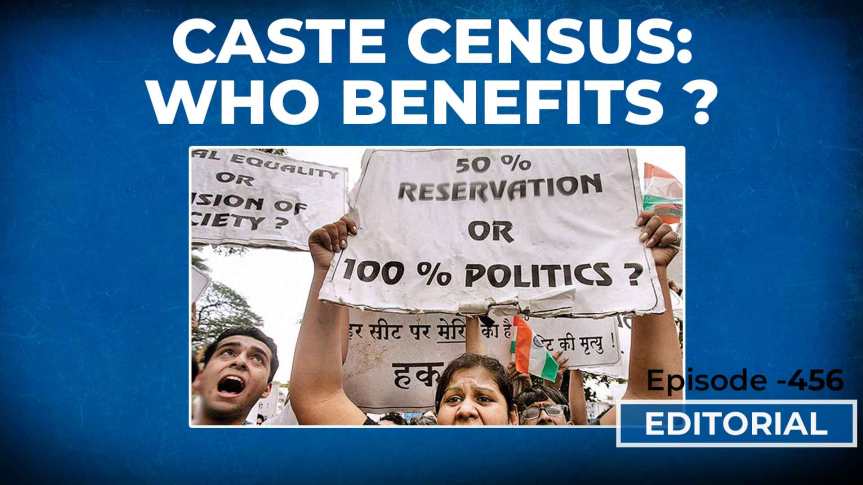
Bihar government has announced that it will undertake a socio-economic survey of all castes and communities (SECC). The Socio-Economic and Caste Census (SECC) was conducted in 2011 for the first time since 1931. SECC is meant to canvass every Indian family, both in rural and urban India, and ask about their:
- Economic status, so as to allow Central and State authorities to come up with a range of indicators of deprivation, permutations, and combinations of which could be used by each authority to define a poor or deprived person.
- It is also meant to ask every person their specific caste name to allow the government to re-evaluate which caste groups were economically worse off and which were better off.
- SECC has the potential to allow for a mapping of inequalities at a broader level.

The Census provides a portrait of the Indian population, while the SECC is a tool to identify beneficiaries of state support. Since the Census falls under the Census Act of 1948, all data are considered confidential, whereas according to the SECC website, “all the personal information given in the SECC is open for use by Government departments to grant and/or restrict benefits to households.”
Pros
- Helpful in Managing Social Equity Programmes: India’s social equality programmes cannot be a success without the data and a caste census would help fix that.
- Due to the lack of data, there is no proper estimate for the population of OBCs, groups within the OBCs and more.
- Census enumeration would yield a wealth of demographic information (sex ratio, mortality rate, life expectancy), educational data (male and female literacy, ratio of school-going population, number of graduates) and policy relevant information about economic conditions (house-type, assets, occupation) of the OBCs’.
- A caste-based census could go a long way in bringing a measure of objectivity to the debate on reservations.
Cons:
- Caste has an emotive element and thus there exist the political and social repercussions of a caste census. There have been concerns that counting caste may help solidify or harden identities.
- Caste Is Context-specific: Caste has never been a proxy for class or deprivation in India, it constitutes a distinct kind of embedded discrimination that often transcends class. For example:
- People with Dalit last names are less likely to be called for job interviews even when their qualifications are better than that of an upper-caste candidate.
- They are also less likely to be accepted as tenants by landlords. Thus, difficult to measure.
- Marriage to a well- educated, well-off Dalit man still sparks violent reprisals among the families of upper-caste women every day across the country.
 Eduindex
You must be logged in to post a comment.