Hello everybody, In order to end caste discrimination from the country, the government introduced the policy of caste reservation after independence. And this has been quite a controversial issue. People debate on this issue a lot but very few have sought answers as to whether caste reservations have actually been effective in changing and improving the lives of SCs and STs and in decreasing caste discrimination. Specifically, we will look at the impact of reservation in three different areas; public education institutes, government jobs and political representation. Outputs vs Outcomes Before talking about the impact of caste reservation, I would like to explain this basic difference to you. What is the difference between output and outcome? It is important for you to understand this so that you can understand the content of this video going forward. These two words sound similar but there is a big difference between the two.
Let’s take the example of Swacch Bharat Abhiyan. What was the target outcome of Swachh Bharat Abhiyan? What did the scheme actually intended to achieve? Make India Open Defecation free! Make it clean, increase sanitation in the country and decrease the number of diseases that occur due to lack of cleanliness. But how will Swachh Bharat Abhiyan achieve its outcome? It will be through outputs. The output of Swachh Bharat Abhiyan was to construct toilets. Outputs tell us how effectively a policy has been implemented and on the other hand outcomes tell us the impact of implementing the policy. It is easy for governments to ask for votes in the name of outputs.
This is the reason governments want to focus more on outputs. with claims like- Look how many toilets we have constructed…look how many free cycles we have distributed to girls. But in reality if we really want to develop our nation then we should focus on the outcomes. Did building more toilets result in the nation becoming cleaner? Did dirtiness in the county actually lessen? Did distributing cycles to girls result in them being more educated? Similarly, when we talk about the impact of caste reservation in this video, we will first look at the output -whether caste reservation has resulted in larger representation of lower caste in colleges (which is an output) Thereafter we will look at the outcome whether lower caste people got better job opportunities? Have their lives improved? Have their incomes risen? And has caste discrimination decreased in society? Let’s talk about outputs in higher education first. Has reservation resulted in increased representation of the marginal groups in higher educational institutes or not? Article 15 and 16 of the Constitution has given powers to our government to reserve seats in educational institutes and in matters of public employment.
According to population shares, about 22% seats have been reserved for SCs and STs. So the first question is has reservation resulted in increased representation of the SCs and STs? Yes, it has increased. From 1970 to 1990s, this representation has increased for both the groups and according to the latest higher education survey; this representation has increased further as well. But can we say with utmost guarantee that reservation is the reason behind the increase in representation? It is possible that due to good economic growth in India, SCs and STs have been uplifted more and this is the reason behind the increase in their representation and not reservation. If we want, we can speak of it in probabilities but as told by a researcher, we cannot say with guarantee that reservation only is responsible for it. Despite the increase, we must focus on the fact that the representation share of STs is still lower than their seat reservation number. One of the most common criticisms of reservation is of the creamy layer. According to this theory, the SCs and STs that do get reservations do not belong to some poor family but are in fact from a rich family and because of their reservation, the people belonging to the poorer section from the general category do not get seats.
Researchers have looked into this as well. They found out that the SCs and STs that do get reservations are better off in their own group but their situation is not better than general category people. The second argument given against reservation in education is that the reserved students have lesser score requirements. This might help them get a seat but after getting into the college, they would struggle and this seat would be wasted. In a research conducted in 215 engineering colleges, it was found that there isn’t any evidence that suggests that reserved students are not able to cope up with the syllabus. Now, let’s talk about public employment. Let’s get to know whether reservation has resulted in the increase in representation of SCs, STs and other marginal groups in Indian bureaucracy or not.
According to government data, there has been an increase in representation of SCs and STs in government administration. But when we look at this data in detail and divide the government positions in different levels, we see that SCs, STs do have representation but it is mostly in lower positions. For example, their representation is near their representation quota only in group C and group D category. SCs have higher representation in group D positions because many of these people are “Safai Karamcharis” (sanitation workers) In fact, almost 40% Safai Karamcharis belong to the scheduled castes. A common criticism against reservation in government jobs as well is of the creamy layer. A researcher investigated the same but found no evidence to support this creamy layer theory. One more argument that is quoted against reservation in government jobs is that if people from the marginal groups enter governance then the effectiveness of governance will be compromised.
But researchers did not find any evidence regarding this as well. Two researchers conducted a very interesting study to investigate this. They considered the data of Indian railways from 1980 to 2002 and studied 15 lakh railway employees. They wanted to see if reservation affected the productivity of the Indian railways in a negative manner. After analyzing, they found no such evidence suggesting that the efficiency of the railways were decreasing due to reserved employees. In fact, in some cases, they found out that the efficiency increased due to the reserved employees. Reservation has resulted in increased representation of disadvantaged groups in public administration and higher education institutes but what has been its impact in their lives? Let’s get to know about that.
According to research, overall it has had a positive impact in their lives but there is a lot of room for improvement even now. For example, a research highlighted that post reservation in government jobs, the representation of SCs and STs in salaried jobs increased by 5%. Another study highlighted that reservation in government jobs has resulted in boosting the morale of OBC students and they started studying more. Due to reservation, on an average, a student started studying for 0.8 years more. If we talk about reservation in political seats then we see a mixed impact. According to one study, reservation in gram panchayat has resulted in decrease in poverty amongst the STs but a similar impact was not seen in SCs Another paper showed that reservation in politics has not only resulted in more jobs for SCs and STs but government schemes have also started targeting them more. Another study tried investigating the impact of quotas in panchayat elections.
They found out that because of these quotas the people from the disadvantaged groups get more aid from the MNREGA scheme and there is improvement in their roads, water and education as well. Another study that was conducted in Rajasthan found that when a SC sarpanch is elected then the entire community benefits in many ways. If you look at all these studies then you feel like that reservation is quite a good policy tool resulting in so many positive changes. But we should also remember that reservation cannot change everything. The same researchers also said that despite a SC Sarpanch, the relationship between different castes did not change much within the village. And we have seen many such examples that reservation wouldn’t necessarily result in changing the undercurrent of the society. Recently, we saw a report where a SC panchayat President had to sit on the floor because of her caste in Tamil Nadu.
“The woman panchayat leader there has not been allowed to sit on a chair. She was sitting on the floor and she also alleged that she was also not allowed to hoist the flag.” Many researchers have even talked about the same as well that including quotas in political representations do not guarantee benefit to marginal communities. A researcher said that to win any panchayat election, a leader needs support from different social groups and this is the reason that many times they would not take such a decision that will only help their group. Despite these benefits of reservations, there is a huge gap between lower caste and upper caste people today. Data from 2011 shows that a Brahman adult on an average acquires 5.6 years of more education over the course of his lifetime as compared to a scheduled tribe adult. This map is from 1954. This shows how people reside on the basis of caste in the country.
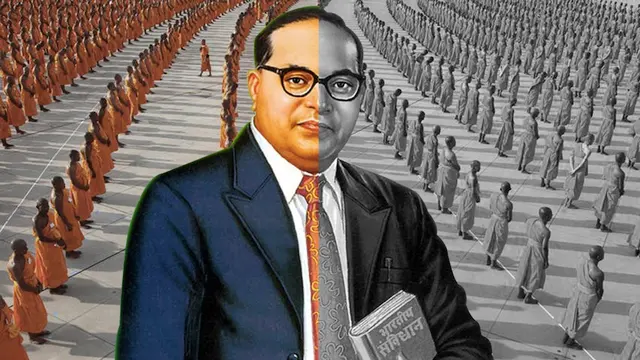
Even after 6 decades, there isn’t a huge change in it. This table shows you a comparison of average income, assets and education level across different caste groups. You can easily see that forward caste members compared to the rest of population are quite ahead in every aspect. All these data proves that only caste reservation is not enough to solve the problem of caste discrimination in our country. And this is not just my opinion. DR. B R Ambedkar opined the same in his book Annihilation of Caste. Greater social integration simply means that people from different castes live together in every aspect of life. Not just lie in the same societies but also participate in similar activities and inter caste marriages also rise. We gave a great example of the same in the last video that how researchers conducted an experiment where they organised a cricket tournament.
They observed that the teams which had members from different caste had greater sense of friendship which does not happen when all the players in a cricket team belong to similar caste. Actually schools are one of the best social settings to enhance this integration. According to another research experiment conducted in Delhi schools found out that the classes where poor and rich kids mingle, the rich kids discriminate lesser and they interact more with poor kids. And if such interactions happen more is school and colleges then inter-caste marriages will automatically rise in the country consequently resulting in decrease in discrimination. Another research found out that if women in the country are given the independence to choose their husbands while marrying, 20% of such cases are inter-caste marriage. But in reality, in the entire country only 6% marriages are inter-caste marriages.
So an interesting connection can be seen here that how giving the right to choose to women i.e women empowerment increases inter caste marriage and also results in reduction in caste discrimination. This is the reason that some governments have tried promoting the same. Recently, Odisha government has announced a scheme to incentivise social harmony They launched a Sumangal portal to increase inter-caste marriages in the state. But this is not just the job of the government alone. Here, the Police and judiciary too need to take swift action in cases of discrimination. Prevention of Atrocities Act, 1955 tries to protect SCs and STs from discrimination. But the evidence that has come to the front suggests the provisions of act have been barely utilised. The conviction rate is quite low and the backlogs are quite high in such cases. There was a study conducted of 100 such cases in Andhra Pradesh in 2002-03. The study found out that the Police usually does not register such cases or pressurise lower caste individuals to compromise and the accused doesn’t get arrested here.
Another good example of improving the system is to not only provide reservation for seats but also offer free coaching to marginalized groups. One such scheme was launched by the Ministry of Social Justice in 2016 where SCs and OBCs were offered free coaching for UPSC, NEET and JEE exam. It was reported that more than 10 percent of students who availed the benefits of this scheme cracked these exams. So these are some solutions/suggestions to improve the reservation system in order to further reduce the caste discrimination in our country and equality flourishes. Some people would argue that reservation is actually against equality because the hard work put in by us in order to secure a seat, our options shrink and an undeserved candidate takes our seat away. In my opinion, it is quite a narrow perspective to look at the entire situation here. Imagine, you are competing with one lakh people and you write an exam to get selected on one of the 100 seats.
Amongst these 100 seats, say 50 seats are reserved. But think about that if you are competing with one lakh people just for 100 sets then how difficult it is in the first place itself. And if the seats are reduced from 100 to 50 then does that make any difference to the difficulty level? But imagine if there were 1000 seats instead of 100 for which one lakh people were competing.
If 50% were reserved then you would write the exam for 500 seats but otherwise you were writing for 50 seats. It is not right to blame reservation for this problem. If the exam is so competitive and seats are so less then this problem is of our education system.
Ask the government to build more universities, schools and colleges so that seats can be increased. Or the education system should be overhauled such that people go to other fields and more jobs are available.



 Eduindex
You must be logged in to post a comment.